A Knight for the Ages
Among the most revered martyrs in Christian history, Saint George’s legacy lives not merely through a medieval tale of dragon-slaying, but through his heroic witness to Jesus Christ amid a pagan empire. His name echoes in both the East and West, and his life has stirred the hearts of soldiers, knights, monarchs, and saints for centuries. He is not just a legendary figure, but a very real martyr who stood boldly for the truth in a time of terror.
Celebrated each year on April 23, Saint George is recognized as a symbol of valor, chivalry, and unwavering Christian conviction. Though famously tied to the tale of a dragon, the true victory of George was his steadfast faith in Jesus Christ, even in the face of brutal torture and death. He is the patron saint of England, Catalonia, and Palestine, and has been invoked by Christian warriors and the faithful for protection, courage, and perseverance. His standard—the red cross on a white field—became one of the most enduring symbols of Christian hope in the face of evil.
From Soldier to Servant
Saint George was born sometime between AD 275 and 285 in Cappadocia, a region in modern-day Turkey, into a noble Christian family of Greek origin. His father, Gerontius, served as an officer in the Roman army and died a martyr for the faith. His mother, Polychronia, returned to her native city of Lydda (in present-day Israel) with George, where she raised him to be a devout Christian.
George entered the Roman army as a young man, following in his father’s footsteps. His natural leadership, integrity, and strength quickly gained him favor with Emperor Diocletian, under whom he rose to high rank, possibly as a military tribune or member of the imperial guard. At the height of his military career, George stood at a crossroads: obey the emperor’s edict to persecute Christians, or remain faithful to the Lord he had loved since childhood.
When Diocletian issued a decree in AD 303 commanding the arrest of all Christians and the destruction of their churches, George responded with unwavering resolve. He publicly declared his faith in Jesus Christ and tore down the imperial edict. This act of defiance sealed his fate—but also his eternal glory. Unlike a sudden conversion story, Saint George’s holiness was the fruit of a lifetime nurtured in Christian virtue and solidified by courageous public witness.
George is remembered not only for this confession but also as a man who lived the Gospel with conviction. The Catechism of the Catholic Church reminds us, “The duty of Christians to take part in the life of the Church impels them to act as witnesses of the Gospel and of the obligations that flow from it” (CCC 2472). George lived this call fully, refusing to compromise or hide his identity as a follower of Christ.
Of Dragons and the Cross
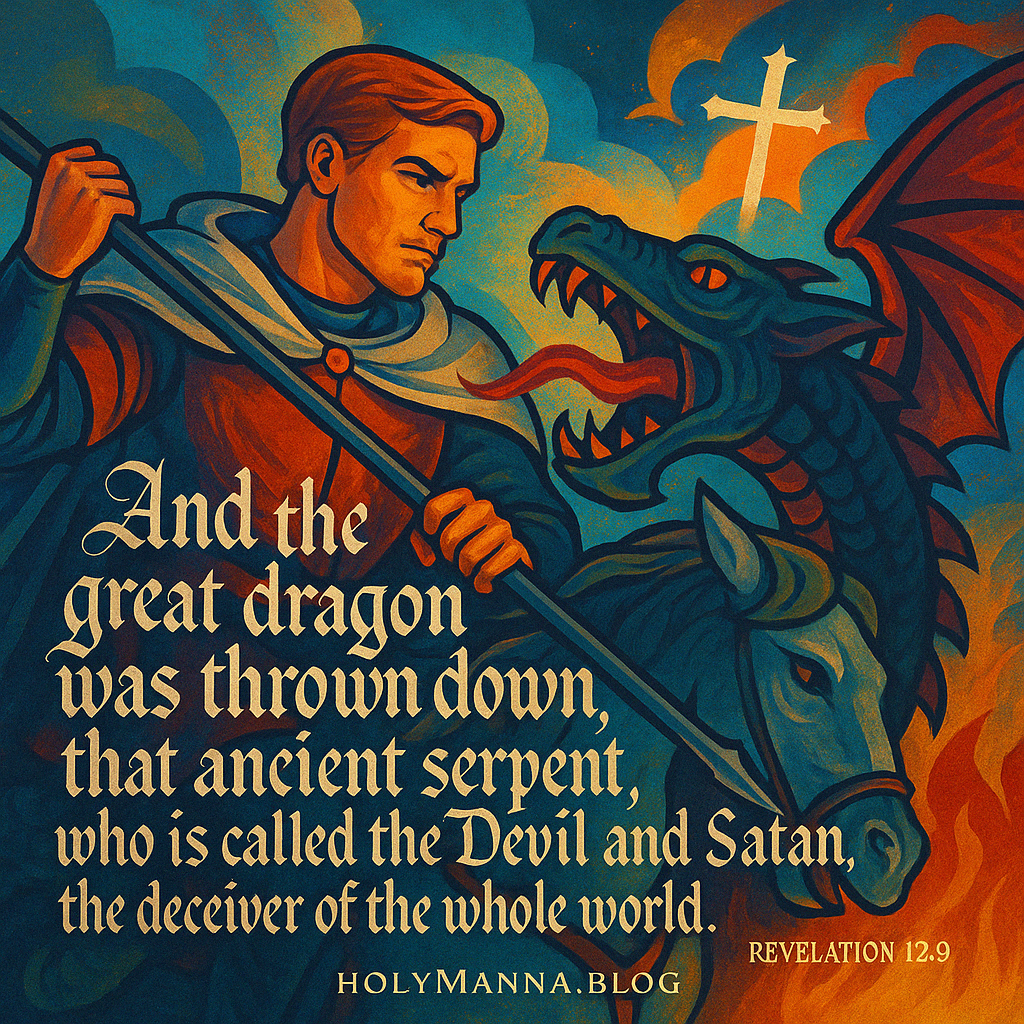
The tale of Saint George and the dragon, though likely not historical in the literal sense, is profoundly theological. It originated in Eastern Christian storytelling and became wildly popular in Europe during the Crusades. The story tells of a dragon that terrorized a city, demanding the lives of its people. When the king’s daughter was chosen as the next sacrifice, Saint George arrived, made the Sign of the Cross, and slew the beast—rescuing the princess and converting the town to Christianity.
Though the dragon may not have been real, the spiritual meaning is undeniable. The dragon represents Satan, sin, and spiritual death. Saint George stands as the knight of Christ, armed not with worldly power, but with the strength of faith and the authority of Christ. As it is written in the Book of Revelation, “And the great dragon was thrown down, that ancient serpent, who is called the Devil and Satan, the deceiver of the whole world” (Revelation 12:9).
Through this story, we understand that Christian courage conquers the chaos of evil. It is a metaphor of the spiritual battles we all face—temptations, fear, falsehood—and a reminder that Christ has already won the victory. Saint George’s bravery reminds us that divine intervention works through human virtue, and that saints are not merely men of strength, but men of faith.
A Soldier’s True Test
George’s real dragon was Diocletian’s violent persecution. After proclaiming his Christian faith, George was arrested and subjected to one of the most horrifying series of tortures in Christian martyrdom accounts. He was imprisoned, whipped, stretched on the rack, burned with torches, and forced to drink poison. Through it all, he remained calm, faithful, and even joyful, praising Christ in the midst of agony.
Tradition holds that many witnessed his miracles during this time. One jailer was converted after seeing George’s wounds miraculously healed overnight. Another account says that George raised a dead man to life through the power of Christ. His fortitude, serenity, and miracle-working ability spread rapidly, bringing even the empress—Alexandra, the wife of Diocletian—to faith in Christ.
Eventually, George was beheaded, likely in Lydda, around AD 303. He died a martyr, victorious not through the sword, but through his witness to the Resurrection. As the Catechism teaches us, “Martyrdom is the supreme witness given to the truth of the faith: it means bearing witness even unto death” (CCC 2473). Saint George gave this witness with dignity, boldness, and supernatural grace.
The Banner of the Cross
Saint George’s death was not the end, but the beginning of a global legacy. Soon after his martyrdom, Christians venerated him as a great intercessor and protector. In Lydda, a church was built over his tomb by Emperor Constantine, becoming a place of pilgrimage for the faithful seeking healing, courage, and protection.
Reports of miracles flooded in—sick pilgrims were cured, soldiers experienced divine protection, and many were converted through his intercession. Over the centuries, his relics were distributed throughout the Christian world. Devotion to Saint George became especially prominent in the Eastern Churches and later in Europe during the Crusades, when soldiers took him as their heavenly champion.
In England, his popularity reached new heights when King Edward III named him the patron of the Order of the Garter in 1348. From then on, Saint George’s red cross became the national emblem, flown in battles and worn on armor. But more than a military symbol, it became a call to Christian nobility—courage united with humility, strength in service of faith.
To this day, churches, monasteries, and entire countries celebrate his feast with reverence. His image continues to inspire Christian men and women to face their own dragons with the armor of God.
Following the Knight of Christ
Saint George calls every Christian—man, woman, and child—to holy courage. He reminds us that our battles are not only physical, but spiritual. In a world where truth is often mocked and virtue is dismissed, Saint George teaches us to stand firm in our identity as children of God. He challenges us to be public in our faith, joyful in our trials, and merciful even to our enemies.
He invites us to look at our lives and ask: Am I willing to suffer for my faith? Am I living with integrity when no one is watching? Do I confront evil, or compromise with it?
We may not face dragons or emperors, but we do face the pressures of secularism, impurity, fear, and indifference. Like Saint George, we are called to “slay the dragon” by living in truth, pursuing holiness, and keeping our eyes fixed on Christ. Let us clothe ourselves in the armor of God—truth, righteousness, faith, and the sword of the Spirit—and press forward with love as our banner.
As Saint Paul writes in The Letter to the Ephesians, “Be strong in the Lord and in the strength of His might” (Ephesians 6:10). May Saint George, Martyr-Knight of Christ, intercede for us.
✦ Engage with Us!
What dragons are you being called to face today? In what ways is Christ asking you to stand firm like Saint George?
Share your thoughts and prayers in the comments!
Reflection Questions:
- What are the “dragons” in your life that threaten your faith or integrity?
- How can you boldly witness to your Catholic faith in a society that often discourages it?
- What does Saint George’s martyrdom teach you about the cost—and reward—of discipleship?
Let’s journey together in faith, encouraging one another to fight the good fight and finish the race with courage. May we, like Saint George, do all things with love, for the greater glory of God and the triumph of His Kingdom!
Saint George, pray for us! 🐉
Follow us on Instagram and Facebook for more insights and reflections on living a faith-filled life.

 Holy Manna!
Leave a comment