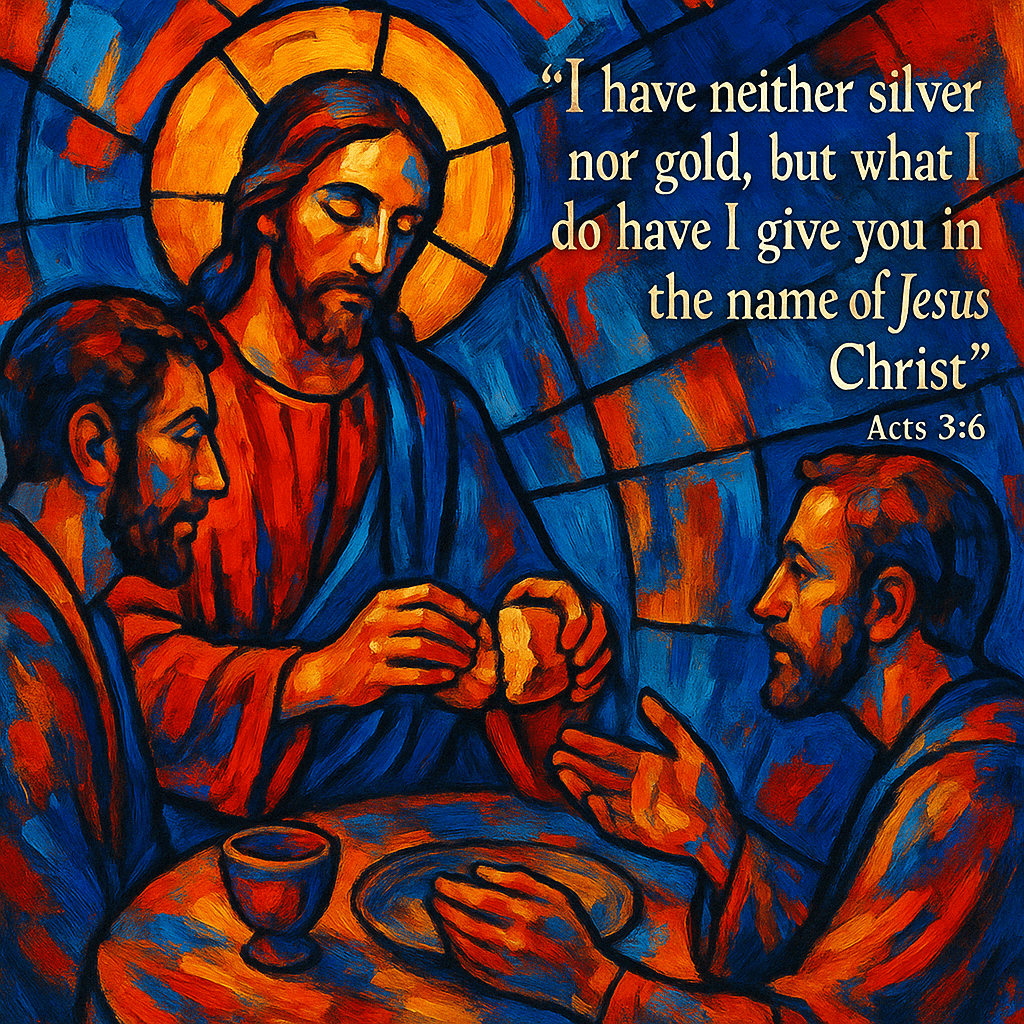
Eyes to See, Hearts to Burn
Have you ever walked past someone and missed the miracle standing right in front of you? Sometimes the most life-changing moments don’t come dressed in grandeur, but in quiet encounters—an unexpected word, a shared meal, a hand extended in love. Today’s readings invite us into such moments. They beckon us to slow down, look again, and recognize the Risen Lord at work in the ordinary and the miraculous. Whether through healing at the temple gate or a heart-burning conversation on the road to Emmaus, Jesus reveals Himself not to the powerful or the prepared—but to the faithful, the humble, and the seeking.
In the early days of the Church, the Apostles were filled with the fire of Pentecost, empowered to act in Jesus’ name. Acts of the Apostles introduces us to Peter and John healing a crippled man—not with wealth, but with faith: “In the name of Jesus Christ the Nazorean, rise and walk”. This wasn’t just a physical healing; it was a sign that Jesus was alive and His power was now moving through His Body, the Church. The Responsorial Psalm grounds this miracle in a deeper promise, recalling the everlasting covenant God made with Abraham and Isaac—a covenant fulfilled in Jesus, whose Resurrection is the definitive sign of God’s fidelity. Meanwhile, the Gospel of Luke draws us into one of the most intimate and mysterious Resurrection appearances: the road to Emmaus, where the disciples failed to recognize Jesus until the breaking of the bread.
These readings form a tapestry of revelation. They span the spectrum of faith—from astonishment at a healed body, to remembrance of ancient promises, to the burning realization that He was with us all along. Culturally, the Jewish hour of prayer and the breaking of bread were deeply rooted in tradition, yet Jesus transforms both into divine encounters. Historically, the early Church was just beginning to understand what it meant to live as witnesses of the Resurrection. Religiously, the message is clear: Christ continues to reveal Himself, especially to those willing to walk with Him, listen to His Word, and recognize Him in the Eucharist. Are your eyes open to see Him today?
First Reading – Acts 3:1–10
More Than Silver or Gold
Set in the days immediately following Pentecost, this reading from Acts of the Apostles captures the awe-inspiring birth of the Church’s mission in action. Written by Saint Luke as a continuation of The Gospel of Luke, Acts is a powerful narrative of how the Holy Spirit guided the Apostles to spread the Good News and carry on Jesus’ ministry. In today’s passage, Peter and John—two of the Church’s foundational leaders—perform a healing at the Beautiful Gate of the temple, a key location in Jewish worship and culture. This encounter is more than just a miracle; it’s a sign that Jesus is alive and working through His Church. The theme of divine encounter echoes throughout all today’s readings, and here, we witness the risen Christ’s power manifest not in silver or gold, but in the authority of His name. This miracle sets the tone for the new evangelization: not material provision, but spiritual transformation.
Acts 3:1-10
New American Bible (Revised Edition)
Cure of a Crippled Beggar. 1 Now Peter and John were going up to the temple area for the three o’clock hour of prayer. 2 And a man crippled from birth was carried and placed at the gate of the temple called “the Beautiful Gate” every day to beg for alms from the people who entered the temple. 3 When he saw Peter and John about to go into the temple, he asked for alms. 4 But Peter looked intently at him, as did John, and said, “Look at us.” 5 He paid attention to them, expecting to receive something from them. 6 Peter said, “I have neither silver nor gold, but what I do have I give you: in the name of Jesus Christ the Nazorean, [rise and] walk.” 7 Then Peter took him by the right hand and raised him up, and immediately his feet and ankles grew strong. 8 He leaped up, stood, and walked around, and went into the temple with them, walking and jumping and praising God. 9 When all the people saw him walking and praising God, 10 they recognized him as the one who used to sit begging at the Beautiful Gate of the temple, and they were filled with amazement and astonishment at what had happened to him.
Detailed Exegesis
Verse 1 – “Now Peter and John were going up to the temple area for the three o’clock hour of prayer.”
This hour, known as the ninth hour, was a sacred time for Jewish prayer and sacrifice. The Apostles, though now followers of Christ, continue to participate in temple worship, demonstrating their continuity with Jewish tradition. It also prefigures the Christian hour of mercy—three o’clock being the hour Christ died.
Verse 2 – “And a man crippled from birth was carried and placed at the gate of the temple called ‘the Beautiful Gate’ every day to beg for alms from the people who entered the temple.”
The man’s lifelong condition represents a kind of spiritual paralysis—a helplessness from birth that echoes humanity’s fallen state. His placement at the Beautiful Gate is poignant: so near the sacred, yet barred from full participation due to his disability, which under Jewish law rendered him ritually unclean.
Verse 3 – “When he saw Peter and John about to go into the temple, he asked for alms.”
This man seeks only a temporary relief—material sustenance. But the Apostles are about to offer him something eternal. His small request opens the door for a much greater encounter with Christ through His Church.
Verse 4 – “But Peter looked intently at him, as did John, and said, ‘Look at us.’”
This intense gaze suggests intentionality and spiritual authority. They ask for his full attention—not to elevate themselves, but to prepare his heart for an encounter with divine power.
Verse 5 – “He paid attention to them, expecting to receive something from them.”
Expectation is key. Though misdirected at first, his openness allows him to receive something far beyond what he imagined. It reminds us that God often answers our prayers in unexpected and transformative ways.
Verse 6 – “Peter said, ‘I have neither silver nor gold, but what I do have I give you: in the name of Jesus Christ the Nazorean, rise and walk.’”
This is the heart of the miracle. The name of Jesus is not a magic formula, but the living authority of the risen Lord. As Philippians 2:10 declares, “at the name of Jesus every knee should bend”. Peter speaks with the confidence of one who knows that Christ is alive and active.
Verse 7 – “Then Peter took him by the right hand and raised him up, and immediately his feet and ankles grew strong.”
The right hand is a symbol of blessing and strength throughout Scripture. Peter’s act mirrors Jesus’ healing style—physical contact that transmits divine power. The immediacy of the healing underscores the complete and miraculous nature of the act.
Verse 8 – “He leaped up, stood, and walked around, and went into the temple with them, walking and jumping and praising God.”
This man, once excluded, now enters the temple with joy and wholeness. His physical healing mirrors the spiritual access that all believers have through Christ. His leaping recalls Isaiah 35:6: “Then the lame shall leap like a stag”—a messianic prophecy fulfilled.
Verse 9 – “When all the people saw him walking and praising God,”
The public nature of the miracle confirms its authenticity and points all glory back to God. The community becomes a witness to the power of Jesus working through His followers.
Verse 10 – “they recognized him as the one who used to sit begging at the Beautiful Gate of the temple, and they were filled with amazement and astonishment at what had happened to him.”
Recognition seals the miracle’s impact. This man’s transformation becomes a testimony—his new life a signpost to Christ. The astonishment of the crowd prefigures the early Church’s explosive growth, built on firsthand encounters with the risen Jesus.
Teachings of the Church
The Catechism of the Catholic Church emphasizes the power of Christ’s name and His presence in the Church: “The name ‘Jesus’ signifies that the very name of God is present in the person of his Son… the name of Jesus is at the heart of Christian prayer” (CCC 432). This reading shows that invoking the name of Jesus is more than tradition—it is power. Just as Peter heals the beggar in Christ’s name, we are called to act in His name with faith.
Saint John Chrysostom, in his homilies on Acts, marvels at Peter’s boldness: “Observe how he shows that it was not by any native power of his own that he did this… but by invoking Christ.” Chrysostom insists that the miracle is not about Peter, but about Jesus living through Peter—a truth that affirms apostolic authority and the divine origin of the Church’s mission.
Historically, this event signals a shift from temple-centered worship to the risen Christ as the new center. The Church, as the Body of Christ, becomes the place of healing, proclamation, and divine encounter. This healing wasn’t simply a spectacle—it was a manifestation of the Kingdom breaking into human lives, a pattern that continues through the sacraments today. In particular, the sacrament of the Anointing of the Sick echoes this same reality: through the hands of the Church, Christ still touches, heals, and raises up.
Reflection
This passage invites us to ask ourselves what we truly seek from God. Are we asking only for silver and gold—comforts, security, quick fixes—or are we open to the deeper healing Christ wants to bring? Many of us carry wounds or lifelong struggles—whether physical, emotional, or spiritual—that can leave us begging at the gates of faith, not realizing that Jesus is offering us Himself. Like the crippled man, we are called not only to be healed but to enter the temple with joy, praising God with our lives.
In a culture obsessed with material solutions, Peter’s words challenge us: “What I do have I give you: in the name of Jesus Christ the Nazorean, rise and walk.” Do we believe that the name of Jesus can still heal, transform, and set us free? And are we, like Peter and John, willing to step out in faith, offer what we do have, and invite others to experience the living Christ?
What if today, instead of asking God for “more,” we allowed Him to open our eyes to what He’s already offering? What if the miracle begins when we look up, meet His gaze, and believe that we too can rise and walk?
Responsorial Psalm – Psalm 105:1–4, 6–9
Remember His Wondrous Deeds
Psalm 105 is a joyful, covenantal hymn that recalls God’s faithfulness throughout salvation history. It is a song of remembrance and proclamation, exhorting the people of Israel to recall the mighty deeds of the Lord and to praise Him publicly for His faithfulness to His promises. Composed during or after the Babylonian exile, this psalm served as a way for the Israelites to anchor themselves in their identity as God’s chosen people. In the context of today’s readings, it connects the miraculous healing of the crippled man and the burning hearts of the Emmaus disciples to the broader story of God’s fidelity. The God who made a covenant with Abraham, who raised up His people, and who revealed Himself through the prophets, is the same God now present in the name and person of Jesus Christ. This psalm sets the tone for hearts that seek, praise, and remember—an interior disposition necessary to recognize the Risen Lord.
Psalm 105:1-4, 6-9
New American Bible (Revised Edition)
God’s Fidelity to the Promise
1 Give thanks to the Lord, invoke his name;
make known among the peoples his deeds!
2 Sing praise to him, play music;
proclaim all his wondrous deeds!
3 Glory in his holy name;
let hearts that seek the Lord rejoice!
4 Seek out the Lord and his might;
constantly seek his face.
6 You descendants of Abraham his servant,
offspring of Jacob the chosen one!
7 He the Lord, is our God
whose judgments reach through all the earth.
8 He remembers forever his covenant,
the word he commanded for a thousand generations,
9 Which he made with Abraham,
and swore to Isaac,
Detailed Exegesis
Verse 1 – “Give thanks to the Lord, invoke his name; make known among the peoples his deeds!”
Gratitude is the foundation of worship. The psalmist calls Israel to praise the Lord not in private, but publicly. To “invoke His name” is to call upon God’s power and presence, much like Peter did at the temple gate. Evangelization begins with thanksgiving and testimony.
Verse 2 – “Sing praise to him, play music; proclaim all his wondrous deeds!”
Music and proclamation go hand-in-hand in biblical worship. Praising God through song is both a personal and communal act of love, and “wondrous deeds” refers not only to past miracles but also to the living memory of God’s work in their lives. In today’s context, it aligns beautifully with the healed man’s joyful praise and the disciples’ retelling of their encounter with Jesus.
Verse 3 – “Glory in his holy name; let hearts that seek the Lord rejoice!”
The psalm reminds us that seeking God is not a burden but a source of joy. To “glory” in His name means to boast not in our strength or success, but in His holiness. The joyful leap of the man healed by Peter and the joy of the Emmaus disciples reflect the fruit of hearts that truly seek the Lord.
Verse 4 – “Seek out the Lord and his might; constantly seek his face.”
This is not a one-time command but a lifestyle. To seek God’s face is to long for intimacy, to desire to be in His presence. Just as the disciples on the road to Emmaus didn’t recognize Jesus until they sought His presence in the breaking of the bread, we are called to keep our eyes and hearts open to the divine presence in everyday life.
Verse 6 – “You descendants of Abraham his servant, offspring of Jacob the chosen one!”
The psalmist anchors this call in identity. By invoking the patriarchs, he reminds the people of their heritage and the covenant that defines them. This verse connects us to Acts 3, where Peter speaks to Israelites in the temple—descendants of the same Abraham—now being invited to see the fulfillment of God’s promises in Christ.
Verse 7 – “He, the Lord, is our God whose judgments reach through all the earth.”
God is not merely a tribal deity; His dominion is universal. This prepares the way for the Gospel to be spread beyond Israel, a reality that is unfolding in the Acts of the Apostles. His “judgments” are not arbitrary laws but expressions of divine justice and mercy.
Verse 8 – “He remembers forever his covenant, the word he commanded for a thousand generations,”
God’s faithfulness is not fleeting. The covenant is everlasting, rooted in His word. This verse reassures us that even when we are unfaithful, God remains true—a truth that undergirds all the Resurrection appearances of Jesus, who comes back to those who doubted and feared.
Verse 9 – “Which he made with Abraham, and swore to Isaac,”
This verse reinforces the generational depth of God’s plan. The mention of Abraham and Isaac highlights God’s historical faithfulness, which reaches its culmination in Jesus Christ, the fulfillment of the covenant promises. This connection invites the reader to see the Resurrection not as an isolated miracle, but as the climactic act in God’s eternal plan of redemption.
Teachings of the Church
The Catechism teaches that “in the Old Testament, God revealed himself as the one ‘who has made himself known from the deeds that he has done’” (CCC 69). Psalm 105 echoes this revelation, calling believers to remember and proclaim these deeds. When we meditate on God’s actions in history—creation, covenant, Exodus, and ultimately the Incarnation and Resurrection—we grow in faith, hope, and love. We are not part of a new story, but of a story that began before time and continues into eternity.
Saint Augustine often emphasized the importance of remembering God’s work as a form of spiritual discipline. In his Confessions, he wrote: “Let me remember You, let me understand You, let me love You.” This triad—memory, understanding, and love—is mirrored in Psalm 105’s invitation to recall God’s deeds, seek His face, and rejoice in His name. For Augustine, memory was the gateway to deeper communion with God, much like the disciples’ memory of the breaking of bread opened their eyes to Christ.
Historically, the Jewish people sang psalms like this during feasts and pilgrimages, especially when ascending to the temple in Jerusalem. These songs shaped their identity and reminded them of God’s faithfulness. In the early Church, the psalms became the heartbeat of Christian prayer, particularly in the Liturgy of the Hours. Psalm 105’s themes of covenant and praise remain central to our worship today—especially in Eastertide, when we celebrate God’s definitive act of salvation in Christ.
Reflection
In a world of forgetfulness, Psalm 105 is a clarion call to remember. What deeds of the Lord can you recall from your own life? When was the last time you gave thanks not just for what God has done in Scripture, but for what He has done in your heart? This psalm invites us to be storytellers of grace—to sing, proclaim, and rejoice in a God who keeps His promises.
When we “seek His face” each day—in prayer, in Scripture, in the Eucharist—we position ourselves to recognize Him, just as the disciples eventually did at Emmaus. The joy of the crippled man and the burning hearts of the disciples are not ancient relics—they are available to us now. Do you believe that God’s faithfulness to Abraham is still alive in your story? The invitation is open: to remember, to rejoice, and to make known the mighty works of the Lord.
What “wondrous deeds” will you proclaim today?
Holy Gospel – Luke 24:13–35
Hearts Burning, Eyes Opened
The Gospel of Luke is often called the Gospel of Mercy, filled with intimate encounters, compassionate parables, and stories that speak directly to the human heart. Today’s passage is one of the most beautiful and moving in the entire New Testament. Occurring on the very day of the Resurrection, the road to Emmaus story captures the confusion, grief, and eventual joy of two disciples struggling to make sense of Jesus’ crucifixion. Culturally, the road to Emmaus represents not just a physical journey, but the spiritual path many of us walk when we experience doubt or loss. Religiously, this Gospel reading is rich with sacramental overtones: the Liturgy of the Word and the Liturgy of the Eucharist are both mirrored in Christ’s actions. In the context of today’s theme, this passage completes the thread: from miraculous healing, to covenantal remembrance, to the risen Christ personally accompanying, teaching, and revealing Himself in the breaking of the bread.
Luke 24:13-35
New American Bible (Revised Edition)
13 Now that very day two of them were going to a village seven miles from Jerusalem called Emmaus, 14 and they were conversing about all the things that had occurred. 15 And it happened that while they were conversing and debating, Jesus himself drew near and walked with them, 16 but their eyes were prevented from recognizing him. 17 He asked them, “What are you discussing as you walk along?” They stopped, looking downcast. 18 One of them, named Cleopas, said to him in reply, “Are you the only visitor to Jerusalem who does not know of the things that have taken place there in these days?” 19 And he replied to them, “What sort of things?” They said to him, “The things that happened to Jesus the Nazarene, who was a prophet mighty in deed and word before God and all the people, 20 how our chief priests and rulers both handed him over to a sentence of death and crucified him. 21 But we were hoping that he would be the one to redeem Israel; and besides all this, it is now the third day since this took place. 22 Some women from our group, however, have astounded us: they were at the tomb early in the morning 23 and did not find his body; they came back and reported that they had indeed seen a vision of angels who announced that he was alive. 24 Then some of those with us went to the tomb and found things just as the women had described, but him they did not see.” 25 And he said to them, “Oh, how foolish you are! How slow of heart to believe all that the prophets spoke! 26 Was it not necessary that the Messiah should suffer these things and enter into his glory?” 27 Then beginning with Moses and all the prophets, he interpreted to them what referred to him in all the scriptures. 28 As they approached the village to which they were going, he gave the impression that he was going on farther. 29 But they urged him, “Stay with us, for it is nearly evening and the day is almost over.” So he went in to stay with them. 30 And it happened that, while he was with them at table, he took bread, said the blessing, broke it, and gave it to them. 31 With that their eyes were opened and they recognized him, but he vanished from their sight. 32 Then they said to each other, “Were not our hearts burning [within us] while he spoke to us on the way and opened the scriptures to us?” 33 So they set out at once and returned to Jerusalem where they found gathered together the eleven and those with them 34 who were saying, “The Lord has truly been raised and has appeared to Simon!” 35 Then the two recounted what had taken place on the way and how he was made known to them in the breaking of the bread.
Detailed Exegesis
Verse 13 – “Now that very day two of them were going to a village seven miles from Jerusalem called Emmaus,”
The journey away from Jerusalem, the place of the Resurrection, symbolizes a movement away from hope. The number seven in Scripture often indicates completion or fulfillment, subtly hinting that their journey will end in revelation.
Verse 14 – “and they were conversing about all the things that had occurred.”
They are trying to process the trauma of the Passion and the strange reports of the empty tomb. Like many of us, they are caught between sorrow and hope, reason and faith.
Verse 15 – “And it happened that while they were conversing and debating, Jesus himself drew near and walked with them,”
Jesus meets us where we are. He enters into their confusion, unrecognized, and begins to walk alongside them. This verse reflects the tenderness of the Good Shepherd who never abandons His sheep.
Verse 16 – “but their eyes were prevented from recognizing him.”
This mysterious veiling of Jesus’ identity suggests that spiritual perception requires more than physical sight. Recognition comes through faith, not familiarity.
Verse 17 – “He asked them, ‘What are you discussing as you walk along?’ They stopped, looking downcast.”
Jesus prompts reflection. Their sadness speaks volumes—hopes crushed by the cross, they do not yet understand that suffering was part of the plan.
Verse 18 – “One of them, named Cleopas, said to him in reply, ‘Are you the only visitor to Jerusalem who does not know of the things that have taken place there in these days?’”
This irony is poignant: the one they think knows nothing is the one who experienced everything. Cleopas represents every believer who struggles to see Jesus in the midst of despair.
Verse 19 – “And he replied to them, ‘What sort of things?’ They said to him, ‘The things that happened to Jesus the Nazarene, who was a prophet mighty in deed and word before God and all the people,’”
Jesus invites them to articulate their faith. They describe Him as a prophet—true, but incomplete. Their understanding hasn’t yet caught up to the truth of the Resurrection.
Verse 20 – “how our chief priests and rulers both handed him over to a sentence of death and crucified him.”
Their pain is not just in His death, but in the betrayal by their own leaders. This echoes a recurrent biblical theme: God’s chosen ones being rejected by those meant to shepherd them.
Verse 21 – “But we were hoping that he would be the one to redeem Israel; and besides all this, it is now the third day since this took place.”
Hope deferred makes the heart sick (Proverbs 13:12). Their use of the past tense—“we were hoping”—reveals lost faith. Yet they unknowingly reference the very day Jesus promised to rise.
Verse 22 – “Some women from our group, however, have astounded us: they were at the tomb early in the morning”
The witness of women is pivotal. Though not fully believed, their testimony becomes the catalyst for discovery. The early Church was built on such faithful witnesses.
Verse 23 – “and did not find his body; they came back and reported that they had indeed seen a vision of angels who announced that he was alive.”
This is the first proclamation of the Resurrection. Even when the disciples do not yet understand, the message is already being spread.
Verse 24 – “Then some of those with us went to the tomb and found things just as the women had described, but him they did not see.”
Seeing the empty tomb is not enough. Without faith and divine revelation, the Resurrection remains a mystery veiled in absence.
Verse 25 – “And he said to them, ‘Oh, how foolish you are! How slow of heart to believe all that the prophets spoke!’”
Jesus does not condemn, but corrects. Faith is not only about feelings—it requires trust in the Word of God. Their slowness mirrors our own reluctance to believe beyond what we see.
Verse 26 – “Was it not necessary that the Messiah should suffer these things and enter into his glory?”
This is the heart of Christian faith: the cross was not a detour, but the way. Suffering becomes the doorway to resurrection.
Verse 27 – “Then beginning with Moses and all the prophets, he interpreted to them what referred to him in all the scriptures.”
Here we witness the first formal scriptural exegesis of Jesus’ life. The Word explains the Word. This prefigures the Liturgy of the Word in every Mass, where Christ opens Scripture to us.
Verse 28 – “As they approached the village to which they were going, he gave the impression that he was going on farther.”
Jesus never forces Himself. Love always invites, never coerces. He allows us to desire His presence and ask Him to stay.
Verse 29 – “But they urged him, ‘Stay with us, for it is nearly evening and the day is almost over.’ So he went in to stay with them.”
Their invitation leads to revelation. The moment they invite Him in, the stage is set for the unveiling of who He truly is.
Verse 30 – “And it happened that, while he was with them at table, he took bread, said the blessing, broke it, and gave it to them.”
These four verbs—took, blessed, broke, gave—are Eucharistic. Jesus reveals Himself in the breaking of the bread, just as He continues to do at every Mass.
Verse 31 – “With that their eyes were opened and they recognized him, but he vanished from their sight.”
They did not recognize Him in the walking, but in the sacrament. Faith no longer needs physical presence. He is truly present in the Eucharist.
Verse 32 – “Then they said to each other, ‘Were not our hearts burning [within us] while he spoke to us on the way and opened the scriptures to us?’”
This is the fruit of divine encounter: burning hearts, awakened faith, new understanding. God’s Word, when received, ignites the soul.
Verse 33 – “So they set out at once and returned to Jerusalem where they found gathered together the eleven and those with them”
Their response is immediate. Once they’ve encountered Christ, they cannot remain where they are. Discipleship means mission.
Verse 34 – “who were saying, ‘The Lord has truly been raised and has appeared to Simon!’”
Faith spreads through testimony. The community is already being formed, bound together by Resurrection joy.
Verse 35 – “Then the two recounted what had taken place on the way and how he was made known to them in the breaking of the bread.”
Their story becomes part of the Gospel. Jesus is recognized in the Eucharist—this is the climax of their journey, and the message they carry forth.
Teachings of the Church
The Catechism beautifully echoes the mystery of today’s Gospel: “In the liturgy of the Church, it is principally his own Paschal mystery that Christ signifies and makes present. During his earthly life Jesus announced his Paschal mystery by his teaching and anticipated it by his actions” (CCC 1085). On the road to Emmaus, Jesus opens Scripture and then breaks bread—both liturgical actions—showing that the Mass is where we encounter the living Christ.
Saint Pope John Paul II, in his apostolic letter Mane Nobiscum Domine, reflects on this very passage: “The two disciples of Emmaus, after encountering the Risen Christ, felt their hearts ‘burning’ within them… The Eucharist was their school of faith.” He emphasized that in the breaking of the bread, we come to know Jesus not as a memory, but as a real and transforming presence.
Saint Augustine, preaching on this Gospel, said: “They did not recognize Him in His teaching; they did recognize Him in the breaking of bread.” For Augustine, the Eucharist is not merely symbolic—it is the fulfillment of Christ’s promise to be with us always. The Church, from the earliest days, has understood this passage as both theological and liturgical instruction, drawing believers to love Scripture and the Blessed Sacrament.
Reflection
This Gospel is our story. How often do we walk away from hope because we fail to recognize Jesus walking beside us? When we are downcast, when prayers seem unanswered, or when suffering blinds us, Christ draws near—not to scold us, but to gently reveal Himself. He comes in Word and Sacrament, in conversation and communion.
Like the disciples, we are invited to ask: Were not our hearts burning within us? Every Mass, every moment of prayer, every encounter with the Word of God is a chance to rediscover the One who never left our side. Do we invite Him to stay with us? Do we recognize Him in the Eucharist? Christ meets us in our brokenness and opens our eyes through His presence in the breaking of the bread.
Today, let your heart burn again. Let His Word pierce through your weariness. And when you receive Him in the Eucharist, remember: the same Jesus who walked that road walks with you now. Will you recognize Him? Will you rise and return to Jerusalem with joy?
Hearts Awakened by Glory
Today’s readings are a radiant mosaic of divine encounter. In Acts of the Apostles, we see the power of the name of Jesus—a name stronger than silver or gold—bringing healing and restoration to a man crippled from birth. His joyful leap into the temple becomes a symbol of all who have been touched by Christ and now enter into true worship. Psalm 105 invites us to remember the Lord’s wondrous deeds, to rejoice in His faithfulness, and to never forget that the God of Abraham is still keeping His promises today. And in the Gospel of Luke, we walk with two broken-hearted disciples who encounter the Risen Lord in Scripture and in the breaking of the bread—recognizing Him just as He vanishes, only to run back to Jerusalem ablaze with joy.
All three readings converge on one vital truth: Jesus is alive, and He desires to be known and encountered personally. His healing hand, His ancient covenant, His Eucharistic presence—these are not relics of the past, but living realities in the Church today. We are not left alone in our confusion, suffering, or longing. Christ walks with us, speaks to us, and feeds us. And once we recognize Him, like the disciples and the healed man, we cannot help but praise, proclaim, and run back to share the good news.
What if today you asked for more than silver or gold? What if you slowed down to remember what God has already done in your life? What if, even in sorrow, you asked Jesus to stay with you and open your eyes in the breaking of the bread? Wherever you find yourself on the road, know this: Jesus walks with you. So let your heart burn again. Invite Him in. And then go—go and tell the world that He is truly risen.
Engage with Us!
We’d love to hear how the Word of God is speaking to your heart today. Share your reflections in the comments—whether it’s a moment that stirred you, a challenge you’re facing, or a grace you’re praying for. This is a space for prayerful community and honest conversation. Let’s walk this road of faith together.
Reflection Questions
First Reading – Acts 3:1–10
Have you ever experienced or witnessed spiritual healing that was more valuable than anything material? How can you, like Peter, offer what you do have to those in need, even if it’s not silver or gold?
Responsorial Psalm – Psalm 105:1–4, 6–9
What “wondrous deeds” of the Lord can you remember and give thanks for today? How can you grow in seeking the Lord’s face more consistently throughout your daily life?
Holy Gospel – Luke 24:13–35
In what areas of your life are you like the disciples on the road—downcast, confused, or slow to believe? Do you recognize Jesus in the breaking of the bread at Mass? How can you prepare your heart better for that moment?
Stay rooted in His Word, attentive to His presence, and quick to share the joy of encountering Him. May you live each day with hearts that burn for truth and eyes wide open to grace—doing everything with the love and mercy that Jesus taught us.
Follow us on Instagram and Facebook for more insights and reflections on living a faith-filled life.

 Holy Manna!
Leave a comment