Called by Name, Sent with Power
Have you ever been so moved by an experience that you felt your heart burning, your identity shaken, and your whole life redirected? Today’s readings speak to that kind of divine encounter — not one of vague inspiration, but of a personal call from the Risen Lord, who knows us by name and sends us out with new purpose. From the trembling crowd at Pentecost to the tear-streaked face of Mary Magdalene in the garden, we witness souls awakened, transformed, and sent forth into mission.
The early chapters of Acts of the Apostles reveal a Church freshly empowered by the Holy Spirit. Peter’s speech pierces the hearts of thousands, prompting a collective cry: “What are we to do, my brothers?” The answer is clear — repentance, baptism, and reception of the Holy Spirit. This radical response to Christ is not reserved for the chosen few but is extended “to all those far off, whomever the Lord our God will call.” In this new covenant, rooted in the fulfillment of God’s promises, the Church is born — a people made alive by mercy, purified in truth, and sustained by hope.
This same pattern of encounter and commission echoes in The Gospel of John, where Mary Magdalene, overcome by grief, becomes the first witness of the Resurrection. Jesus does not offer her an abstract teaching — He simply calls her: “Mary!” In that moment of recognition, the veil is lifted. Her mission begins not in holding on to what was, but in proclaiming what is: “I have seen the Lord.” As the Psalm reminds us, “Our soul waits for the Lord… He is our help and shield.” In every age, the Church is built on those who encounter Christ, are cut to the heart, and respond with joyful obedience. Are we ready to hear Him call our name — and to rise, go, and tell the world?
First Reading – Acts 2:36–41
Pierced Hearts and New Birth
The reading from Acts of the Apostles captures the electric energy of Pentecost — the very moment when the Holy Spirit breathes life into the newborn Church. This book, written by St. Luke, is a sequel to his Gospel and serves as a detailed narrative of the early Church’s expansion. Set in Jerusalem, just after the descent of the Holy Spirit upon the apostles, today’s passage is taken from Peter’s first public sermon. The boldness with which Peter now preaches is striking, especially considering that just weeks before he denied Christ three times. This transformation is itself a testimony to the Resurrection and the power of the Holy Spirit. His message strikes a deep chord among the Jewish listeners, many of whom had been in the crowd shouting “Crucify him!” just days earlier. In today’s reading, we witness what happens when the truth is proclaimed without compromise: hearts are pierced, sins are confessed, and souls are born again. This sets the stage for the Church’s mission — to invite all people into personal encounter, repentance, and divine adoption.
Acts 2:36-41
New American Bible (Revised Edition)
36 Therefore let the whole house of Israel know for certain that God has made him both Lord and Messiah, this Jesus whom you crucified.”
37 Now when they heard this, they were cut to the heart, and they asked Peter and the other apostles, “What are we to do, my brothers?” 38 Peter [said] to them, “Repent and be baptized, every one of you, in the name of Jesus Christ for the forgiveness of your sins; and you will receive the gift of the holy Spirit. 39 For the promise is made to you and to your children and to all those far off, whomever the Lord our God will call.” 40 He testified with many other arguments, and was exhorting them, “Save yourselves from this corrupt generation.” 41 Those who accepted his message were baptized, and about three thousand persons were added that day.
Detailed Exegesis
Verse 36 – “Therefore let the whole house of Israel know for certain that God has made him both Lord and Messiah, this Jesus whom you crucified.”
Peter boldly declares that Jesus is both Kyrios (Lord) and Christos (Messiah) — titles reserved for God’s anointed. He roots this proclamation in Jewish identity, appealing to “the whole house of Israel.” His final clause, “this Jesus whom you crucified,” is not meant to shame, but to awaken. The crucifixion is no longer a defeat, but the very instrument through which God’s saving plan was fulfilled.
Verse 37 – “Now when they heard this, they were cut to the heart, and they asked Peter and the other apostles, ‘What are we to do, my brothers?’”
The phrase “cut to the heart” suggests profound conviction — a moment of grace breaking through hardened minds. Their question, “What are we to do?”, echoes the universal response to encountering truth: action. This is the interior movement that precedes conversion.
Verse 38 – “Peter said to them, ‘Repent and be baptized, every one of you, in the name of Jesus Christ for the forgiveness of your sins; and you will receive the gift of the holy Spirit.’”
Peter lays out the essential elements of the Christian response: repentance, baptism, forgiveness, and the indwelling of the Holy Spirit. Baptism is not merely symbolic; it effects a real transformation, washing away sin and configuring the soul to Christ. This verse is foundational for the Church’s understanding of the sacraments of initiation.
Verse 39 – “For the promise is made to you and to your children and to all those far off, whomever the Lord our God will call.”
Peter expands the promise beyond his Jewish audience to include “all those far off,” a prophetic hint at the inclusion of Gentiles and a reminder that God’s mercy is universal. The phrase “whomever the Lord our God will call” underscores divine initiative in every conversion.
Verse 40 – “He testified with many other arguments, and was exhorting them, ‘Save yourselves from this corrupt generation.’”
Peter’s preaching continues beyond what is recorded here. His call to “save yourselves” does not imply self-redemption, but rather choosing to separate oneself from the sinful culture that opposes God. The term “corrupt generation” reflects a prophetic tone, echoing the warnings of Isaiah and other Old Testament voices.
Verse 41 – “Those who accepted his message were baptized, and about three thousand persons were added that day.”
The response is staggering: three thousand souls baptized in one day. This is the birth of the Church in action, a visible sign of the Holy Spirit’s power and Peter’s new authority. The Kingdom of God begins not with armies, but with repentance and water.
Teachings from the Church
The Catechism of the Catholic Church affirms the necessity of both faith and baptism for salvation: “Holy Baptism is the basis of the whole Christian life, the gateway to life in the Spirit… and the door which gives access to the other sacraments” (CCC 1213). This foundational sacrament initiates believers into the death and resurrection of Christ, a theme made explicit in Peter’s invitation. Furthermore, “Baptism not only purifies from all sins, but also makes the neophyte ‘a new creature,’ an adopted son of God, who has become a ‘partaker of the divine nature’” (CCC 1265). This transformative grace is precisely what the crowd in Jerusalem received — a new life sealed by the Spirit.
St. John Chrysostom, reflecting on this very passage, marveled at the change in Peter: “He who had been timid and cowardly now stands before thousands, bold as a lion. This is what the fire of the Holy Spirit does.” His words remind us that courage in witnessing to Christ comes not from natural disposition but from divine empowerment. The Church’s earliest converts were not intellectual elites, but ordinary people touched by truth and grace.
Historically, this moment inaugurates a new covenant community — no longer defined by circumcision and Mosaic law, but by faith in Jesus Christ and baptism in His name. The early Church Fathers saw Pentecost as a reversal of Babel: where language once scattered nations, the Spirit now unites them through the Gospel. The inclusion of “those far off” would unfold over time, especially through the missionary journeys of Paul, but Peter’s words laid the theological foundation for the universality of the Church.
Reflection
This reading is a mirror held up to our own hearts. Are we still “cut to the heart” by the Gospel, or has familiarity dulled its sharpness? Peter’s sermon demands more than passive listening — it calls us to conversion. What in our lives needs to be repented of? What corrupt influences are we being invited to step away from today? Like the crowd in Jerusalem, we are invited to respond not with fear, but with hope. Baptism may have happened once, but the grace it imparts is ongoing. Each day is a chance to live out our baptismal identity more fully — as sons and daughters of the Father, temples of the Holy Spirit, and living witnesses to the risen Christ.
The Church’s mission did not begin with strategy but with surrender — with men and women who heard the truth, were pierced by it, and allowed it to transform their lives. Are we willing to allow the Holy Spirit to stretch us, convict us, and send us into the world with courage? In a culture often hostile to truth, our yes matters. What might God be asking you to do today — to repent, to proclaim, to lead others to the waters of life? Let us not delay. “The promise is made to you.”
Responsorial Psalm – Psalm 33:4–5, 18–20, 22
Eyes Fixed on Mercy
The Book of Psalms is the prayer book of the Church — a collection of inspired songs and petitions that capture the entire spectrum of human emotion: joy, sorrow, trust, fear, lament, and praise. Psalm 33 is a hymn of confidence and reverence, likely composed during the period of the united monarchy under David or Solomon. It celebrates God’s sovereignty, His creative power, and His steadfast love toward those who revere Him. In today’s liturgy, this psalm functions as a spiritual echo to the first reading and Gospel: a response of the soul that has encountered the Lord. As thousands were baptized at Peter’s preaching and Mary Magdalene was commissioned to proclaim the Resurrection, the psalm reminds us that our help and shield is not found in human power but in the mercy of the Lord. It invites us into a posture of reverent trust, rooted in the knowledge that God sees, loves, and delivers those who hope in Him.
Psalm 33:4-5, 18-20, 22
New American Bible (Revised Edition)
4 For the Lord’s word is upright;
all his works are trustworthy.
5 He loves justice and right.
The earth is full of the mercy of the Lord.
18 Behold, the eye of the Lord is upon those who fear him,
upon those who count on his mercy,
19 To deliver their soul from death,
and to keep them alive through famine.
20 Our soul waits for the Lord,
he is our help and shield.
22 May your mercy, Lord, be upon us;
as we put our hope in you.
Detailed Exegesis
Verse 4 – “For the Lord’s word is upright; all his works are trustworthy.”
This verse affirms that God’s word — unlike the shifting rhetoric of men — is always just, straight, and true. It sets the tone for trust: we can rely on God not only because He is powerful, but because He is good. His deeds do not contradict His promises.
Verse 5 – “He loves justice and right. The earth is full of the mercy of the Lord.”
Here we see God’s character on display: He delights in moral order and fills the earth with His hesed — the Hebrew word often translated as “steadfast love” or “mercy.” This mercy is not abstract but visible in creation, providence, and the covenants that God makes with His people.
Verse 18 – “Behold, the eye of the Lord is upon those who fear him, upon those who count on his mercy.”
This verse is deeply relational. The “eye of the Lord” signifies God’s attentive care, not surveillance. To “fear Him” is to revere, honor, and submit to Him — not out of dread, but out of love. Those who “count on His mercy” trust in His goodness, not their own merit.
Verse 19 – “To deliver their soul from death, and to keep them alive through famine.”
God’s protection is both spiritual and physical. He preserves souls from eternal death and provides sustenance in the midst of earthly lack. This reflects Israel’s experience in the wilderness, and it speaks to our own trials where God’s providence becomes our lifeline.
Verse 20 – “Our soul waits for the Lord, he is our help and shield.”
This verse expresses the calm expectancy of the faithful. The soul that “waits” is not idle but watches with hope. God is both a “help” in times of need and a “shield” in times of battle — a warrior who defends and a Father who provides.
Verse 22 – “May your mercy, Lord, be upon us, as we put our hope in you.”
The psalm closes with a communal petition — not just a personal cry, but a prayer of the people. It ties mercy and hope together. The more we hope in the Lord, the more we are open to receiving His mercy. The heart that expects His love is never disappointed.
Teachings from the Church
The Catechism underscores that hope is a theological virtue grounded in God’s mercy: “Hope is the confident expectation of divine blessing and the beatific vision of God; it is also the fear of offending God’s love and of incurring punishment” (CCC 2090). Psalm 33 is a living expression of this hope — a hope not rooted in man’s achievements but in God’s character. The psalmist trusts not in chariots or princes, but in the mercy of a God who sees, knows, and acts.
St. Augustine, commenting on the psalms, once said: “He who sings prays twice… sing with the heart, sing with the voice, sing with your life” (Sermon 336). Psalm 33 calls us to that kind of integrated life of praise — a heart posture that watches for the Lord with reverence and thanksgiving. In today’s liturgy, it bridges the fire of Pentecost and the intimacy of the Resurrection with contemplative trust: God is here, God is good, and we are not alone.
Historically, this psalm would have been sung in temple liturgies and later became part of the Church’s Liturgy of the Hours. It reminds us that even amid famine, persecution, or confusion, God’s eye is upon those who fear Him. In times of cultural decay or personal trial — like those described by Peter in Acts — the psalm becomes both armor and anchor. Its verses train the heart to look up and wait.
Reflection
This psalm teaches us how to live as people who have been called, forgiven, and sent. Are our souls truly waiting on the Lord, or are we distracted by lesser hopes? The Church invites us today to make this psalm our own prayer. When we are faced with spiritual famine — seasons where God feels distant or life feels dry — this text reminds us: “Our soul waits for the Lord… he is our help and shield.” What would it look like to really trust in God’s mercy, to anchor our identity not in success or perfection, but in being seen and loved by Him?
Perhaps the greatest invitation here is to lean into silence, stillness, and sacred expectation. Are we cultivating a soul that waits — not anxiously, but faithfully? Are we opening our lives to God’s justice and mercy, or are we trying to shield ourselves with our own plans? Psalm 33 gently calls us to rest in the gaze of the Father — to trust that He sees us, knows us, and never withholds His mercy from those who hope in Him.
Holy Gospel – John 20:11–18
From Weeping to Witnessing
The Gospel of John often unveils the deepest mysteries of the faith through moments of intimate encounter, and today’s passage is a profound example of that. Set just after the Resurrection, this scene takes place at the empty tomb, where Mary Magdalene remains after Peter and John have departed. She becomes the first person to see the Risen Christ — a striking honor for a woman in first-century Jewish culture, especially one who had once been possessed by seven demons. Yet in the upside-down logic of the Gospel, it is the one who loved most passionately and waited most faithfully who is entrusted with the first Resurrection proclamation. The Gospel of John is deeply theological, emphasizing signs and relationships, and this passage reveals the heart of our theme: encountering the Risen Lord brings both healing and mission. Mary is not only consoled — she is commissioned. The weeping woman becomes the apostle to the apostles.
John 20:11-18
New American Bible (Revised Edition)
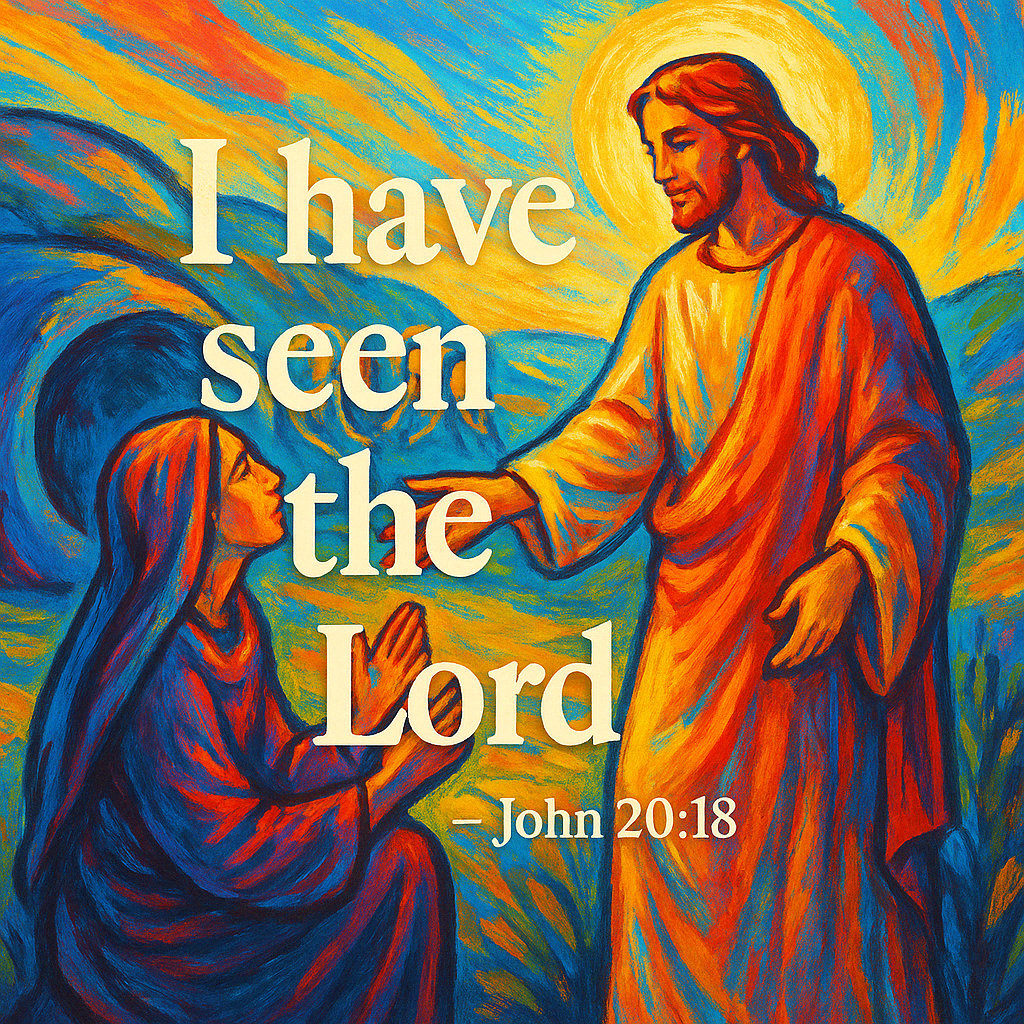
11 But Mary stayed outside the tomb weeping. And as she wept, she bent over into the tomb 12 and saw two angels in white sitting there, one at the head and one at the feet where the body of Jesus had been. 13 And they said to her, “Woman, why are you weeping?” She said to them, “They have taken my Lord, and I don’t know where they laid him.” 14 When she had said this, she turned around and saw Jesus there, but did not know it was Jesus. 15 Jesus said to her, “Woman, why are you weeping? Whom are you looking for?” She thought it was the gardener and said to him, “Sir, if you carried him away, tell me where you laid him, and I will take him.” 16 Jesus said to her, “Mary!” She turned and said to him in Hebrew, “Rabbouni,” which means Teacher. 17 Jesus said to her, “Stop holding on to me, for I have not yet ascended to the Father. But go to my brothers and tell them, ‘I am going to my Father and your Father, to my God and your God.’” 18 Mary of Magdala went and announced to the disciples, “I have seen the Lord,” and what he told her.
Detailed Exegesis
Verse 11 – “But Mary stayed outside the tomb weeping. And as she wept, she bent over into the tomb”
Mary’s tears are an expression of grief, love, and longing. She refuses to leave the place of loss — a sign of her steadfast devotion. Her act of bending over into the tomb shows a desire to understand, to seek, even in sorrow.
Verse 12 – “And saw two angels in white sitting there, one at the head and one at the feet where the body of Jesus had been.”
The presence of angels confirms the divine significance of this moment. Their position — one at the head and one at the feet — recalls the mercy seat of the Ark of the Covenant, flanked by cherubim. Jesus’ tomb becomes a new mercy seat, a sacred place where God’s presence dwells.
Verse 13 – “And they said to her, ‘Woman, why are you weeping?’ She said to them, ‘They have taken my Lord, and I don’t know where they laid him.’”
The angels’ question is not to mock but to redirect her vision. Mary’s answer reveals that her love for Christ endures beyond death. She speaks of Him as “my Lord,” even though she believes His body has been taken. Her personal relationship with Jesus is unbroken.
Verse 14 – “When she had said this, she turned around and saw Jesus there, but did not know it was Jesus.”
Her failure to recognize Him speaks to both her grief and the glorified nature of Jesus’ risen body. Like the disciples on the road to Emmaus, her eyes must be opened not by sight alone, but by love and revelation.
Verse 15 – “Jesus said to her, ‘Woman, why are you weeping? Whom are you looking for?’ She thought it was the gardener and said to him, ‘Sir, if you carried him away, tell me where you laid him, and I will take him.’”
Jesus gently repeats the angels’ question, drawing her deeper into encounter. The mention of a gardener evokes Eden — the place of original intimacy with God. Unknowingly, Mary is speaking to the New Adam, who tends the new creation.
Verse 16 – “Jesus said to her, ‘Mary!’ She turned and said to him in Hebrew, ‘Rabbouni,’ which means Teacher.”
The moment of recognition comes not through explanation but through a name. Jesus calls her as the Good Shepherd calls His sheep. Her response, “Rabbouni,” is not just a title — it is a cry of love, awe, and restored relationship.
Verse 17 – “Jesus said to her, ‘Stop holding on to me, for I have not yet ascended to the Father. But go to my brothers and tell them, ‘I am going to my Father and your Father, to my God and your God.’”
Jesus redirects Mary’s love into mission. He is not to be clung to physically, because His glorified life is now shared with all believers. His words “my Father and your Father” express the new family created through His Passion — we are now children of the Father.
Verse 18 – “Mary of Magdala went and announced to the disciples, ‘I have seen the Lord,’ and what he told her.”
Mary becomes the first evangelist of the Resurrection. Her message is simple but world-changing: “I have seen the Lord.” She does not preach a doctrine but a person — the Risen Christ who knows her and sends her.
Teachings from the Church
The Catechism of the Catholic Church affirms the importance of Mary Magdalene’s role: “In the course of her mission, Mary Magdalene becomes the apostle to the apostles. The news she proclaims becomes the foundation of the Christian faith: Christ is risen!” (CCC 641, 647). Her encounter with Jesus exemplifies how Christian witness is born not from theory, but from personal relationship. The Catechism also emphasizes that “faith in the Resurrection has as its object an event which is historically attested to by the disciples, who really encountered the Risen One” (CCC 639). Mary’s testimony is not an allegory — it is an historical moment grounded in real, physical experience.
St. Gregory the Great commented on this passage, saying: “Jesus is not recognized when he calls her ‘woman’; he is recognized when he calls her by name. This shows that it is not by hearing others that we come to know the Lord, but when we are called by him from within.” This interior call is essential to Christian life — we are each called by name, each personally known and loved. Mary represents every soul longing for Jesus, every heart broken by sin or grief, and every life transformed by His voice.
Throughout Church history, Mary Magdalene has been honored not only as a penitent sinner but as a model of contemplative love and apostolic zeal. Her feast day was elevated to the rank of a Feast in 2016 by Pope Francis, who said: “She is the apostle to the apostles, the woman of the first witness to the Resurrection, the woman of the new evangelization.” Her story reveals that no one is disqualified from being a vessel of Christ’s glory. The love that once wept now goes forth to proclaim.
Reflection
This Gospel pierces the soul with beauty. Have we heard Jesus call our name? Have we lingered long enough in prayer to recognize His voice, even when He seems absent? Mary Magdalene’s example teaches us to seek Christ with tears, to wait with love, and to rise when He sends. In a world filled with noise, distractions, and shallow substitutes for love, we are invited to remain outside the tomb — in stillness, in longing, and in faith — until the voice of the Lord calls us.
Her transformation from grief to mission reminds us that true healing comes when we stop clinging to what was and embrace what God is doing now. Where in our lives are we holding on too tightly to a past version of Christ, rather than receiving the newness of His risen presence? Jesus does not leave us in sorrow — He sends us with joy. Every Christian is meant to echo Mary’s proclamation: “I have seen the Lord.” Are we willing to carry that message into our homes, our workplaces, and our broken world?
Let us ask Mary Magdalene to intercede for us, that we might hear the Lord’s voice anew and respond with the same love, the same courage, and the same joy. What would change if we truly believed that the Lord of glory is calling us by name today? May we, too, go forth and declare with our lives: “I have seen the Lord.”
Hearts Set Afire, Lives Sent Forth
Today’s readings trace a breathtaking arc: from the fiery preaching of Peter, to the psalmist’s quiet hope, to Mary Magdalene’s tearful recognition of the Risen Lord. At every turn, we see the power of divine encounter — the kind that stirs the soul, pierces the heart, and reshapes the direction of one’s life. In Acts, Peter boldly calls for repentance and baptism, and three thousand respond with conversion and joy. In Psalm 33, we are reminded that God’s mercy is not reserved for the few, but is poured out upon all who revere and hope in Him. In The Gospel of John, Jesus calls Mary by name, lifting her from sorrow and commissioning her as the first herald of the Resurrection.
These are not ancient stories preserved for memory’s sake. They are divine invitations whispered anew to each of us. The Risen Christ still calls. The Spirit still convicts. The Father still waits with mercy for every prodigal soul. Are we listening? Are we willing to respond as they did — with repentance, trust, and joyful witness?
Let us step into this Easter season not as passive spectators, but as disciples aflame with purpose. May we echo Mary’s cry — “I have seen the Lord” — not just with our words, but with our lives. Where is the Lord sending you today? Who needs to hear your testimony? Be bold. Be still. Be ready. The tomb is empty, and the world is waiting.
Engage with Us!
We’d love to hear how the Word of God is moving in your heart today. Share your thoughts, prayers, and insights in the comments below — your witness may be the encouragement someone else needs! Take a few moments to sit with the readings, ponder the reflection questions, and let the Holy Spirit guide your response. This is how we grow — together, in the Body of Christ.
Reflection Questions:
First Reading – Acts 2:36–41
“What are we to do, my brothers?”
Have you experienced a moment when the Gospel pierced your heart? What parts of your life might the Holy Spirit be calling you to repent from or renew today? How can you help others encounter the grace of baptism and life in the Spirit?
Responsorial Psalm – Psalm 33:4–5, 18–20, 22
“Our soul waits for the Lord, he is our help and shield.”
Are you actively placing your trust in the Lord’s mercy, or are you trying to carry life’s burdens alone? How can you cultivate a deeper spirit of hope and stillness this week? Where have you seen the Lord’s steadfast love in your life recently?
Holy Gospel – John 20:11–18
“Mary!”… “Rabbouni!”
Have you heard Jesus speak your name in prayer or through others? Are you holding onto something that Jesus is asking you to release so He can send you on mission? What does it look like for you to proclaim, “I have seen the Lord” in your daily life?
Let us go forth today with open hearts, renewed purpose, and courageous love. May we live each moment with the faith, mercy, and tenderness that Jesus has shown us — and extend that same mercy to everyone we encounter. Keep your eyes on the Risen Lord, listen for His voice, and be ready to rise when He calls your name.
Follow us on Instagram and Facebook for more insights and reflections on living a faith-filled life.

 Holy Manna!
Leave a comment