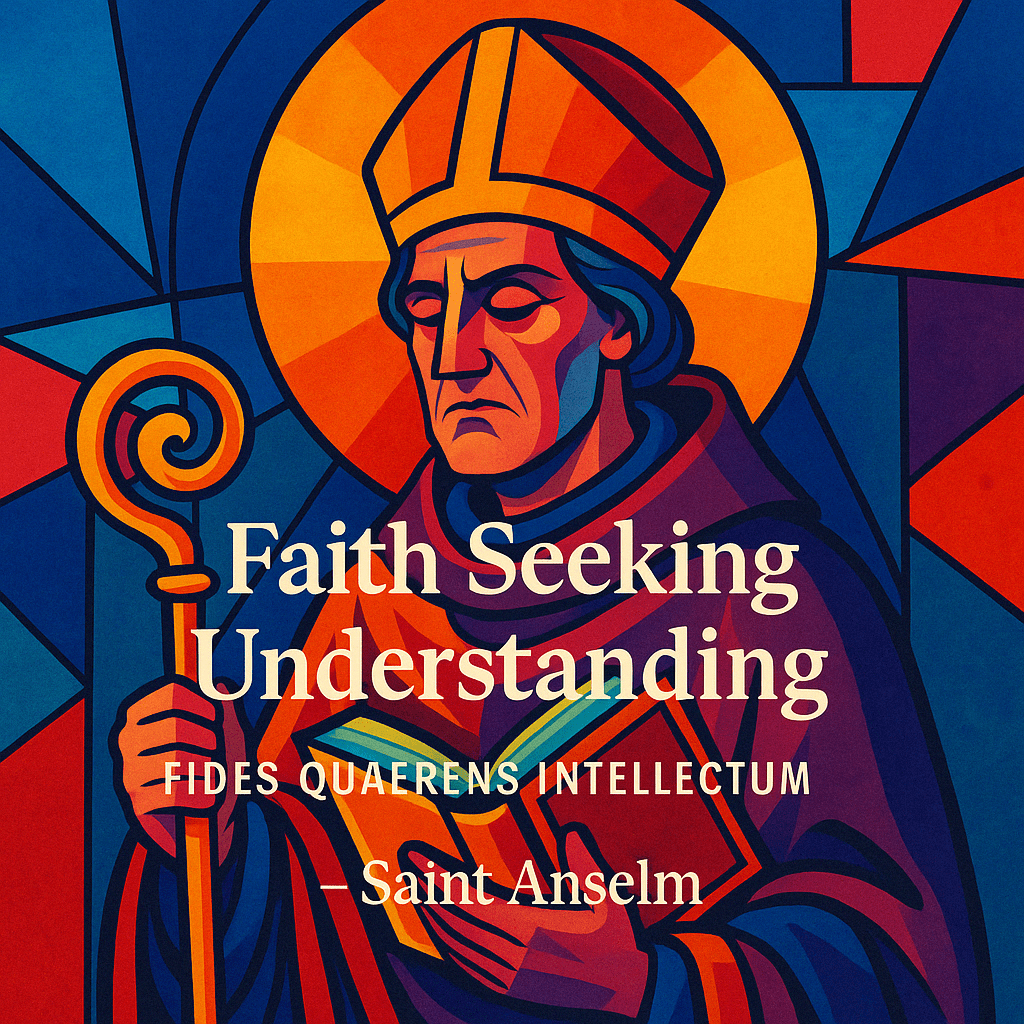
🌟 A Mind on Fire: Saint Anselm’s Enduring Greatness
Among the great saints who have shaped the Catholic Church through both holiness and intellect, Saint Anselm of Canterbury stands as a beacon of reason illuminated by faith. Often called the “Father of Scholasticism,” Anselm was not only a philosopher and theologian but a man deeply in love with God. His most famous motto—“faith seeking understanding”—has become a foundation stone in Catholic thought. Anselm believed that theology was not about proving God for the sake of argument, but about coming to know the One he already loved. This devotion to divine truth, coupled with a disciplined and fearless intellect, earned him the title of Doctor of the Church in 1720. In a world where faith and reason often seem at odds, Saint Anselm reminds us that the mind and heart are meant to journey together toward the eternal mystery of God.
🏰 A Pilgrim’s Path: From Noble Youth to Shepherd of Souls
Saint Anselm was born in 1033 in Aosta, a picturesque town nestled in the Italian Alps. His father, Gundulf, was a feudal nobleman—proud, ambitious, and often harsh. His mother, Ermenberga, was his opposite: gentle, devout, and wise. From her, Anselm received the seeds of Christian virtue that would blossom throughout his life. As a child, Anselm had a vivid dream in which he climbed the Alps to the court of God and was received joyfully. Though he later wandered spiritually, this dream foreshadowed his journey to holiness.
At 15, Anselm wished to enter religious life, but his father opposed the idea, leading Anselm to withdraw from the faith and pursue worldly pursuits. It wasn’t until his twenties, after traveling across Europe and reflecting deeply on the emptiness of a life without God, that he encountered Lanfranc, the prior of the Abbey of Bec in Normandy. Under Lanfranc’s guidance, Anselm rediscovered his vocation and entered the monastery at the age of 27.
His sanctity and brilliance were quickly recognized. After Lanfranc became Archbishop of Canterbury, Anselm succeeded him as Abbot of Bec, and later—though humbly resistant—was made Archbishop himself in 1093. Anselm’s episcopacy was marked by his unwavering defense of the Church’s freedom, especially during the Investiture Controversy. Though royalty tried to dominate the Church, Anselm stood firm, preferring exile to compromise.
He is perhaps most remembered for his profound theological writings, particularly Proslogion, where he offers his ontological argument for the existence of God: “God is that than which nothing greater can be conceived.” This was not cold reasoning but a love letter from a soul intoxicated with the beauty of divine truth.
✨ Signs from Heaven: The Quiet Wonders of Anselm’s Life
While Saint Anselm is primarily remembered for his intellectual contributions, his life was not without miracles. Though he never sought attention for himself, those around him witnessed how God confirmed Anselm’s holiness through quiet signs and wonders.
One such moment came during his time as Abbot. A monk, stricken with a mysterious illness and thought to be near death, was brought to Anselm. With gentleness and prayer, Anselm laid his hands upon him and invoked God’s mercy. The monk recovered completely—an act seen not only as physical healing but as a testament to Anselm’s deep union with God.
Anselm also experienced moments of mystical prayer, during which witnesses said his face would become radiant with joy and awe. In these moments, it seemed he was no longer on earth but in the court of heaven, echoing the vision from his childhood. These were not displays of power, but of a heart fully attuned to the divine.
🌊 The Crown of Suffering: Exile, Fidelity, and the Martyrdom of the Will
Anselm’s life was no stranger to suffering. Though he was never martyred by sword or fire, he endured what the Church calls a white martyrdom—a complete self-sacrifice through hardship, obedience, and unwavering fidelity.
As Archbishop of Canterbury, Anselm came into immediate conflict with King William II, who sought to control ecclesial appointments and seize Church property. Anselm refused to consecrate bishops appointed by the crown without papal approval. As a result, he was exiled from England twice, once under William and again under Henry I.
While in exile, Anselm never ceased to pray, teach, or lead. He continued to write theological masterpieces and worked tirelessly to reconcile Church and state. Despite the pain of separation from his flock and the comforts of home, he accepted his trials with Christlike patience, believing that obedience to God must always come first.
His suffering was not in vain. By the end of his life, Anselm had helped secure greater autonomy for the Church and left behind a legacy of courage and holiness that outshone any worldly opposition.
🌹 Light Beyond the Grave: Anselm’s Intercession and Lasting Influence
After his holy death on April 21, 1109, Saint Anselm’s memory was immediately honored. He was buried in Canterbury Cathedral, and pilgrims soon began flocking to his tomb, seeking healing and intercession. Many who visited reported miraculous recoveries, including a woman who regained her sight and a crippled man who stood and walked after praying at Anselm’s shrine.
His writings continued to inspire generations of theologians, mystics, and saints. Saint Thomas Aquinas, centuries later, would praise Anselm’s clarity and devotion. The Church officially recognized his sanctity long before the formal canonization process existed, and in 1720, Pope Clement XI declared him a Doctor of the Church, placing him among the greatest teachers of the faith.
Today, his relics remain a source of veneration. Though time and war have scattered many of them, the spiritual power of his intercession remains undiminished. He is the patron of philosophers, theologians, and students—those who seek God with both heart and mind.
💡 Living Like Anselm: Seeking God with Head and Heart
Saint Anselm calls out to every modern Catholic with a message both ancient and urgent: “Do not seek to understand in order to believe, but believe so that you may understand.” This is not a call to blind faith, but to faith that opens the door to true wisdom. In a world of shallow answers and empty noise, Anselm invites us to ponder the deeper questions—not to satisfy curiosity, but to fall in love with God.
What would our lives look like if we allowed faith to shape our thinking, rather than letting doubt cloud our trust in God? How much deeper would our joy be if we pursued knowledge not for pride, but for communion with our Creator?
To live like Saint Anselm is to be brave in our thinking, humble in our hearts, and steadfast in our convictions. It means standing firm in truth, even when it costs us exile from popular opinion. It means making time each day to seek God in prayer and study, and to never settle for mediocrity in the spiritual life.
Saint Anselm reminds us that our faith is not just a feeling, but a pursuit—an adventure of the soul, guided by grace and crowned by truth.
Are you ready to seek God with your whole mind and whole heart?
💬 Engage with Us!
We’d love to hear how Saint Anselm’s life speaks to you! Share your thoughts in the comments or DM us on Instagram @HolyManna.blog.
Here are 3 reflection questions to pray and ponder:
- When was the last time you sought to understand your faith more deeply?
- Are there areas in your life where God is calling you to stand firm in truth, even when it’s hard?
- How can you better unite your reason and your love for God in your daily decisions?
Let us support each other in our faith journey. May we strive, like Saint Anselm, to do everything with love, as our Lord Jesus did.
Saint Anselm, pray for us! 🌟
Follow us on Instagram and Facebook for more insights and reflections on living a faith-filled life.

 Holy Manna!
Leave a comment