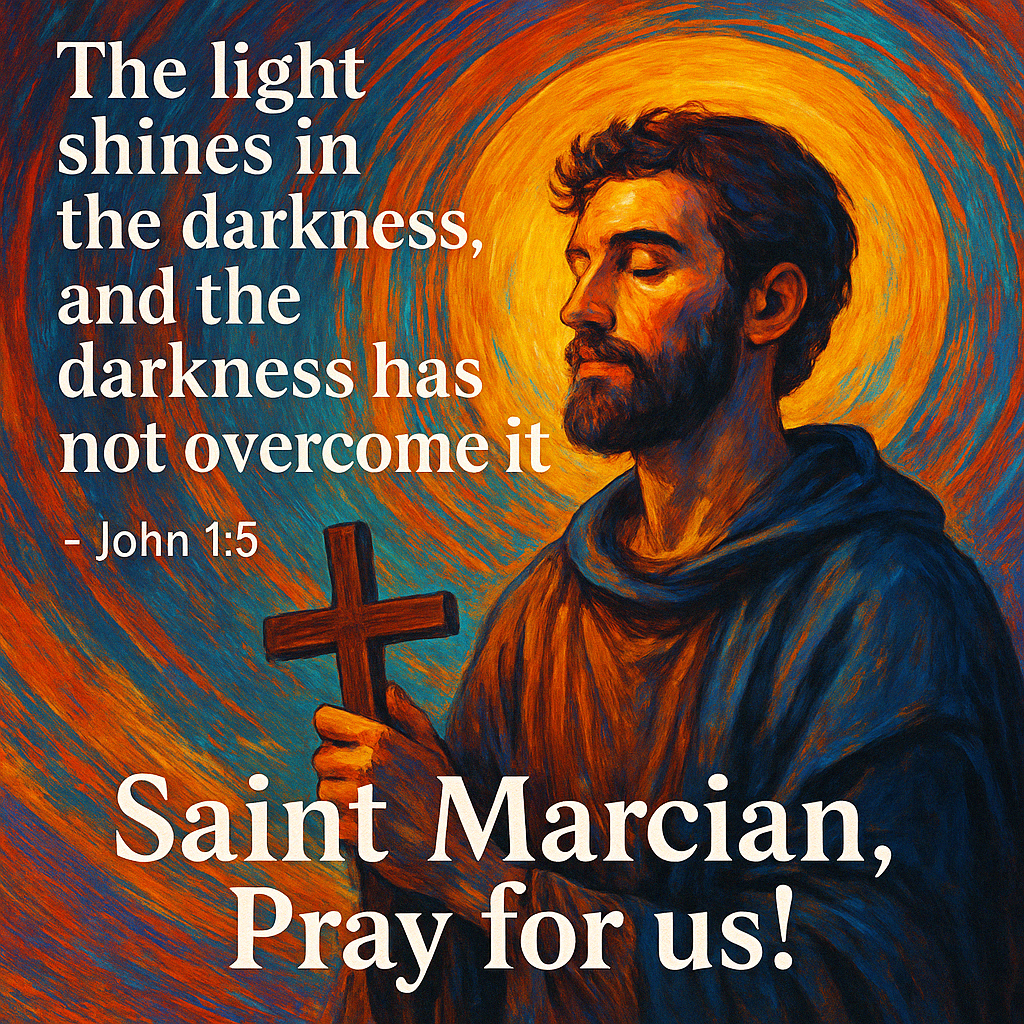
🔥 Marcian the Flamebearer
When the Church remembers her early martyrs, she often highlights bold preachers, miracle workers, and leaders who confronted emperors with unwavering defiance. Yet, some of the most inspiring saints were quiet followers—men and women who walked behind the giants of faith and bore the same Cross with humble love. Saint Marian, also known as Saint Marcian, is one such figure. While not as well-known as his spiritual companion Saint Mamertinus, Marian shines as a faithful disciple, a courageous witness, and a fellow sufferer in the fires of persecution. His life was a testament to the beauty of supporting roles in the Body of Christ—roles that, though hidden, are essential and holy. In honoring Saint Marian, we honor every believer who chooses quiet fidelity over worldly recognition and who endures trials with eyes fixed on heaven.
🌿 From Pagan Silence to Christian Fire
Saint Marian lived during the 3rd century in what is now modern-day France, specifically in the region of Auxerre—a city that would eventually become a stronghold of Christian devotion. Though details of his early life remain largely obscured by time, we know that Marian was likely raised in a pagan society that adhered to Roman religious practices. Christianity was still spreading quietly and often dangerously through Gaul, and public association with Christ could quickly turn deadly.
It was in this climate of tension and risk that Marian encountered Saint Mamertinus, a former Roman soldier who had dramatically converted to Christianity. Mamertinus, imprisoned for his newfound faith, radiated a peace and strength that could not be explained by human logic. Marian, deeply moved by Mamertinus’s witness, was drawn to the truth of the Gospel. Through their relationship, Marian experienced a profound conversion of heart, receiving baptism and choosing to walk the difficult path of discipleship alongside Mamertinus.
From that moment on, Marian lived a life of unwavering devotion. He is remembered primarily for his decision to remain close to his spiritual mentor, serving the imprisoned, encouraging the faithful, and sharing in their suffering. In the eyes of the world, his deeds may have seemed small. But in the eyes of God, Marian’s life was marked by great love. His fidelity, courage, and willingness to suffer for Christ would eventually lead him to share in the martyr’s crown.
✨ Grace in the Shadows
Saint Marian’s sanctity did not manifest through spectacular displays or public acts of power, but rather in the quieter, subtler miracles of endurance, encouragement, and spiritual presence. The early Christian communities revered him not for raising the dead or healing the sick in dramatic fashion, but for performing the miracle of remaining faithful amid darkness and danger.
His presence among fellow prisoners brought a sense of peace and strength. Accounts passed down through oral tradition suggest that Marian was known for his consoling words, his prayers that brought calm to terrified believers, and his ability to maintain serenity in the face of suffering. These were not minor things—they were miracles of interior transformation, graces poured out on the persecuted through one man’s deep communion with Christ.
One of the most poignant miracles associated with his life was the spiritual transformation of other prisoners. Just as Marian had once been inspired by Mamertinus, he too became a light to others. Through his witness, several prisoners are believed to have found courage to confess Christ before their execution. “The light shines in the darkness, and the darkness has not overcome it” (cf. John 1:5). In Saint Marian, that light flickered persistently, a sign of hope in the darkest places.
⚔️ Chains of Glory
The life of Saint Marian was defined not by ease but by trial. After embracing the Christian faith, Marian became a target for Roman authorities. His arrest, likely in conjunction with the imprisonment of Saint Mamertinus, marked the beginning of his public suffering for Christ. In the dungeons of Auxerre, Marian endured brutal treatment. The prisons of that era were filthy, overcrowded, and merciless to anyone who refused to renounce the “forbidden” name of Jesus.
Yet, rather than weakening his resolve, Marian’s sufferings became a source of strength. Fellow prisoners and even some Roman guards were reportedly amazed by his peace. When interrogated and offered release in exchange for offering sacrifice to Roman gods, Marian stood firm, echoing the quiet strength of other early martyrs. “We must obey God rather than men” (Acts 5:29) was not just a verse—it was the living motto of his heart.
Eventually, Marian was sentenced to death. While the specific method of his execution is not definitively recorded, early sources treat his death as martyrdom, meaning he died in odium fidei—in hatred of the faith. His death was not the end but the fulfillment of a journey that began in prison and ended in glory. Like his spiritual father Mamertinus, Marian was sealed in blood as a faithful witness to Christ. His body may have fallen, but his soul rose triumphantly into the embrace of the eternal King.
🌟 The Fire Still Burns
Though history has left us with fewer records of Saint Marian’s posthumous miracles than those of more widely venerated saints, his memory endured through sacred tradition. He was honored alongside Saint Mamertinus, and the two became known in Auxerre and surrounding regions as examples of divine companionship and unwavering faith.
Marian’s relics were preserved and venerated in Auxerre, a city that became a focal point for Christian pilgrimage in later centuries. Pilgrims sought not just the intercession of Mamertinus, but also that of Marian—recognizing the deep spiritual bond the two shared. Testimonies of answered prayers, healings, and conversions at their shared site reflect the Church’s long-standing belief in the “communion of saints”, a doctrine taught in The Catechism of the Catholic Church:
“Being more closely united to Christ, those who dwell in heaven fix the whole Church more firmly in holiness… they do not cease to intercede with the Father for us” (CCC 956).
Though Marian’s fame never reached the heights of other martyrs, the quiet devotion of the faithful and the continued honor of his memory reveal the enduring impact of his intercession. His presence may remain humble in the annals of history, but it is profound in the hearts of those who venerate him as a saint who followed Christ all the way to the cross.
💬 Faithfulness in the Quiet
Saint Marian’s story offers a powerful reminder that sainthood is not about prominence, praise, or public recognition. It’s about faithfulness—especially when no one is looking. He did not stand alone as a solitary preacher or prophet. He chose instead to walk beside another, to support, to serve, and to suffer in silence. Yet that very choice made him great in the eyes of God.
How often are we tempted to believe that our small acts of love and service go unnoticed? Marian teaches us that the Kingdom of God treasures those very acts. “Whoever is faithful in small matters will be faithful in large ones” (Luke 16:10). The Church canonizes not only miracle workers but also those who remain faithful unto death, even in the background.
Today, Saint Marian invites us to embrace hidden holiness, to serve without seeking applause, and to stand firm in our faith when trials come. How might your quiet witness encourage someone else’s faith? Are you being called to walk alongside someone else’s mission, offering them strength and love in the background? These are not lesser roles—they are sacred paths.
May we follow Marian’s example by choosing faith over fear, service over self, and love over comfort. In the small prisons of our everyday lives—whether they be suffering, loneliness, or silence—may we radiate the same peace that marked his final days.
🕊️ Engage with Us!
What does Saint Marian’s example stir in your heart? How do you feel called to follow Christ in your daily life—even when it’s unseen?
Here are a few reflection questions to help guide your prayer today:
- Do I ever feel that my efforts to live my faith go unnoticed? How can I offer these hidden acts to God with love?
- In what ways am I being called to follow or support others in their mission, like Marian did for Mamertinus?
- How do I respond when my faith is tested—do I rely on God’s strength as Marian did, or do I try to endure on my own?
Let’s support one another in this journey. Comment below with your thoughts, and don’t forget—every quiet act of love brings heaven closer to earth. May we all strive, like Saint Marian, to follow Christ with hearts ablaze, even in the shadows.
Saint Marcian, pray for us! 🕊️
Follow us on Instagram and Facebook for more insights and reflections on living a faith-filled life.

 Holy Manna!
Leave a comment