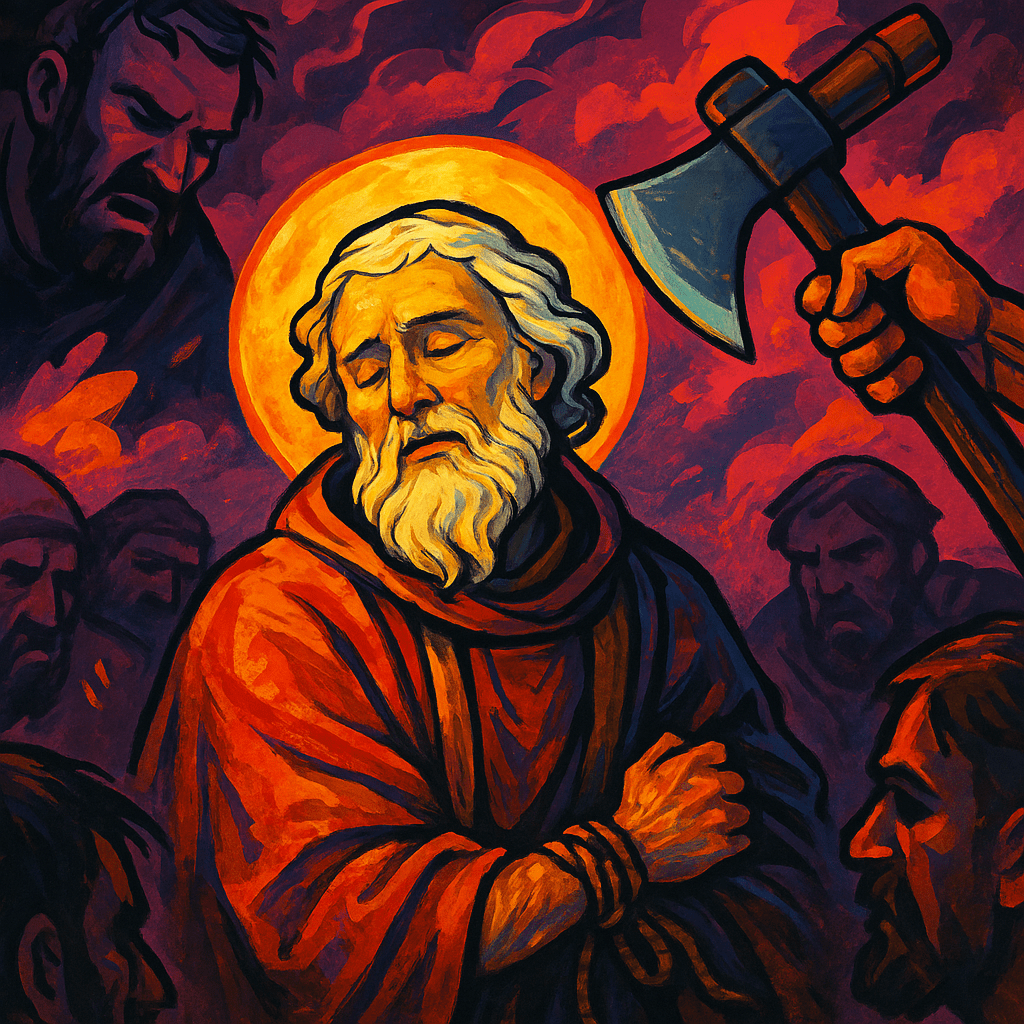
A Martyr of Mercy
In the long line of holy men and women who have laid down their lives for the sake of the Gospel, Saint Alphege stands out as a beacon of compassionate leadership and courageous witness. His life, deeply rooted in humility and unwavering trust in God, challenges each of us to consider the cost of true discipleship. As the Archbishop of Canterbury in a time of violence and political instability, Alphege modeled the Good Shepherd, not just in title, but in action—protecting the weak, feeding the hungry, and even offering his life in place of his people. His martyrdom, marked not by anger or resistance, but by prayer and forgiveness, reflects the radiant image of Christ crucified. Celebrated on April 19, Saint Alphege continues to be a powerful intercessor and example for those seeking to live lives of service, justice, and holy sacrifice.
From Noble Roots to Holy Poverty
Saint Alphege was born around the year 953 in Weston, near Bath, England, into a noble and influential Saxon family. Despite the wealth and privilege of his background, Alphege felt a calling that was not satisfied by earthly honors. Drawn by the desire to serve God in a deeper and more radical way, he entered monastic life at Deerhurst Abbey. Eventually, he withdrew further from the world to live as a hermit in Bath, choosing solitude, prayer, and penance over prestige. His piety, wisdom, and dedication to the poor made a strong impression on those around him. In time, his holiness could not remain hidden.
Alphege was appointed Bishop of Winchester in 984, succeeding another great English saint, Saint Ethelwold. As bishop, he became known for his tireless devotion to the poor and his bold reforms within the Church. He gave freely to those in need, often using the wealth of the Church to relieve the suffering caused by famine and disease. In 1006, he was appointed Archbishop of Canterbury, a position of immense responsibility, especially during a time of increasing Viking aggression. Alphege did not shy away from his pastoral duty. He remained steadfast in his mission, bringing spiritual leadership and moral clarity to a nation facing chaos. He is remembered not only as a bishop and martyr, but as a man who lived with radical charity and trusted in God’s providence to the very end.
The Miracle of Charity
Although Saint Alphege may not be associated with the spectacular miracles of healing or levitation that often adorn the lives of other saints, his entire life was, in essence, a living miracle of Gospel charity. In a time when clerics were often criticized for holding onto luxury and political power, Alphege stood apart. He gave away church treasures not to curry favor with kings or lords, but to feed the hungry, clothe the naked, and comfort the suffering. When famine swept through the land, he liquidated wealth from the Church to purchase grain and provide relief to the poor. In doing so, he embodied the Lord’s command: “Give to everyone who begs from you, and do not refuse anyone who wants to borrow from you” (Matthew 5:42).
He did not perform these works of mercy from a distance. Alphege was known to personally tend to the sick, entering homes plagued by illness and despair. His very presence brought peace and comfort, and his prayers were said to calm restless hearts. In this way, Alphege demonstrated that the true miracles of the Christian life are not always wrapped in spectacle, but in compassion, sacrifice, and love. Are we willing to be miracles of mercy in the lives of others?
A Shepherd’s Sacrifice
In 1011, the Danes launched a brutal assault on the city of Canterbury. The archbishop, Saint Alphege, was captured along with many others. The invaders demanded an enormous ransom: 3,000 pounds of silver. Knowing that paying such a sum would devastate the already suffering people, Alphege refused. He would not allow the poor to be burdened for his freedom. For months, he endured imprisonment and abuse, always clinging to his faith and refusing to compromise his conscience.
On April 19, 1012, after a feast and heavy drinking, his captors—frustrated by his resolve—dragged him out and began to mock him. They pelted him with bones and stones, finally ending his life with a blow from an axe. In his final moments, Alphege did not curse his killers. He did not cry out for vengeance. Instead, like Christ, he prayed for them. “Father, forgive them, for they know not what they do” (Luke 23:34). His martyrdom was a holy echo of the crucifixion—a powerful testimony to the strength of forgiveness and the ultimate triumph of love over hatred.
The Catechism of the Catholic Church teaches, “Martyrdom is the supreme witness given to the truth of the faith: it means bearing witness even unto death” (CCC 2473). Saint Alphege gave this witness not only in words, but with his very life.
A Legacy of Light
After Saint Alphege’s death, reports of miraculous healings and divine interventions began to emerge. His body was initially laid to rest in St. Paul’s Cathedral in London, and almost immediately, the faithful began to visit his tomb. Pilgrims reported cures, comfort, and spiritual conversions after praying for his intercession. These events were seen not merely as signs of his holiness, but as affirmations of God’s continued work through His faithful servant.
In 1023, under the reign of King Canute—a ruler who had once represented the very forces that killed Alphege—the saint’s relics were solemnly translated to Canterbury. The journey itself became a pilgrimage, and numerous miracles were reported at each stop along the route. Canute himself had undergone a spiritual transformation and participated in the translation as a gesture of repentance and reverence. The event signified a remarkable reconciliation between past sins and renewed devotion.
Today, Saint Alphege’s memory is preserved in churches across England, most notably in St. Alfege Church in Greenwich, built near the site of his martyrdom. Pilgrims continue to visit, drawn by the example of a man who lived for God’s people and died for their salvation. His relics, once carried through the countryside, remain powerful reminders that the saints do not vanish at death—they intercede, inspire, and accompany us even now.
Walking in His Footsteps
Saint Alphege challenges each of us to reflect deeply on the meaning of sacrificial love. In a world that so often rewards self-interest, he reminds us that greatness is found in serving others, in protecting the vulnerable, and in standing firm for what is right—even when it costs us dearly. His refusal to burden the poor for his own ransom is a radical testimony of solidarity. His forgiveness of his murderers is a breathtaking example of mercy. His unwavering faith amidst suffering calls us to be courageous disciples, not just when it’s easy, but when it’s hard.
How can we apply this to our own lives? By seeking out opportunities to serve those in need, by speaking truth with love in our families and communities, and by offering forgiveness where we’ve been wronged. Like Saint Alphege, we may not be called to martyrdom, but we are called to love without counting the cost.
The Catechism reminds us that holiness is not reserved for the extraordinary: “All Christians in any state or walk of life are called to the fullness of Christian life and to the perfection of charity” (CCC 2013). Saint Alphege lived that call to perfection. May we, by God’s grace, strive to do the same.
Engage with Us!
Reflection Questions:
- Have you ever been called to defend your faith or values in the face of pressure?
- Do you find it hard to forgive those who hurt you?
- What practical acts of compassion can you take today that mirror Saint Alphege’s love for the poor?
Share your reflections in the comments below! Let’s build one another up in faith, courage, and love. As Saint Paul urges, “Let all that you do be done in love” (1 Corinthians 16:14).
Saint Alphege, pray for us!
Follow us on Instagram and Facebook for more insights and reflections on living a faith-filled life.

 Holy Manna!
Leave a comment