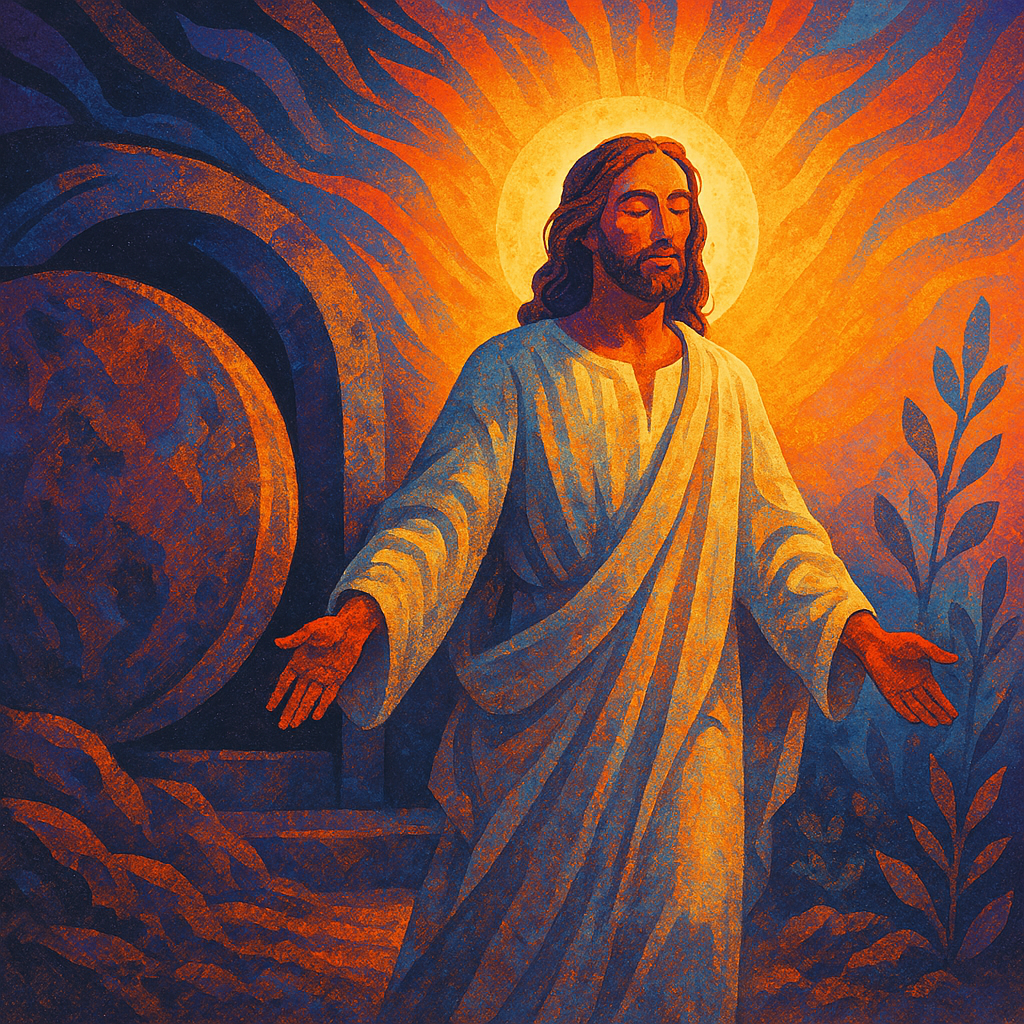
From Darkness to Dawn: The Unfolding Story of New Life
On this holiest of nights, as we gather around the Paschal flame, the Church invites us into a sacred storytelling unlike any other—the story of our salvation. Holy Saturday at the Easter Vigil in the Holy Night is not merely a memorial of Christ’s Resurrection, but a sweeping journey through the entirety of salvation history, from Genesis to the empty tomb. Each reading tonight is a brushstroke in the divine masterpiece God has been painting since the beginning of time. As we sit in the stillness of night, surrounded by candlelight and silence, the darkness begins to break with the first words: “In the beginning, when God created the heavens and the earth…”. This is where it all begins—creation, covenant, deliverance, promise, and renewal—all leading us to the triumphant cry: “He is not here, but he has been raised!”
The readings for the Easter Vigil follow a deliberate and profound arc. From the creation of the world in Genesis, we see God’s power to bring life out of nothing. We witness the radical obedience of Abraham, the liberation of the Israelites through the Red Sea, and the Lord’s steadfast love for His people through the voices of Isaiah, Baruch, and Ezekiel. These passages prepare us to understand the depth of God’s mercy and His unrelenting pursuit of our hearts. Historically, the Vigil was the night catechumens received the sacraments of initiation, passing from darkness into light, from death into life, through baptism. Saint Paul affirms this in his epistle to the Romans: “We were indeed buried with him through baptism into death, so that… we too might live in newness of life”. The ancient Church saw this Vigil not as a passive watching but an active entering into the mystery of our redemption.
At the heart of it all is a theme that echoes through every reading: God brings life where there was death, light where there was darkness, and hope where there was despair. The Vigil calls us to remember, to rejoice, and to renew. Do we recognize the God who creates, redeems, and restores us? Have we allowed ourselves to be made new? From the waters of creation to the waters of the Red Sea, to the living waters of baptism, this night is our story too. We are not just recalling history—we are stepping into it, letting its truth shape us, and rising with Christ to walk in the newness of life.
First Reading – Genesis 1:1—2:2
Let There Be Light: The Dawn of Divine Order
The Easter Vigil begins with the very first words of Scripture, drawing us back to Genesis, the Book of Beginnings. In the ancient world, origin stories held immense importance—they were not only about the past but were also keys to identity and purpose. The creation account in Genesis isn’t just a scientific or poetic explanation of how the world began; it is a liturgical hymn that reveals who created, why He created, and how all creation reflects His order, goodness, and love. Composed in a time when Israel was surrounded by pagan nations that worshiped multiple gods of chaos, death, and violence, this sacred text boldly proclaims one God who creates out of love, speaks life into existence, and establishes a world marked by beauty, harmony, and purpose. This first reading of the Vigil sets the foundation for the entire liturgy—it is the first step in salvation history, which finds its fulfillment in the Resurrection of Christ. The same God who spoke “Let there be light” into the darkness is the One who, in the tomb of Easter morning, brings forth new creation from death.
Genesis 1:1-2:2
New American Bible (Revised Edition)
The Story of Creation. 1 In the beginning, when God created the heavens and the earth— 2 and the earth was without form or shape, with darkness over the abyss and a mighty wind sweeping over the waters—
3 Then God said: Let there be light, and there was light. 4 God saw that the light was good. God then separated the light from the darkness. 5 God called the light “day,” and the darkness he called “night.” Evening came, and morning followed—the first day.
6 Then God said: Let there be a dome in the middle of the waters, to separate one body of water from the other. 7 God made the dome, and it separated the water below the dome from the water above the dome. And so it happened. 8 God called the dome “sky.” Evening came, and morning followed—the second day.
9 Then God said: Let the water under the sky be gathered into a single basin, so that the dry land may appear. And so it happened: the water under the sky was gathered into its basin, and the dry land appeared. 10 God called the dry land “earth,” and the basin of water he called “sea.” God saw that it was good. 11 Then God said: Let the earth bring forth vegetation: every kind of plant that bears seed and every kind of fruit tree on earth that bears fruit with its seed in it. And so it happened: 12 the earth brought forth vegetation: every kind of plant that bears seed and every kind of fruit tree that bears fruit with its seed in it. God saw that it was good. 13 Evening came, and morning followed—the third day.
14 Then God said: Let there be lights in the dome of the sky, to separate day from night. Let them mark the seasons, the days and the years, 15 and serve as lights in the dome of the sky, to illuminate the earth. And so it happened: 16 God made the two great lights, the greater one to govern the day, and the lesser one to govern the night, and the stars. 17 God set them in the dome of the sky, to illuminate the earth, 18 to govern the day and the night, and to separate the light from the darkness. God saw that it was good. 19 Evening came, and morning followed—the fourth day.
20 Then God said: Let the water teem with an abundance of living creatures, and on the earth let birds fly beneath the dome of the sky. 21 God created the great sea monsters and all kinds of crawling living creatures with which the water teems, and all kinds of winged birds. God saw that it was good, 22 and God blessed them, saying: Be fertile, multiply, and fill the water of the seas; and let the birds multiply on the earth. 23 Evening came, and morning followed—the fifth day.
24 Then God said: Let the earth bring forth every kind of living creature: tame animals, crawling things, and every kind of wild animal. And so it happened: 25 God made every kind of wild animal, every kind of tame animal, and every kind of thing that crawls on the ground. God saw that it was good. 26 Then God said: Let us make human beings in our image, after our likeness. Let them have dominion over the fish of the sea, the birds of the air, the tame animals, all the wild animals, and all the creatures that crawl on the earth.
27 God created mankind in his image;
in the image of God he created them;
male and female he created them.
28 God blessed them and God said to them: Be fertile and multiply; fill the earth and subdue it. Have dominion over the fish of the sea, the birds of the air, and all the living things that crawl on the earth. 29 God also said: See, I give you every seed-bearing plant on all the earth and every tree that has seed-bearing fruit on it to be your food; 30 and to all the wild animals, all the birds of the air, and all the living creatures that crawl on the earth, I give all the green plants for food. And so it happened. 31 God looked at everything he had made, and found it very good. Evening came, and morning followed—the sixth day.
2:1 Thus the heavens and the earth and all their array were completed. 2 On the seventh day God completed the work he had been doing; he rested on the seventh day from all the work he had undertaken.
Detailed Exegesis
Verse 1 – “In the beginning, when God created the heavens and the earth—”
This opening line is not just the start of Scripture—it is a cosmic declaration that God is the origin of everything. Unlike other ancient myths that depicted creation as the result of divine warfare or accident, this verse introduces a personal, intentional Creator. The Hebrew phrase bereshit bara Elohim signals a divine act that is sovereign and singular. God alone initiates creation, and all that follows will unfold under His command.
Verse 2 – “and the earth was without form or shape, with darkness over the abyss and a mighty wind sweeping over the waters—”
This verse paints a picture of chaos—formlessness and emptiness—yet God’s Spirit (ruah Elohim) hovers, ready to bring order and life. The early Church Fathers saw this as a foreshadowing of baptism: the waters that once symbolized death and void would, through the Spirit, become a source of life and rebirth.
Verse 3 – “Then God said: Let there be light, and there was light.”
God’s Word creates reality. This is the first instance of divine speech bringing forth life. Saint John Chrysostom teaches that God’s Word is not like ours—His speech is power. This light is not merely physical but represents divine illumination, truth, and goodness. The early Church saw in this verse a prefigurement of Christ, the Light of the World.
Verse 4 – “God saw that the light was good. God then separated the light from the darkness.”
This separation is the beginning of divine order—God does not just create, He establishes meaning. The moral symbolism here is profound: light represents righteousness, darkness evil. This sets the stage for the biblical drama of human choice and God’s justice.
Verse 5 – “God called the light ‘day,’ and the darkness he called ‘night.’ Evening came, and morning followed—the first day.”
Naming signifies authority. God gives identity to time itself, instituting a sacred rhythm that will guide human life. The structure of days reflects God’s intentionality and foreshadows the Sabbath, a concept that will become foundational for covenant life.
Verses 6–8 – “Then God said: Let there be a dome in the middle of the waters, to separate one body of water from the other…”
God creates the sky by separating waters, forming a dome—an image of order amidst chaos. In the ancient worldview, this act confirmed God’s power over the elements. The dome of the heavens becomes a sign of divine shelter and grandeur.
Verses 9–10 – “Then God said: Let the water under the sky be gathered into a single basin, so that the dry land may appear…”
The appearance of dry land introduces stability and structure, showing that God brings security where there was once instability. Naming the land and sea again asserts God’s dominion and affirms creation’s purposefulness.
Verses 11–13 – “Then God said: Let the earth bring forth vegetation…”
The creation of vegetation marks the first instance of life that reproduces. God not only creates but makes creation fruitful. This fruitfulness is echoed throughout salvation history, culminating in Jesus, the true Vine.
Verses 14–19 – “Then God said: Let there be lights in the dome of the sky…”
The sun, moon, and stars are given roles—not worshipped as deities, but servants of God’s design. They “govern” day and night, pointing to divine providence. Their creation also reflects liturgical time, “marking the seasons,” an image that foreshadows the Church’s liturgical calendar.
Verses 20–23 – “Then God said: Let the water teem with an abundance of living creatures…”
The waters and skies are filled with living creatures. God’s blessing to “be fruitful and multiply” shows that life is meant to overflow with abundance. This prepares us to understand humanity’s vocation to steward, not exploit, creation.
Verses 24–25 – “Then God said: Let the earth bring forth every kind of living creature…”
God populates the earth with land animals, reinforcing the theme of variety and goodness. Every stage of creation is declared “good,” a repeated refrain that reminds us of the innate goodness of the material world.
Verses 26–27 – “Then God said: Let us make human beings in our image, after our likeness…”
The climax of creation: mankind. Created in the image and likeness of God, male and female, humanity is unique—meant for relationship, responsibility, and communion with God and one another. This divine image is the foundation of human dignity.
Verses 28–30 – “God blessed them and God said to them: Be fertile and multiply…”
God gives humanity dominion—not domination—over creation. The Catechism reminds us, “Man’s dominion over inanimate and other living beings… requires a religious respect for the integrity of creation” (Catechism of the Catholic Church 2415). The gift of stewardship reflects God’s trust in humanity.
Verse 31 – “God looked at everything he had made, and found it very good.”
Only here does God say it is “very good”. The completeness of creation is affirmed. God’s creation is not something to escape, but something to be redeemed.
Genesis 2:1–2 – “On the seventh day God completed the work he had been doing; he rested…”
God rests—not because He is tired, but to bless and sanctify time. The Sabbath becomes a covenantal sign between God and His people. It points to the eternal rest promised in Christ, who, after completing His work on the Cross, also “rested” in the tomb before the Resurrection.
Teachings of the Church
The Catechism of the Catholic Church teaches: “Creation is the foundation of ‘all God’s saving plans,’ the ‘beginning of the history of salvation’” (CCC 280). This reading from Genesis reveals that salvation does not begin with Christ’s Resurrection but with God’s first breath into the void. Everything God makes, He declares good, and this goodness is the backdrop against which the tragedy of sin—and the glory of redemption—unfolds. The Catechism also affirms that man and woman, created in the image and likeness of God, are the summit of creation and entrusted with its care (CCC 343–344). Our dignity is not earned; it is bestowed by the Creator Himself.
Saint Irenaeus beautifully connects this creation story to the Resurrection when he writes: “The glory of God is man fully alive; and the life of man is the vision of God” (Against Heresies, IV, 20, 7). For Irenaeus, human life—fully alive in God—is the crowning glory of creation. The Resurrection of Christ is not a plan B; it is the fulfillment of this original glory that was marred by sin. God does not abandon His creation but enters into it, restores it, and elevates it in Christ. The empty tomb is not the rejection of material life—it is its transformation.
Saint Augustine adds: “God’s rest on the seventh day signifies the peace of those who rest in Him” (City of God, XI, 8). This eternal rest is not just the absence of labor—it is communion with the divine. When Christ rested in the tomb on Holy Saturday, He fulfilled the mystery of the seventh day, preparing the world for the eighth day—Resurrection, new creation, and eternal life. Just as God created the world with His Word, so too does He re-create it in the Word made flesh.
Reflection
In our daily lives, this reading invites us to view the world—and ourselves—as God does: created, called good, and made for communion. We are not accidents. We are not alone in a chaotic universe. We are intentionally crafted by a loving Creator who continues to sustain and sanctify us. Do we see the image of God in ourselves and in others? Do we care for creation as stewards, or do we consume without gratitude? Let us also reflect on the gift of rest—not just physical rest, but the spiritual rest that comes from trusting in God’s order, providence, and timing.
The same Spirit who hovered over the waters in the beginning now hovers over the baptismal font. The same Word who brought light into chaos now speaks to the darkness in our hearts. What part of your life is still without form and void, in need of God’s creative Word? This Vigil night reminds us that God is not done creating. In Christ, He begins again. Let us enter the new creation with awe, joy, and hope—ready to walk in the light of the Risen Lord.
First Responsorial Psalm – Psalm 104:1–2, 5–6, 10, 12–14, 24, 35
The Song of the Creator’s Glory
Psalm 104 is a majestic hymn of praise that mirrors the themes found in the Genesis creation account, making it the perfect response to the First Reading of the Easter Vigil. Rooted in Israel’s worship tradition, this psalm is a poetic retelling of God’s creative work, celebrating not only His power but His providential care for all creation. In ancient Hebrew culture, the psalms were central to prayer, liturgy, and life. They expressed Israel’s collective memory, theology, and hope. Psalm 104 stands out as a doxological response to God’s artistry, emphasizing the goodness and beauty of all that He has made. It invites the hearer into a contemplative awe before creation, which is not an end in itself but a revelation of its Creator. During the Easter Vigil, this psalm helps us lift our hearts in gratitude and wonder at the God who not only created the world but continues to sustain it and now, in Christ, renews it.
Psalm 104:1-2, 5-6, 10, 12-14, 24, 35
New American Bible (Revised Edition)
1 Bless the Lord, my soul!
Lord, my God, you are great indeed!
You are clothed with majesty and splendor,
2 robed in light as with a cloak.
You spread out the heavens like a tent;
5 You fixed the earth on its foundation,
so it can never be shaken.
6 The deeps covered it like a garment;
above the mountains stood the waters.
10 You made springs flow in wadies
that wind among the mountains.
12 Beside them the birds of heaven nest;
among the branches they sing.
13 You water the mountains from your chambers;
from the fruit of your labor the earth abounds.
14 You make the grass grow for the cattle
and plants for people’s work
to bring forth food from the earth,
24 How varied are your works, Lord!
In wisdom you have made them all;
the earth is full of your creatures.
Detailed Exegesis
Verse 1 – “Bless the Lord, my soul! Lord, my God, you are great indeed!”
This opening is a personal cry of praise, originating from the very depths of the psalmist’s being. The phrase “Bless the Lord, my soul” is an invitation to total self-offering in worship. The greatness of God here is not abstract—it is the greatness of a God intimately involved with His creation.
Verse 2 – “You are clothed with majesty and splendor, robed in light as with a cloak. You spread out the heavens like a tent;”
This verse likens God’s majesty to royal garments. Light, associated with the first act of creation in Genesis, is His robe—symbolizing truth, glory, and holiness. The heavens being “spread out” evoke a divine tent, suggesting both grandeur and closeness, like the tabernacle among His people.
Verse 5 – “You fixed the earth on its foundation, so it can never be shaken.”
This line speaks to the stability and reliability of God’s creation. In a world where natural chaos was often feared, Israel’s confidence in God’s ordering power sets Yahweh apart from the capricious deities of surrounding nations.
Verse 6 – “The deeps covered it like a garment; above the mountains stood the waters.”
This image recalls the watery chaos from Genesis 1:2. God brings order by covering the earth and then setting boundaries for the sea. It is a poetic nod to God’s sovereignty over even the most untamable elements.
Verse 10 – “You made springs flow in wadies that wind among the mountains.”
The imagery here is of water—essential for life—flowing generously. The “wadies” were dry valleys that only flowed in rainy seasons. God’s provision is not random; He sends life-giving water even to hidden, dry places.
Verse 12 – “Beside them the birds of heaven nest; among the branches they sing.”
Here we witness the joy and peace that God’s provision brings to creation. The birds’ song is a natural response of praise, reinforcing the psalm’s theme that all creation participates in the worship of the Creator.
Verse 13 – “You water the mountains from your chambers; from the fruit of your labor the earth abounds.”
God’s “chambers” symbolize the heavenly realm, from which He nourishes the earth. This abundance is directly tied to God’s ongoing creative work—it is not a one-time act, but a continual blessing.
Verse 14 – “You make the grass grow for the cattle and plants for people’s work to bring forth food from the earth,”
This verse emphasizes that God’s creation is ordered for human and animal flourishing. God provides both the natural resources and the capacity for human labor. Work, here, is not a curse but a cooperation with divine providence.
Verse 24 – “How varied are your works, Lord! In wisdom you have made them all; the earth is full of your creatures.”
This beautiful line celebrates the diversity of creation and affirms that it is all rooted in divine wisdom. The variety of life reflects God’s creativity and invites us to marvel at the intricate harmony of the natural world.
Verse 35 – “Bless the Lord, my soul!”
The psalm ends where it began—in personal praise. After reflecting on the grandeur of creation, the soul is once again moved to worship. It completes the circle: from observation to adoration.
Teachings of the Church
The Catechism of the Catholic Church teaches: “Because creation comes forth from God’s goodness, it shares in that goodness—‘And God saw that it was good… very good.’ For God willed creation as a gift addressed to man, an inheritance destined for and entrusted to him” (CCC 299). Psalm 104 illustrates this truth vividly. The psalmist’s awe mirrors the reverence that each of us is called to have for God’s handiwork—not merely admiring it, but responding with praise and responsibility. Our stewardship of creation is not an optional ecological concern—it is a spiritual mandate.
Saint Basil the Great, in his Hexaemeron (a series of homilies on the six days of creation), writes: “The world is a school of souls, the order of the universe, the succession of seasons, the harmony of the elements, all that is beautiful in the cosmos, lead the spirit of man to a deep knowledge of the Creator.” In other words, nature is not simply background—it is revelation. When we contemplate the beauty of creation, we come to know God more deeply. This aligns with the Church’s understanding that creation is sacramental in character—it reveals something of God.
Saint Francis of Assisi, known for his Canticle of the Creatures, embodies the spirituality of Psalm 104. His ability to see God’s glory in the sun, moon, animals, and even death itself, shows us how creation can be a path to holiness. He teaches us that creation is not just for utility but for communion. The Church has consistently taught that creation is a gift that reveals God’s presence and leads us to worship. As Pope Francis reminds us in Laudato Si’, “Rather than a problem to be solved, the world is a joyful mystery to be contemplated with gladness and praise” (Laudato Si’ 12).
Reflection
This psalm calls us to a deeper awareness and reverence for the natural world—not as something separate from our faith but as a vital dimension of it. In our often fast-paced, concrete-filled lives, do we take time to recognize God’s presence in creation? Do we marvel at the sunrise, listen to birdsong, or notice the intricacy of a flower with hearts full of praise? These small moments can become acts of worship if we let them.
Psalm 104 also reminds us of our dependence on God for everything. From the water that flows in hidden valleys to the food that sustains us, all comes from His hand. Do we live with grateful hearts, acknowledging God as the source of every good gift? This Vigil night, as the new fire is kindled and the light spreads, let our souls echo the psalmist’s joy. Let us not only say “Bless the Lord, my soul”, but truly live it—by honoring creation, praising our Creator, and participating in the new life offered through Christ.
Second Reading – Genesis 22:1–18
Faith That Surrenders: The Test and the Promise
Few passages in the Old Testament evoke such intensity, mystery, and foreshadowing as Genesis 22, often referred to as the Akedah, or “The Binding of Isaac.” This reading is both deeply personal and profoundly theological. At its core lies the tension between the promise of God and the cost of obedience. Abraham, the father of faith, is tested in a way that would have been both culturally unthinkable and emotionally devastating. In a time when child sacrifice was tragically common among neighboring pagan cultures, God’s request would have echoed with disturbing familiarity—yet His intervention would demonstrate a radical divergence. The God of Israel does not demand death but provides life. This passage is not merely a story of one man’s obedience; it is a prophetic image of the Father’s love, preparing us for the offering of His only Son. Within the Vigil’s liturgy, this reading reminds us that the journey of faith often involves surrender, trust, and a hope that clings to God even when all seems lost.
Genesis 22:1-18
New American Bible (Revised Edition)
The Testing of Abraham. 1 Some time afterward, God put Abraham to the test and said to him: Abraham! “Here I am!” he replied. 2 Then God said: Take your son Isaac, your only one, whom you love, and go to the land of Moriah. There offer him up as a burnt offering on one of the heights that I will point out to you. 3 Early the next morning Abraham saddled his donkey, took with him two of his servants and his son Isaac, and after cutting the wood for the burnt offering, set out for the place of which God had told him.
4 On the third day Abraham caught sight of the place from a distance. 5 Abraham said to his servants: “Stay here with the donkey, while the boy and I go on over there. We will worship and then come back to you.” 6 So Abraham took the wood for the burnt offering and laid it on his son Isaac, while he himself carried the fire and the knife. As the two walked on together, 7 Isaac spoke to his father Abraham. “Father!” he said. “Here I am,” he replied. Isaac continued, “Here are the fire and the wood, but where is the sheep for the burnt offering?” 8 “My son,” Abraham answered, “God will provide the sheep for the burnt offering.” Then the two walked on together.
9 When they came to the place of which God had told him, Abraham built an altar there and arranged the wood on it. Next he bound his son Isaac, and put him on top of the wood on the altar. 10 Then Abraham reached out and took the knife to slaughter his son. 11 But the angel of the Lord called to him from heaven, “Abraham, Abraham!” “Here I am,” he answered. 12 “Do not lay your hand on the boy,” said the angel. “Do not do the least thing to him. For now I know that you fear God, since you did not withhold from me your son, your only one.” 13 Abraham looked up and saw a single ram caught by its horns in the thicket. So Abraham went and took the ram and offered it up as a burnt offering in place of his son. 14 Abraham named that place Yahweh-yireh; hence people today say, “On the mountain the Lord will provide.”
15 A second time the angel of the Lord called to Abraham from heaven 16 and said: “I swear by my very self—oracle of the Lord—that because you acted as you did in not withholding from me your son, your only one, 17 I will bless you and make your descendants as countless as the stars of the sky and the sands of the seashore; your descendants will take possession of the gates of their enemies, 18 and in your descendants all the nations of the earth will find blessing, because you obeyed my command.”
Detailed Exegesis
Verse 1 – “Some time afterward, God put Abraham to the test and said to him: Abraham! ‘Here I am!’ he replied.”
This verse sets the tone: Abraham is being tested, not tempted. The Hebrew root nissah implies a trial meant to prove and purify, not to deceive. Abraham’s response, “Here I am!”, is a posture of total availability—echoed by prophets, and ultimately by the Blessed Virgin Mary at the Annunciation.
Verse 2 – “Then God said: Take your son Isaac, your only one, whom you love, and go to the land of Moriah. There offer him up as a burnt offering…”
Each phrase intensifies the emotional weight—Isaac is not only Abraham’s son but the beloved son of the promise. The land of Moriah would later become the location of the Temple Mount, connecting this moment to future sacrificial worship in Jerusalem. God is asking Abraham to surrender everything, even the future.
Verse 3 – “Early the next morning Abraham saddled his donkey…”
Abraham obeys without hesitation. There is no dialogue, no delay. His faith is immediate, though surely not without interior agony. This swift obedience reveals deep trust in God’s character.
Verse 4 – “On the third day Abraham caught sight of the place from a distance.”
The third day is a powerful biblical motif symbolizing revelation and resurrection. Abraham’s journey is one of anticipation and dread, yet it mirrors the rhythm of death and rising.
Verse 5 – “Stay here with the donkey, while the boy and I go on over there. We will worship and then come back to you.”
Remarkably, Abraham tells the servants that both he and Isaac will return. This is either a statement of faith or a prophetic utterance. Hebrews 11:19 tells us that Abraham believed God could raise Isaac from the dead.
Verse 6 – “So Abraham took the wood for the burnt offering and laid it on his son Isaac…”
This verse resonates with the Passion of Christ. Just as Isaac carries the wood of the sacrifice, so Jesus will carry His Cross. The parallel is striking and deliberate—Isaac is a type of Christ.
Verse 7 – “Isaac said… ‘Where is the sheep for the burnt offering?’”
Isaac’s question reveals both innocence and faith. He senses something is missing but trusts his father. This dialogue captures the human dimension of the drama—this is not an abstract story but a deeply personal one.
Verse 8 – “Abraham answered, ‘God will provide the sheep for the burnt offering.’”
This is a profound declaration of faith. Abraham doesn’t explain how, but he trusts that God will make a way. His words will echo into eternity when God provides the Lamb—Jesus Christ.
Verse 9 – “Abraham built an altar… then he bound his son Isaac, and put him on top of the wood.”
This is the moment of ultimate surrender. Abraham’s obedience is complete, and Isaac’s trust is astounding. Rabbinic tradition and Christian commentary often highlight Isaac’s willing participation, prefiguring Christ’s self-offering.
Verse 10 – “Then Abraham reached out and took the knife to slaughter his son.”
This verse is almost unbearable in its intensity. Abraham is moments away from sacrificing his son, and yet he still trusts that God’s promise will not fail.
Verse 11 – “But the angel of the Lord called to him from heaven… ‘Do not lay your hand on the boy…’”
God intervenes at the critical moment, revealing that the test was not for God’s benefit, but for Abraham’s purification. His fear of the Lord—his reverence and trust—has been proven.
Verse 12 – “For now I know that you fear God, since you did not withhold from me your son, your only one.”
This echoes later Scripture describing God’s love: “He did not spare his own Son but handed him over for us all” (Romans 8:32). Abraham is now seen as a true friend of God, his faith tested and found pure.
Verse 13 – “Abraham looked up and saw a single ram caught by its horns…”
The ram is God’s provision, a substitute for Isaac. This moment crystallizes the doctrine of substitutionary atonement—God provides what we cannot.
Verse 14 – “Abraham named that place Yahweh-yireh…”
The name means “The Lord will provide.” It becomes a foundational theme in salvation history, fulfilled completely in Christ.
Verse 15–16 – “Because you acted as you did in not withholding… I will bless you…”
God’s covenant is reaffirmed and expanded. Abraham’s faith is rewarded with promises of abundant descendants and a universal blessing.
Verse 17–18 – “Your descendants will take possession… in your descendants all the nations of the earth will find blessing…”
This is the turning point. Abraham’s obedience becomes a channel of blessing for all humanity. The Messianic promise is seeded here, pointing directly to Jesus Christ.
Teachings of the Church
The Catechism of the Catholic Church teaches that “Abraham is the model of such obedience offered us by Sacred Scripture. The Virgin Mary is its most perfect embodiment” (CCC 144). Abraham’s journey up Mount Moriah with Isaac is not simply a test—it is a teaching moment for all who would follow God in faith. His total surrender prefigures Mary’s fiat at the Annunciation, and both foreshadow Christ’s obedience unto death. The Catechism also notes that “Faith is a personal act—the free response of the human person to the initiative of God who reveals himself” (CCC 166), which Abraham exemplifies so clearly in this passage.
Saint John Paul II, in Veritatis Splendor, reflects on this story by saying: “It is precisely in his obedience of faith that Abraham becomes the father of us all… This obedience must be free and complete, entrusting oneself totally to the word of the living God.” In the same way, the story challenges us to evaluate the depth of our own surrender. Are we clinging to our plans, or are we ready to give God everything—even what we love most?
The early Church Fathers saw Isaac as a figure of Christ—not only in his carrying of the wood, but in his willingness to be offered. Saint Ambrose wrote: “Isaac himself carried the wood for the holocaust, and he who was to be sacrificed was himself carrying what was to be used for his own death. But what does this mean except that he was bearing the cross on which he was to suffer?” (De Sacramentis II.8). In this way, the Akedah is not merely a test, but a foreshadowing of the Gospel—where another beloved Son would not be spared, and where God’s provision would be eternal.
Reflection
In our journey of faith, God will ask us to trust Him in ways that stretch and sometimes terrify us. This reading calls us to ask: What are we holding back from God? What “Isaacs” in our lives—dreams, relationships, plans—are we clinging to instead of placing on the altar? Abraham’s faith teaches us that surrender is not the end of God’s promise but the gateway to its fulfillment.
This passage also reminds us of the power of trust. Abraham could not see the ram in the thicket when he began his journey. Do we believe that God will provide even when we cannot yet see how? Faith often requires us to walk in the dark, but never alone. When we step forward in obedience, God meets us with mercy and provision.
As we meditate on this powerful reading during the Easter Vigil, we are invited to renew our trust in God’s goodness. He will never demand something from us without offering something far greater in return. The God who tested Abraham is the same God who gave His only Son—not to test us, but to save us. Let us respond with the faith of Abraham and the hope of Easter: “The Lord will provide.”
Second Responsorial Psalm – Psalm 16:5, 8–11
Confidence in the God of Life
Psalm 16 is a profound declaration of trust, a psalm of unwavering faith in God’s providence, presence, and promise of life beyond death. As part of the Book of Psalms—Israel’s sacred hymnal—it holds a unique place in both Jewish and Christian spirituality. This particular psalm, attributed to David, reflects an intimate and confident relationship with the Lord. Set within the context of the Easter Vigil, Psalm 16 becomes even more poignant. Following the reading of Genesis 22, where Abraham’s trust in God is tested to the limit, this psalm answers with assurance: “You will not abandon my soul to Sheol”. Early Christians, including Saint Peter in his Pentecost sermon (see Acts 2:25–28), saw this psalm as prophetically pointing to Jesus’ Resurrection. It expresses not only hope for divine protection in life but the confidence that God will conquer death itself—a perfect companion to the Vigil’s overarching theme of renewal and Resurrection.
Psalm 16:5, 8-11
New American Bible (Revised Edition)
5 Lord, my allotted portion and my cup,
you have made my destiny secure.
8 I keep the Lord always before me;
with him at my right hand, I shall never be shaken.
9 Therefore my heart is glad, my soul rejoices;
my body also dwells secure,
10 For you will not abandon my soul to Sheol,
nor let your devout one see the pit.
11 You will show me the path to life,
abounding joy in your presence,
the delights at your right hand forever.
Detailed Exegesis
Verse 5 – “Lord, my allotted portion and my cup, you have made my destiny secure.”
This verse uses sacrificial and covenantal imagery. The “allotted portion” and “cup” recall the inheritance of the Levites, whose portion was the Lord Himself (Numbers 18:20). It proclaims a deep spiritual truth: God alone is enough. Our destiny, or “lot,” is not left to chance but held securely in the hands of the One who is faithful.
Verse 8 – “I keep the Lord always before me; with him at my right hand, I shall never be shaken.”
This is the secret to unshakable peace—keeping the Lord ever before our eyes. To have God “at my right hand” is to acknowledge His strength and protection. This verse reveals a soul that lives in constant awareness of God’s nearness.
Verse 9 – “Therefore my heart is glad, my soul rejoices; my body also dwells secure,”
Faith in God does not only bring spiritual joy—it brings holistic peace. The integration of heart, soul, and body in this verse speaks to a Hebrew understanding of the human person as a unified whole. Nothing in us is outside of God’s reach.
Verse 10 – “For you will not abandon my soul to Sheol, nor let your devout one see the pit.”
Here lies the climax of the psalm’s hope. “Sheol” refers to the realm of the dead, a shadowy existence feared in the ancient world. But the psalmist expresses trust that God will not abandon His faithful. Early Christians understood this verse as a clear prophecy of Christ’s Resurrection—God’s refusal to allow His Holy One to remain in the grave.
Verse 11 – “You will show me the path to life, abounding joy in your presence, the delights at your right hand forever.”
This final verse explodes with eschatological hope. God is not only the sustainer of earthly life but the giver of eternal life. “The path to life” is not merely about surviving—it is about walking with God in a joy-filled relationship that continues beyond the grave.
Teachings of the Church
The Catechism of the Catholic Church speaks to the promise and hope embedded in this psalm when it affirms: “By his death and Resurrection, Jesus Christ has ‘opened’ heaven to us” (CCC 1026). Psalm 16 is a declaration of that heavenly promise made accessible through Christ. The psalmist’s trust becomes the trust of the Church, especially in the face of suffering and death. The Resurrection is not only Christ’s victory—it is the guarantee of our own.
Saint Peter himself, in Acts 2:25–28, directly quotes Psalm 16 in his proclamation of the Resurrection at Pentecost. He declares: “David says of him: ‘I saw the Lord ever before me… because you will not abandon my soul to the netherworld…’” and then explains that David foresaw the Messiah’s triumph over death. In this way, Psalm 16 becomes more than poetry—it becomes prophecy fulfilled.
Saint Augustine reflects deeply on this psalm, saying: “This psalm is a prophecy of the passion and resurrection of Christ… He suffered death, but He did not see corruption. For He rose on the third day” (Expositions on the Psalms, Psalm 16). For Augustine, this is not just about Christ—it is about all who are joined to Him. The secure hope and joy described in the psalm are available to every believer who walks the path of faith.
Reflection
Psalm 16 invites us to trust God with everything—our present, our future, even our mortality. Do we believe that our lives are truly secure in His hands? Can we declare with confidence that He is our portion, our inheritance, our joy? In a world filled with uncertainty, this psalm reminds us that true security is not found in possessions or plans, but in a relationship with the living God.
This Easter Vigil, as we journey from the tomb toward the light of Resurrection, Psalm 16 becomes a prayer we can take into our own hearts. Let us echo its words in the quiet moments of our lives—when fear tries to shake us, when grief touches us, when joy feels distant. God will not abandon us. He will show us the path to life. Let us keep Him always before us, so that we, too, may never be shaken. Let this be our song tonight: “You will not abandon my soul… You will show me the path to life.”
Third Reading – Exodus 14:15—15:1
From Slavery to Freedom: A God Who Makes a Way
The Exodus is the defining story of Israel’s identity—a story of liberation, covenant, and God’s unwavering fidelity. This third reading at the Easter Vigil recounts the climactic moment of Israel’s escape from Egypt: the parting of the Red Sea. It is not just a dramatic rescue; it is a spiritual rebirth. For the ancient Israelites, this event marked their transformation from a people in bondage to a nation under God’s protection and promise. Liturgically and theologically, this passage lies at the heart of the Easter Vigil because it prefigures the Christian sacrament of Baptism. Just as the Israelites passed through the waters from death to life, so too do we pass through the waters of Baptism into the life of the Risen Christ. The Church, from its earliest days, has interpreted this event as a foreshadowing of the Paschal Mystery—Jesus’ death and Resurrection—as the ultimate act of deliverance.
Exodus 14:15-15:1
New American Bible (Revised Edition)
15 Then the Lord said to Moses: Why are you crying out to me? Tell the Israelites to set out. 16 And you, lift up your staff and stretch out your hand over the sea, and split it in two, that the Israelites may pass through the sea on dry land. 17 But I will harden the hearts of the Egyptians so that they will go in after them, and I will receive glory through Pharaoh and all his army, his chariots and his horsemen. 18 The Egyptians will know that I am the Lord, when I receive glory through Pharaoh, his chariots, and his horsemen.
19 The angel of God, who had been leading Israel’s army, now moved and went around behind them. And the column of cloud, moving from in front of them, took up its place behind them, 20 so that it came between the Egyptian army and that of Israel. And when it became dark, the cloud illumined the night; and so the rival camps did not come any closer together all night long. 21 Then Moses stretched out his hand over the sea; and the Lord drove back the sea with a strong east wind all night long and turned the sea into dry ground. The waters were split, 22 so that the Israelites entered into the midst of the sea on dry land, with the water as a wall to their right and to their left.
Rout of the Egyptians. 23 The Egyptians followed in pursuit after them—all Pharaoh’s horses and chariots and horsemen—into the midst of the sea. 24 But during the watch just before dawn, the Lord looked down from a column of fiery cloud upon the Egyptian army and threw it into a panic; 25 and he so clogged their chariot wheels that they could drive only with difficulty. With that the Egyptians said, “Let us flee from Israel, because the Lord is fighting for them against Egypt.”
26 Then the Lord spoke to Moses: Stretch out your hand over the sea, that the water may flow back upon the Egyptians, upon their chariots and their horsemen. 27 So Moses stretched out his hand over the sea, and at daybreak the sea returned to its normal flow. The Egyptians were fleeing head on toward it when the Lord cast the Egyptians into the midst of the sea. 28 As the water flowed back, it covered the chariots and the horsemen. Of all Pharaoh’s army which had followed the Israelites into the sea, not even one escaped. 29 But the Israelites had walked on dry land through the midst of the sea, with the water as a wall to their right and to their left. 30 Thus the Lord saved Israel on that day from the power of Egypt. When Israel saw the Egyptians lying dead on the seashore 31 and saw the great power that the Lord had shown against Egypt, the people feared the Lord. They believed in the Lord and in Moses his servant.
15:1 Then Moses and the Israelites sang this song to the Lord:
I will sing to the Lord, for he is gloriously triumphant;
horse and chariot he has cast into the sea.
Detailed Exegesis
Verse 15 – “Then the Lord said to Moses: Why are you crying out to me? Tell the Israelites to set out.”
This verse reveals a God who calls for active trust. While Moses prays, God instructs him to move forward. Faith is not passive—it requires movement even when the path is unclear. This line also teaches us that God sometimes answers not with comfort, but with a command to act.
Verse 16 – “And you, lift up your staff and stretch out your hand over the sea, and split it in two, that the Israelites may pass through the sea on dry land.”
God empowers Moses to act with divine authority. The staff, used previously to display God’s power, becomes a visible sign of divine intervention. The “dry land” is key—it contrasts the chaos of the sea, symbolizing order, salvation, and the miraculous.
Verse 17 – “But I will harden the hearts of the Egyptians so that they will go in after them, and I will receive glory through Pharaoh and all his army…”
This echoes a recurring theme in Exodus: God uses even the stubbornness of Pharaoh to display His glory. The defeat of Egypt is not just about punishment—it’s a revelation to all nations that “I am the Lord.”
Verse 18 – “The Egyptians will know that I am the Lord, when I receive glory through Pharaoh, his chariots, and his horsemen.”
God’s purpose is not mere victory but divine self-revelation. The repeated declaration “they will know that I am the Lord” frames this as a theological event—not just political liberation but spiritual recognition of God’s sovereignty.
Verse 19 – “The angel of God, who had been leading Israel’s army, now moved and went around behind them…”
The angel and the pillar of cloud represent God’s protective presence. By moving behind them, God positions Himself between His people and their enemies—a powerful image of divine shielding.
Verse 20 – “It came between the Egyptian army and that of Israel… the cloud illumined the night; and so the rival camps did not come any closer together all night long.”
The cloud functions as both darkness and light, depending on perspective. To Israel, it brings clarity; to Egypt, confusion. This reversal illustrates the duality of divine action—protection for the faithful, judgment for the oppressor.
Verse 21 – “Then Moses stretched out his hand over the sea; and the Lord drove back the sea with a strong east wind all night long…”
The east wind symbolizes God’s invisible power. The splitting of the sea is a creative act, recalling the Spirit moving over the waters in Genesis. This is new creation—chaos reordered for the sake of salvation.
Verse 22 – “The Israelites entered into the midst of the sea on dry land, with the water as a wall to their right and to their left.”
This moment is the crossing point of faith. Walking between towering walls of water demands total trust. It is both literal and symbolic—a passage from death into life.
Verse 23 – “The Egyptians followed in pursuit after them—all Pharaoh’s horses and chariots and horsemen…”
The enemy’s persistence highlights the gravity of Israel’s danger and God’s dramatic rescue. Egypt, the symbol of worldly power, cannot defeat the people chosen by God.
Verse 24 – “The Lord looked down from a column of fiery cloud… and threw it into a panic.”
God’s glance is enough to undo the might of Egypt. The fire and cloud symbolize divine presence and judgment. Panic in the enemy camp signals the unraveling of false power.
Verse 25 – “He so clogged their chariot wheels… ‘Let us flee from Israel, because the Lord is fighting for them against Egypt.’”
This admission from the Egyptians is profound. Even they recognize that the battle is divine. The Lord’s intervention is unmistakable and complete.
Verse 26 – “Then the Lord spoke to Moses: Stretch out your hand over the sea, that the water may flow back…”
Moses once again becomes the instrument of God’s justice. The parted sea becomes a weapon of righteousness, swallowing up what threatened God’s people.
Verse 27 – “At daybreak the sea returned to its normal flow… the Lord cast the Egyptians into the midst of the sea.”
The timing—daybreak—is symbolic of resurrection, of new beginnings. What began in fear ends in deliverance. The enemy is defeated not by Israel’s strength, but by the Lord’s intervention.
Verse 28 – “As the water flowed back, it covered the chariots… not even one escaped.”
This totality emphasizes the completeness of God’s deliverance. Nothing of the oppressor remains. It is a clean break from bondage, a total salvation.
Verse 29 – “But the Israelites had walked on dry land… with the water as a wall to their right and to their left.”
This repeated image reinforces the miracle. God doesn’t just rescue partially—He makes a path where none existed. It is divine assurance made visible.
Verse 30 – “Thus the Lord saved Israel on that day from the power of Egypt…”
The use of the word “saved” marks this as a foundational act of redemption. This is Israel’s “baptism” moment—their first real experience of God as Savior.
Verse 31 – “When Israel saw the Egyptians lying dead… the people feared the Lord… and believed in the Lord and in Moses his servant.”
The response is awe and faith. Their belief is now rooted not in promise alone but in experience. God has revealed Himself through saving power.
Chapter 15:1 – “Then Moses and the Israelites sang this song to the Lord: I will sing to the Lord, for he is gloriously triumphant; horse and chariot he has cast into the sea.”
Worship follows deliverance. This is the first recorded song in Scripture—a hymn of victory, gratitude, and praise. It becomes the pattern for liturgical response to salvation.
Teachings of the Church
The Catechism of the Catholic Church explicitly connects the crossing of the Red Sea to Christian Baptism: “The crossing of the Red Sea is a type of Christ’s victory and also of Christian Baptism” (CCC 1221). Just as the Israelites were freed from slavery through the waters, so are we freed from sin. The Church sees in this passage not just a historical event, but a sacramental mystery—a prefiguration of the waters that bring us into the Church and the life of grace.
Saint Paul reinforces this typology in 1 Corinthians 10:1–2, where he writes: “Our ancestors… all passed through the sea, and all of them were baptized into Moses in the cloud and in the sea.” For Paul, the Exodus is not merely history—it is theology. The event becomes a template for the Christian journey: from captivity, through water, into covenantal relationship.
Saint Gregory of Nyssa adds a deeply spiritual dimension: “The Egyptian perishes in the water, while the Israelite comes out of it. This is what happens in baptism: sin dies and righteousness is reborn.” (On the Life of Moses). He reads the Red Sea crossing as a personal call to conversion and purification. The event is not just national deliverance—it is the death of the old self and the birth of the new in Christ.
Reflection
This reading invites us to recall the moments when God has “parted the sea” in our own lives—those moments when there seemed to be no way forward, yet God made a path. Where do we still feel trapped, hemmed in by fear, sin, or doubt? Are we willing to move forward in faith, even before we see the miracle?
The Israelites’ walk through the sea is a symbol of Baptism and a reminder that God is not only the Creator but the Redeemer—one who acts within history, within our lives, to rescue and restore. Let us reflect on the truth that our God is a God who fights for His people, who places Himself between us and our enemies, who leads us from slavery to freedom, from night to dawn, from death to life.
Tonight, as we renew our baptismal promises, may we walk confidently through the waters of our own Red Sea, trusting that the Lord who brought Israel safely through the deep is the same Lord who brings us to new life in Christ. Let our hearts echo their song: “I will sing to the Lord, for he is gloriously triumphant.”
Third Responsorial Psalm – Exodus 15:1–6, 17–18
A Song of Victory and Belonging
This canticle from Exodus 15—often called the Song of the Sea—is the first recorded hymn of praise in the Bible, sung by Moses and the Israelites immediately after the miraculous crossing of the Red Sea. As such, it is one of the most ancient songs of salvation in Judeo-Christian tradition. The people, newly delivered from bondage, erupt into spontaneous worship, celebrating God’s might, mercy, and fidelity. Their praise is not merely poetic—it is prophetic. It declares who God is: “a warrior”, “my savior”, “the Lord”, and it anticipates God’s continued guidance and dwelling among them. This psalm is deeply fitting for the Easter Vigil because it reflects the joy of a people rescued from death. Just as Israel was led through water into freedom, so are we, through baptism, led into the life of the Risen Christ. The Song of the Sea becomes our own song, proclaiming the triumph of God over sin and death.
Exodus 15:1-6, 17-18
New American Bible (Revised Edition)
1 Then Moses and the Israelites sang this song to the Lord:
I will sing to the Lord, for he is gloriously triumphant;
horse and chariot he has cast into the sea.
2 My strength and my refuge is the Lord,
and he has become my savior.
This is my God, I praise him;
the God of my father, I extol him.
3 The Lord is a warrior,
Lord is his name!
4 Pharaoh’s chariots and army he hurled into the sea;
the elite of his officers were drowned in the Red Sea.
5 The flood waters covered them,
they sank into the depths like a stone.
6 Your right hand, O Lord, magnificent in power,
your right hand, O Lord, shattered the enemy.
17 You brought them in, you planted them
on the mountain that is your own—
The place you made the base of your throne, Lord,
the sanctuary, Lord, your hands established.
18 May the Lord reign forever and ever!
Detailed Exegesis
Verse 1 – “Then Moses and the Israelites sang this song to the Lord: I will sing to the Lord, for he is gloriously triumphant; horse and chariot he has cast into the sea.”
This verse sets the tone: spontaneous, communal worship in response to salvation. The repetition of “the Lord” emphasizes that the glory belongs to God alone. The phrase “horse and chariot” represents the might of Egypt—completely undone by God’s power.
Verse 2 – “My strength and my refuge is the Lord, and he has become my savior. This is my God, I praise him; the God of my father, I extol him.”
This is a personal and communal confession. The Lord is not only powerful—He is intimate, present, and saving. The line “the God of my father” ties this experience to the covenantal history of the patriarchs, affirming continuity in God’s faithfulness.
Verse 3 – “The Lord is a warrior, Lord is his name!”
God is portrayed as a divine warrior—not one of violence for domination, but of liberation and justice. In contrast to the gods of Egypt, who were capricious or cruel, the Lord fights for His people and delivers them.
Verse 4 – “Pharaoh’s chariots and army he hurled into the sea; the elite of his officers were drowned in the Red Sea.”
The imagery is vivid and intentional. Pharaoh’s elite are no match for the God of Israel. This is not just the defeat of an army—it is the toppling of a kingdom that defied God’s will.
Verse 5 – “The flood waters covered them, they sank into the depths like a stone.”
The description underscores the finality of God’s deliverance. Egypt’s power is not only broken—it is buried, never to rise again. The metaphor “like a stone” conveys suddenness and certainty.
Verse 6 – “Your right hand, O Lord, magnificent in power, your right hand, O Lord, shattered the enemy.”
In Scripture, the “right hand” of God symbolizes strength and authority. The repetition of the phrase emphasizes God’s decisive action. His intervention is complete, powerful, and merciful.
Verse 17 – “You brought them in, you planted them on the mountain that is your own—The place you made the base of your throne, Lord, the sanctuary, Lord, your hands established.”
This verse transitions from past deliverance to future promise. The “mountain” refers to Zion, the dwelling place of God among His people. The sanctuary represents stability, presence, and intimacy with the Lord—a foreshadowing of the Church as His new temple.
Verse 18 – “May the Lord reign forever and ever!”
The final line is a proclamation of divine kingship. This is not a temporary victory—it is the beginning of God’s eternal reign. It anticipates the Resurrection and the reign of Christ, the true King who triumphs over sin and death.
Teachings of the Church
The Catechism of the Catholic Church teaches: “By Baptism, all sins are forgiven, original sin and all personal sins, as well as all punishment for sin… Baptism is the sacrament of faith” (CCC 1263–1264). This passage from Exodus 15, following immediately after the people’s safe passage through the Red Sea, symbolizes the joy and freedom that follow baptism. Just as Israel left behind its bondage, the newly baptized leave behind the slavery of sin. Their song becomes the Church’s song, echoed especially during the Easter Vigil when catechumens are brought through the waters into the life of grace.
Saint Gregory of Nyssa connects this moment to the spiritual life when he writes: “The Egyptians who pursue the Hebrews into the sea are an image of our sins… Baptism takes away sin, burying it in the water, while we come forth renewed.” (On the Life of Moses). His interpretation affirms the Church’s understanding that Exodus is more than history—it is a living pattern of the Christian journey. The joy in this song is not naïve but the fruit of true spiritual rebirth.
The Church Fathers also interpreted the Song of the Sea liturgically. Saint Ambrose notes that “The song teaches us to give thanks not only when we are safe but to sing before the victory is complete, for our God is faithful.” (Exposition on the Psalms). This reflects a deep truth: worship is not only a response—it is a weapon of faith, shaping our hearts to trust in the God who saves. The psalm teaches the faithful to remember God’s past acts of deliverance as assurance for the present and hope for the future.
Reflection
This ancient hymn is not just a record of what God once did—it is a reminder of what He is still doing. When was the last time we broke into praise for what God has rescued us from? Do we remember His deliverance in our lives, or are we quick to forget once the crisis passes? The Song of the Sea invites us to live in a posture of worship, to carry a spirit of gratitude into every new trial and transition.
The psalm also points forward—to the sanctuary, to God’s presence with His people, and ultimately to His eternal reign. Are we walking toward that promise with confidence, or are we still looking back at the “Egypts” we left behind? God did not just lead Israel out—He led them forward. In our spiritual journey, we too must keep walking, trusting that He has already made a way.
Let this psalm be our victory song tonight. Let us stand with Moses and the Israelites at the edge of the sea and sing—not only because God has acted in the past, but because He is the same today, and His mercy endures forever. Let us proclaim with joy: “I will sing to the Lord, for He is gloriously triumphant!”
Fourth Reading – Isaiah 54:5–14
Redeemed and Reclaimed: A Covenant of Everlasting Love
The prophet Isaiah’s words in Isaiah 54 speak with tenderness and depth to a people battered by exile, loss, and shame. Written during or after the Babylonian Exile, this chapter is part of what scholars call Second Isaiah—a section of the book focused on consolation, hope, and the promise of restoration. The Lord addresses Jerusalem as a forsaken bride, assuring her that though she was momentarily abandoned, His mercy and love will return in abundance. This reading fits beautifully within the Easter Vigil, particularly following the great rescue of Exodus. The people who were delivered by God are now being promised something even deeper: not only physical safety, but emotional healing, spiritual restoration, and covenantal intimacy with God. Just as God brought light into the chaos of creation and freedom out of slavery, here He speaks into the loneliness of the soul, declaring His eternal commitment to His people—a love that will never be shaken.
Isaiah 54:5-14
New American Bible (Revised Edition)
5 For your husband is your Maker;
the Lord of hosts is his name,
Your redeemer, the Holy One of Israel,
called God of all the earth.
6 The Lord calls you back,
like a wife forsaken and grieved in spirit,
A wife married in youth and then cast off,
says your God.
7 For a brief moment I abandoned you,
but with great tenderness I will take you back.
8 In an outburst of wrath, for a moment
I hid my face from you;
But with enduring love I take pity on you,
says the Lord, your redeemer.
9 This is for me like the days of Noah:
As I swore then that the waters of Noah
should never again flood the earth,
So I have sworn now not to be angry with you,
or to rebuke you.
10 Though the mountains fall away
and the hills be shaken,
My love shall never fall away from you
nor my covenant of peace be shaken,
says the Lord, who has mercy on you.
11 O afflicted one, storm-battered and unconsoled,
I lay your pavements in carnelians,
your foundations in sapphires;
12 I will make your battlements of rubies,
your gates of jewels,
and all your walls of precious stones.
13 All your children shall be taught by the Lord;
great shall be the peace of your children.
14 In justice shall you be established,
far from oppression, you shall not fear,
from destruction, it cannot come near.
Detailed Exegesis
Verse 5 – “For your husband is your Maker; the Lord of hosts is his name, your redeemer, the Holy One of Israel, called God of all the earth.”
This powerful verse shifts the image of God from King or Warrior to Husband—a deeply personal metaphor. Israel is not merely rescued but loved, not just freed but intimately known. The title “redeemer” evokes the role of the go’el, a kinsman-redeemer who restores dignity and inheritance. God is both cosmic and close—“God of all the earth”, yet spouse to the lowly city.
Verse 6 – “The Lord calls you back, like a wife forsaken and grieved in spirit, a wife married in youth and then cast off, says your God.”
The language evokes deep emotional pain. Jerusalem, personified as a woman abandoned by her spouse, is now being sought out again. This mirrors Israel’s exile—feeling rejected, judged, and isolated—and prefigures the Church as the Bride of Christ, restored by divine initiative.
Verse 7 – “For a brief moment I abandoned you, but with great tenderness I will take you back.”
Here, God acknowledges the experience of abandonment while placing it in perspective. His justice led to separation, but His mercy moves Him to reconciliation. The phrase “great tenderness” reveals God’s true desire—not punishment, but restoration.
Verse 8 – “In an outburst of wrath, for a moment I hid my face from you; but with enduring love I take pity on you, says the Lord, your redeemer.”
This verse juxtaposes two qualities of God: justice and mercy. His anger is brief, but His “enduring love” (hesed in Hebrew) is eternal. The hiding of His face is a metaphor for spiritual desolation, now lifted by compassion.
Verse 9 – “This is for me like the days of Noah: As I swore then that the waters of Noah should never again flood the earth, so I have sworn now not to be angry with you, or to rebuke you.”
God anchors His promise in the covenant made with Noah. Just as He vowed never to destroy the world with a flood, He now promises to withhold anger and extend peace. The covenant becomes not only legal but emotional—a divine vow of patience.
Verse 10 – “Though the mountains fall away and the hills be shaken, my love shall never fall away from you nor my covenant of peace be shaken, says the Lord, who has mercy on you.”
This is one of the most beautiful declarations of divine fidelity in all of Scripture. Mountains and hills—the most stable parts of the earth—may collapse, but God’s love will not. The “covenant of peace” (berit shalom) is unshakable, rooted in mercy.
Verse 11 – “O afflicted one, storm-battered and unconsoled, I lay your pavements in carnelians, your foundations in sapphires.”
The tone shifts again to comfort. The once-abandoned city will be rebuilt in splendor. The use of precious stones symbolizes dignity, worth, and a kind of heavenly architecture. It also foreshadows the description of the New Jerusalem in Revelation 21.
Verse 12 – “I will make your battlements of rubies, your gates of jewels, and all your walls of precious stones.”
The imagery of beauty and permanence continues. The restored city is not only safe but radiant, transformed by God’s loving hand. This is not just restoration—it is glorification.
Verse 13 – “All your children shall be taught by the Lord; great shall be the peace of your children.”
God promises generational blessing. This verse anticipates the outpouring of divine wisdom and peace upon future generations. Jesus later quotes this verse in John 6:45, applying it to those who come to Him in faith.
Verse 14 – “In justice shall you be established, far from oppression, you shall not fear, from destruction, it cannot come near.”
The final verse offers assurance: justice, not fear, will define the renewed people of God. Oppression and terror, so familiar in exile, are banished. God’s restoration brings lasting peace.
Teachings of the Church
The Catechism of the Catholic Church teaches that God’s covenant is rooted in mercy and love, even when His people stray. “The covenant with Noah remains in force during the times of the Gentiles, until the universal proclamation of the Gospel” (CCC 58). Isaiah’s reference to the Noahic covenant connects divine fidelity across salvation history. This passage from Isaiah confirms that God’s mercy is not an afterthought—it is His enduring character. Even in justice, He acts as a Redeemer, not a destroyer.
Saint Catherine of Siena wrote passionately about God’s mercy, saying, “Your mercy is greater than all the sins of all creatures… it is the flame of love which consumes all hatred and sin” (Dialogue, 30). Isaiah’s proclamation to the “storm-battered” soul echoes this truth. The love of God is not fragile; it is unshakable, even in the face of human failure. This teaches us that our relationship with God is not based on performance but on promise.
The Church also identifies the image of the Bride as symbolic of the Church. “The Church is the spotless bride of the spotless Lamb. Christ ‘loved the Church and gave himself up for her, that he might sanctify her’” (CCC 796). In this light, Isaiah 54 is not merely a word to ancient Israel—it is a living promise to the Church, the Bride of Christ, being purified and glorified for her divine Spouse. The reading reminds us that we are pursued, protected, and ultimately perfected by the Bridegroom who laid down His life for us.
Reflection
This reading speaks tenderly to anyone who has ever felt abandoned, ashamed, or unworthy of love. Have you ever experienced a moment where you thought God had turned His face from you? Have you felt storm-battered by life? Isaiah assures us: God has not forgotten. His wrath is momentary, but His mercy is forever. Our wounds do not repel Him—they draw forth His compassion.
We are invited to see ourselves as the beloved bride, reclaimed and adorned. The Lord is not content with partial healing—He wants to rebuild us in radiance. What areas of your life are in ruins? Where do you need to allow God to lay new foundations of grace? Let this reading rekindle hope that no failure is final, no exile permanent.
On this holy night, as the Church prepares to welcome new members through baptism, we are reminded that God calls each of us back into covenant. Not a contract of performance, but a relationship of love. Let us echo His promise in our hearts: “My love shall never fall away from you.”
Fourth Responsorial Psalm – Psalm 30:2, 4–6, 11–13
From Mourning to Dancing: The God Who Restores
Psalm 30 is a psalm of thanksgiving attributed to David, likely composed for the dedication of the Temple or perhaps to commemorate recovery from a grave illness or near-death experience. Regardless of the historical occasion, its message is timeless: God delivers, restores, and transforms suffering into joy. The structure of the psalm moves from lament to praise, capturing the emotional and spiritual rhythm of Israel’s life—and our own. This psalm fits seamlessly within the flow of the Easter Vigil readings, following the prophetic promises of Isaiah 54. The language of darkness turning into light, and despair into joy, anticipates the joy of the Resurrection. It also prepares our hearts for renewal through Baptism, calling us to praise the God who rescues us not just from physical enemies or trials, but from spiritual death itself.
Psalm 30:2, 4-6, 11-13
New American Bible (Revised Edition)
2 I praise you, Lord, for you raised me up
and did not let my enemies rejoice over me.
4 Lord, you brought my soul up from Sheol;
you let me live, from going down to the pit.
5 Sing praise to the Lord, you faithful;
give thanks to his holy memory.
6 For his anger lasts but a moment;
his favor a lifetime.
At dusk weeping comes for the night;
but at dawn there is rejoicing.
11 Hear, O Lord, have mercy on me;
Lord, be my helper.”
12 You changed my mourning into dancing;
you took off my sackcloth
and clothed me with gladness.
13 So that my glory may praise you
and not be silent.
O Lord, my God,
forever will I give you thanks.
Detailed Exegesis
Verse 2 – “I praise you, Lord, for you raised me up and did not let my enemies rejoice over me.”
The psalmist opens with heartfelt gratitude. The image of being “raised up” points to restoration—both physical and spiritual. It is also a foreshadowing of the Resurrection. The “enemies” could be literal foes or symbolic of sin and death. God’s rescue prevents disgrace and brings honor.
Verse 4 – “Lord, you brought my soul up from Sheol; you let me live, from going down to the pit.”
“Sheol” is the realm of the dead in ancient Hebrew belief. The psalmist was on the brink of death, yet God intervened. The phrase “brought my soul up” is resurrection language, hinting at the very mystery we celebrate tonight—the defeat of death itself.
Verse 5 – “Sing praise to the Lord, you faithful; give thanks to his holy memory.”
The focus turns from personal praise to communal worship. This verse encourages all of God’s people to remember and praise His faithfulness. “Holy memory” (zeker qodesh) suggests a liturgical dimension—praising not just with words but through sacred remembrance.
Verse 6 – “For his anger lasts but a moment; his favor a lifetime. At dusk weeping comes for the night; but at dawn there is rejoicing.”
This is one of the most quoted verses of hope in the Psalms. It acknowledges the reality of suffering but places it within the larger context of divine mercy. God’s justice is real, but His mercy is far greater. Sorrow has a time, but joy has eternity. This “dusk-to-dawn” language mirrors the Vigil itself—moving from darkness to light.
Verse 11 – “Hear, O Lord, have mercy on me; Lord, be my helper.”
Here we find a humble plea—short, urgent, and intimate. It’s a reminder that prayer can be simple yet profound. The speaker acknowledges complete dependence on God for restoration.
Verse 12 – “You changed my mourning into dancing; you took off my sackcloth and clothed me with gladness.”
This verse expresses a radical transformation. Sackcloth, worn for mourning or penance, is replaced by garments of joy. The imagery recalls the change that happens through sacramental grace—our old self is stripped away, and we are robed in new life, especially through Baptism.
Verse 13 – “So that my glory may praise you and not be silent. O Lord, my God, forever will I give you thanks.”
The psalmist ends in perpetual gratitude. The “glory” here may refer to the soul or the whole person, now fully alive and responsive to God. Praise becomes the natural response to divine mercy, a lifelong—and eternal—act.
Teachings of the Church
The Catechism of the Catholic Church speaks directly to the themes found in this psalm: “The New Testament affirms the resurrection of the dead as a truth revealed by God… Our resurrection, like Christ’s own, will be the work of the Most Holy Trinity” (CCC 989). Psalm 30 anticipates this truth. It is not only about being rescued from temporal affliction, but about the deeper promise that death itself does not have the final word. God’s mercy, shown in raising us from “the pit,” points to the fullness of life found in the Resurrection.
Saint Augustine, in his Confessions, reflects on this psalm as he describes his own conversion. “You have broken my chains. I will offer you a sacrifice of praise.” Augustine sees in this psalm the pattern of every soul who turns from sin to God. The movement from mourning to dancing is not merely external—it is the conversion of the heart, a transformation that only God can accomplish.
Pope Francis, in Evangelii Gaudium, reminds the Church that “No one is excluded from the joy brought by the Lord. The Lord does not disappoint those who take this risk; whenever we take a step toward Jesus, we come to realize that He is already there, waiting for us with open arms” (Evangelii Gaudium, 3). Psalm 30 captures this joy. It calls us to stop clinging to the garments of sorrow and receive the robe of gladness offered in Christ. God does not simply patch our wounds—He transforms them into places of praise.
Reflection
This psalm invites each of us to reflect on our own journey from night to day, from weeping to rejoicing. Have you ever been in a place where hope seemed lost—only to discover that God was quietly preparing a rescue? What moments in your life has He turned your mourning into dancing? Sometimes, our lives are marked by long nights of grief or uncertainty, but the promise of this psalm is clear: dawn always comes.
Psalm 30 also challenges us to respond. If God has restored us, healed us, lifted us up, are we living lives of gratitude and praise? Do we allow our “glory”—our voice, our talents, our story—to give Him thanks? This holy night is not just about remembering what God did long ago. It is about celebrating what He is doing right now—bringing light into darkness, joy out of sorrow, and life out of death.
Let your soul echo the words of the psalmist tonight: “O Lord, my God, forever will I give you thanks.”
Fifth Reading – Isaiah 55:1–11
The Word That Satisfies and Saves
Isaiah 55 is a triumphant call to return to God, given to the exiled people of Israel with the promise that the Lord’s mercy is freely offered to all who seek Him. As part of Second Isaiah—chapters filled with consolation for the exiles in Babylon—this chapter concludes a sweeping invitation that is both poetic and deeply theological. The imagery of thirst, bread, covenant, and fruitfulness points to both physical and spiritual renewal. In the context of the Easter Vigil, this reading echoes the themes of Baptism, rebirth, and God’s Word accomplishing what it promises. The early Church interpreted this passage as a foreshadowing of the invitation to the waters of Baptism and the universal call to salvation through Christ. It prepares our hearts to receive God’s mercy and to trust that His Word—like the risen Christ—will not return empty but will bear the fruit of new life.
Isaiah 55:1-11
New American Bible (Revised Edition)
1 All you who are thirsty,
come to the water!
You who have no money,
come, buy grain and eat;
Come, buy grain without money,
wine and milk without cost!
2 Why spend your money for what is not bread;
your wages for what does not satisfy?
Only listen to me, and you shall eat well,
you shall delight in rich fare.
3 Pay attention and come to me;
listen, that you may have life.
I will make with you an everlasting covenant,
the steadfast loyalty promised to David.
4 As I made him a witness to peoples,
a leader and commander of peoples,
5 So shall you summon a nation you knew not,
and a nation that knew you not shall run to you,
Because of the Lord, your God,
the Holy One of Israel, who has glorified you.
6 Seek the Lord while he may be found,
call upon him while he is near.
7 Let the wicked forsake their way,
and sinners their thoughts;
Let them turn to the Lord to find mercy;
to our God, who is generous in forgiving.
8 For my thoughts are not your thoughts,
nor are your ways my ways—oracle of the Lord.
9 For as the heavens are higher than the earth,
so are my ways higher than your ways,
my thoughts higher than your thoughts.
10 Yet just as from the heavens
the rain and snow come down
And do not return there
till they have watered the earth,
making it fertile and fruitful,
Giving seed to the one who sows
and bread to the one who eats,
11 So shall my word be
that goes forth from my mouth;
It shall not return to me empty,
but shall do what pleases me,
achieving the end for which I sent it.
Detailed Exegesis
Verse 1 – “All you who are thirsty, come to the water! You who have no money, come, buy grain and eat; Come, buy grain without money, wine and milk without cost!”
This opening invitation is directed to the needy and broken. The “thirsty” symbolize all who long for spiritual fulfillment. The language of “buying without money” reveals the radical generosity of God—His grace cannot be earned but is freely given. The “water” prefigures Baptism, and “wine and milk” signify joy and nourishment.
Verse 2 – “Why spend your money for what is not bread; your wages for what does not satisfy? Only listen to me, and you shall eat well, you shall delight in rich fare.”
God exposes the futility of chasing worldly pleasures that cannot satisfy the soul. The contrast between what we strive for and what God freely offers invites deep self-examination. The promise of “rich fare” points to the Eucharist, where Christ gives us Himself as true food.
Verse 3 – “Pay attention and come to me; listen, that you may have life. I will make with you an everlasting covenant, the steadfast loyalty promised to David.”
God calls for attentiveness and response. The “everlasting covenant” recalls the Davidic covenant, now expanded to all through the Messiah. This is the same covenant fulfilled in Christ, the Son of David and Savior of the world.
Verse 4 – “As I made him a witness to peoples, a leader and commander of peoples,”
David is presented not only as a king but as a witness to the nations—a role Christ fulfills perfectly. Jesus leads not with violence, but with truth and mercy. This verse hints at the global mission of the Church.
Verse 5 – “So shall you summon a nation you knew not, and a nation that knew you not shall run to you, because of the Lord, your God, the Holy One of Israel, who has glorified you.”
This is a prophecy of the Gentile mission—those outside Israel will come running to the Lord. The “glorification” of Israel is ultimately fulfilled in Christ, who draws all nations to Himself. The Easter Vigil, with its baptism of catechumens from all walks of life, fulfills this promise.
Verse 6 – “Seek the Lord while he may be found, call upon him while he is near.”
There is urgency in this verse. Grace is offered, but we must respond. It affirms God’s nearness—especially in the sacraments, where we encounter Him in concrete ways.
Verse 7 – “Let the wicked forsake their way, and sinners their thoughts; Let them turn to the Lord to find mercy; to our God, who is generous in forgiving.”
This verse offers a path to conversion. God does not merely forgive—He is generous in it. There is no sin too great for His mercy. This call to repentance prepares the heart for the grace of Baptism and Reconciliation.
Verse 8 – “For my thoughts are not your thoughts, nor are your ways my ways—oracle of the Lord.”
God reminds us of the vast difference between divine wisdom and human reasoning. His mercy often seems illogical to us—precisely because it is rooted in love beyond our understanding.
Verse 9 – “For as the heavens are higher than the earth, so are my ways higher than your ways, my thoughts higher than your thoughts.”
This poetic parallel continues the previous verse. God’s transcendence is meant not to distance Him, but to humble and draw us into deeper trust. His way is perfect, even when we do not understand.
Verse 10 – “Yet just as from the heavens the rain and snow come down and do not return there till they have watered the earth, making it fertile and fruitful…”
The metaphor of rain underscores the effectiveness of God’s actions. His Word, like rain, has a purpose: to make life flourish. It nourishes the soul, just as water nourishes the land.
Verse 11 – “So shall my word be that goes forth from my mouth; it shall not return to me empty, but shall do what pleases me, achieving the end for which I sent it.”
This is the crescendo of the reading. God’s Word is creative, effective, and unstoppable. Ultimately, Jesus is the Word made flesh (John 1:14), and His Paschal Mystery is the perfect fulfillment of this promise. The Resurrection is proof that the Word does not return void.
Teachings of the Church
The Catechism of the Catholic Church teaches: “The desire for God is written in the human heart, because man is created by God and for God” (CCC 27). The opening verses of Isaiah 55 speak to this thirst for God—an ache that cannot be quenched by anything but His Word, His grace, His presence. In our baptismal liturgy, the Church echoes this longing: “O God, who by the power of the Word accomplishes the mystery of new life…” The water and the Word together bring forth the miracle of salvation.
Saint Jerome famously said: “Ignorance of Scripture is ignorance of Christ.” This reading reminds us of the power of God’s Word to nourish, convert, and sanctify. The Church teaches that the Scriptures are “food for the soul” (CCC 131), and that the Word proclaimed in the liturgy is Christ Himself speaking to His people. The image of rain returning to heaven only after it bears fruit reinforces our call to not only receive the Word but to allow it to transform us.
Pope Benedict XVI, in Verbum Domini, wrote: “The Word of God is effective: it is not a mere sound or a breath, but the Creator’s voice which gives life, and calls us into communion with himself.” (Verbum Domini, 52). On this Vigil night, this truth comes alive. The Word is not only proclaimed—it is fulfilled in Christ’s victory over death. His Resurrection is the sign that God’s promises are trustworthy and eternal.
Reflection
What are you thirsting for? This reading invites each of us to recognize the deep longing within us—a longing that only God can satisfy. In our striving for success, comfort, or control, we often find ourselves empty. But God says: “Come to the water.” We are welcomed not because we are worthy, but because He is generous. Are we willing to receive what we cannot earn?
This passage also challenges us to trust the power of God’s Word. Do we believe that when God speaks, it transforms? Are we immersing ourselves in Scripture, allowing His Word to rain down on the dry soil of our hearts? Tonight is a night of grace, and the invitation is clear: turn to the Lord, seek Him while He is near, and be satisfied.
Let this reading awaken in you a hunger for truth and a thirst for righteousness. Let it reassure you that God’s Word is active, His mercy abundant, and His promises sure. As we await the proclamation of the Resurrection, let us echo the hope of this reading and believe that the Word has come, has triumphed, and will not return empty. “You shall delight in rich fare.”
Fifth Responsorial Psalm – Isaiah 12:2–6
Joy from the Fountains of Salvation
This canticle from Isaiah 12 is a hymn of praise and confidence, arising in the aftermath of divine judgment and the promise of restoration. Set within the context of Isaiah’s prophecies of both destruction and redemption, this passage captures the response of a heart that has witnessed God’s mercy and is overflowing with joy. It comes after the assurance of God’s wrath being turned away and replaced by comfort (Isaiah 12:1), signaling a personal and communal return to grace. In the Easter Vigil, this psalm serves as a jubilant response to the Fifth Reading from Isaiah 55, affirming that those who come to the Lord in humility and thirst will indeed draw deeply from His salvation. It echoes the themes of Baptismal renewal and Easter joy. As we approach the celebration of Christ’s Resurrection, this psalm leads us to proclaim His greatness, not in fear, but in exultation.
Isaiah 12:2-6
New American Bible (Revised Edition)
2 God indeed is my salvation;
I am confident and unafraid.
For the Lord is my strength and my might,
and he has been my salvation.
3 With joy you will draw water
from the fountains of salvation,
4 And you will say on that day:
give thanks to the Lord, acclaim his name;
Among the nations make known his deeds,
proclaim how exalted is his name.
5 Sing praise to the Lord for he has done glorious things;
let this be known throughout all the earth.
6 Shout with exultation, City of Zion,
for great in your midst
is the Holy One of Israel!
Detailed Exegesis
Verse 2 – “God indeed is my salvation; I am confident and unafraid. For the Lord is my strength and my might, and he has been my salvation.”
This verse begins with a bold declaration: not only is God the source of salvation, but He Himself is salvation. The repetition emphasizes personal trust. The reference to God as “strength and might” echoes Exodus 15:2, linking this to Israel’s song after crossing the Red Sea. The psalmist’s fearlessness flows not from personal courage but divine deliverance.
Verse 3 – “With joy you will draw water from the fountains of salvation.”
This vivid imagery speaks to both physical refreshment and spiritual renewal. In a desert culture, water is life. Spiritually, it evokes Baptism, grace, and the outpouring of the Holy Spirit. The plural “fountains” suggests the overflowing abundance of divine mercy. The joy is not fleeting—it is deep, sustaining, and communal.
Verse 4 – “And you will say on that day: give thanks to the Lord, acclaim his name; Among the nations make known his deeds, proclaim how exalted is his name.”
This verse shifts from personal gratitude to public proclamation. The people of God are called not only to receive salvation but to witness to it. The phrase “acclaim his name” points to liturgical worship, and “make known his deeds” connects to the Church’s missionary identity.
Verse 5 – “Sing praise to the Lord for he has done glorious things; let this be known throughout all the earth.”
God’s “glorious things” are not private blessings but world-altering acts—especially in the context of the Vigil, where the glory of the Resurrection is the pinnacle of salvation history. The command to let it be known “throughout all the earth” echoes the universal call of the Gospel.
Verse 6 – “Shout with exultation, City of Zion, for great in your midst is the Holy One of Israel!”
The psalm concludes with joyful exultation, centered on the presence of God Himself. Zion represents not only Jerusalem but the Church, the Bride of Christ. The phrase “great in your midst” finds its fulfillment in the Incarnation and, ultimately, in the Risen Christ present among His people.
Teachings of the Church
The Catechism of the Catholic Church highlights the joy of salvation as central to the Christian life: “The Gospel is the revelation in Jesus Christ of God’s mercy to sinners. The angel announced to Joseph: ‘You shall call his name Jesus, for he will save his people from their sins.’ The same is true of the Eucharist, the sacrament of our salvation” (CCC 1846). In this psalm, we proclaim that God is our salvation—not just historically, but personally and presently. This joy, grounded in truth, becomes the wellspring of evangelization.
Saint Cyril of Jerusalem, speaking of Baptism, said: “You go down dead in your sins, and come up made alive in righteousness. For you shall be baptized with the Holy Spirit and with fire” (Catechetical Lectures, III.4). The image of drawing water from the “fountains of salvation” reflects the life-giving grace of the sacraments. Every drop of water at Baptism, every stream of grace from the Church, flows from the pierced side of Christ.
Pope Francis, in Evangelii Gaudium, reminds us: “The joy of the Gospel fills the hearts and lives of all who encounter Jesus… With Christ joy is constantly born anew” (Evangelii Gaudium, 1). Isaiah 12 is a song of such joy. It’s not dependent on circumstance—it arises from the unchanging truth that God dwells among us and saves us. In a world weary of fear and cynicism, this joy is revolutionary.
Reflection
What does it mean for you to say: “God indeed is my salvation”? This psalm invites us to examine not only what we believe, but how that belief changes the way we live. Are we drawing deeply from the fountains of salvation, or are we trying to quench our thirst elsewhere? In the waters of Baptism, we are made new, but we must return to those waters daily through prayer, the sacraments, and acts of faith.
This joyful hymn is also a call to evangelize. Are we sharing the joy of salvation with others, or are we keeping it to ourselves? In our homes, our workplaces, our conversations—do others hear us “acclaim His name” and see the glorious things He has done in us?
As we near the climax of the Easter Vigil, let this psalm lift your heart. Salvation is not a concept; it is a Person, and He is risen. Rejoice, Zion! “Great in your midst is the Holy One of Israel!” Let this truth echo in your soul and overflow into every corner of your life.
Sixth Reading – Baruch 3:9–15
Returning to Wisdom, Returning to Life
The Book of Baruch, traditionally attributed to the secretary of the prophet Jeremiah, was written during a time of exile and sorrow for the people of Israel. Likely composed in the post-exilic period, it offers a profound meditation on Israel’s disobedience, their resulting suffering, and the unwavering mercy of God who invites them back through wisdom and faithfulness. In Baruch 3, we hear a call to Israel—a lament and an invitation—to return to the source of life: God’s wisdom. This short but powerful reading is perfectly placed in the Easter Vigil, where the Church journeys through salvation history toward the fullness of life in Christ. Having passed through the waters and heard God’s promise of mercy and renewal, we are now summoned to seek and receive true wisdom—a wisdom that is not merely knowledge, but the lived relationship with God that brings life and peace.
Baruch 3:9-15
New American Bible (Revised Edition)
9 Hear, Israel, the commandments of life:
listen, and know prudence!
10 How is it, Israel,
that you are in the land of your foes,
grown old in a foreign land,
11 Defiled with the dead,
counted among those destined for Hades?
12 You have forsaken the fountain of wisdom!
13 Had you walked in the way of God,
you would have dwelt in enduring peace.
14 Learn where prudence is,
where strength, where understanding;
That you may know also
where are length of days, and life,
where light of the eyes, and peace.
15 Who has found the place of wisdom?
Who has entered into her treasuries?
Detailed Exegesis
Verse 9 – “Hear, Israel, the commandments of life: listen, and know prudence!”
The address to “Israel” is both national and personal. The “commandments of life” highlight that God’s law is not a burden but a path to flourishing. “Prudence” is more than practical wisdom—it is the virtue of rightly ordering one’s life according to truth. This verse sets the tone: wisdom begins with listening.
Verse 10 – “How is it, Israel, that you are in the land of your foes, grown old in a foreign land,”
This rhetorical question invites reflection on the consequences of disobedience. Israel is in exile—both physically and spiritually—because they turned away from God. The image of being “grown old” in a foreign land speaks of stagnation, decay, and distance from their true identity.
Verse 11 – “Defiled with the dead, counted among those destined for Hades?”
Here the imagery intensifies. Exile is not only dislocation but spiritual death. Being “defiled with the dead” evokes impurity, separation from God, and hopelessness. “Hades” is the abode of the dead, further emphasizing the urgency of repentance.
Verse 12 – “You have forsaken the fountain of wisdom!”
This verse is the heart of the indictment. Israel’s suffering stems from abandoning the source of all life and truth. “Fountain” evokes the image of a spring—flowing, pure, life-giving. The problem is not just moral failure, but the rejection of divine wisdom itself.
Verse 13 – “Had you walked in the way of God, you would have dwelt in enduring peace.”
This verse reveals what could have been: peace, permanence, wholeness. “Enduring peace” is the shalom of God—complete harmony with Him and with one another. It is the fruit of walking in His ways.
Verse 14 – “Learn where prudence is, where strength, where understanding; That you may know also where are length of days, and life, where light of the eyes, and peace.”
This verse is a poetic appeal to seek what is truly valuable. The gifts listed—prudence, strength, understanding, life, light, peace—are all rooted in God’s wisdom. The connection between moral living and true happiness is being restored.
Verse 15 – “Who has found the place of wisdom? Who has entered into her treasuries?”
This final verse asks a pair of rhetorical questions meant to stir desire and awe. Wisdom is portrayed as a treasure hidden yet available to those who seek. It calls to mind the personification of Wisdom in Proverbs and Sirach, which the Church later sees fulfilled in Christ Himself.
Teachings of the Church
The Catechism of the Catholic Church teaches: “By natural reason man can know God with certainty… but there is another order of knowledge, which man cannot possibly arrive at by his own powers: the order of divine Revelation” (CCC 50). Baruch’s exhortation is not merely to use reason, but to receive revelation. The wisdom spoken of here is not human cleverness—it is the revealed will of God, the living Word, who is Christ. God calls us to return not to an idea, but to a relationship that brings life.
In the Christian tradition, Jesus is identified as the embodiment of divine wisdom. Saint Paul proclaims: “Christ the power of God and the wisdom of God” (1 Corinthians 1:24). Therefore, this reading from Baruch foreshadows the Gospel. The Church, in presenting this reading during the Vigil, reminds us that our exile ends when we return to Christ. He is the one who opens the “treasuries” of wisdom and reveals the way to peace.
Saint Thomas Aquinas speaks of wisdom as the highest of the gifts of the Holy Spirit, saying: “Wisdom is a certain rectitude of judgment according to the Eternal Law” (Summa Theologiae, II-II, q.45). In other words, wisdom allows us to see the world and ourselves as God sees—clearly, truthfully, lovingly. The wisdom Baruch describes leads us from exile into communion, from confusion into clarity, from death into life.
Reflection
Have you ever felt like you were living in a foreign land, spiritually speaking? Perhaps distant from God, uncertain of your direction, or surrounded by confusion? Baruch’s words pierce our distractions and call us back to the Source. Where have we forsaken the fountain of wisdom? What voices have we listened to instead of God’s?
This reading invites us to remember that peace is not found in success, pleasure, or power, but in aligning our lives with God’s will. Wisdom begins with listening—and listening leads to life. In this holy night, when so many will come to the waters of Baptism, we are all invited to return to the fountain of life and be renewed.
Let your heart respond to the invitation in this reading. Seek the wisdom that leads to peace. Let go of exile and come home. And let us remember: “Had you walked in the way of God, you would have dwelt in enduring peace.” Tonight, we choose to walk in that way again.
Sixth Responsorial Psalm – Psalm 19:8–11
The Radiance of God’s Law
Psalm 19 is a beautiful meditation on the revelation of God—first through creation and then through His law. The portion selected for this responsorial psalm, verses 8–11, focuses on the second half of the psalm, which praises the Torah, God’s instruction, as a perfect and radiant guide for life. In the Jewish context, the Torah was not seen as a cold legal code, but as a gift of intimacy—a way to live in harmony with the Creator. Within the Easter Vigil, this psalm responds to the reading from Baruch, where Israel is called back to the “fountain of wisdom.” Psalm 19 echoes and expands this call, reminding us that God’s law is not burdensome but life-giving. It forms our minds and hearts, restoring us to the path of peace and truth. As we prepare to renew our baptismal promises, these verses offer a powerful reminder that the Christian life is not directionless but grounded in the luminous wisdom of God.
Psalm 19:8-11
New American Bible (Revised Edition)
8 The law of the Lord is perfect,
refreshing the soul.
The decree of the Lord is trustworthy,
giving wisdom to the simple.
9 The precepts of the Lord are right,
rejoicing the heart.
The command of the Lord is clear,
enlightening the eye.
10 The fear of the Lord is pure,
enduring forever.
The statutes of the Lord are true,
all of them just;
11 More desirable than gold,
than a hoard of purest gold,
Sweeter also than honey
or drippings from the comb.
Detailed Exegesis
Verse 8 – “The law of the Lord is perfect, refreshing the soul. The decree of the Lord is trustworthy, giving wisdom to the simple.”
This verse highlights two qualities of God’s Word: perfection and trustworthiness. The law (Torah) is described as “refreshing the soul”, not draining it. It brings renewal and strength, especially for those who feel weary or lost. Even the “simple”—those without advanced knowledge—gain wisdom through God’s Word.
Verse 9 – “The precepts of the Lord are right, rejoicing the heart. The command of the Lord is clear, enlightening the eye.”
Here the psalmist emphasizes the emotional and intellectual impact of God’s commands. They are not oppressive—they bring joy. The clarity of the Lord’s commands “enlightens the eye”, helping us see with spiritual insight. It is a reversal of the blindness that sin brings.
Verse 10 – “The fear of the Lord is pure, enduring forever. The statutes of the Lord are true, all of them just.”
“Fear of the Lord” refers to reverent awe, not terror. It is called “pure”, meaning holy and without corruption. It endures, suggesting that reverence is eternal. The statutes are “true” and “just”, foundational qualities of God’s moral order.
Verse 11 – “More desirable than gold, than a hoard of purest gold, sweeter also than honey or drippings from the comb.”
This verse culminates the praise of God’s Word by comparing it to the two most prized things in ancient Israelite culture: wealth and sweetness. The Torah is not just good—it is desirable. The imagery of honey suggests nourishment and delight. God’s commands are not duty alone—they are a source of joy.
Teachings of the Church
The Catechism of the Catholic Church affirms the unity between God’s law and our flourishing: “The moral law is the work of divine Wisdom. Its biblical meaning can be defined as fatherly instruction, God’s pedagogy. It prescribes for man the ways, the rules of conduct that lead to the promised beatitude” (CCC 1950). This is precisely what Psalm 19 communicates: the law is not restrictive, but instructive. It is God’s way of guiding us toward happiness and communion with Him.
Saint Augustine reflects on this psalm by saying: “The law of the Lord is not to be seen with eyes, but with the heart. Its sweetness is not of the mouth, but of the spirit.” For him, the soul that loves God delights in His Word, finding in it the true treasure of life. The joy that the psalmist describes is the fruit of a heart in communion with its Creator.
Saint Thomas Aquinas identifies God’s law as the foundation of all wisdom: “The natural law is nothing other than the rational creature’s participation in the eternal law” (Summa Theologiae, I-II, q.91, a.2). Psalm 19 reminds us that we are not left to navigate life blindly. God has given us a light—the clarity of His Word and the guidance of His Spirit—to live rightly and joyfully.
Reflection
In a world that often treats law and obedience as oppressive, Psalm 19 offers a radically different view. Do we see God’s commandments as limits—or as a path to freedom and joy? Do we trust that His Word is sweeter than honey, more valuable than gold? If not, perhaps we’ve been looking at the commandments as obligations rather than invitations to live in the light.
This psalm challenges us to renew our relationship with Scripture and with the moral teachings of the Church—not as rules to be followed reluctantly, but as gifts meant to refresh the soul. How often do we seek wisdom from the world before consulting the Word of God? Are we truly allowing His precepts to “rejoice our hearts” and “enlighten our eyes”?
As we continue through this holy night, let us return to the fountain of wisdom and allow God’s Word to shape us. Let it be our treasure, our guide, our joy. And let us pray for hearts that echo the psalmist’s declaration: “The law of the Lord is perfect, refreshing the soul.”
Seventh Reading – Ezekiel 36:16–28
A New Heart and a New Spirit: God’s Promise of Interior Renewal
The prophet Ezekiel ministered during one of Israel’s most devastating periods: the Babylonian exile. Amid widespread despair, Ezekiel’s mission was not only to explain the reasons for exile—Israel’s infidelity and idolatry—but also to proclaim a future restoration rooted in God’s mercy and covenant fidelity. In Ezekiel 36, the Lord promises more than a return to land or national identity—He pledges an interior transformation: cleansing, a new heart, a new spirit, and the indwelling of His own Spirit. This passage anticipates the grace of Baptism, making it one of the most powerful prefigurations of the sacramental life fulfilled in Christ. Within the Easter Vigil, this reading serves as a final preparatory step before the proclamation of the Resurrection. It proclaims that the salvation God offers is not merely external rescue, but inner renewal. It reminds the Church that we are not only called out of exile but into holiness—into a life filled with the Spirit of the living God.
Ezekiel 36:16-28
New American Bible (Revised Edition)
Regeneration of the People. 16 The word of the Lord came to me: 17 Son of man, when the house of Israel lived in its land, they defiled it with their behavior and their deeds. In my sight their behavior was like the impurity of a woman in menstruation. 18 So I poured out my fury upon them for the blood they poured out on the ground and for the idols with which they defiled it. 19 I scattered them among the nations, and they were dispersed through other lands; according to their behavior and their deeds I carried out judgment against them. 20 But when they came to the nations, where they went, they desecrated my holy name, for people said of them: “These are the people of the Lord, yet they had to leave their land.” 21 So I relented because of my holy name which the house of Israel desecrated among the nations to which they came. 22 Therefore say to the house of Israel: Thus says the Lord God: Not for your sake do I act, house of Israel, but for the sake of my holy name, which you desecrated among the nations to which you came. 23 But I will show the holiness of my great name, desecrated among the nations, in whose midst you desecrated it. Then the nations shall know that I am the Lord—oracle of the Lord God—when through you I show my holiness before their very eyes. 24 I will take you away from among the nations, gather you from all the lands, and bring you back to your own soil. 25 I will sprinkle clean water over you to make you clean; from all your impurities and from all your idols I will cleanse you. 26 I will give you a new heart, and a new spirit I will put within you. I will remove the heart of stone from your flesh and give you a heart of flesh. 27 I will put my spirit within you so that you walk in my statutes, observe my ordinances, and keep them. 28 You will live in the land I gave to your ancestors; you will be my people, and I will be your God.
Detailed Exegesis
Verse 16 – “The word of the Lord came to me:”
This phrase introduces a divine oracle, emphasizing that what follows is not the prophet’s opinion but a direct message from God. It is a solemn and authoritative beginning to a transformative promise.
Verse 17 – “Son of man, when the house of Israel lived in its land, they defiled it with their behavior and their deeds. In my sight their behavior was like the impurity of a woman in menstruation.”
God recounts Israel’s past sins. The comparison to ritual impurity may sound harsh to modern ears, but in ancient Israelite culture, this language indicated separation from God’s presence. Israel’s sin made the land spiritually unclean.
Verse 18 – “So I poured out my fury upon them for the blood they poured out on the ground and for the idols with which they defiled it.”
The exile was not random—it was a divine judgment for grave offenses, including violence and idolatry. These sins severed Israel’s covenantal relationship with God, leading to exile and destruction.
Verse 19 – “I scattered them among the nations, and they were dispersed through other lands; according to their behavior and their deeds I carried out judgment against them.”
The scattering is both a physical exile and a spiritual consequence. The just judgment of God aligns with His righteousness—yet it sets the stage for His merciful restoration.
Verse 20 – “But when they came to the nations, where they went, they desecrated my holy name…”
Even in exile, Israel failed to witness to God’s holiness. The surrounding nations mocked them, seeing their defeat as a sign of God’s weakness rather than understanding it as divine chastisement. God’s name was profaned through their failure to live as His people.
Verse 21 – “So I relented because of my holy name which the house of Israel desecrated among the nations to which they came.”
God’s motivation for restoration is not based on Israel’s merit, but on the holiness of His name. His desire is to reveal His character—merciful, faithful, and holy—even through a disobedient people.
Verse 22 – “Therefore say to the house of Israel: Thus says the Lord God: Not for your sake do I act… but for the sake of my holy name…”
This verse emphasizes divine initiative. Restoration is an act of grace, not reward. God acts for the glory of His name, revealing that His mercy is stronger than human sin.
Verse 23 – “Then the nations shall know that I am the Lord… when through you I show my holiness before their very eyes.”
God’s restoration of Israel becomes a global sign. The transformation of His people serves as a witness to all nations, revealing who God truly is.
Verse 24 – “I will take you away from among the nations, gather you from all the lands, and bring you back to your own soil.”
This is a promise of return—not just geographically, but spiritually. It prefigures the Church as the people gathered from all nations and called to dwell in the presence of God.
Verse 25 – “I will sprinkle clean water over you to make you clean; from all your impurities and from all your idols I will cleanse you.”
This verse directly anticipates the sacrament of Baptism. “Sprinkling with water” recalls ritual purification, but here it is elevated to a deeper, spiritual cleansing—a cleansing from sin and idolatry.
Verse 26 – “I will give you a new heart, and a new spirit I will put within you. I will remove the heart of stone… and give you a heart of flesh.”
God promises not only external cleansing but internal renewal. The “heart of stone” symbolizes resistance and deadness; the “heart of flesh” is responsive, alive, and open to divine grace.
Verse 27 – “I will put my spirit within you so that you walk in my statutes, observe my ordinances, and keep them.”
This is the heart of the new covenant: God doesn’t just command obedience—He enables it by giving His Spirit. Obedience becomes the fruit of divine indwelling.
Verse 28 – “You will live in the land I gave to your ancestors; you will be my people, and I will be your God.”
The covenant formula is restored. This verse expresses the ultimate goal of salvation history: communion with God. The relationship fractured by sin is now fully healed.
Teachings of the Church
The Catechism of the Catholic Church connects this passage directly to the sacrament of Baptism: “This bath is called enlightenment, because those who receive this instruction are enlightened in their understanding… Having received in Baptism the Word, ‘the true light that enlightens every man,’ the person baptized has been ‘enlightened,’ he becomes a ‘son of light,’ indeed, he becomes ‘light’ himself” (CCC 1216). Ezekiel’s vision of clean water and a new heart is fulfilled when the soul is washed clean and filled with the Holy Spirit in Baptism.
Saint Irenaeus speaks of the Spirit as the one who transforms us into the likeness of God, saying: “The Spirit prepares man, makes him spiritual… and thus he becomes the image and likeness of God” (Against Heresies, V.6.1). This transformation—from a stony heart to a heart of flesh—is not self-generated but Spirit-wrought. In Ezekiel’s vision, we see the blueprint for Christian sanctity: divine initiative met with a transformed human response.
Pope Benedict XVI wrote in Deus Caritas Est: “Being Christian is not the result of an ethical choice or a lofty idea, but the encounter with an event, a person, which gives life a new horizon and a decisive direction” (Deus Caritas Est, 1). This new horizon is precisely what God offers through Ezekiel. Not merely a return to old ways, but a radical renewal—a new spirit, a new heart, and a new identity as the people of God.
Reflection
Is there a part of your heart that feels stony—unmoved, resistant, or weary? This reading reminds us that God does not leave us in that place. He offers not a bandage but a transplant: a heart of flesh, alive and capable of love. What impurities do you need God to wash away? What idols have taken space in your heart? The Easter Vigil is the moment to surrender them all to the One who alone can renew us.
God’s promise is deeply personal, but also communal. He gathers His people, fills them with His Spirit, and sends them to witness His holiness. Are we living as people filled with the Spirit, or are we still living as though in exile? Are we letting God’s Word and sacraments shape our choices and desires?
Tonight, as we welcome the newly baptized and renew our own promises, let us ask God for the grace to receive this promise anew. Let us open our hearts—yes, even the hardened places—to His cleansing water and life-giving Spirit. And let us rejoice in the fulfillment of His ancient promise: “You will be my people, and I will be your God.”
Seventh Responsorial Psalm – Isaiah 12:2–6
The Wellspring of Salvation Flows Within You
This final responsorial psalm of the Vigil once again draws from the prophet Isaiah and offers a triumphant echo to the promises of Ezekiel 36. The same text as the Fifth Responsorial Psalm, its repetition in the liturgy is intentional and profound: when placed after the promise of the new heart and Spirit in Ezekiel, Isaiah 12 becomes not only a song of gratitude but the anthem of a newly reborn people. In the prophetic timeline, this song celebrates God’s turning away of wrath and His bringing comfort and restoration. Within the Easter Vigil, it becomes a powerful hymn of response to the promise of Baptism—the cleansing, the indwelling of the Spirit, and the return to the heart of God. The “wells of salvation” now flow from within the believer, filled with the Spirit, singing joyfully because “great in your midst is the Holy One of Israel.”
Isaiah 12:2-6
New American Bible (Revised Edition)
2 God indeed is my salvation;
I am confident and unafraid.
For the Lord is my strength and my might,
and he has been my salvation.
3 With joy you will draw water
from the fountains of salvation,
4 And you will say on that day:
give thanks to the Lord, acclaim his name;
Among the nations make known his deeds,
proclaim how exalted is his name.
5 Sing praise to the Lord for he has done glorious things;
let this be known throughout all the earth.
6 Shout with exultation, City of Zion,
for great in your midst
is the Holy One of Israel!
Detailed Exegesis
Verse 2 – “God indeed is my salvation; I am confident and unafraid. For the Lord is my strength and my might, and he has been my salvation.”
This declaration is a personal and communal creed. The soul, once fearful or alienated, now proclaims trust. The phrase “he has been my salvation” indicates past deliverance and enduring faithfulness. The repetition of “salvation” emphasizes God’s role not only as Savior, but as the very source of security and strength.
Verse 3 – “With joy you will draw water from the fountains of salvation.”
This verse is rich in Eucharistic and baptismal imagery. Water is a sign of life, cleansing, and divine presence. Drawing water “with joy” evokes the ancient image of pilgrims in Jerusalem drawing water during the Feast of Tabernacles, as well as Christ’s invitation to drink from the water of eternal life in John 4. The “fountains of salvation” are the sacraments, grace, and Christ Himself.
Verse 4 – “And you will say on that day: give thanks to the Lord, acclaim his name; Among the nations make known his deeds, proclaim how exalted is his name.”
This is a call to evangelization. The people who have been saved cannot remain silent. To “acclaim his name” and “make known his deeds” is to become a missionary Church, echoing Mary’s Magnificat and the Great Commission.
Verse 5 – “Sing praise to the Lord for he has done glorious things; let this be known throughout all the earth.”
The joy of salvation is not private—it is meant to resound through the world. “Glorious things” refers to God’s historical interventions (like the Exodus) and ultimately to the Resurrection. This verse reminds us that praise is a response to remembrance.
Verse 6 – “Shout with exultation, City of Zion, for great in your midst is the Holy One of Israel!”
This climactic verse identifies the cause of joy: God’s presence. “Zion” is the city of God, and in the New Covenant, it is the Church. The “Holy One of Israel” who dwells among us is Christ Himself, Emmanuel—God with us, alive, risen, and present in Word, sacrament, and the assembly.
Teachings of the Church
The Catechism of the Catholic Church affirms: “God gives his people a new heart and a new spirit. This purification from sin and new birth in the Holy Spirit are the work of God and a sign of his mercy” (CCC 1989). Isaiah’s song is a celebration of that very mercy—God acting to transform, restore, and dwell within His people. The song becomes the soundtrack of Baptism and of the Christian journey, not just once, but every day we draw from that fountain.
Saint Ambrose reflects on the joy of the newly baptized, saying: “You went down into the water… and you came up a new man, a new creation, enlightened, a child of light, a son of God” (On the Mysteries, 7.36). For Ambrose, the response to such grace must be praise—joy that overflows. This psalm, then, is not simply a reading—it is the voice of the newly baptized, now rejoicing in the life of Christ.
Pope Saint John Paul II, in Redemptor Hominis, wrote: “Man cannot live without love. He remains a being that is incomprehensible for himself… if love is not revealed to him… and made his own” (RH, 10). Isaiah 12 reveals the God who saves not by force, but by love. The reason we shout with joy, the reason we evangelize, the reason we trust without fear—is because we have come to know that love through Christ crucified and risen.
Reflection
This psalm invites us to ask: Do I truly live as someone who has been saved? Do I draw joyfully from the fountains of salvation, or do I often try to quench my thirst elsewhere—through control, achievement, or pleasure? Isaiah 12 challenges us to embrace the joy that comes from grace, and to proclaim it boldly.
What does your “song of salvation” sound like? Are you letting God’s work in your life be made “known throughout all the earth”? If you’ve experienced His mercy, don’t keep it quiet. Let your voice rise like Zion’s, with praise that springs from a transformed heart.
On this holy night, may we sing with all the Church—saints, angels, and the newly baptized—this song of salvation. Let us believe and proclaim: “With joy you will draw water from the fountains of salvation.” Because tonight, the fountain has been opened once more—and it will never run dry.
Epistle – Romans 6:3–11
From Death to Life: Baptized into Resurrection
Saint Paul’s Letter to the Romans stands as one of the most theologically rich texts in the New Testament, composed around A.D. 57 to a diverse Christian community living in the heart of the Roman Empire. Chapter 6 serves as a foundational teaching on the transformative power of Baptism, placing the believer directly into the death and resurrection of Jesus Christ. In this passage, Paul does not speak symbolically—he insists that what happens in Baptism is a real participation in the Paschal Mystery. During the Easter Vigil, this epistle is proclaimed at the climactic moment—just before the alleluia rings out and the Resurrection is declared. It ties together the entire vigil, revealing the ultimate purpose of all the previous readings: to show how God, through Christ, brings us from slavery to sin into new life. Baptism is not merely a ritual—it is our personal entrance into Christ’s death so that we may also rise with Him, fully alive, eternally changed.
Romans 6:3-11
New American Bible (Revised Edition)
3 Or are you unaware that we who were baptized into Christ Jesus were baptized into his death? 4 We were indeed buried with him through baptism into death, so that, just as Christ was raised from the dead by the glory of the Father, we too might live in newness of life.
5 For if we have grown into union with him through a death like his, we shall also be united with him in the resurrection. 6 We know that our old self was crucified with him, so that our sinful body might be done away with, that we might no longer be in slavery to sin. 7 For a dead person has been absolved from sin. 8 If, then, we have died with Christ, we believe that we shall also live with him. 9 We know that Christ, raised from the dead, dies no more; death no longer has power over him. 10 As to his death, he died to sin once and for all; as to his life, he lives for God. 11 Consequently, you too must think of yourselves as [being] dead to sin and living for God in Christ Jesus.
Detailed Exegesis
Verse 3 – “Or are you unaware that we who were baptized into Christ Jesus were baptized into his death?”
Paul begins with a rhetorical question to awaken the reader’s awareness. To be baptized “into Christ Jesus” means more than a public declaration; it means to be mystically united with Him. Baptism is not only initiation into the Church—it is immersion into Christ’s death.
Verse 4 – “We were indeed buried with him through baptism into death, so that, just as Christ was raised from the dead by the glory of the Father, we too might live in newness of life.”
This is the heart of the passage. Our old life is left in the waters of Baptism. Just as Christ’s Resurrection inaugurated a new creation, so too we rise to a life that is entirely new—powered by grace, not by the flesh.
Verse 5 – “For if we have grown into union with him through a death like his, we shall also be united with him in the resurrection.”
This verse assures the believer that our identification with Christ does not end in suffering. Because we share in His death, we are also destined to share in His glory. The Resurrection is not merely Christ’s victory—it is ours too.
Verse 6 – “We know that our old self was crucified with him, so that our sinful body might be done away with, that we might no longer be in slavery to sin.”
Paul introduces the concept of the “old self” being crucified. Baptism is a break with sin’s dominion. The “sinful body” is not merely our physical form but our fallen, self-centered nature. This verse reveals the liberating effect of Baptism—it destroys the mastery of sin.
Verse 7 – “For a dead person has been absolved from sin.”
This line affirms the spiritual reality that death severs the power of sin. Through Baptism, we “die” to sin and are thus freed from its legal and spiritual claim over us. This absolution is not only juridical—it is ontological.
Verse 8 – “If, then, we have died with Christ, we believe that we shall also live with him.”
Paul links death and life. The believer’s hope rests on this mystery: just as Christ’s death was not the end, neither is ours. We are not only called to die to sin, but to live in Christ—now and forever.
Verse 9 – “We know that Christ, raised from the dead, dies no more; death no longer has power over him.”
This verse proclaims the permanence of the Resurrection. Christ’s victory over death is final and total. By being united to Him, we too are delivered from the ultimate consequence of sin.
Verse 10 – “As to his death, he died to sin once and for all; as to his life, he lives for God.”
Christ’s death was decisive, singular, and sufficient. He conquered sin’s reign once. Now, His risen life is entirely dedicated to the Father—a model for us who are called to live wholly for God.
Verse 11 – “Consequently, you too must think of yourselves as [being] dead to sin and living for God in Christ Jesus.”
Paul ends with a call to action: this new identity is not a theory—it is to be lived. Our mindset must change. We are no longer defined by sin but by Christ. To “live for God in Christ Jesus” is the very definition of Christian existence.
Teachings of the Church
The Catechism of the Catholic Church teaches: “Through Baptism we are freed from sin and reborn as sons of God; we become members of Christ, are incorporated into the Church and made sharers in her mission” (CCC 1213). Romans 6 is the foundational text for this teaching. The Church does not regard Baptism as symbolic but as real incorporation into the death and resurrection of Christ. It is the sacrament through which we become a new creation.
Saint Cyril of Jerusalem offers this vivid image: “You were led by the hand to the holy pool of divine Baptism… You went down into the water and came up… having died and been born again; and that saving water was at once your grave and your mother” (Catechetical Lectures, 20.4). Cyril’s poetic insight aligns perfectly with Paul’s theology. The font is both tomb and womb—a place of death to sin and rebirth into grace.
Saint John Chrysostom likewise insists: “To be baptized is to be buried with Christ and to rise with Him… Do not look at the water alone, but see the power of God’s hand” (Homily on Romans). This mystery is the joy of Easter: not just that Christ rose, but that He raises us with Him. This night, the Church celebrates not only Jesus’ Resurrection, but the birth of new sons and daughters of God.
Reflection
Have you embraced the truth that your Baptism was your participation in the Resurrection? So often we reduce Baptism to a memory or a ceremony. But Paul insists—it is an ongoing identity. Do you think of yourself as “dead to sin and alive for God”? This is the posture we are called to live in: not enslaved to past sins, but walking confidently in the grace of the Risen Lord.
This reading also calls us to radical hope. In what ways do you feel defeated by sin or discouraged in your spiritual life? Remember: the old self has been crucified. You are not a slave to your past. You are a new creation. What would it look like to live out that truth more fully this Easter?
As we prepare to renew our baptismal promises, let us remember the words of Saint Paul and make them our own declaration: “We too might live in newness of life.” The tomb is empty. Christ is risen. And so are you.
Eighth Responsorial Psalm – Psalm 118:1–2, 16–17, 22–23
The Stone Has Become the Cornerstone: Rejoicing in the Triumph of the Lord
Psalm 118 is a jubilant hymn of thanksgiving, sung by pilgrims as they entered the Temple, rejoicing in God’s enduring love and miraculous salvation. Traditionally associated with liturgical processions, it is the final psalm in the Hallel (Psalms 113–118), recited by Jews during major feasts like Passover. Within the Christian liturgical tradition, it becomes the perfect psalm to accompany the Resurrection, for it proclaims both deliverance from death and the exaltation of the one rejected. In the Easter Vigil, this psalm is sung with victorious joy after the Epistle and just before the Gospel. It is a declaration that the Resurrection of Jesus is not only the triumph of life over death, but also the vindication of God’s plan. Christ, the stone rejected by the builders, has become the cornerstone of a new and eternal covenant. His mercy endures forever—and tonight, the Church cannot help but sing it.
Psalm 118:1-2, 16-17, 22-23
New American Bible (Revised Edition)
1 Give thanks to the Lord, for he is good,
his mercy endures forever.
2 Let Israel say:
his mercy endures forever.
16 the Lord’s right hand is raised;
the Lord’s right hand works valiantly.”
17 I shall not die but live
and declare the deeds of the Lord.
22 The stone the builders rejected
has become the cornerstone.
23 By the Lord has this been done;
it is wonderful in our eyes.
Detailed Exegesis
Verse 1 – “Give thanks to the Lord, for he is good, his mercy endures forever.”
This verse is a refrain repeated throughout Psalm 118. It is both an invitation and a proclamation. God’s “goodness” is not abstract—it is revealed in His faithful, covenantal love (hesed in Hebrew), which endures through all circumstances, including suffering and death.
Verse 2 – “Let Israel say: his mercy endures forever.”
The psalmist now directs the entire nation to declare this truth. This collective response affirms that God’s mercy is not a private comfort but a shared reality. Israel’s survival and flourishing—even through exile, conquest, and hardship—are testimony to this enduring mercy.
Verse 16 – “The Lord’s right hand is raised; the Lord’s right hand works valiantly.”
In Scripture, the “right hand” symbolizes power and authority. This verse praises God’s active intervention. His “valiant” hand has triumphed over death in the Resurrection. This is the same right hand that rescued Israel from Egypt, raised Christ from the tomb, and now works in the Church.
Verse 17 – “I shall not die but live and declare the deeds of the Lord.”
This is a Resurrection verse par excellence. Though the psalmist may have faced death, he now proclaims life—not as a personal victory, but as a testimony to God’s saving work. It is the cry of the risen Christ, and of every baptized soul reborn in Him.
Verse 22 – “The stone the builders rejected has become the cornerstone.”
This verse is one of the most quoted Old Testament passages in the New Testament (cf. Matthew 21:42, Acts 4:11, 1 Peter 2:7). The early Church understood this prophecy as fulfilled in Jesus. Rejected by the leaders, He is now the foundation of salvation. The Resurrection confirms His identity and role in God’s plan.
Verse 23 – “By the Lord has this been done; it is wonderful in our eyes.”
The marvel is not merely in the reversal of rejection but in the divine authorship of this plan. It was God’s doing, not man’s. This verse expresses awe, wonder, and gratitude at the unexpected yet perfect unfolding of divine redemption.
Teachings of the Church
The Catechism of the Catholic Church connects this psalm to Christ directly: “Jesus is the stone which was rejected by the builders but which has become the cornerstone. Picked up by the New Testament writers, this image is used as a key to understanding the death and Resurrection of Christ” (CCC 756). The Church is built upon this cornerstone—Jesus, who was cast aside but is now the firm foundation of our hope. This liturgical moment invites us to renew our identity as living stones in His temple.
Saint Augustine comments on verse 22, writing: “Christ is the stone which the builders rejected; yet, it is on Him that the whole structure rests. Without Him, nothing stands firm” (Sermon 56). The Resurrection does not simply rehabilitate Jesus’ reputation—it confirms His role as the indispensable axis of all salvation history. In Him, all things hold together.
Pope Benedict XVI, reflecting on this psalm during an Easter Vigil homily, said: “In the Resurrection, we behold the full revelation of God’s faithfulness: the rejected stone has become the cornerstone… and this is indeed marvelous in our eyes”. The liturgy does not present the Resurrection as a happy ending, but as the central and astonishing truth of our faith. It is the moment when history bends toward eternal life.
Reflection
Have you ever felt rejected, overlooked, or forgotten? This psalm speaks directly to those experiences. Christ was rejected first—not to abandon us to our rejection, but to redeem it. What parts of your life feel like they’ve been discarded? God is in the business of making those very places into cornerstones of grace.
Psalm 118 also teaches us to praise boldly. Do we “declare the deeds of the Lord” in our daily lives? Are we living as people who believe we will not die but live? Our call as Easter people is to witness—not only with words but with transformed lives that point to the Risen Christ.
Tonight, let this psalm become your anthem. Sing it with confidence, sing it with awe: “The stone the builders rejected has become the cornerstone.” And may your life, built on that cornerstone, be a living proclamation that “his mercy endures forever.”
Holy Gospel – Luke 24:1–12
Why Do You Seek the Living Among the Dead?
The Gospel according to Luke is characterized by its emphasis on mercy, reversal, and the action of the Holy Spirit. In Luke 24, the narrative reaches its glorious crescendo: the empty tomb and the first announcement of the Resurrection. This Gospel account, written by the physician and companion of Paul, is known for its careful attention to detail, the role of women, and the invitation to believe in the unexpected work of God. The Resurrection in Luke unfolds with awe, confusion, and gradual recognition—mirroring the journey of faith that each believer undergoes. As proclaimed during the Easter Vigil, this passage is the heart of the liturgy and the climax of salvation history. Every reading before this moment has been leading here. The tomb is empty. Jesus has risen. And everything has changed.
Luke 24:1-12
New American Bible (Revised Edition)
The Resurrection of Jesus. 1 But at daybreak on the first day of the week they took the spices they had prepared and went to the tomb. 2 They found the stone rolled away from the tomb; 3 but when they entered, they did not find the body of the Lord Jesus. 4 While they were puzzling over this, behold, two men in dazzling garments appeared to them. 5 They were terrified and bowed their faces to the ground. They said to them, “Why do you seek the living one among the dead? 6 He is not here, but he has been raised. Remember what he said to you while he was still in Galilee, 7 that the Son of Man must be handed over to sinners and be crucified, and rise on the third day.” 8 And they remembered his words. 9 Then they returned from the tomb and announced all these things to the eleven and to all the others. 10 The women were Mary Magdalene, Joanna, and Mary the mother of James; the others who accompanied them also told this to the apostles, 11 but their story seemed like nonsense and they did not believe them. 12 But Peter got up and ran to the tomb, bent down, and saw the burial cloths alone; then he went home amazed at what had happened.
Detailed Exegesis
Verse 1 – “But at daybreak on the first day of the week they took the spices they had prepared and went to the tomb.”
The setting is significant: “daybreak on the first day of the week” echoes the first day of creation in Genesis. This signals a new creation, the dawning of the new covenant. The women come to anoint a dead body, still acting out of grief, not yet understanding the fullness of Jesus’ promise.
Verse 2 – “They found the stone rolled away from the tomb;”
This detail, mentioned in all four Gospels, is not just logistical—it is theological. The stone, a symbol of death’s finality, has been moved by divine power. What the women expected to block their way is already gone.
Verse 3 – “but when they entered, they did not find the body of the Lord Jesus.”
The absence of the body is not a loss—it is a sign. Jesus’ Resurrection is not the continuation of earthly life, but the beginning of a new, glorified existence. “Lord Jesus” affirms His divinity even in this mysterious moment.
Verse 4 – “While they were puzzling over this, behold, two men in dazzling garments appeared to them.”
Confusion precedes revelation. The “two men in dazzling garments” are angelic messengers, consistent with other theophanies in Luke. Their sudden appearance signals that something extraordinary and divine is being revealed.
Verse 5 – “They were terrified and bowed their faces to the ground. They said to them, ‘Why do you seek the living one among the dead?’”
The women’s posture reflects reverence and fear. The angels’ question is rhetorical but piercing. It confronts the assumptions of the mourners—and all of us—who look for life in places marked by death. The Resurrection demands a new way of seeing.
Verse 6 – “He is not here, but he has been raised. Remember what he said to you while he was still in Galilee,”
The central proclamation: Jesus is risen. The verb “has been raised” is passive, indicating the Father’s action in raising the Son. The angels also call the women to “remember,” pointing to faith not based on sight, but on trust in the Word.
Verse 7 – “that the Son of Man must be handed over to sinners and be crucified, and rise on the third day.”
This verse recaps Jesus’ own prophecies. The word “must” (dei in Greek) indicates divine necessity. The Passion and Resurrection are not unfortunate events, but the fulfillment of God’s salvific plan.
Verse 8 – “And they remembered his words.”
A quiet but powerful moment. The women’s transformation begins not with seeing Jesus, but with remembering His words. Memory, in biblical faith, is a sacred act—recalling God’s deeds in order to understand the present.
Verse 9 – “Then they returned from the tomb and announced all these things to the eleven and to all the others.”
The women become the first evangelists of the Resurrection. Their witness is immediate and communal. Though not yet met with faith by the apostles, it marks the beginning of Christian proclamation.
Verse 10 – “The women were Mary Magdalene, Joanna, and Mary the mother of James; the others who accompanied them also told this to the apostles,”
Luke names the women explicitly, honoring their role. In a culture that did not recognize female testimony legally, the Gospel boldly affirms their authority and faithfulness.
Verse 11 – “but their story seemed like nonsense and they did not believe them.”
This verse reflects the difficulty of belief. Even the apostles resist the truth at first. The Resurrection is not easy to accept—it challenges all human understanding of death and life.
Verse 12 – “But Peter got up and ran to the tomb, bent down, and saw the burial cloths alone; then he went home amazed at what had happened.”
Peter’s running indicates eagerness. His amazement, though not yet full belief, reflects a heart opening to mystery. This verse foreshadows the faith that will soon come to life in him and the others.
Teachings of the Church
The Catechism of the Catholic Church teaches: “The Resurrection of Jesus is the crowning truth of our faith in Christ, a faith believed and lived as the central truth by the first Christian community” (CCC 638). Luke’s account demonstrates this. The Resurrection is not an appendix to the Gospel—it is its climax. Without it, the story of Jesus ends in tragedy. With it, everything is transformed.
Saint Gregory the Great wrote: “The women who came to anoint the Lord’s body with spices became the first to carry the fragrance of the Resurrection” (Homily on the Gospels). Their love and faithfulness are rewarded with the most profound revelation: life has conquered death. The Church, like these women, is sent to proclaim what the world cannot yet understand.
Pope Francis, in Christus Vivit, reminds the faithful: “Christ is alive! We need to keep reminding ourselves of this, because we risk seeing Jesus as a fine model from the distant past, as a memory, as someone who saved us two thousand years ago… But that would be of no use to us. What matters is that He is alive today” (CV, 124). Luke’s Gospel demands this personal encounter. It is not enough to know about the Resurrection—it must change our lives.
Reflection
Why do you seek the living among the dead? This question, posed by the angels, pierces through time and reaches each one of us. Where are you looking for life—in fleeting pleasures, in self-reliance, in worldly success? The Resurrection calls us to turn our gaze, to remember His words, and to believe anew.
This Gospel challenges us to move from mourning to mission. Are we like the women—ready to run and announce the good news? Or like the apostles—slow to believe what seems “like nonsense”? Faith in the Resurrection doesn’t mean we understand everything—it means we trust in the One who conquered the grave.
Tonight, the tomb is empty. The stone is rolled away. And the question remains: Will you live as though Christ is truly risen? Let us remember His words, proclaim His victory, and join the whole Church in saying: “He is not here, but he has been raised!” Alleluia!
From Darkness to Light, From Death to Life
Tonight, we have walked a sacred path—one carved by the Word of God through time, from the very first words of Genesis to the radiant dawn of the Gospel of Luke. Each reading proclaimed in the Easter Vigil has been a step on the road from creation to new creation, from bondage to freedom, from exile to home, from despair to hope. We have seen the mighty hand of God bring order to chaos, split the seas, raise up a people, and restore them when they fell. We have heard promises spoken through prophets and fulfilled in Christ. And now, we have heard the news that changed the world: “He is not here, but he has been raised.”
At the heart of this great liturgy is a God who does not abandon His people but enters into our darkness to bring us light. The readings from Genesis, Exodus, Isaiah, Baruch, Ezekiel, and Romans declare it with one voice: we were made for communion with God, we wandered, and He came to bring us back. In the waters of Baptism, we die with Christ and rise with Him. In the proclamation of the Gospel, we are invited to live not just as spectators of the Resurrection, but as participants in it. “You too must think of yourselves as dead to sin and living for God in Christ Jesus.”
So now, beloved, what will you do with this joy? How will the story we heard tonight shape your own? The Vigil doesn’t end with the final “Amen”—it begins there. Let this holy night be the turning point, the moment you choose anew to live as a child of the light. Return to the Scriptures often. Draw deeply from the fountains of salvation. Let the Word of God be your light, your guide, your hope. And with the women at the tomb, with Peter and the apostles, with the newly baptized and the entire Church, go and proclaim with your life: “The Lord is truly risen, alleluia!”
Engage with Us!
We’d love to hear how the Word of God touched your heart during this holy night. Which reading stirred something deep within you? What part of the Vigil moved you the most? Share your reflections in the comments below—your witness might be the encouragement someone else needs. Let’s walk this journey of faith together, encouraging and praying for one another as we proclaim the glory of the Risen Christ.
Reflection Questions:
First Reading – Genesis 1:1–2:2:
What does it mean to you that all creation was declared “very good”? How can you honor God’s image within yourself and others more intentionally this week?
First Responsorial Psalm – Psalm 104:
How do you see God’s handiwork in the natural world around you? What stirs awe and praise in your heart today?
Second Reading – Genesis 22:1–18:
What is God asking you to entrust to Him completely? How does Abraham’s obedience inspire your own journey of faith?
Second Responsorial Psalm – Psalm 16:
In what ways has God shown you the “path to life”? When have you experienced joy in His presence?
Third Reading – Exodus 14:15–15:1:
What “Red Sea” moment has God led you through? How do you praise Him for the ways He has fought for you?
Third Responsorial Psalm – Exodus 15:
What “glorious thing” has the Lord done in your life lately? How can you make His deeds known “throughout all the earth”?
Fourth Reading – Isaiah 54:5–14:
Have you ever felt like the “storm-battered and unconsoled”? What does it mean to you that God’s covenant of peace will never be shaken?
Fourth Responsorial Psalm – Psalm 30:
How has God turned your mourning into dancing? What’s one reason you can praise Him today?
Fifth Reading – Isaiah 55:1–11:
What “fountains of salvation” are you drawing from in your daily life? Are you listening for God’s Word to accomplish its purpose in you?
Fifth Responsorial Psalm – Isaiah 12:
What joy have you experienced in the Lord recently? How can you proclaim His name more boldly in your circle of influence?
Sixth Reading – Baruch 3:9–15:
Where in your life do you need to return to the “fountain of wisdom”? What’s one step you can take this week to walk in God’s way?
Sixth Responsorial Psalm – Psalm 19:
How is God’s Word refreshing your soul? Do you desire it more than gold, sweeter than honey?
Seventh Reading – Ezekiel 36:16–28:
What part of your heart needs to be made flesh again? How can you open yourself more fully to the Spirit’s work in you?
Seventh Responsorial Psalm – Isaiah 12:
How do you draw joy from the wells of salvation? In what ways can you share that joy with others this Easter season?
Epistle – Romans 6:3–11:
Do you see yourself as “dead to sin and alive for God”? What might change if you truly lived in the newness of life today?
Eighth Responsorial Psalm – Psalm 118:
Where have you seen God’s mercy endure forever in your life? What does it mean to you that Jesus is the cornerstone?
Holy Gospel – Luke 24:1–12:
Where are you still seeking the living among the dead? How can you become a witness to the Resurrection in your daily encounters?
As you step into this Easter season, remember: you are no longer bound by death—you are alive in Christ. Let your heart overflow with His love. Let your actions reflect His mercy. Let your life proclaim: “Christ is risen! He is truly risen!” Go forth in joy, and do everything with the love, courage, and compassion Jesus has poured into you.
Follow us on Instagram and Facebook for more insights and reflections on living a faith-filled life.

 Holy Manna!
Leave a comment