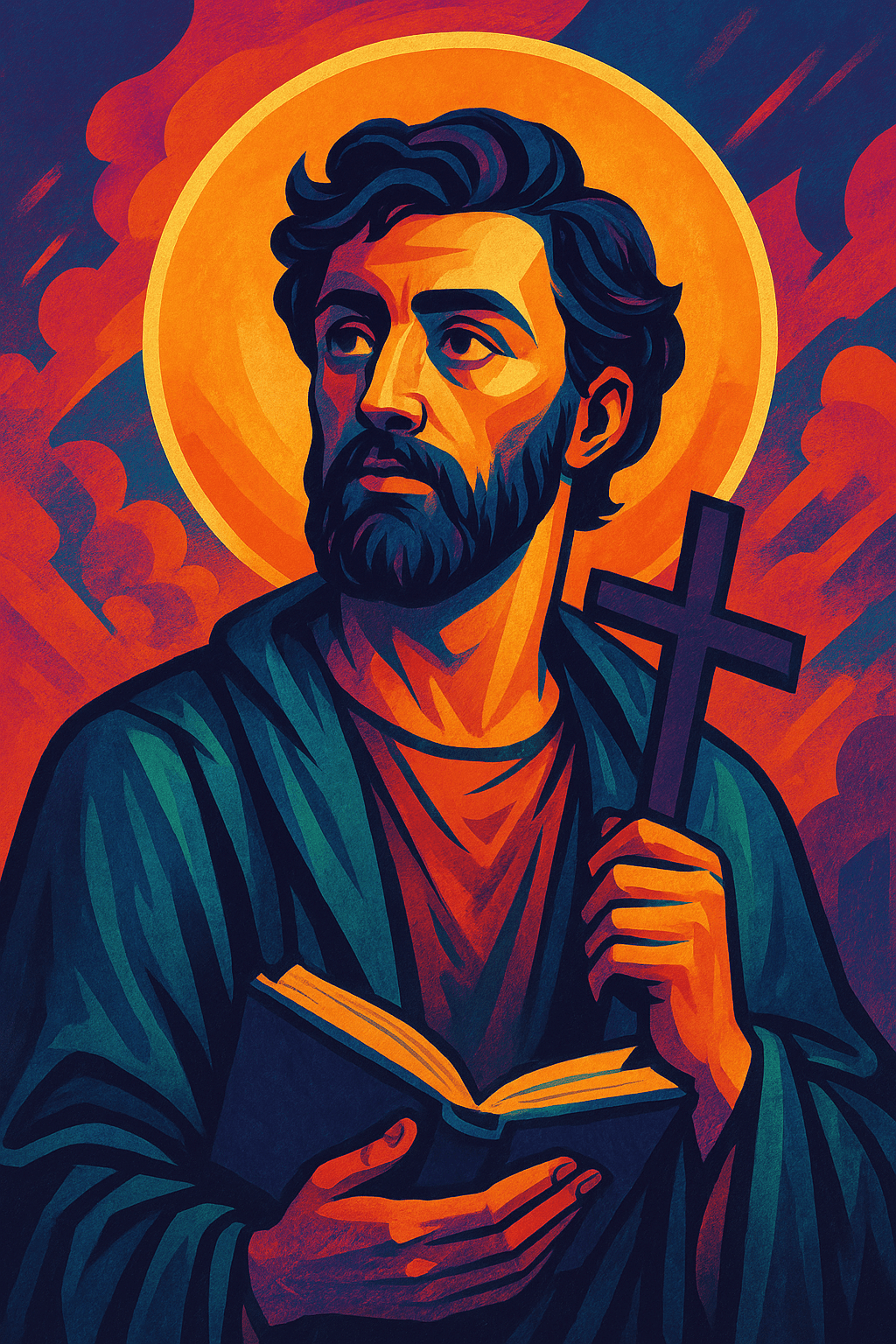
✨ A Philosopher’s Witness
In the early centuries of Christianity, when the Church was still finding her voice amid persecution and misunderstanding, God raised up a man whose sharp intellect and unwavering faith would echo through time. Saint Apollonius the Apologist was not a man of visions or miracles in the traditional sense. He didn’t retreat into the wilderness or receive divine apparitions. Instead, he stood boldly in the heart of the Roman Empire, testifying to Christ with the tools of logic, rhetoric, and reason. A Roman senator by vocation and a philosopher by formation, Saint Apollonius embraced the faith with such profound conviction that he was willing to risk, and ultimately give, his life rather than renounce the truth of the Gospel.
His significance lies not only in his martyrdom but in how he chose to meet it—with a written and verbal defense of Christianity that would earn him the title of “Apologist.” Though the original text of his defense has been lost, early Christian writers like Saint Jerome and Eusebius of Caesarea praised it as a work of exceptional wisdom and clarity. He is remembered in the Roman Martyrology on April 18, and his witness reminds us that sanctity and intellect are not opposites—they are partners in the pursuit of Truth who is Christ Himself.
🕯 From the Senate to the Cross
Though much of Saint Apollonius’s early life is shrouded in mystery, what we do know paints a picture of a man deeply rooted in the cultural and intellectual life of second-century Rome. Born into a noble family, Apollonius rose through the ranks of society to become a respected Roman senator. This role would have placed him at the very center of political power, surrounded by philosophers, lawmakers, and elite thinkers of the time. In this world, Christianity was still considered a subversive and dangerous sect, a threat to the stability and traditions of the empire.
It is unclear exactly when Apollonius encountered the Gospel, but it is believed that he converted as an adult, likely through the quiet, courageous witness of other Christians or perhaps through his own philosophical inquiry into the nature of truth and justice. Christianity offered what pagan philosophy could not: not just a code of ethics, but the revelation of God made flesh in Jesus Christ. Once Apollonius embraced this truth, he refused to keep it hidden. Instead, he allowed it to transform every aspect of his life—including his very public role in Roman society.
What makes him truly extraordinary is that he did not run from persecution, nor did he hide his beliefs to preserve his reputation or safety. When accused of being a Christian—a capital offense at the time—Apollonius composed a formal apologia, a defense of the Christian faith grounded in philosophy, theology, and natural law. He presented this defense not with arrogance or anger, but with calm dignity, trusting that the truth of the Gospel could stand on its own. This profound act of witness reveals the depth of his conviction: that Christ was worth not only living for, but also dying for.
🌟 Reasoned Faith
Saint Apollonius is not remembered for healing the sick or raising the dead, but for something equally powerful: the miracle of a mind totally surrendered to the truth of Christ. His greatest miracle was his ability to speak the wisdom of God in a way that could pierce even the most skeptical hearts. When he stood before the Roman authorities, he did not plead for mercy or attempt to escape the charges. Instead, he used the moment as an opportunity to proclaim Christ crucified and risen.
Though we have lost the full text of his defense, accounts from early Church historians describe it as a brilliant synthesis of Christian doctrine and classical philosophy. Apollonius argued for the immortality of the soul, the futility of idolatry, and the coherence of Christian morality. He did so not just with persuasive logic, but with a heart aflame for God. This union of faith and intellect is itself a grace—a divine empowerment that allowed him to speak with clarity and courage under the threat of death.
This recalls the promise of our Lord in the Gospel of Matthew:
“Do not worry about how you are to speak or what you are to say; for what you are to say will be given to you in that hour.” (Matthew 10:19)
The Church teaches in the Catechism of the Catholic Church that “Faith and reason are like two wings on which the human spirit rises to the contemplation of truth” (CCC 159). In Apollonius, these two wings were fully spread, lifting him toward the eternal glory he would soon enter.
⚔️ The Final Defense
The courage of Saint Apollonius is all the more striking given the circumstances of his arrest. It was not an outsider or enemy who betrayed him, but one of his own household slaves. Under Roman law, being a Christian was a criminal offense. When his slave reported his faith to the authorities, Apollonius was summoned to appear before a tribunal. Rather than deny the accusation, he prepared a written defense and stood before the Roman Senate—a body of men who had the power to end his life—with serenity and resolve.
In his defense, he explained the rationality of Christian belief and the profound hope it offered. He pointed to the moral excellence of Christian life and the absurdity of idol worship. He made a case for the resurrection of the dead, grounding his arguments in both reason and divine revelation. Even some members of the Senate, it is said, were impressed by his words.
Nevertheless, the law demanded that Christians must either renounce their faith or die. Apollonius chose the cross. Some accounts suggest he was beheaded; others say he was subjected to a cruel form of torture in which his legs were crushed—a method reserved for traitors and those deemed enemies of the state. In any case, he met his death with dignity, echoing the words of Saint Paul:
“For to me, to live is Christ and to die is gain.” (Philippians 1:21)
His martyrdom reveals that even in the heart of political power, where truth is often twisted by convenience, the Word of God remains sharper than any two-edged sword.
🌹 A Legacy that Speaks Louder Than Death
Though the Church does not record dramatic healings or visions associated with the relics of Saint Apollonius, the miracle of his legacy continues to bear fruit. His courage, his eloquence, and his willingness to suffer for the truth have inspired generations of apologists, scholars, and saints. The early Church Fathers referred to him with deep respect, and his memory was preserved not through spectacular signs, but through the testimony of those who saw in him the light of Christ.
His relics were honored in Rome, and though the exact site of his burial has been lost to time, his witness lives on in every believer who dares to speak the name of Jesus in a hostile world. Churches and altars were later dedicated in his honor, and his feast day continues to be a quiet yet powerful reminder that martyrdom does not always roar—it sometimes reasons.
The Church honors him not only as a martyr, but as an apologist—a man who gave a defense for the hope that was within him (cf. 1 Peter 3:15). The Catechism teaches us that such witnesses are not merely historical figures, but part of the living communion of saints, interceding for us and strengthening us in our own trials (CCC 956).
✨ A Mind and Heart on Fire
Saint Apollonius teaches us that faith is not opposed to reason, and that the Gospel is not just for the heart but also for the intellect. His life challenges us to engage our culture with clarity and charity, never backing down from the truth, but always speaking it with love. In a world that often prizes comfort over conviction and relativism over reason, his example calls us to something higher: a life shaped by truth, even when it costs us everything.
In practical terms, we can follow his lead by deepening our knowledge of the faith. Reading The Catechism, studying Scripture, and learning from the writings of the saints and Doctors of the Church all help form our minds for Christ. When we encounter challenges to our beliefs, we are called not to retreat, but to respond with thoughtful, loving clarity—just as Apollonius did.
Let us not be afraid to ask questions, seek understanding, and speak the truth in love. Whether we are in the boardroom, the classroom, or around the dinner table, we are called to be apologists in our own way: not combative, but compassionate; not defensive, but devoted.
Let us remember the words of Saint Paul, which surely lived in the heart of Apollonius:
“I am not ashamed of the Gospel, for it is the power of God for salvation to everyone who believes.” (Romans 1:16)
💬 Engage with Us!
We’d love to hear from you! How does the story of Saint Apollonius inspire you? What challenges do you face when trying to defend your faith?
Reflection Questions:
How can I better prepare myself to give a reason for my hope in Christ, like Saint Apollonius did?
Am I willing to defend my faith even when it’s unpopular or inconvenient?
How do I balance compassion and clarity when speaking about the truths of the Catholic faith?
Let’s support one another in this journey of faith. And remember—whatever we do, let’s strive to do it with love, just as our Lord Jesus did.

 Holy Manna!
Leave a comment