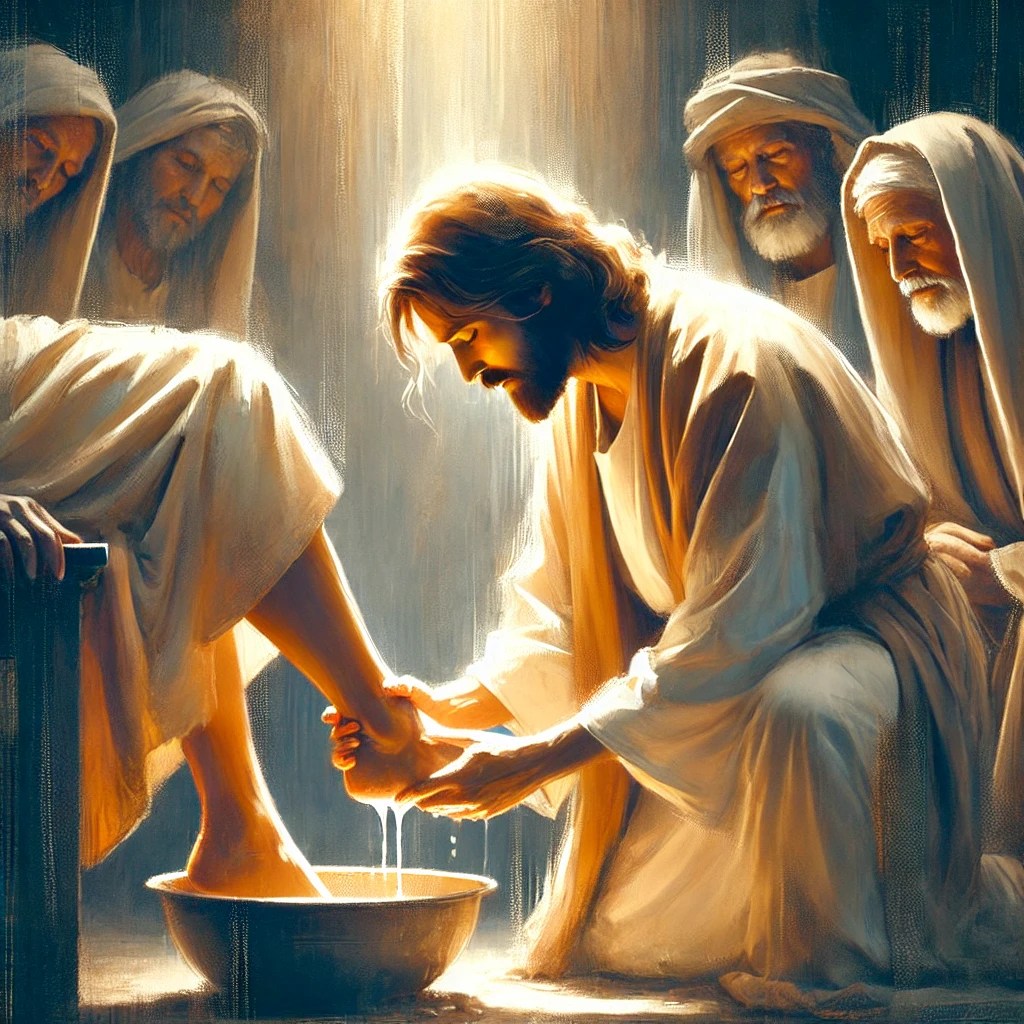
The Lamb, the Table, and the Towel
Have you ever been so deeply loved that it made you uncomfortable? A love so humble, so sacrificial, so unearned, that all you could do was sit in stunned silence? Today’s readings take us straight into the heart of that kind of love—a love that bleeds, that kneels, that feeds, and that saves.
On this holy night—the beginning of the Paschal Triduum—the Church draws our eyes to the institution of two sacraments: the Eucharist and Holy Orders. In Exodus, we hear of the first Passover, when God commanded the Israelites to sacrifice a spotless lamb and mark their doorposts with its blood, so that death might pass them over. This was more than a rescue mission from Egypt; it was the beginning of a new identity as God’s chosen people, bound together by covenant and sacrifice. Fast forward to the First Letter to the Corinthians, and we find St. Paul passing on what he “received from the Lord”—the institution of the Eucharist, where Jesus becomes the true and eternal Paschal Lamb, offering His Body and Blood for the salvation of the world.
Then, in a move that would have stunned His disciples, Jesus kneels to wash their feet in The Gospel of John. The Master becomes the servant. The Teacher stoops low. It is here that the mystery of the Eucharist is made visible in action: self-giving love. Christ does not only feed us with His life—He shows us how to live ours. As we step into the sacred space of Holy Thursday, we are invited not just to remember what He has done, but to be transformed by it. What does it mean for you that the Lamb of God would kneel at your feet?
First Reading – Exodus 12:1–8
Marked by the Blood of the Lamb
The Book of Exodus is a cornerstone of salvation history, detailing God’s powerful liberation of the Israelites from slavery in Egypt. At the heart of this deliverance is the institution of the Passover—a sacred ritual that not only saves God’s people from the angel of death but also redefines their identity as His covenant family. Chapter 12 marks a turning point where divine instruction becomes a communal act of obedience, worship, and memory. The ritual of the lamb, the blood, and the meal is more than symbolic—it is life-preserving. This first Passover directly prefigures the Paschal Mystery of Christ, making it a crucial foundation for understanding the Eucharist, which is the central theme of today’s liturgy. The blood on the doorposts, the roasted lamb, and the unleavened bread all point forward to Jesus, the true Lamb of God, who gives Himself in the New Covenant meal. Exodus 12 invites us to see God’s saving action in history not as a distant event, but as a present and eternal reality fulfilled in Christ.
Exodus 12:1-8
New American Bible (Revised Edition)
The Passover Ritual Prescribed. 1 The Lord said to Moses and Aaron in the land of Egypt: 2 This month will stand at the head of your calendar; you will reckon it the first month of the year. 3 Tell the whole community of Israel: On the tenth of this month every family must procure for itself a lamb, one apiece for each household. 4 If a household is too small for a lamb, it along with its nearest neighbor will procure one, and apportion the lamb’s cost in proportion to the number of persons, according to what each household consumes. 5 Your lamb must be a year-old male and without blemish. You may take it from either the sheep or the goats. 6 You will keep it until the fourteenth day of this month, and then, with the whole community of Israel assembled, it will be slaughtered during the evening twilight. 7 They will take some of its blood and apply it to the two doorposts and the lintel of the houses in which they eat it. 8 They will consume its meat that same night, eating it roasted with unleavened bread and bitter herbs.
Detailed Exegesis
Verse 1 – “The Lord said to Moses and Aaron in the land of Egypt:”
This verse emphasizes divine initiative. God speaks directly to His appointed leaders, marking this moment as the beginning of a divine rescue mission. Salvation is not the product of human strategy—it is God’s response to covenantal love and mercy.
Verse 2 – “This month will stand at the head of your calendar; you will reckon it the first month of the year.”
God resets the Hebrew calendar around this salvific event. Time itself becomes reoriented to redemption. Just as Christians center time around the Resurrection (celebrating Sunday as the Lord’s Day), the Israelites now define their identity by the God who delivers.
Verse 3 – “Tell the whole community of Israel: On the tenth of this month every family must procure for itself a lamb, one apiece for each household.”
The lamb is central to the Passover—not as a symbol only, but as a living sacrifice. This act draws every family into direct participation in salvation. It’s a foretaste of the personal nature of the Eucharist, where Christ, the Lamb, is received by each believer.
Verse 4 – “If a household is too small for a lamb, it along with its nearest neighbor will procure one, and apportion the lamb’s cost in proportion to the number of persons, according to what each household consumes.”
This inclusion reflects God’s justice and mercy. No one is to be left out. The Passover is not a private event but a communal one, foreshadowing the Church’s call to unity in Christ, where the Eucharist is shared with all who believe.
Verse 5 – “Your lamb must be a year-old male and without blemish. You may take it from either the sheep or the goats.”
A lamb “without blemish” is essential for the sacrifice. This prefigures Jesus, who is sinless and pure, the perfect offering. “You were ransomed…with the precious blood of Christ, like that of a lamb without blemish or spot” (1 Peter 1:18–19).
Verse 6 – “You will keep it until the fourteenth day of this month, and then, with the whole community of Israel assembled, it will be slaughtered during the evening twilight.”
The timing and collective nature of the sacrifice point toward liturgical worship. Christ too was crucified as the Passover Lamb during twilight, uniting His death with this ancient sign.
Verse 7 – “They will take some of its blood and apply it to the two doorposts and the lintel of the houses in which they eat it.”
Blood is the sign of life and covenant. Applying it to the doorposts turns the home into a sacred space—marked for life and protected from death. This act is echoed in the sign of the Cross, marking us with the blood of Christ at baptism and every Mass.
Verse 8 – “They will consume its meat that same night, eating it roasted with unleavened bread and bitter herbs.”
This sacrificial meal must be consumed, just as Christ commands us to eat His Body and drink His Blood. The unleavened bread recalls the haste of deliverance, and the bitter herbs the pain of slavery—reminders of both suffering and hope.
Teachings
The Catechism of the Catholic Church clearly connects the Passover to the mystery of Christ’s sacrifice. “By celebrating the Last Supper with his apostles in the course of the Passover meal, Jesus gave the Jewish Passover its definitive meaning. Jesus’ passing over to his Father by his death and Resurrection, the new Passover, is anticipated in the Supper and celebrated in the Eucharist” (CCC 1340). This shows how the old covenant ritual finds its fulfillment in the new covenant liturgy. The Passover is not abolished, but transformed—its deepest meaning revealed in Christ.
St. Augustine famously taught that “the New is hidden in the Old and the Old is fulfilled in the New” (Quaest. in Hept. 2, 73). The blood of the lamb in Exodus is not merely a historical protection—it is a prophetic sign pointing to the Cross. As the Israelites were saved by the blood on the wood of their doorframes, so we are saved by the blood on the wood of the Cross. The bitter herbs reflect the bitterness of slavery, just as Lent prepares us through penance to receive Easter joy. These connections are not coincidental; they reveal the mind and providence of God throughout salvation history.
Historically, the Passover meal was not only a remembrance but also a renewal. Each time the Israelites celebrated it, they entered into the same saving act of God. In this way, it prefigures the Eucharist, where, as the Church teaches, we are not merely recalling Christ’s sacrifice—we are made present to it. “In the liturgy of the Church, it is principally his own Paschal mystery that Christ signifies and makes present” (CCC 1085). The Mass is therefore not just a symbol but a real participation in Christ’s once-for-all sacrifice.
Reflection
This reading calls us to contemplate what it truly means to be people marked by the blood of the Lamb. Are we living as if we belong to God—set apart, redeemed, and called to remember Him through every aspect of our lives? The Israelites were saved not only by believing but by obeying—by preparing the lamb, marking their homes, and eating the meal. In the same way, our faith is lived out through visible acts: attending Mass, receiving the Eucharist, and loving our neighbor.
What parts of your life still need to be marked by Christ’s blood—your work, your relationships, your time? This Holy Week, we are invited not just to observe but to participate. We are called to prepare our hearts as a dwelling place for the Lord, just as the Israelites prepared their homes. Are you making space in your life for the Lamb to dwell? Are you helping others find their place at the table?
To be redeemed is not to be rescued into comfort, but into covenant. And covenant means commitment. Let this reading remind us that our salvation came at a cost—the blood of the spotless Lamb—and that this gift calls for a response of gratitude, obedience, and love.
Responsorial Psalm – Psalm 116:12–18
A Cup of Salvation, A Life of Gratitude
Psalm 116 is part of the Hallel psalms (Psalms 113–118), traditionally sung during Jewish feasts, particularly the Passover. This liturgical context is essential: it would have been on Jesus’ lips at the Last Supper, the night He instituted the Eucharist and washed His disciples’ feet. The psalmist, overwhelmed by the Lord’s goodness and deliverance, offers praise and vows of loyalty. Its personal tone of thanksgiving beautifully mirrors the communal gratitude of Israel during the first Passover, and also prefigures the Church’s ongoing response to Christ’s saving love in the Eucharist. On this Holy Thursday, this psalm becomes our own: an offering of praise, a vow to serve, and a call to recognize that everything we are and have flows from divine mercy.
Psalm 116:12-18
New American Bible (Revised Edition)
12 How can I repay the Lord
for all the great good done for me?
13 I will raise the cup of salvation
and call on the name of the Lord.
14 I will pay my vows to the Lord
in the presence of all his people.
15 Dear in the eyes of the Lord
is the death of his devoted.
16 Lord, I am your servant,
your servant, the child of your maidservant;
you have loosed my bonds.
17 I will offer a sacrifice of praise
and call on the name of the Lord.
18 I will pay my vows to the Lord
in the presence of all his people,
Detailed Exegesis
Verse 12 – “How can I repay the Lord for all the great good done for me?”
This verse sets the tone for the entire psalm—a heart humbled by God’s mercy. The question is rhetorical: there is no way to repay the infinite grace of salvation. Instead of repayment, the psalmist points us toward thanksgiving and worship. This is the heart of the Eucharist, which literally means “thanksgiving.”
Verse 13 – “I will raise the cup of salvation and call on the name of the Lord.”
This “cup of salvation” evokes liturgical imagery. In Jewish tradition, four cups of wine were raised during the Passover meal, symbolizing God’s promises of redemption. Jesus reinterprets this during the Last Supper, saying: “This cup is the new covenant in my blood” (1 Corinthians 11:25). To raise the cup is to receive salvation and proclaim God’s deliverance.
Verse 14 – “I will pay my vows to the Lord in the presence of all his people.”
Here, worship is not a private act but a public declaration. In ancient Israel, fulfilling a vow often involved a sacrificial offering in the Temple. Today, our vows—whether baptismal promises or personal commitments—are fulfilled in the life of the Church, through participation in the sacraments and active discipleship.
Verse 15 – “Dear in the eyes of the Lord is the death of his devoted.”
This tender verse reveals God’s intimate concern for His faithful ones. The word “devoted” implies a covenantal relationship, and the death of such a one is not meaningless but precious. In the context of Holy Thursday, it anticipates the Passion, reminding us that Christ’s death—and the martyrdom of the saints—is infinitely valuable in the eyes of God.
Verse 16 – “Lord, I am your servant, your servant, the child of your maidservant; you have loosed my bonds.”
The psalmist claims his identity not just as a follower, but as a servant—an echo of Mary’s words: “I am the handmaid of the Lord” (Luke 1:38). The phrase “loosed my bonds” speaks to liberation from sin and suffering, evoking both the Exodus and the personal freedom found in Christ.
Verse 17 – “I will offer a sacrifice of praise and call on the name of the Lord.”
This verse reflects the transition from temple sacrifices to offerings of the heart. Hebrews 13:15 affirms this shift: “Through him then let us continually offer a sacrifice of praise to God, that is, the fruit of lips that confess his name.” Praise becomes the true and fitting response to God’s mercy.
Verse 18 – “I will pay my vows to the Lord in the presence of all his people.”
This final repetition reinforces the communal dimension of faith. The spiritual life is never solitary—we fulfill our promises to God in the presence of His people, just as Jesus offered Himself in the presence of His disciples at the Last Supper.
Teachings
The Catechism teaches us that the Eucharist is the Church’s supreme act of thanksgiving and worship. “The Eucharist is an act of thanksgiving to God. The very word ‘Eucharist’ means thanksgiving. The Eucharist is also the sacrifice of praise by which the Church sings the glory of God in the name of all creation” (CCC 1360–1361). This psalm beautifully captures that spirit of gratitude. The question, “How can I repay the Lord?”, is not a cry of debt but of love. It reminds us that liturgy is our joyful response to God’s faithfulness.
St. Irenaeus writes, “The glory of God is man fully alive, and the life of man is the vision of God” (Against Heresies, Book 4, 20, 7). To live in gratitude and praise is to be truly alive. In the Eucharist, Christ gives Himself fully, and in response, we give our lives in service. As the psalmist declares, “I am your servant… you have loosed my bonds”, we remember that true freedom is found in serving the Lord who sets us free.
Historically, early Christians sang psalms like this one during their gatherings, often inserting them into Eucharistic prayers. It is significant that this psalm may have been sung by Jesus Himself on Holy Thursday night before entering Gethsemane. His offering—the “cup of salvation”—was not metaphorical but deeply literal. He drank it for love of us, and now invites us to share in that same cup, offering our lives in thanksgiving.
Reflection
This psalm is a call to remember and respond. Are you living a life of gratitude, or has routine dulled your awareness of what God has done for you? The cup of salvation is not just for the altar—it is for your daily life. Every moment, every relationship, every trial is a chance to raise the cup and call on the name of the Lord. What does it look like for you to “offer a sacrifice of praise” today—through your time, your service, your words?
When we gather for the Eucharist, we are not just remembering the past—we are entering into the saving mystery of Christ made present again. Like the psalmist, we are invited to say: “I will pay my vows to the Lord in the presence of all his people”. This means living out our baptismal promises, being faithful to our vocations, and proclaiming with our lives that God is good.
How will you live differently today because of what Christ has done for you? Let this psalm awaken in your heart a deeper hunger for praise, for worship, and for a life poured out in joyful response to the One who drank the cup for our salvation.
Second Reading – 1 Corinthians 11:23–26
This Is My Body: The Heartbeat of the Church
In this deeply sacred passage from 1 Corinthians, St. Paul brings us directly into the Upper Room, echoing the very words of Jesus at the Last Supper. Paul is not introducing a new concept but reaffirming a tradition he himself received. The early Christian community in Corinth was struggling with divisions and a misunderstanding of the Eucharist—treating it more like a common meal than the sacrament of Christ’s self-giving love. Paul’s correction is both pastoral and doctrinal. By recalling the institution narrative, he centers their focus back on Christ’s sacrificial offering, tying them—and us—into the eternal mystery of salvation. This text is foundational to the Church’s Eucharistic theology and fits seamlessly into Holy Thursday’s theme, where Jesus gives us not only a meal, but His very self.
1 Corinthians 11:23-26
New American Bible (Revised Edition)
Tradition of the Institution. 23 For I received from the Lord what I also handed on to you, that the Lord Jesus, on the night he was handed over, took bread, 24 and, after he had given thanks, broke it and said, “This is my body that is for you. Do this in remembrance of me.” 25 In the same way also the cup, after supper, saying, “This cup is the new covenant in my blood. Do this, as often as you drink it, in remembrance of me.” 26 For as often as you eat this bread and drink the cup, you proclaim the death of the Lord until he comes.
Detailed Exegesis
Verse 23 – “For I received from the Lord what I also handed on to you, that the Lord Jesus, on the night he was handed over, took bread,”
Paul’s opening line emphasizes apostolic tradition: “I received… I handed on”. These words establish a sacred chain of transmission rooted in Christ Himself. The phrase “on the night he was handed over” draws attention to Jesus’ betrayal, underscoring that His gift of self happened not in comfort, but in sorrow. Yet even in the shadow of the Cross, Jesus institutes the sacrament of unity and love.
Verse 24 – “and, after he had given thanks, broke it and said, ‘This is my body that is for you. Do this in remembrance of me.’”
This verse contains the heart of Eucharistic theology. The Greek word for “given thanks” is eucharisteō, from which we get the word Eucharist. Jesus gives thanks even as He offers His own body. The phrase “This is my body” is not metaphorical—it is literal. The Church has always affirmed the Real Presence: that in the Eucharist, Jesus is truly, substantially present. The command “Do this in remembrance of me” is not mere recollection but a liturgical re-presentation of the one sacrifice of Christ.
Verse 25 – “In the same way also the cup, after supper, saying, ‘This cup is the new covenant in my blood. Do this, as often as you drink it, in remembrance of me.’”
The cup symbolizes the covenant, just as in Exodus, blood sealed the old covenant. Now Jesus offers His own blood to establish a new and eternal covenant. His command to drink the cup emphasizes active participation. Every time we celebrate the Eucharist, we are drawn into this covenant anew, made part of Christ’s Body and mission.
Verse 26 – “For as often as you eat this bread and drink the cup, you proclaim the death of the Lord until he comes.”
The Eucharist is not only communion—it is proclamation. We witness to Christ’s Passion every time we participate in the liturgy. This verse also contains an eschatological hope: we remember the past, receive grace in the present, and await His return in glory. The Mass spans all of time in a single act of love.
Teachings
The Catechism teaches: “The Eucharist is the memorial of Christ’s Passover, that is, of the work of salvation accomplished by the life, death, and resurrection of Christ, a work made present by the liturgical action” (CCC 1409). This means that the Eucharist is not simply a symbol of Christ’s sacrifice—it is that sacrifice, made mysteriously and truly present. Through Paul’s recounting in 1 Corinthians, we receive a window into this early and unbroken belief of the Church.
St. John Chrysostom, a Doctor of the Church, wrote, “When you see the Lord sacrificed and lying before you, and the priest standing and praying over the victim, and all the people empurpled with that precious blood, can you think that you are still among men and on earth?” (Homily 3 on the Treachery of Judas). This awe-filled vision reveals the cosmic significance of every Mass. The Eucharist is heaven touching earth, the eternal entering time, love poured out in visible form.
The early Church Fathers, such as St. Ignatius of Antioch, affirmed this same truth in the first century. He warned against those who “abstain from the Eucharist and from prayer because they do not confess that the Eucharist is the flesh of our Savior Jesus Christ” (Letter to the Smyrnaeans, 6:2). Paul’s account to the Corinthians reflects the earliest understanding of the Church: the Eucharist is Christ—body, blood, soul, and divinity. To participate is to proclaim the mystery of faith.
Reflection
This passage confronts us with a profound question: Do I truly believe in the mystery I receive? The Eucharist is not a routine, a symbol, or a tradition—it is Jesus, offering Himself to you. Every Mass is a personal encounter with the God who gives His Body “for you.” How would your participation in the liturgy change if you fully grasped the gift before you?
This also challenges us to reflect: Am I living as someone bound by the New Covenant? Receiving the Body and Blood of Christ is not just a privilege—it is a responsibility. We are called to proclaim His death, to make visible His love through our lives. Are you proclaiming His sacrifice in the way you serve, forgive, and sacrifice for others?
As you approach the altar this Holy Thursday and every Mass that follows, let your heart echo Christ’s words: “This is my body, given for you.” Then go and live those words—offering yourself in love, in memory of Him, until He comes again.
Holy Gospel – John 13:1–15
The Towel and the Table: Love That Kneels
The Gospel of John offers a profoundly intimate portrait of Jesus during His final hours with His disciples. Unlike the Synoptic Gospels, which focus on the institution of the Eucharist at the Last Supper, John highlights another deeply Eucharistic act: the washing of the feet. In doing so, he reveals not only what Jesus did for us but how we are to live in imitation of Him. In first-century Jewish culture, washing feet was the task of the lowest servant—certainly not the role of a rabbi or master. And yet, Jesus deliberately performs this act on the eve of His Passion, not just as a lesson in humility, but as a sacrament of service. On this Holy Thursday, as we contemplate the Eucharist and Christ’s sacrificial love, John reminds us that love without action is empty. The Lord who gives Himself in the bread and wine also stoops to wash our feet. How will we respond to such love?
John 13:1-15
New American Bible (Revised Edition)
The Washing of the Disciples’ Feet. 1 Before the feast of Passover, Jesus knew that his hour had come to pass from this world to the Father. He loved his own in the world and he loved them to the end. 2 The devil had already induced Judas, son of Simon the Iscariot, to hand him over. So, during supper, 3 fully aware that the Father had put everything into his power and that he had come from God and was returning to God, 4 he rose from supper and took off his outer garments. He took a towel and tied it around his waist. 5 Then he poured water into a basin and began to wash the disciples’ feet and dry them with the towel around his waist. 6 He came to Simon Peter, who said to him, “Master, are you going to wash my feet?” 7 Jesus answered and said to him, “What I am doing, you do not understand now, but you will understand later.” 8 Peter said to him, “You will never wash my feet.” Jesus answered him, “Unless I wash you, you will have no inheritance with me.” 9 Simon Peter said to him, “Master, then not only my feet, but my hands and head as well.” 10 Jesus said to him, “Whoever has bathed has no need except to have his feet washed, for he is clean all over; so you are clean, but not all.” 11 For he knew who would betray him; for this reason, he said, “Not all of you are clean.”
12 So when he had washed their feet [and] put his garments back on and reclined at table again, he said to them, “Do you realize what I have done for you? 13 You call me ‘teacher’ and ‘master,’ and rightly so, for indeed I am. 14 If I, therefore, the master and teacher, have washed your feet, you ought to wash one another’s feet. 15 I have given you a model to follow, so that as I have done for you, you should also do.
Detailed Exegesis
Verse 1 – “Before the feast of Passover, Jesus knew that his hour had come to pass from this world to the Father. He loved his own in the world and he loved them to the end.”
This verse sets the emotional and theological tone for the passage. The phrase “his hour had come” signals the beginning of Jesus’ Passion. But the focus is not on fear or suffering—it’s on love. “He loved them to the end” (Greek: eis telos) can mean both to the utmost and to completion, signifying perfect, total, self-giving love.
Verse 2 – “The devil had already induced Judas, son of Simon the Iscariot, to hand him over.”
Here, the drama intensifies. Love and betrayal exist side by side at the table. Even as Jesus prepares to wash the feet of His betrayer, the narrative reminds us that God’s love persists in the face of evil. Christ’s actions are not naive—they are deliberate.
Verse 3 – “Fully aware that the Father had put everything into his power and that he had come from God and was returning to God,”
Jesus’ humility is underscored by His divinity. He acts not out of weakness but with full knowledge of His identity and mission. This divine self-awareness makes His actions even more astonishing—true power reveals itself in loving service.
Verse 4 – “He rose from supper and took off his outer garments. He took a towel and tied it around his waist.”
Every movement here is symbolic. Rising from the table, stripping His garments, and tying a servant’s towel—all of it is a foreshadowing of His Passion, where He will be stripped and crucified. Jesus doesn’t just serve; He becomes the servant.
Verse 5 – “Then he poured water into a basin and began to wash the disciples’ feet and dry them with the towel around his waist.”
This act was shocking. Feet, considered unclean and lowly, were the last part of the body a rabbi would touch. Yet Christ embraces the lowest task, pointing to the deeper cleansing He will provide through His death.
Verse 6 – “He came to Simon Peter, who said to him, ‘Master, are you going to wash my feet?’”
Peter’s question is filled with confusion and discomfort. He recognizes the inversion of roles and doesn’t understand how the Messiah could stoop so low.
Verse 7 – “Jesus answered and said to him, ‘What I am doing, you do not understand now, but you will understand later.’”
This verse highlights the mystery of divine action. Often, God’s ways are veiled in the moment but made clear in hindsight. Peter’s full understanding will come after the Resurrection and Pentecost.
Verse 8 – “Peter said to him, ‘You will never wash my feet.’ Jesus answered him, ‘Unless I wash you, you will have no inheritance with me.’”
Peter’s resistance reflects our own difficulty in accepting grace. But Jesus reveals that this washing is essential—it’s not just a gesture, it’s a condition of communion. To receive Christ’s love, we must allow ourselves to be served by Him.
Verse 9 – “Simon Peter said to him, ‘Master, then not only my feet, but my hands and head as well.’”
Peter swings from resistance to overzealousness. Yet his desire is sincere—he wants full participation in Christ. His response shows a heart that, though confused, longs for communion.
Verse 10 – “Jesus said to him, ‘Whoever has bathed has no need except to have his feet washed, for he is clean all over; so you are clean, but not all.’”
This verse distinguishes between justification and ongoing sanctification. The disciples are generally clean, but continual cleansing—symbolized by the washing of feet—is necessary. It reminds us of the sacrament of Reconciliation, which renews our baptismal grace.
Verse 11 – “For he knew who would betray him; for this reason, he said, ‘Not all of you are clean.’”
Even as He serves, Jesus is aware of Judas’ betrayal. His love does not exclude the sinner; rather, it reaches out even more tenderly. This is the tragedy of rejected grace.
Verse 12 – “So when he had washed their feet and put his garments back on and reclined at table again, he said to them, ‘Do you realize what I have done for you?’”
Jesus transitions from action to explanation. The disciples have witnessed a shocking act, but now He invites them to reflect—to internalize the meaning of His humble love.
Verse 13 – “‘You call me ‘teacher’ and ‘master,’ and rightly so, for indeed I am.’”
Jesus affirms His authority even as He models service. He is not abdicating His role; He is redefining leadership as service. True greatness is found in humility.
Verse 14 – “‘If I, therefore, the master and teacher, have washed your feet, you ought to wash one another’s feet.’”
This is the command at the heart of Christian discipleship: to love as Christ loves. Service is not optional—it is the defining mark of a follower of Jesus.
Verse 15 – “‘I have given you a model to follow, so that as I have done for you, you should also do.’”
Jesus leaves no ambiguity. He sets the pattern. The Eucharist is not complete without a life of service. We are called not just to receive Christ but to become like Him.
Teachings
The Catechism reminds us that “The Eucharist commits us to the poor. To receive in truth the Body and Blood of Christ given up for us, we must recognize Christ in the poorest” (CCC 1397). This teaching comes alive in John 13, where Jesus, the Bread of Life, also becomes the servant of all. The Eucharist is not isolated worship—it demands an ethical response: to wash one another’s feet.
St. Teresa of Calcutta lived this Gospel with radical clarity. She wrote, “The Eucharist and the poor are inseparable. To love Jesus in the Eucharist is to serve Him in the poor.” Her life was a continual washing of feet—a living tabernacle of service. This Gospel demands we connect our worship to real action: feeding the hungry, forgiving those who wrong us, lifting the burdens of others.
Pope Benedict XVI emphasized this in Deus Caritas Est: “A Eucharist which does not pass over into the concrete practice of love is intrinsically fragmented” (DCE 14). Jesus washing His disciples’ feet is not a break from theology—it is theology incarnate. It is what the Eucharist looks like when lived. To receive Christ and not become like Him is to miss the point.
Reflection
This Gospel asks us a deeply personal question: Whose feet are you being called to wash? It might not be literal, but it could be just as humbling—apologizing first, serving someone difficult, listening without judgment. Are you willing to stoop low in love, or are there places where pride still reigns?
Do you let Jesus wash your feet, or do you resist His love? Like Peter, we may feel unworthy. But unless we allow Christ to serve us, we cannot serve others in His name. This Holy Thursday, let Him kneel at your feet—not because you deserve it, but because He desires it.
To follow Christ means to take up the towel as well as the Cross. What would it look like if your home, your work, your parish became places where foot washing—humble, hidden acts of love—was the norm? Let tonight be the beginning of that transformation. Let the towel and the table define your discipleship.
Feast and Footsteps: Living the Love We Receive
Tonight, Love Speaks in Sacrifice and Silence
Holy Thursday draws us into the most sacred mysteries of our faith—not through thunder or spectacle, but through bread broken, wine poured, and feet washed. In Exodus, we see the first Passover, the beginning of God’s covenantal love—a people saved by the blood of a spotless lamb. In Psalm 116, that deliverance becomes a song of gratitude, a commitment to serve and praise the God who saves. In 1 Corinthians, St. Paul reminds us that every time we receive the Eucharist, we proclaim the Lord’s death until He comes again. And in John’s Gospel, Jesus kneels—not only as a teacher, but as a servant—giving us a model of love that stoops, serves, and sacrifices.
These readings converge in the heart of the Eucharist, where Christ, the true Lamb, offers Himself for our salvation and teaches us to do the same. “This is my body… this is my blood” is more than a liturgical formula—it is a call to live lives poured out in love. “I have given you a model to follow, so that as I have done for you, you should also do” is not a suggestion—it is our vocation. Tonight is not just a remembrance of what Jesus did. It is an invitation to become what we receive.
So, how will you respond to this love? Will you let Him wash your feet? Will you lift the burdens of your neighbor? Will you let the table lead you to the towel? As we enter the Triduum, let us not leave this night unchanged. Let us raise the cup of salvation in thanksgiving, receive the Lamb in reverence, and walk the path of humble love. The altar becomes our sending place. The towel becomes our mission. Go, then—love like He loved, serve like He served, and remember: the world will believe in the Gospel not by our words alone, but by the way we kneel.
Engage with Us!
We’d love to hear how today’s readings touched your heart. Share your thoughts, prayers, or experiences in the comments below—your reflection might inspire someone else on their journey of faith. Let’s walk together through these holy days, drawing strength from God’s Word and one another.
Reflection Questions:
First Reading – Exodus 12:1–8
What does it mean for you to be “marked by the blood of the Lamb”? How can you live more intentionally as part of God’s covenant family today?
Responsorial Psalm – Psalm 116:12–18
How do you express gratitude to God in your daily life? What “sacrifice of praise” is God inviting you to offer in this season?
Second Reading – 1 Corinthians 11:23–26
Do you truly believe in the Real Presence of Christ in the Eucharist? How does receiving the Body and Blood of Christ change the way you live your everyday life?
Holy Gospel – John 13:1–15
Whose feet is God calling you to wash—perhaps figuratively, perhaps literally? How can you embrace a life of service, modeled after Jesus’ example?
Let these questions guide your prayer and action this Holy Thursday. Live a life marked by the Eucharist, poured out in gratitude and humble love. And remember: every act of mercy, every gesture of service, and every quiet “yes” to God is a step on the path Jesus walked first—for you. Do everything today with the love and mercy He has taught us.
Follow us on Instagram and Facebook for more insights and reflections on living a faith-filled life.

 Holy Manna!
Leave a comment