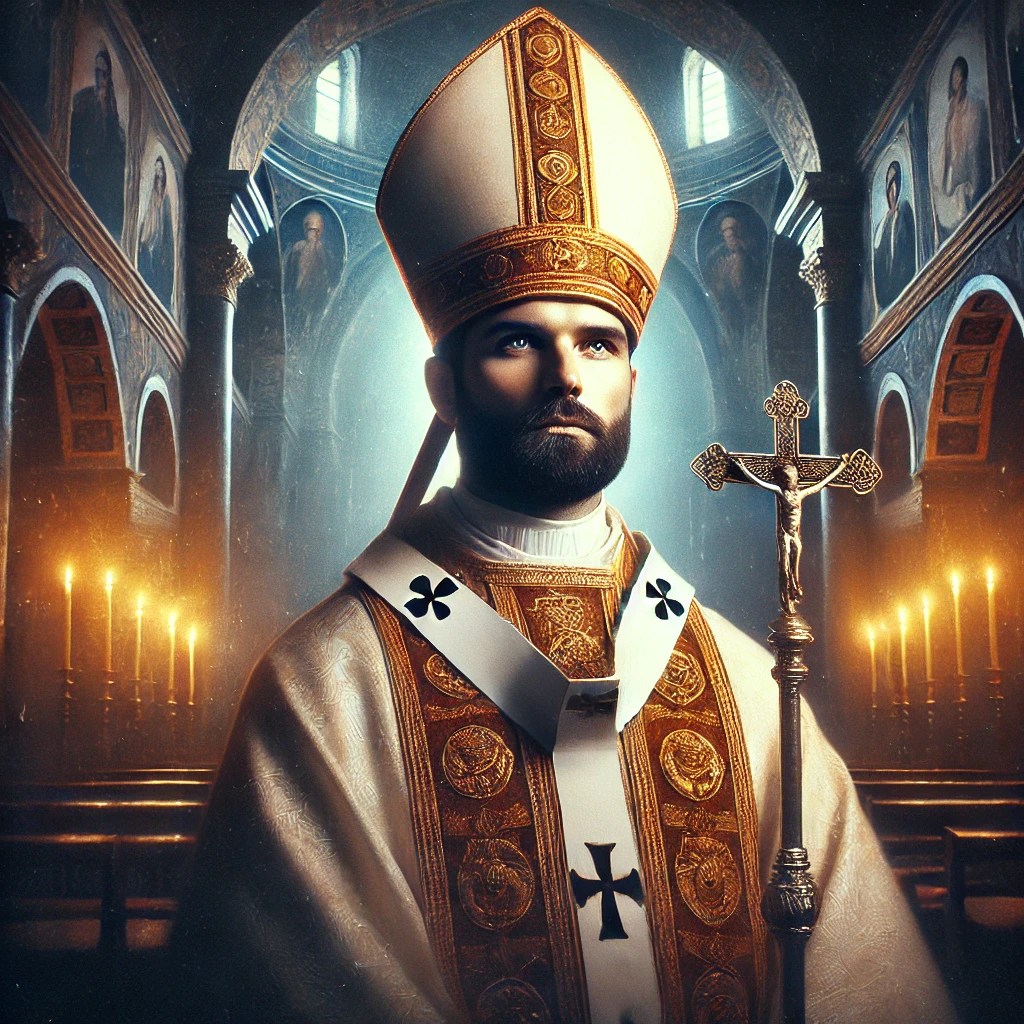
Defender of Two Wills, Witness to One Faith
A Shepherd Who Would Not Be Silent
In the long line of popes who have guided the Church through storms of heresy and persecution, Pope Saint Martin I stands out as a beacon of fearless fidelity to Christ. As the last pope to be officially venerated as a martyr by the Church, his legacy is one of profound courage, doctrinal clarity, and sacrificial love for the truth. His refusal to compromise on the nature of Christ’s will—even under threat from the Byzantine emperor himself—marks him as a heroic defender of the faith during a time when the unity of the Church was under assault. Through suffering and exile, he bore witness to the fullness of the Incarnation, declaring by word and deed that Jesus Christ is true God and true man, with both a divine and a human will.
From Tuscany to the Chair of Peter
Born in Todi, a town in central Italy, around the late 6th century, Martin came from a noble and devout Christian family. From his youth, he was known for his piety, intellectual brilliance, and a heart attuned to the needs of the poor. Martin entered the service of the Church early, eventually becoming a deacon under Pope Theodore I. His abilities earned him an assignment as papal apocrisiarius—or ambassador—to Constantinople. There, he was exposed to the theological debates raging across the Christian world, particularly the growing influence of Monothelitism, a heresy claiming that Christ had only one will.
When Martin was elected pope in 649 AD, he stepped into a Church already grappling with immense political pressure from the Eastern Empire to conform to this erroneous teaching. Unwilling to let error gain ground, Pope Martin I boldly convened the Lateran Council of 649, which condemned Monothelitism and reaffirmed the truth that Christ has two wills—human and divine—in accordance with the decisions of the Council of Chalcedon. This affirmation wasn’t just academic; it was a defense of the mystery of the Incarnation, the very heart of Christian faith.
A Bold Voice Silenced but Not Broken
There are no recorded miracles performed by Pope Saint Martin I during his lifetime, but perhaps the greatest miracle was his steadfast endurance in the face of imperial tyranny. His entire papacy was marked by spiritual fortitude and clarity of doctrine—a miracle in its own right during such a politically fraught period. His leadership at the Lateran Council—held without imperial approval—was an act of profound courage and spiritual discernment.
In an age when emperors expected popes to submit to state power, Martin modeled the truth that the Church is not subordinate to earthly rulers. His words, teachings, and the council he convened strengthened the Church’s theological foundation for centuries to come. As Saint Paul reminds us in 2 Timothy 4:7, “I have fought the good fight, I have finished the race, I have kept the faith.” Martin’s very life was an echo of this testimony.
Exile for the Truth
Martin’s bold defiance of the emperor did not go unanswered. In 653 AD, agents of Emperor Constans II kidnapped him from the Lateran Palace in Rome. He was forcibly taken to Constantinople, where he suffered public ridicule, harsh imprisonment, and was denied even the basic necessities of life. He was condemned without trial and treated as a criminal for holding fast to Catholic doctrine. Reports say he was paraded in chains, left to languish in filthy dungeons, and denied medical care.
Still, Martin remained unshaken. In his letters from exile, we see a man utterly surrendered to God’s will. He never accused his captors with bitterness but continued to pray for the Church and to strengthen his brothers and sisters in the faith. Ultimately, he was exiled to the remote region of Cherson (modern-day Crimea), where the cold, hunger, and disease ravaged his already weakened body. Yet he remained joyful in Christ, even in affliction. He died on September 16, 655, exhausted by persecution but radiant in faith. His martyrdom was not bloody but no less real, marked by a slow suffering offered in union with Christ.
Grace Flows from the Grave
While no singular posthumous miracle defines the veneration of Pope Saint Martin I, the witness of his life became a source of spiritual renewal across the Church. His tomb in Cherson became a quiet place of pilgrimage, especially in the Eastern Churches that also recognized his sanctity. Over time, his example inspired bishops and laypeople alike to resist heresies and political pressures that sought to compromise the faith.
The Catechism of the Catholic Church reminds us in paragraph 957 that: “Being more closely united to Christ, those who dwell in heaven fix the whole Church more firmly in holiness… They do not cease to intercede with the Father for us.” Pope Saint Martin I, though largely hidden in death, continues to intercede for the Church, especially for those who suffer for proclaiming the truth in hostile environments.
Faith that Defies the World
The life of Pope Saint Martin I challenges us to ask: What are we willing to suffer for the truth? In an age when the Church is often pressured to dilute or soften her teachings, Martin’s witness reminds us that charity and clarity must go hand in hand. He teaches us that fidelity to Christ is worth more than comfort or approval and that the path of the cross, though difficult, is filled with grace.
In our daily lives, we are invited to stand with courage in our own small ways—by defending the faith with kindness, living with integrity, and refusing to compromise the Gospel for convenience. Pope Martin’s story invites us to listen more deeply to the will of God in our lives and to trust that no suffering is wasted when it is united to Christ’s.
What areas of your life call for greater courage in the face of pressure?
How can you defend your faith lovingly in a world that may not understand it?
What does it mean to you that Christ has both a human and divine will? How does this deepen your relationship with Him?
Let us ask Pope Saint Martin I to pray for us, that we may be bold witnesses to the truth, tender in love, and unwavering in faith.
Engage with Us!
We invite you to share your thoughts and reflections in the comments below. Here are some questions to ponder:
- How can we find the strength to stand firm in our beliefs when faced with opposition?
- In what ways can we balance obedience to authority with adherence to our personal convictions?
- How does the example of Pope Saint Martin I inspire you to live out your faith more fully?
Let us support one another in our faith journeys, striving to act with love and integrity, following the example of our Lord Jesus Christ.

 Holy Manna!
Leave a comment