A Love That Chooses Suffering
There is a holy tension that lives in the heart of Palm Sunday—a paradox of glory and grief, of hosannas and heartbreak. Today’s readings invite us to walk with Jesus from the heights of adoration to the depths of rejection, not merely as observers but as disciples called to follow in His footsteps. What does it mean that the same crowd who shouted “Blessed is the king” would, days later, cry “Crucify him”? This day opens Holy Week with a vivid portrayal of a King who enters not on a war horse, but on a colt, and who reigns not from a golden throne, but from a wooden cross.
At the heart of every reading today is a single, unshakable theme: glory through humility and redemptive suffering. From the Gospel of Luke’s triumphant procession to the Passion narrative, from Isaiah’s prophecy of the suffering servant to Paul’s hymn of Christ’s kenosis—His self-emptying—each passage reveals a Messiah who willingly embraces suffering out of love and obedience. This is not accidental pain; it is chosen. As The Catechism reminds us, “The cross is the unique sacrifice of Christ, the ‘one mediator between God and men’” (CCC 618). And in that sacrifice, we discover the radical logic of divine love: humility is strength, and death leads to resurrection.
Culturally and liturgically, Palm Sunday is a bridge between Lent and Holy Week—a day that mirrors our own human complexity. In ancient Jewish tradition, Passover was a time of liberation, a remembering of God’s saving power. Jesus enters Jerusalem during this sacred time, not to overthrow Rome, but to free hearts from sin. The crowds expect a political Messiah, but Jesus reveals something far greater: a suffering servant whose Kingdom is not of this world. As you journey through today’s readings, where do you find yourself—among the cheering crowd, the sleeping disciples, the weeping women, or the penitent thief?
Procession with Palms– Holy Gospel: Luke 19:28–40
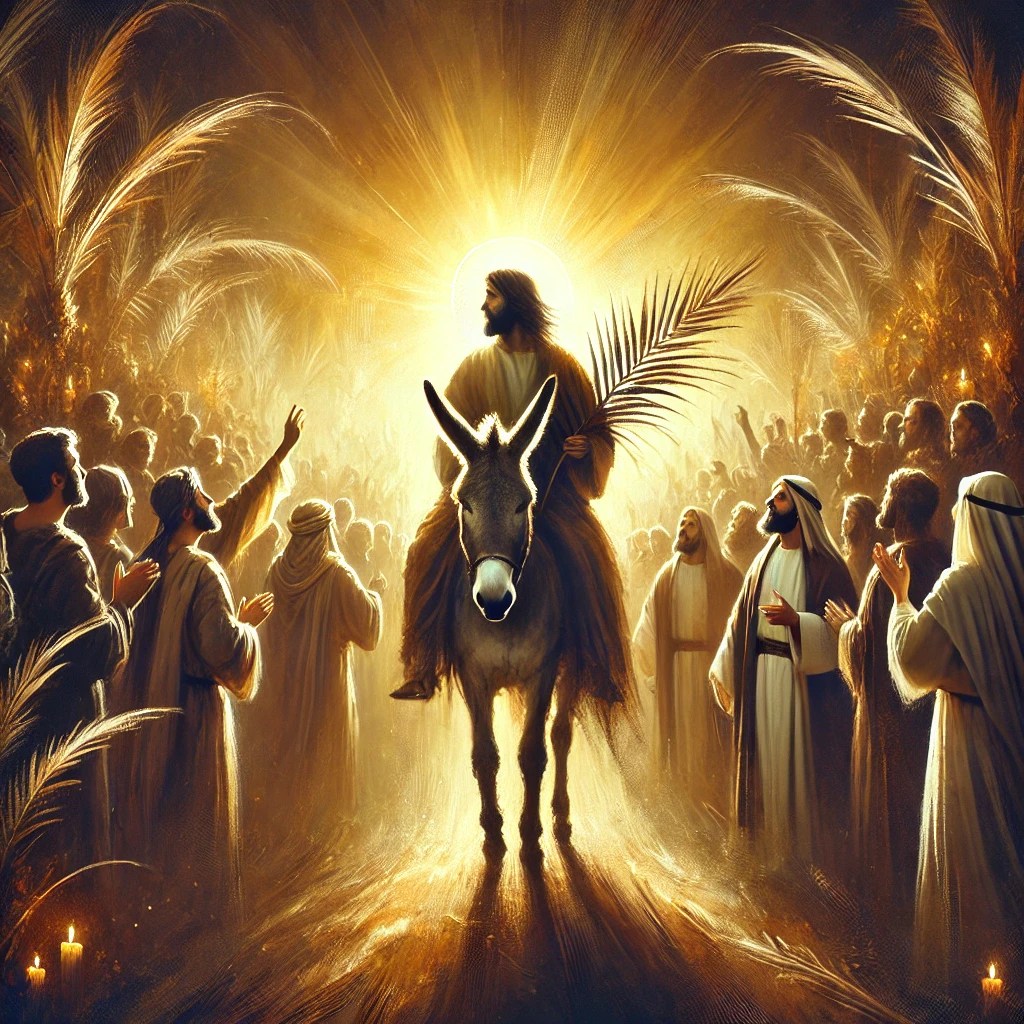
The King Who Rides a Donkey
Today’s procession with palms opens The Gospel of Luke’s account of Jesus’ final journey into Jerusalem, an event rich in prophetic symbolism and royal irony. This passage marks the beginning of Holy Week, when Jesus is hailed as a king by the crowds yet knows the cross awaits Him. In Jewish culture, this moment echoes the triumphal entries of kings and messianic hopes rooted in the Old Testament, particularly Zechariah 9:9, which proclaims: “Rejoice greatly, O daughter Zion! Shout aloud, O daughter Jerusalem! Lo, your king comes to you; triumphant and victorious is he, humble and riding on a donkey.” The choice of a donkey, rather than a chariot or warhorse, signifies not conquest but peace. This moment is deeply liturgical, echoing pilgrimages to Jerusalem during Passover, when Jewish people celebrated God’s deliverance. Here, Jesus becomes the new Paschal Lamb, entering the Holy City not to receive glory, but to give Himself as a sacrifice.
Luke 19:28-40
New American Bible (Revised Edition)
28 After he had said this, he proceeded on his journey up to Jerusalem. 29 As he drew near to Bethphage and Bethany at the place called the Mount of Olives, he sent two of his disciples. 30 He said, “Go into the village opposite you, and as you enter it you will find a colt tethered on which no one has ever sat. Untie it and bring it here. 31 And if anyone should ask you, ‘Why are you untying it?’ you will answer, ‘The Master has need of it.’” 32 So those who had been sent went off and found everything just as he had told them. 33 And as they were untying the colt, its owners said to them, “Why are you untying this colt?” 34 They answered, “The Master has need of it.” 35 So they brought it to Jesus, threw their cloaks over the colt, and helped Jesus to mount. 36 As he rode along, the people were spreading their cloaks on the road; 37 and now as he was approaching the slope of the Mount of Olives, the whole multitude of his disciples began to praise God aloud with joy for all the mighty deeds they had seen. 38 They proclaimed:
“Blessed is the king
who comes in the name of the Lord.
Peace in heaven
and glory in the highest.”
39 Some of the Pharisees in the crowd said to him, “Teacher, rebuke your disciples.” 40 He said in reply, “I tell you, if they keep silent, the stones will cry out!”
Detailed Exegesis
Verse 28 – “After he had said this, he proceeded on his journey up to Jerusalem.”
This signals a dramatic shift in Jesus’ ministry. “Up to Jerusalem” is both geographical and theological—Jerusalem is elevated physically and spiritually as the city of the Temple and the site of God’s covenantal fulfillment. Jesus’ journey is purposeful, pointing toward the cross.
Verse 29 – “As he drew near to Bethphage and Bethany at the place called the Mount of Olives, he sent two of his disciples.”
The Mount of Olives is a significant location tied to messianic expectation (cf. Zechariah 14:4). Jesus acts with intentionality, orchestrating events that fulfill Scripture.
Verse 30 – “He said, ‘Go into the village opposite you, and as you enter it you will find a colt tethered on which no one has ever sat. Untie it and bring it here.’”
The colt signifies purity and sacred purpose. An unridden animal was often reserved for holy use. Jesus is identifying Himself with the fulfillment of messianic prophecy (cf. Genesis 49:11; Zechariah 9:9).
Verse 31 – “And if anyone should ask you, ‘Why are you untying it?’ you will answer, ‘The Master has need of it.’”
The phrase “The Master has need of it” reveals Jesus’ authority and the providential nature of this moment. Even the smallest detail is foreseen and under divine control.
Verse 32 – “So those who had been sent went off and found everything just as he had told them.”
This affirms Jesus’ prophetic knowledge and His divine identity. Nothing is left to chance—He is fulfilling the will of the Father.
Verse 33 – “And as they were untying the colt, its owners said to them, ‘Why are you untying this colt?’”
The questioning mirrors the preparation for a sacred ritual. Ownership is acknowledged, but divine purpose overrides earthly claims.
Verse 34 – “They answered, ‘The Master has need of it.’”
The response is simple and profound. When the Lord has need of something—or someone—there is no higher claim.
Verse 35 – “So they brought it to Jesus, threw their cloaks over the colt, and helped Jesus to mount.”
Cloaks placed on the colt indicate reverence, a gesture of enthronement. Jesus is being treated as royalty, yet this is a humble coronation.
Verse 36 – “As he rode along, the people were spreading their cloaks on the road.”
A customary act to honor a king, this is a spontaneous liturgy of praise. It recalls the enthronement of Jehu in 2 Kings 9:13.
Verse 37 – “As he was approaching the slope of the Mount of Olives, the whole multitude of his disciples began to praise God aloud with joy for all the mighty deeds they had seen.”
This moment is charged with messianic expectation. The disciples’ joy flows from the miracles and teachings of Jesus, now culminating in what they hope is His earthly reign.
Verse 38 – “They proclaimed: ‘Blessed is the king who comes in the name of the Lord. Peace in heaven and glory in the highest.’”
This echoes Psalm 118, a hymn sung during Jewish pilgrimages. It connects Jesus to liturgical tradition and divine mission. “Peace in heaven” reflects the heavenly dimension of His kingship, a reversal of the angelic proclamation at His birth: “Glory to God in the highest and on earth peace” (Luke 2:14).
Verse 39 – “Some of the Pharisees in the crowd said to him, ‘Teacher, rebuke your disciples.’”
Religious leaders resist this messianic fervor. They fear political consequences and reject the divine identity being celebrated.
Verse 40 – “He said in reply, ‘I tell you, if they keep silent, the stones will cry out!’”
Creation itself recognizes its Creator. Jesus affirms that this moment of praise is divinely ordained—unstoppable and cosmic in scope.
Teachings
The Catechism of the Catholic Church teaches that Jesus’ entry into Jerusalem manifests the coming of the Kingdom He had preached: “Jesus’ entry into Jerusalem manifested the coming of the kingdom that the Messiah-King, welcomed into His city by children and the humble of heart, was going to accomplish by the Passover of His Death and Resurrection” (CCC 560). This moment is not mere pageantry; it is theologically loaded with the mystery of redemption. Jesus is simultaneously welcomed and on His way to being rejected, foreshadowing the paradox of the Cross.
St. Andrew of Crete, in his Homily on Palm Sunday, writes: “Let us run to accompany Him as He hastens toward His Passion, and imitate those who met Him then…not by covering His path with garments or palms, but by doing all we can to prostrate ourselves before Him by being humble and by trying to live as He would wish.” This ancient insight reminds us that liturgy is not only expressed in external rites, but in internal transformation. Jesus’ kingship demands our obedience and humility.
Historically, Palm Sunday developed in the early Church as both a reenactment and a proclamation. By the fourth century, pilgrims in Jerusalem began to commemorate Jesus’ entry by walking the same path, waving palm branches. The Church enshrined this tradition to prepare believers for the mystery of the Passion. It is not just a moment of triumph, but of deep invitation—to walk with Christ all the way to Calvary. “Take up your cross and follow me” (cf. Luke 9:23) becomes more than metaphor; it is the path of true discipleship.
Reflection
This reading challenges us to consider: What kind of king do we expect Jesus to be in our lives? Are we willing to embrace a Messiah who chooses humility over dominance, suffering over success? In our culture, greatness is often equated with visibility, acclaim, and power. But Jesus redefines greatness as service, surrender, and sacrificial love. Are we laying our cloaks down in genuine surrender, or merely going through the motions of praise?
Practically, this passage calls us to enter Holy Week with intentionality. We can begin by identifying the “colts” in our lives—the things the Lord “has need of” that we are called to untie and offer. Whether it’s our time, talents, resources, or trust, the King approaches gently and asks for our cooperation. We are not passive observers of salvation history but participants. What can you lay down at the feet of Christ this Holy Week? Let your actions proclaim what your lips cry today: “Blessed is the king who comes in the name of the Lord!”
First Reading: Isaiah 50:4–7
The Courage to Suffer: The Servant’s Silent Strength
The Book of Isaiah contains some of the most striking and profound prophecies of the Old Testament, especially the “Servant Songs,” which foretell a figure who would suffer on behalf of others. Today’s passage, taken from the third of these Servant Songs, is a prophetic glimpse into the heart and mission of Christ. Written during or shortly after the Babylonian exile, Isaiah 50 speaks to a people who have known humiliation, defeat, and despair. But it also introduces a mysterious figure—the obedient servant—who suffers not as punishment, but as part of God’s redemptive plan. This passage aligns seamlessly with Palm Sunday’s theme: glory through humility and redemptive suffering. Before Jesus carries the Cross, before He is mocked and spat upon, Isaiah paints the portrait of one who listens, obeys, and does not turn away. In this Servant, we see the very heart of Christ.
Isaiah 50:4-7
New American Bible (Revised Edition)
4 The Lord God has given me
a well-trained tongue,
That I might know how to answer the weary
a word that will waken them.
Morning after morning
he wakens my ear to hear as disciples do;
5 The Lord God opened my ear;
I did not refuse,
did not turn away.
6 I gave my back to those who beat me,
my cheeks to those who tore out my beard;
My face I did not hide
from insults and spitting.
7 The Lord God is my help,
therefore I am not disgraced;
Therefore I have set my face like flint,
knowing that I shall not be put to shame.
Detailed Exegesis
Verse 4 – “The Lord God has given me a well-trained tongue, that I might know how to answer the weary a word that will waken them. Morning after morning he wakens my ear to hear as disciples do.”
This verse introduces the Servant as one who listens and speaks with divine authority. The “well-trained tongue” suggests wisdom that comes from intimate communion with God. His words bring hope and healing to the weary, echoing Jesus’ invitation: “Come to me, all you who labor and are burdened, and I will give you rest” (Matthew 11:28). The Servant is portrayed not as a warrior but as a teacher and disciple—one who first listens to God, then speaks to others.
Verse 5 – “The Lord God opened my ear; I did not refuse, did not turn away.”
This verse describes the Servant’s free and willing obedience. In ancient Hebrew culture, to have one’s ear opened signified a readiness to serve (see Exodus 21:6). The Servant models the disposition Christ would later embody in the Garden of Gethsemane: “Not my will but yours be done” (Luke 22:42). He does not shrink from suffering but embraces it out of love and mission.
Verse 6 – “I gave my back to those who beat me, my cheeks to those who tore out my beard; my face I did not hide from insults and spitting.”
Here the Servant submits to humiliation and violence without resistance. This verse foreshadows the Passion of Christ with striking precision. The tearing out of the beard, the spitting, and the beatings mirror what Jesus endured before the Sanhedrin and Roman guards. His silence is not weakness but strength, an act of redemptive endurance.
Verse 7 – “The Lord God is my help, therefore I am not disgraced; therefore I have set my face like flint, knowing that I shall not be put to shame.”
Despite suffering, the Servant remains unshaken. “Set my face like flint” indicates unwavering determination. Jesus echoes this in Luke 9:51: “When the days for his being taken up were fulfilled, he resolutely determined to journey to Jerusalem.” The Servant’s confidence rests not in the absence of suffering but in the presence of God.
Teachings
The Catechism directly references Isaiah’s Servant Songs in its explanation of Christ’s Passion: “The Scriptures had foretold this divine plan of salvation through the putting to death of ‘the righteous one, my Servant’ as a mystery of universal redemption, that is, as the ransom that would free men from the slavery of sin” (CCC 601). This highlights how Isaiah 50 is not merely poetic lamentation, but theological revelation. The suffering of the Servant is not accidental—it is salvific.
St. Bernard of Clairvaux once wrote, “Who can describe the strength and beauty of that love which made Christ so meek in the face of insult and death?” The Servant’s humility, silence, and resilience foreshadow the passion of the Lamb of God. His suffering is transformative precisely because it is rooted in self-giving love. In the words of St. Thomas Aquinas, “To love is to will the good of the other as other.” The Servant suffers for the weary, for the lost, for the sinful—willing their redemption.
Historically, early Christians immediately recognized Jesus in the Servant Songs of Isaiah. The Church Fathers often cited these texts as proof of Jesus’ messianic identity. Justin Martyr, in his Dialogue with Trypho, proclaimed: “The very things which happened to Jesus were foretold by the prophet Isaiah… His silence before His accusers, His suffering, His healing words—these are the marks of the true Servant of God.” This deep connection between prophecy and fulfillment is what makes Palm Sunday so powerful: what was spoken in shadows is now seen in flesh and blood.
Reflection
This reading calls us to reflect on our own response to suffering and obedience. Do we allow God to “open our ear” each morning? Are we willing to speak truth to the weary and walk in humility, even when it costs us? The Servant does not avoid hardship, nor does he retaliate—he endures because he trusts in the Lord’s help. In a culture that prizes control and retaliation, the Servant offers a radically different path: one of listening, trusting, and loving even in pain.
In practical terms, we can ask: What are the “insults and spitting” we experience in our own discipleship? How do we respond to rejection, ridicule, or discomfort for the sake of the Gospel? This Holy Week, we are invited not only to remember Christ’s Passion but to enter into it. Whether through patience with others, forgiveness of wounds, or silent perseverance in trials, we can imitate the Servant’s steadfast heart.
Let us pray to have “faces set like flint,” not hardened by bitterness, but strengthened by grace. What would it look like to embrace suffering not as defeat, but as a doorway to deeper love? The Servant leads the way. Will we follow?
Responsorial Psalm: Psalm 22:8-9, 17-20, 23-24
When God Feels Far: A Song of Suffering and Trust
Psalm 22 is one of the most profound and prophetic laments in all of Scripture. Traditionally attributed to King David, it captures the raw, unfiltered cry of a suffering soul who feels abandoned by God, yet continues to hope in Him. This psalm takes on special significance in the Christian tradition because Jesus Himself quotes its opening line from the Cross: “My God, my God, why have you forsaken me?” (Matthew 27:46). It bridges the emotional depth of human anguish with the unwavering reality of divine fidelity. In the context of Palm Sunday, Psalm 22 allows us to enter into the heart of Christ’s Passion—not just as a narrative of events, but as an interior experience of desolation and faith. It fits powerfully within the theme of glory through humility and redemptive suffering, showing us that even in the darkest hour, worship is still possible.
Psalm 22:8-9, 17-20, 23-24
New American Bible (Revised Edition)
8 All who see me mock me;
they curl their lips and jeer;
they shake their heads at me:
9 “He relied on the Lord—let him deliver him;
if he loves him, let him rescue him.”
17 Dogs surround me;
a pack of evildoers closes in on me.
They have pierced my hands and my feet
18 I can count all my bones.
They stare at me and gloat;
19 they divide my garments among them;
for my clothing they cast lots.
20 But you, Lord, do not stay far off;
my strength, come quickly to help me.
23 Then I will proclaim your name to my brethren;
in the assembly I will praise you:
24 “You who fear the Lord, give praise!
All descendants of Jacob, give honor;
show reverence, all descendants of Israel!
Detailed Exegesis
Verse 8 – “All who see me mock me; they curl their lips and jeer; they shake their heads at me.”
This verse echoes the experience of Christ on Calvary, surrounded by soldiers and bystanders who ridicule Him. The gestures—curling lips, shaking heads—signify contempt. Jesus is not merely rejected; He is publicly humiliated. The verse fulfills the prophetic tone of the psalm in exact detail, reminding us that suffering for righteousness often invites scorn.
Verse 9 – “He relied on the Lord—let him deliver him; if he loves him, let him rescue him.”
This line directly mirrors the mocking words spoken to Jesus on the Cross: “He trusted in God; let Him deliver Him now if He wants Him” (Matthew 27:43). It highlights the spiritual taunt often aimed at the faithful: if God loves you, why are you suffering? The psalm gives voice to that inner struggle, yet invites us not to despair, but to deeper trust.
Verse 17 – “Dogs surround me; a pack of evildoers closes in on me. They have pierced my hands and my feet.”
This verse offers a hauntingly vivid image of physical torment. “Dogs” in biblical language often referred to Gentiles or lawless aggressors. The piercing of hands and feet has long been understood by Christians as a prophetic allusion to crucifixion, centuries before the practice became widespread. It connects the psalm directly to Jesus’ Passion.
Verse 18 – “I can count all my bones. They stare at me and gloat.”
The phrase suggests extreme emaciation and vulnerability. Jesus, stripped of His garments, is fully exposed to the crowd. There is not only physical pain, but also psychological torment—being watched and mocked in one’s weakest moment. This is suffering in full view.
Verse 19 – “They divide my garments among them; for my clothing they cast lots.”
This line is fulfilled literally in the Gospels: “They divided His garments by casting lots” (John 19:24). The cruelty of crucifixion extended to the stripping away of dignity. Jesus’ suffering is not metaphorical; it is total. Even His clothes are treated as spoils.
Verse 20 – “But you, Lord, do not stay far off; my strength, come quickly to help me.”
Despite the overwhelming anguish, the psalmist still calls upon the Lord. This verse reveals the hinge of hope in the psalm—a turn from complaint to trust. It affirms that God is still the source of strength, even when His presence feels distant.
Verse 23 – “Then I will proclaim your name to my brethren; in the assembly I will praise you.”
A shift occurs here—from lament to liturgy. The psalmist, having endured suffering, looks forward to a time of communal praise. This anticipates the resurrection and the Church’s mission to proclaim Christ. Suffering is not the end of the story.
Verse 24 – “You who fear the Lord, give praise! All descendants of Jacob, give honor; show reverence, all descendants of Israel!”
The psalm concludes with a call to worship. The faithful are summoned to honor God, not just for deliverance, but for His presence in the midst of pain. It is a declaration that God is worthy of praise even before the resolution arrives.
Teachings
The Catechism speaks to this mystery of Christ’s suffering, explaining that Jesus’ cry on the Cross reveals the depth of His solidarity with us: “In the redeeming love that always united him to the Father, he assumed us in the state of our waywardness to the point that he could say in our name from the cross: ‘My God, my God, why have you forsaken me?’” (CCC 603). Psalm 22 becomes not just a cry from Jesus, but a cry with us and for us. It dignifies human anguish by placing it in the heart of divine love.
St. Augustine, reflecting on this psalm, wrote: “He who was both God and man has transformed our lament into praise by taking our suffering upon Himself.” The Church Fathers often saw Psalm 22 as the bridge between the Old and New Covenants. It begins in agony and ends in glory—just like Holy Week. This duality reinforces our Palm Sunday theme: Jesus is enthroned not in spite of the Cross, but through it.
Historically, Psalm 22 has shaped the Church’s liturgy, particularly during Holy Week. Its lines are interwoven into the Passion narratives, the Stations of the Cross, and even the prayers of the saints. The psalm’s movement from desolation to worship mirrors the paschal mystery—the passage from death into life. “By His wounds, we are healed” (Isaiah 53:5) becomes the lens through which we understand this powerful song of suffering.
Reflection
This psalm invites us into a deeply personal place: What do we do when God feels far? When our prayers are met with silence or our pain feels pointless? Like Jesus, we can pray the words of Psalm 22, not as hopeless victims but as beloved children who know the Father’s heart. The psalm gives us permission to be honest in our pain and yet remain anchored in hope.
In your daily life, take time to pray with this psalm when facing trials. Let its verses be your prayer when you cannot find your own words. Where in your life have you felt mocked, abandoned, or pierced? Can you find God even in that darkness? Let the arc of the psalm—from suffering to praise—remind you that God never abandons His children. Our wounds, when united to Christ’s, become sources of grace and healing.
So let us not be afraid to bring our brokenness before the Lord this Holy Week. What would it look like for you to proclaim God’s name in the assembly even before your deliverance arrives? That is faith. That is love. That is the psalm of the crucified and risen Christ.
Second Reading: Philippians 2:6–11
The Descent That Lifted the World
Few passages in Scripture capture the mystery of Christ’s Passion and exaltation as powerfully as this hymn from Paul’s Letter to the Philippians. Written while Paul was in prison, this second reading is believed by many scholars to be an early Christian hymn—a liturgical treasure of the first-century Church. It poetically narrates the trajectory of Christ: His divine pre-existence, His humility in becoming man, His obedient suffering, and His glorious exaltation. Within the context of Palm Sunday, it serves as a theological anchor. While the crowd sees a humble king entering Jerusalem, Paul unveils the cosmic significance: Jesus is not just a prophet or teacher—He is God who “emptied himself,” becoming a servant to save us. The passage perfectly embodies today’s theme: glory through humility and redemptive suffering. Here, we see that the road to resurrection glory is paved with obedience, humility, and love.
Philippians 2:6-11
New American Bible (Revised Edition)
6 Who, though he was in the form of God,
did not regard equality with God something to be grasped.
7 Rather, he emptied himself,
taking the form of a slave,
coming in human likeness;
and found human in appearance,
8 he humbled himself,
becoming obedient to death,
even death on a cross.
9 Because of this, God greatly exalted him
and bestowed on him the name
that is above every name,
10 that at the name of Jesus
every knee should bend,
of those in heaven and on earth and under the earth,
11 and every tongue confess that
Jesus Christ is Lord,
to the glory of God the Father.
Detailed Exegesis
Verse 6 – “Who, though he was in the form of God, did not regard equality with God something to be grasped.”
This opening verse affirms Christ’s divinity. He exists in the “form of God”—a reference to His divine nature—but chooses not to cling to it for advantage. The Greek word harpagmon (“to be grasped”) implies something not exploited or held onto selfishly. Jesus’ divinity is expressed through generosity, not domination.
Verse 7 – “Rather, he emptied himself, taking the form of a slave, coming in human likeness; and found human in appearance.”
This is the heart of the kenosis, the self-emptying of Christ. He assumes the lowest social status—“slave”—a term that shocked Paul’s audience. He fully enters our human condition, not disguising Himself, but becoming one of us. The humility here is not play-acting; it is total identification with our fragility.
Verse 8 – “He humbled himself, becoming obedient to death, even death on a cross.”
Christ’s obedience is not abstract—it is concrete, culminating in the most shameful form of execution known in the Roman Empire. Crucifixion was reserved for the lowest of criminals. That God would endure such a death is the scandal and glory of Christianity. This verse is the climax of His descent.
Verse 9 – “Because of this, God greatly exalted him and bestowed on him the name that is above every name.”
Christ’s exaltation is the fruit of His obedience. The “name above every name” refers to the divine title “Lord” (Kyrios), a term used for God in the Greek Old Testament. His glory is not restored—it is revealed more fully through the path of suffering.
Verse 10 – “That at the name of Jesus every knee should bend, of those in heaven and on earth and under the earth.”
This is a universal declaration of sovereignty. All creation—angelic, human, and even demonic—must acknowledge His lordship. The bending of the knee reflects both worship and submission. This is the fulfillment of Isaiah 45:23, now applied to Jesus.
Verse 11 – “And every tongue confess that Jesus Christ is Lord, to the glory of God the Father.”
The final verse declares Jesus as “Lord,” the central proclamation of Christian faith. This confession, born of suffering and humility, brings glory to the Father. What began in descent ends in cosmic praise.
Teachings
The Catechism echoes this hymn when it describes Jesus’ descent as the model for Christian humility and obedience: “Jesus’ ascent to glory occurs through the cross. The exaltation of Christ involves the elevation of humanity in Him” (CCC 661). His downward movement is not defeat—it is the path of divine victory. In Him, we are lifted up.
St. Gregory of Nyssa wrote, “He lowered Himself to us in His love so that we might be raised up to Him in glory.” The Church Fathers consistently taught that the Incarnation and Passion are acts of love, not mere condescension. The humility of God in Christ is the greatest revelation of His character. As St. Catherine of Siena declared, “It was not nails that held Jesus to the Cross, but love.”
Historically, this hymn was likely sung by the early Christian community during their Eucharistic gatherings. It shaped how they saw Christ—not just as a suffering Messiah, but as one whose suffering leads to the glorification of all creation. Palm Sunday draws us into that same paradox: the King who reigns by serving, who conquers by dying, and who is exalted because He humbled Himself.
Reflection
This reading invites us to ask a deeply personal question: What in my life needs to be “emptied” so that Christ can be glorified through me? We often cling to status, control, or comfort, but Jesus shows us another way. His humility isn’t weakness—it’s power perfected in love. His obedience isn’t passive—it’s fierce fidelity to the Father’s will.
To follow Christ is to adopt His pattern of descent. How do we respond when obedience costs us something? Are we willing to embrace inconvenience, humiliation, or suffering for the sake of love? This Holy Week, we are called not merely to admire Christ’s humility, but to imitate it. That might mean asking forgiveness, serving someone we find difficult, or letting go of pride in a relationship.
Let us make this our prayer: Jesus, teach me to empty myself as You did. Give me the courage to obey the Father, even when the path leads to a cross. May my life proclaim that You are Lord, not only with my lips, but with every act of humble love.
Holy Gospel: Luke 22:14–23:56
The Silent Triumph: Love That Does Not Turn Away
The Passion narrative from The Gospel of Luke presents the climax of Jesus’ earthly ministry—a moment that is both devastating and divine. Among the four evangelists, Luke is often referred to as the “Gospel of Mercy,” and his account of the Passion is no exception. Luke emphasizes Jesus’ compassion even in the face of betrayal, suffering, and death. This Gospel was written primarily for Gentile Christians, and it reveals Jesus as the Savior of all humanity, especially the marginalized and the penitent. In Luke’s version, we find details unique to him: the healing of the servant’s ear, Jesus’ comforting words to the weeping women of Jerusalem, and His promise to the repentant thief. These scenes unveil the heart of a Messiah who offers forgiveness, dignity, and salvation even in His final hours. Today’s theme—glory through humility and redemptive suffering—is embodied here in its fullest form. In Christ’s Passion, we do not see defeat, but the hidden triumph of divine love.
Luke 22:14-23:56
New American Bible (Revised Edition)
14 When the hour came, he took his place at table with the apostles. 15 He said to them, “I have eagerly desired to eat this Passover with you before I suffer, 16 for, I tell you, I shall not eat it [again] until there is fulfillment in the kingdom of God.” 17 Then he took a cup, gave thanks, and said, “Take this and share it among yourselves; 18 for I tell you [that] from this time on I shall not drink of the fruit of the vine until the kingdom of God comes.” 19 Then he took the bread, said the blessing, broke it, and gave it to them, saying, “This is my body, which will be given for you; do this in memory of me.” 20 And likewise the cup after they had eaten, saying, “This cup is the new covenant in my blood, which will be shed for you.
The Betrayal Foretold. 21 “And yet behold, the hand of the one who is to betray me is with me on the table; 22 for the Son of Man indeed goes as it has been determined; but woe to that man by whom he is betrayed.” 23 And they began to debate among themselves who among them would do such a deed.
The Role of the Disciples. 24 Then an argument broke out among them about which of them should be regarded as the greatest. 25 He said to them, “The kings of the Gentiles lord it over them and those in authority over them are addressed as ‘Benefactors’; 26 but among you it shall not be so. Rather, let the greatest among you be as the youngest, and the leader as the servant. 27 For who is greater: the one seated at table or the one who serves? Is it not the one seated at table? I am among you as the one who serves. 28 It is you who have stood by me in my trials; 29 and I confer a kingdom on you, just as my Father has conferred one on me, 30 that you may eat and drink at my table in my kingdom; and you will sit on thrones judging the twelve tribes of Israel.
Peter’s Denial Foretold. 31 “Simon, Simon, behold Satan has demanded to sift all of you like wheat, 32 but I have prayed that your own faith may not fail; and once you have turned back, you must strengthen your brothers.” 33 He said to him, “Lord, I am prepared to go to prison and to die with you.” 34 But he replied, “I tell you, Peter, before the cock crows this day, you will deny three times that you know me.”
Instructions for the Time of Crisis. 35 He said to them, “When I sent you forth without a money bag or a sack or sandals, were you in need of anything?” “No, nothing,” they replied. 36 He said to them, “But now one who has a money bag should take it, and likewise a sack, and one who does not have a sword should sell his cloak and buy one. 37 For I tell you that this scripture must be fulfilled in me, namely, ‘He was counted among the wicked’; and indeed what is written about me is coming to fulfillment.” 38 Then they said, “Lord, look, there are two swords here.” But he replied, “It is enough!”
The Agony in the Garden. 39 Then going out he went, as was his custom, to the Mount of Olives, and the disciples followed him. 40 When he arrived at the place he said to them, “Pray that you may not undergo the test.” 41 After withdrawing about a stone’s throw from them and kneeling, he prayed, 42 saying, “Father, if you are willing, take this cup away from me; still, not my will but yours be done.” [43 And to strengthen him an angel from heaven appeared to him. 44 He was in such agony and he prayed so fervently that his sweat became like drops of blood falling on the ground.] 45 When he rose from prayer and returned to his disciples, he found them sleeping from grief. 46 He said to them, “Why are you sleeping? Get up and pray that you may not undergo the test.”
The Betrayal and Arrest of Jesus. 47 While he was still speaking, a crowd approached and in front was one of the Twelve, a man named Judas. He went up to Jesus to kiss him. 48 Jesus said to him, “Judas, are you betraying the Son of Man with a kiss?” 49 His disciples realized what was about to happen, and they asked, “Lord, shall we strike with a sword?” 50 And one of them struck the high priest’s servant and cut off his right ear. 51 But Jesus said in reply, “Stop, no more of this!” Then he touched the servant’s ear and healed him. 52 And Jesus said to the chief priests and temple guards and elders who had come for him, “Have you come out as against a robber, with swords and clubs? 53 Day after day I was with you in the temple area, and you did not seize me; but this is your hour, the time for the power of darkness.”
Peter’s Denial of Jesus. 54 After arresting him they led him away and took him into the house of the high priest; Peter was following at a distance. 55 They lit a fire in the middle of the courtyard and sat around it, and Peter sat down with them. 56 When a maid saw him seated in the light, she looked intently at him and said, “This man too was with him.” 57 But he denied it saying, “Woman, I do not know him.” 58 A short while later someone else saw him and said, “You too are one of them”; but Peter answered, “My friend, I am not.” 59 About an hour later, still another insisted, “Assuredly, this man too was with him, for he also is a Galilean.” 60 But Peter said, “My friend, I do not know what you are talking about.” Just as he was saying this, the cock crowed, 61 and the Lord turned and looked at Peter; and Peter remembered the word of the Lord, how he had said to him, “Before the cock crows today, you will deny me three times.” 62 He went out and began to weep bitterly. 63 The men who held Jesus in custody were ridiculing and beating him. 64 They blindfolded him and questioned him, saying, “Prophesy! Who is it that struck you?” 65 And they reviled him in saying many other things against him.
Jesus Before the Sanhedrin. 66 When day came the council of elders of the people met, both chief priests and scribes, and they brought him before their Sanhedrin. 67 They said, “If you are the Messiah, tell us,” but he replied to them, “If I tell you, you will not believe, 68 and if I question, you will not respond. 69 But from this time on the Son of Man will be seated at the right hand of the power of God.” 70 They all asked, “Are you then the Son of God?” He replied to them, “You say that I am.” 71 Then they said, “What further need have we for testimony? We have heard it from his own mouth.”
Chapter 23
Jesus Before Pilate. 1 Then the whole assembly of them arose and brought him before Pilate. 2 They brought charges against him, saying, “We found this man misleading our people; he opposes the payment of taxes to Caesar and maintains that he is the Messiah, a king.” 3 Pilate asked him, “Are you the king of the Jews?” He said to him in reply, “You say so.” 4 Pilate then addressed the chief priests and the crowds, “I find this man not guilty.” 5 But they were adamant and said, “He is inciting the people with his teaching throughout all Judea, from Galilee where he began even to here.”
Jesus Before Herod. 6 On hearing this Pilate asked if the man was a Galilean; 7 and upon learning that he was under Herod’s jurisdiction, he sent him to Herod who was in Jerusalem at that time. 8 Herod was very glad to see Jesus; he had been wanting to see him for a long time, for he had heard about him and had been hoping to see him perform some sign. 9 He questioned him at length, but he gave him no answer. 10 The chief priests and scribes, meanwhile, stood by accusing him harshly. 11 [Even] Herod and his soldiers treated him contemptuously and mocked him, and after clothing him in resplendent garb, he sent him back to Pilate. 12 Herod and Pilate became friends that very day, even though they had been enemies formerly. 13 Pilate then summoned the chief priests, the rulers, and the people 14 and said to them, “You brought this man to me and accused him of inciting the people to revolt. I have conducted my investigation in your presence and have not found this man guilty of the charges you have brought against him, 15 nor did Herod, for he sent him back to us. So no capital crime has been committed by him. 16 Therefore I shall have him flogged and then release him.” [17 ]
The Sentence of Death. 18 But all together they shouted out, “Away with this man! Release Barabbas to us.” 19 (Now Barabbas had been imprisoned for a rebellion that had taken place in the city and for murder.) 20 Again Pilate addressed them, still wishing to release Jesus, 21 but they continued their shouting, “Crucify him! Crucify him!” 22 Pilate addressed them a third time, “What evil has this man done? I found him guilty of no capital crime. Therefore I shall have him flogged and then release him.” 23 With loud shouts, however, they persisted in calling for his crucifixion, and their voices prevailed. 24 The verdict of Pilate was that their demand should be granted. 25 So he released the man who had been imprisoned for rebellion and murder, for whom they asked, and he handed Jesus over to them to deal with as they wished.
The Way of the Cross. 26 As they led him away they took hold of a certain Simon, a Cyrenian, who was coming in from the country; and after laying the cross on him, they made him carry it behind Jesus. 27 A large crowd of people followed Jesus, including many women who mourned and lamented him. 28 Jesus turned to them and said, “Daughters of Jerusalem, do not weep for me; weep instead for yourselves and for your children, 29 for indeed, the days are coming when people will say, ‘Blessed are the barren, the wombs that never bore and the breasts that never nursed.’ 30 At that time people will say to the mountains, ‘Fall upon us!’ and to the hills, ‘Cover us!’ 31 for if these things are done when the wood is green what will happen when it is dry?” 32 Now two others, both criminals, were led away with him to be executed.
The Crucifixion. 33 When they came to the place called the Skull, they crucified him and the criminals there, one on his right, the other on his left. 34 [Then Jesus said, “Father, forgive them, they know not what they do.”] They divided his garments by casting lots. 35 The people stood by and watched; the rulers, meanwhile, sneered at him and said, “He saved others, let him save himself if he is the chosen one, the Messiah of God.” 36 Even the soldiers jeered at him. As they approached to offer him wine 37 they called out, “If you are King of the Jews, save yourself.” 38 Above him there was an inscription that read, “This is the King of the Jews.”
39 Now one of the criminals hanging there reviled Jesus, saying, “Are you not the Messiah? Save yourself and us.” 40 The other, however, rebuking him, said in reply, “Have you no fear of God, for you are subject to the same condemnation? 41 And indeed, we have been condemned justly, for the sentence we received corresponds to our crimes, but this man has done nothing criminal.” 42 Then he said, “Jesus, remember me when you come into your kingdom.” 43 He replied to him, “Amen, I say to you, today you will be with me in Paradise.”
The Death of Jesus. 44 It was now about noon and darkness came over the whole land until three in the afternoon 45 because of an eclipse of the sun. Then the veil of the temple was torn down the middle. 46 Jesus cried out in a loud voice, “Father, into your hands I commend my spirit”; and when he had said this he breathed his last. 47 The centurion who witnessed what had happened glorified God and said, “This man was innocent beyond doubt.” 48 When all the people who had gathered for this spectacle saw what had happened, they returned home beating their breasts; 49 but all his acquaintances stood at a distance, including the women who had followed him from Galilee and saw these events.
The Burial of Jesus. 50 Now there was a virtuous and righteous man named Joseph who, though he was a member of the council, 51 had not consented to their plan of action. He came from the Jewish town of Arimathea and was awaiting the kingdom of God. 52 He went to Pilate and asked for the body of Jesus. 53 After he had taken the body down, he wrapped it in a linen cloth and laid him in a rock-hewn tomb in which no one had yet been buried. 54 It was the day of preparation, and the sabbath was about to begin. 55 The women who had come from Galilee with him followed behind, and when they had seen the tomb and the way in which his body was laid in it, 56 they returned and prepared spices and perfumed oils. Then they rested on the sabbath according to the commandment.
Detailed Exegesis
Verse 22:14 – “When the hour came, he took his place at table with the apostles.”
This verse marks the beginning of the Passion narrative with profound liturgical and theological significance. The phrase “the hour” denotes not just a chronological moment, but the moment of divine fulfillment. Jesus intentionally gathers His closest disciples for what He knows will be His final meal before His suffering and death, initiating the sacred mystery of the Eucharist.
Verse 22:15–16 – “He said to them, ‘I have eagerly desired to eat this Passover with you before I suffer, for, I tell you, I shall not eat it [again] until there is fulfillment in the kingdom of God.’”
Jesus’ words reflect both emotional intimacy and eschatological importance. His desire is not for food, but for communion with His disciples before the sacrifice. The Passover meal, which commemorated Israel’s liberation from Egypt, now becomes the foundation for a new covenant—one that offers liberation from sin and death. Jesus will not eat this meal again until the eschatological fulfillment, signifying the eternal banquet in the kingdom of God.
Verse 22:17–18 – “Then he took a cup, gave thanks, and said, ‘Take this and share it among yourselves; for I tell you [that] from this time on I shall not drink of the fruit of the vine until the kingdom of God comes.’”
The sharing of the cup symbolizes fellowship, unity, and participation in the covenant. By giving thanks and passing the cup, Jesus sanctifies this moment. His statement about not drinking the fruit of the vine again alludes to His impending death and the temporary nature of His earthly fellowship with the disciples. It also hints at the joy of the heavenly banquet to come after the Resurrection.
Verse 22:19–20 – “Then he took the bread, said the blessing, broke it, and gave it to them, saying, ‘This is my body, which will be given for you; do this in memory of me.’ And likewise the cup after they had eaten, saying, ‘This cup is the new covenant in my blood, which will be shed for you.’”
This is the institution of the Holy Eucharist, the central act of Christian worship. Jesus connects the bread and wine directly to His impending sacrifice, making it a memorial of His Passion. This is the fulfillment of the Passover in His person, not as a lamb’s blood on doorposts, but His own blood shed for all humanity.
Verse 22:21–23 – “And yet behold, the hand of the one who is to betray me is with me on the table; for the Son of Man indeed goes as it has been determined; but woe to that man by whom he is betrayed.” And they began to debate among themselves who among them would do such a deed.
Jesus reveals the betrayal is imminent and personal. Despite knowing this, He shares the table with His betrayer. The disciples’ confusion and debate show their spiritual blindness and growing fear. Yet, Jesus continues His mission with clarity and courage.
Verse 22:24–27 – “Then an argument broke out among them about which of them should be regarded as the greatest. He said to them, ‘The kings of the Gentiles lord it over them… but among you it shall not be so. Rather, let the greatest among you be as the youngest, and the leader as the servant.’”
This argument among the disciples shows their continued misunderstanding of Jesus’ mission. He redefines authority in the Kingdom as rooted in service, not status. He Himself is the model of this, being among them as one who serves—pointing to the Cross.
Verse 22:28–30 – “It is you who have stood by me in my trials; and I confer a kingdom on you… that you may eat and drink at my table in my kingdom; and you will sit on thrones judging the twelve tribes of Israel.”
Despite their flaws, Jesus honors the disciples’ loyalty. He assures them of a role in the coming Kingdom. This promise of shared kingship stands in tension with their current failures, highlighting Jesus’ mercy and the hope of transformation.
Verse 22:31–34 – “Simon, Simon, behold Satan has demanded to sift all of you like wheat, but I have prayed that your own faith may not fail; and once you have turned back, you must strengthen your brothers.” Peter said to him, ‘Lord, I am prepared to go to prison and to die with you.’ But he replied, ‘I tell you, Peter, before the cock crows this day, you will deny three times that you know me.’”
Jesus predicts Peter’s denial, yet prays for his restoration and mission. This underscores both the fragility of human faith and the power of divine intercession. Peter’s bold claim contrasts sharply with Jesus’ foreknowledge of his fall.
Verse 22:35–38 – “He said to them, ‘When I sent you forth without a money bag or a sack or sandals, were you in need of anything?’ They replied, ‘No, nothing.’ He said to them, ‘But now… one who does not have a sword should sell his cloak and buy one.’”
Jesus warns the disciples of the coming challenges. The metaphor of the sword indicates preparation, not violence. Their misunderstanding leads to a literal interpretation, showing how far they still are from grasping His way of peace.
Verse 22:39–46 – “Then going out he went, as was his custom, to the Mount of Olives, and the disciples followed him… He said to them, ‘Pray that you may not undergo the test.’… He prayed, ‘Father, if you are willing, take this cup away from me; still, not my will but yours be done.’”
In the garden, Jesus experiences deep agony, expressing the full weight of His mission. His prayer reveals both human fear and divine obedience. The disciples, meanwhile, sleep, showing their spiritual weakness at a critical moment.
Verse 22:47–53 – “While he was still speaking, a crowd approached… Judas went up to Jesus to kiss him. Jesus said to him, ‘Judas, are you betraying the Son of Man with a kiss?’… Then he touched the servant’s ear and healed him.”
The betrayal is intimate and public. A kiss, a sign of friendship, becomes the means of treachery. Jesus’ healing of the servant’s ear underscores His commitment to peace and love, even in the face of violence and betrayal.
Verse 22:54–62 – “After arresting him they led him away… Peter followed at a distance… ‘This man too was with him.’ But he denied it… ‘Before the cock crows today, you will deny me three times.’”
Peter’s denial fulfills Jesus’ prophecy. The cock’s crow and Jesus’ glance break Peter’s heart, prompting his tears of repentance. This moment illustrates the pain of failure and the hope of restoration through divine mercy.
Verse 22:63–71 – “The men who held Jesus in custody were ridiculing and beating him… ‘Are you then the Son of God?’ He replied, ‘You say that I am.’… ‘What further need have we for testimony?’”
Jesus is mocked and falsely condemned by the religious leaders. His calm affirmation of identity—“You say that I am”—reveals His strength and divine authority. Their condemnation exposes their rejection of truth and justice.
Verse 23:1–5 – “Then the whole assembly of them arose and brought him before Pilate. They brought charges against him, saying, ‘We found this man misleading our people; he opposes the payment of taxes to Caesar and maintains that he is the Messiah, a king.’”
Jesus is brought before Pilate with false political accusations. Though Pilate sees no guilt, the charges are serious enough to merit Roman attention. Jesus is falsely portrayed as a rebel against Caesar—an attempt to equate His divine kingship with political insurrection.
Verse 23:6–12 – “On hearing this Pilate asked if the man was a Galilean; and upon learning that he was under Herod’s jurisdiction, he sent him to Herod… Herod and his soldiers treated him contemptuously and mocked him… and sent him back to Pilate.”
Pilate sends Jesus to Herod to avoid responsibility. Herod, who had hoped to see a miracle, mocks Jesus instead. Jesus remains silent, fulfilling Isaiah’s prophecy of the silent Lamb. This act exposes the corruption and cowardice of political leaders.
Verse 23:13–25 – “Pilate… said to them, ‘I have not found this man guilty…’ but they kept shouting, ‘Crucify him!’… So he released the man who had been imprisoned for rebellion and murder, and handed Jesus over to them.”
Despite publicly declaring Jesus’ innocence, Pilate capitulates to the mob. The crowd chooses Barabbas, a murderer, over Jesus. This reversal underscores the tragic blindness of sin. The innocent is condemned, and the guilty goes free—foreshadowing the substitutionary nature of Christ’s death.
Verse 23:26–31 – “As they led him away they took hold of Simon, a Cyrenian… Jesus turned to them and said, ‘Daughters of Jerusalem, do not weep for me; weep instead for yourselves and for your children…’”
Simon of Cyrene is forced to carry the Cross, symbolizing the call to discipleship. Jesus’ warning to the women reflects His prophetic role. He directs their grief not to Himself but to the consequences of rejecting God’s salvation. Judgment will fall not on Him, but on Jerusalem.
Verse 23:32–38 – “When they came to the place called the Skull, they crucified him… Jesus said, ‘Father, forgive them, they know not what they do.’… Above him there was an inscription: ‘This is the King of the Jews.’”
Jesus is crucified, fulfilling His own predictions. His prayer of forgiveness exemplifies divine mercy in the face of extreme injustice. The inscription on the Cross, meant to mock, ironically reveals the truth—He is the King. The irony is intentional and theologically rich.
Verse 23:39–43 – “Now one of the criminals hanging there reviled Jesus… The other said, ‘Jesus, remember me when you come into your kingdom.’ He replied, ‘Amen, I say to you, today you will be with me in Paradise.’”
Two criminals are crucified with Jesus. One mocks, the other repents. The penitent thief makes a profound act of faith, and Jesus assures him of immediate salvation. This is the clearest example in Scripture of divine mercy granted to a soul at the moment of death.
Verse 23:44–49 – “It was now about noon and darkness came over the whole land… Jesus cried out in a loud voice, ‘Father, into your hands I commend my spirit’; and when he had said this he breathed his last.”
The darkness, the tearing of the veil, and Jesus’ final words all point to the cosmic significance of His death. Quoting Psalm 31, Jesus entrusts His spirit to the Father. The centurion’s confession affirms His innocence and divinity. The people begin to mourn, moved by what they have seen.
Verse 23:50–56 – “Now there was a virtuous and righteous man named Joseph… He took the body down, wrapped it in a linen cloth, and laid him in a rock-hewn tomb… The women who had come… saw the tomb… then they rested on the sabbath.”
Joseph of Arimathea’s act of courage gives Jesus an honorable burial. The women’s faithful observation of the tomb ensures the continuity of the Resurrection narrative. Their rest on the Sabbath shows obedience to the Law even in sorrow. The scene ends with quiet reverence, anticipating Easter dawn.
Teachings
The Catechism teaches that Christ’s Passion is the supreme expression of His love for the Father and for all humanity: “The sacrifice of Christ is unique; it completes and surpasses all other sacrifices” (CCC 614). Jesus doesn’t merely suffer—He offers Himself in love, transforming brutality into redemption. The Passion is not just an event; it is the heart of our salvation.
St. Thomas Aquinas wrote, “The Passion of Christ completely suffices to fashion our lives.” In it, we see the fullness of virtue: courage, patience, obedience, and mercy. Every moment of the Passion teaches us how to live, how to love, and how to suffer well. Jesus doesn’t just die for us—He shows us how to die to self. His silence before Pilate, His mercy on the Cross, His endurance through betrayal—these are not passive acts but heroic love.
Historically, the Church has venerated the Passion as the foundation of the liturgical year and the soul of Christian spirituality. The early Christians remembered these events not with somber nostalgia, but with Eucharistic joy. Through the Passion, death loses its sting, and suffering gains redemptive power. As St. Paul affirms: “I have been crucified with Christ; yet I live, no longer I, but Christ lives in me” (Galatians 2:20). This is not poetry—it is the path of sanctity.
Reflection
This Gospel invites us to stand at the foot of the Cross and ask: How will I respond to such love? Every character in the Passion narrative reflects a possible version of ourselves—the sleeping disciples, the denying Peter, the mocking crowd, the faithful women, the repentant thief. Which one are you today? Jesus endures betrayal, injustice, and torture without retaliation. He forgives enemies and consoles others while bearing the weight of the world. How often do we make excuses not to love when it costs us something?
In our daily lives, we are given countless opportunities to carry the cross. Sometimes it looks like staying present with a suffering friend, forgiving someone who won’t say sorry, or trusting God when everything seems uncertain. These are not small things. These are the moments where we, too, say: “Father, into your hands I commend my spirit.” This Holy Week, let us not be passive observers but engaged participants in the Passion. Let us draw near to Jesus—not just to watch Him suffer, but to suffer with Him in love.
What in your life needs to be surrendered? Where is God inviting you to respond with mercy instead of anger, silence instead of defensiveness, love instead of fear? Let the Passion be your path. Let the Cross be your guide. And let Jesus be your hope.
From Cloaks to Cross: Walking the Way of the King
Palm Sunday invites us into the sacred paradox at the heart of our faith: the King who reigns through suffering, the God who saves by serving, the Lamb who conquers by being slain. From the joyous cries of “Hosanna!” to the silent surrender of the Cross, today’s readings reveal a single, powerful truth—love is strongest when it is poured out. In Luke’s Gospel, Jesus enters Jerusalem not with armies but on a colt, embracing the path of humility and pain for our sake. In Isaiah, the Servant listens, obeys, and does not turn away from shame. Psalm 22 gives voice to agony and still ends in praise. Paul’s hymn to the Philippians tells us that Christ was exalted precisely because He emptied Himself. And in the Passion, we see love that forgives, weeps, heals, and endures—even unto death.
Each reading is a step in the journey from the waving of palms to the placing of Christ in the tomb. But this is not merely His journey—it is ours. How will we respond to the Servant who gave His back to be beaten? To the King who chose a donkey over a throne? To the Savior who still says from the Cross, “Father, forgive them”…? We are not just reading history; we are being invited to participate in a divine mystery. The Church, in her wisdom, gives us this week to walk closely with Jesus—to pray, to repent, to serve, and to love with renewed depth.
So let us not rush through Holy Week or approach it as routine. Let us place our cloaks before the Lord not just with palms, but with our lives. Let us weep for our sins, deny ourselves, and embrace the Cross He asks us to carry. Let us forgive boldly, love sacrificially, and believe fiercely—because Resurrection is coming. And for those who walk with the Crucified, the tomb is never the end.
Engage with Us!
We’d love to hear how the Word of God is speaking to your heart this Palm Sunday. What moved you? What challenged you? Where did you see yourself in the readings today? Share your reflections in the comments below and let’s journey together through this Holy Week as a community of faith, hope, and love.
Reflection Questions
Procession with Palms – Luke 19:28–40
How do you receive Jesus as King in your life today? Are there areas in your heart where you cry “Hosanna” with your lips, but resist His reign with your actions?
First Reading – Isaiah 50:4–7
How do you respond to suffering or rejection for the sake of your faith? Is your ear “opened” each morning to listen for God’s will? What might God be inviting you to hear this week?
Responsorial Psalm – Psalm 22
Have you ever felt abandoned by God? How did you continue to trust Him in the silence? What would it look like to turn your pain into praise like the psalmist?
Second Reading – Philippians 2:6–11
What is one way you can “empty yourself” this Holy Week to serve someone else? How might you embody Christ’s humility in your relationships or workplace?
Holy Gospel – Luke 22:14–23:56
Which character in the Passion do you most relate to—Peter, the good thief, the women at the Cross? Why? How is God calling you to forgive, to trust, or to love more deeply through the Passion story?
As you move through this holiest of weeks, remember that every step you take in faith, every act of love, every moment of surrender brings you closer to the heart of Christ. Let everything you do be marked by the mercy, humility, and power of the Cross. And may the God who walked to Calvary for you walk with you every step of the way.
Follow us on Instagram and Facebook for more insights and reflections on living a faith-filled life.

 Holy Manna!
Leave a comment