The Eucharistic Mystic of Catalonia
Saint Michael de Sanctis—also known as Michael of the Saints—is a lesser-known yet radiant light in the communion of saints. Though his life was short, his witness continues to inspire all those striving for deeper intimacy with Jesus Christ, especially through the Eucharist. Known for his mystical experiences during the Consecration at Mass and his strict life of prayer and penance, Saint Michael was a Discalced Trinitarian priest whose entire existence pointed to the Real Presence of Christ in the Blessed Sacrament. He is venerated not for dramatic martyrdom or grand public ministry, but for the quiet intensity of his inner life—a life that overflowed with heavenly grace. Canonized by Pope Pius IX in 1862, his feast day is celebrated on April 10. He is the patron of Eucharistic devotion, and his legacy remains especially powerful for those who hunger for deeper union with God.
From Merchant’s Apprentice to Monk of Mercy
Born Michael Argemir on September 29, 1591, in Vic, a town in Catalonia, Spain, he was raised in a devout Catholic family. After the early death of both his parents, he was entrusted to a merchant for an apprenticeship. Yet even in this setting, Michael’s heart was already turned toward heaven. He had a burning desire to emulate The Life of Saint Francis of Assisi, showing signs of penitence, detachment, and compassion well beyond his years. At the tender age of twelve, he asked to join the Trinitarian Friars in Barcelona, a religious order founded to ransom Christian captives from Muslim lands.
Three years later, he made his profession at the Monastery of St. Lambert in Zaragoza. Though already deeply committed, Michael felt called to even greater austerity. Seeking a more radical life of poverty and spiritual rigor, he transferred to the Discalced Trinitarians, a reformed branch of the order. His studies took him to Seville and Salamanca, where he prepared for the priesthood and eventually became known for both his academic seriousness and mystical spirituality. He later served as superior of the monastery in Valladolid, leading not with ambition, but with deep humility and charity.
Ecstasies at the Altar
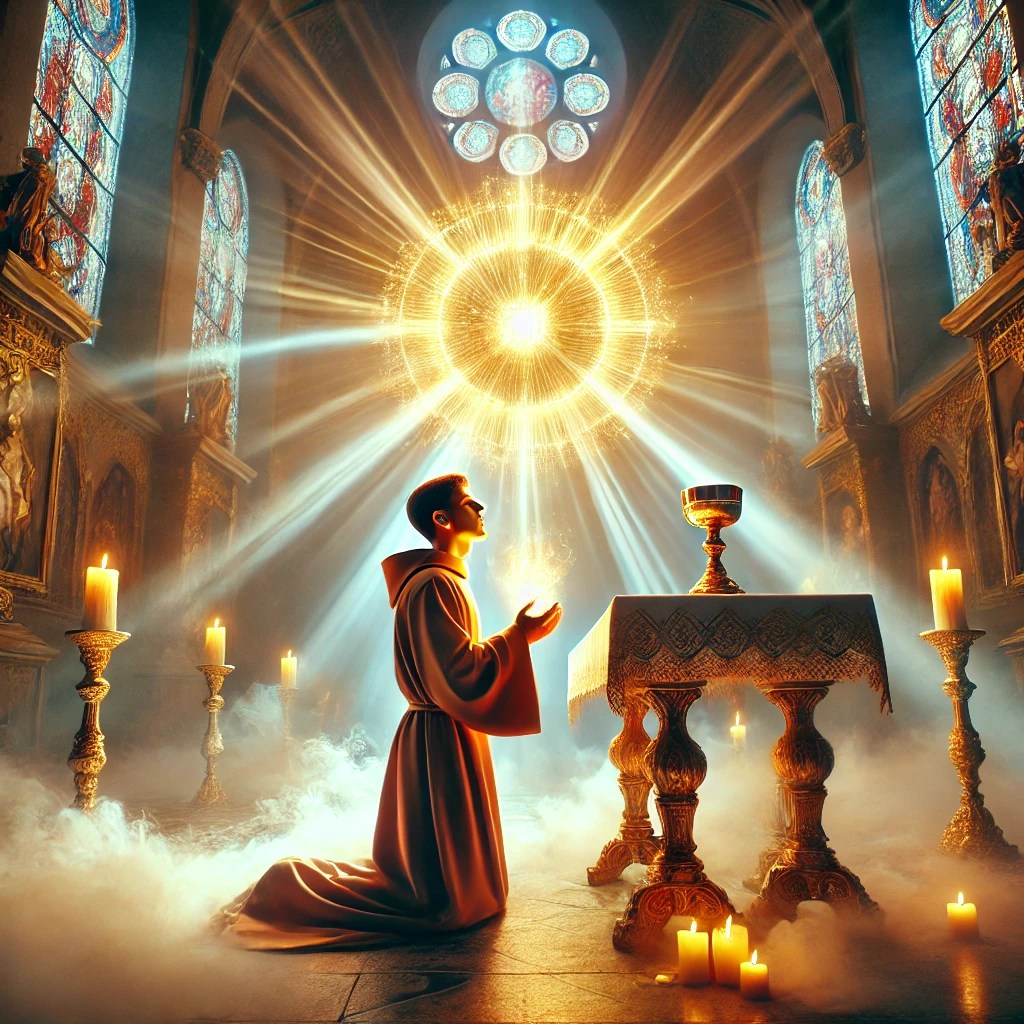
Saint Michael de Sanctis was marked by extraordinary mystical gifts, especially in relation to the Holy Eucharist. During the Consecration at Mass, he would often fall into ecstasy—profound moments of union with Christ that transcended the natural world. These experiences were not theatrical but deeply sacred, often witnessed by his brothers in community, who spoke of how his entire face would glow with otherworldly joy.
One such incident occurred during a community Mass when Michael, while elevating the Host, remained motionless and entranced for several minutes, seemingly unaware of the world around him. Those present testified that it was as if heaven had opened and he was caught up in the glory of God. These occurrences deepened the faith of his community and drew others to reflect on the profound mystery of The Holy Eucharist, reminding all present that, in the words of the Catechism of the Catholic Church, “the Eucharist is the source and summit of the Christian life” (CCC 1324).
A Cross Carried with Grace
Although Michael was not martyred in the conventional sense, his life was one of constant self-offering. He embraced voluntary sufferings through fasting, sleepless nights of prayer, and acts of personal mortification. This self-denial was not rooted in guilt or fear, but in profound love—a desire to unite his own sufferings to those of Christ for the salvation of souls.
He faced spiritual dryness, criticism, and even internal conflicts within his order, yet he never abandoned his vocation. Instead, he leaned ever more into his relationship with God. His health deteriorated rapidly due to his extreme austerities, and by the age of thirty-three—the same age as Christ at His crucifixion—Michael passed from this life into eternal glory. His death came on April 10, 1625, in Valladolid, where he had been serving as the monastery’s superior. He died with the same peace and joy that had marked his life.
Heavenly Echoes and Holy Intercession
After his death, Michael’s tomb became a place of pilgrimage and prayer. Countless faithful reported miraculous healings and divine interventions through his intercession. These posthumous miracles were rigorously investigated by the Church, leading to his beatification in 1779 by Pope Pius VI, and his canonization nearly a century later.
His relics became objects of veneration, and devotion to him spread particularly in Spain and Latin America. One remarkable testimony tells of a woman suffering from a terminal illness who prayed at his tomb and was instantly healed, leaving both doctors and witnesses stunned. The spiritual fruit of his hidden life continues to bloom centuries later.
Today, places like the town of Saint-Michel-des-Saints in Quebec bear his name, keeping his legacy alive. His quiet holiness serves as a powerful reminder that sanctity is not always loud or visible. It is often forged in silence, sacrifice, and hidden love.
The Hidden Fire Within
Saint Michael de Sanctis calls each of us to enter into a deeper relationship with Jesus in the Eucharist. His life is a gentle yet radical invitation: to believe that Christ is truly present in the Blessed Sacrament, and to allow that belief to transform our lives. His example challenges us to cultivate an interior life—a life nourished by prayer, silence, and the sacraments.
His story teaches us that even in the midst of our everyday responsibilities, we can create space for the divine. His youthful determination, his perseverance through trials, and his profound reverence at the altar are all invitations to reflect on the state of our own hearts.
How often do we pause in awe before the presence of Christ in the Eucharist?
Are we making space in our lives for silence, prayer, and acts of love?
What would it look like to surrender more deeply to God’s will, as Saint Michael did—without fanfare, but with faithful love?
Through his intercession, may we each become mystics of the ordinary, living lives that reflect the hidden radiance of God.
Engage with Us!
We invite you to share your thoughts and reflections in the comments below. Consider these questions to spark discussion:
- How can Saint Michael de Sanctis’s devotion to the Eucharist inspire your own spiritual practices?
- In what ways can self-discipline and penance positively impact your faith journey?
- How can you incorporate acts of service and humility into your daily life to emulate the virtues of Saint Michael de Sanctis?
Let’s support each other in our faith journeys and strive to do everything with love, as our Lord Jesus did.
Saint Michael, pray for us!
Follow us on Instagram and Facebook for more insights and reflections on living a faith-filled life.

 Holy Manna!
Leave a comment