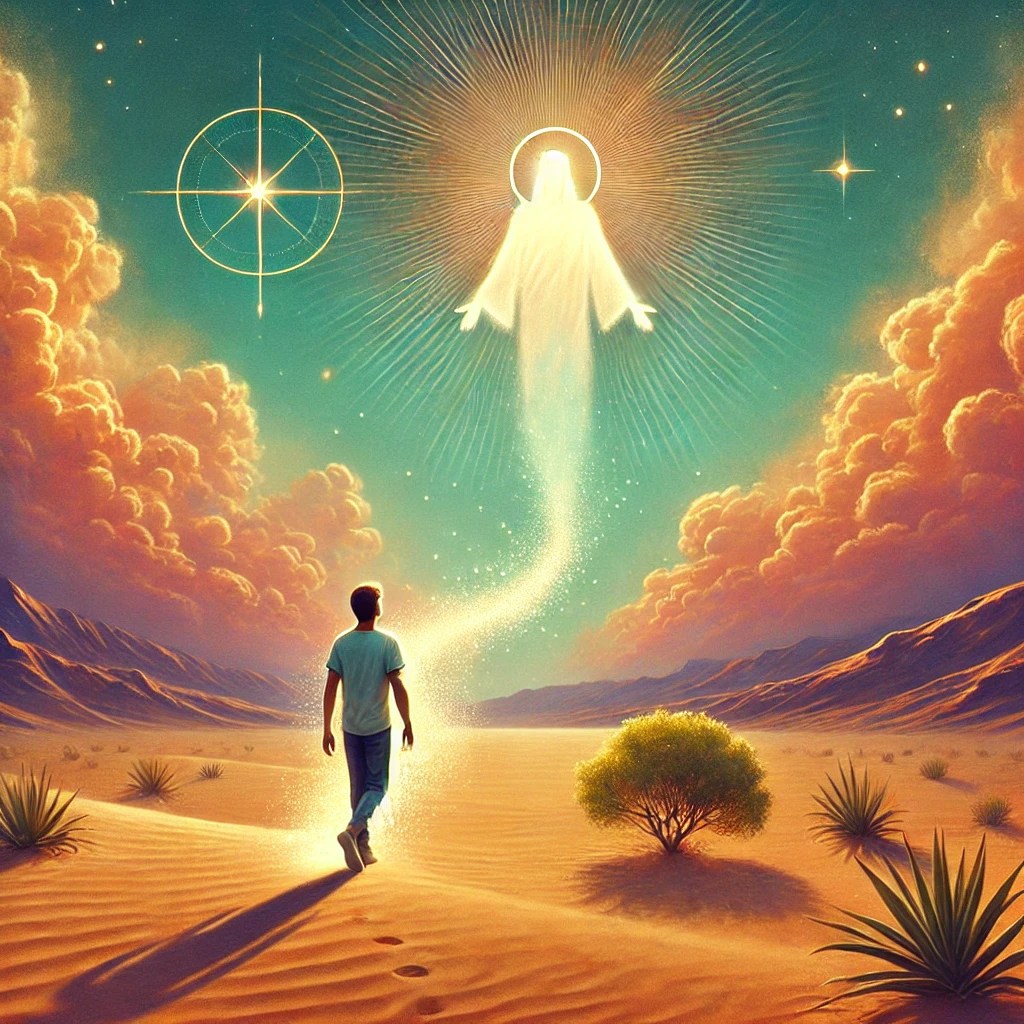
Before Abraham Was…
There’s a mysterious beauty in looking back through the corridors of time to witness the thread of God’s covenant woven through history. Today’s readings draw us into the very heart of that mystery—into promises made, promises remembered, and promises fulfilled in ways that shatter our expectations. We begin with Abraham, our father in faith, kneeling before God as he receives a covenant that will stretch across generations. And we end with Jesus, standing before the people, declaring the unthinkable: “Before Abraham came to be, I AM”. These are not just separate stories—they are a single, unfolding revelation of God’s eternal plan.
To truly understand these readings, we have to place ourselves within the long and sacred history of Israel. In Genesis, we see God rename Abram to Abraham, marking a turning point not just in one man’s life, but in the life of the world. The covenant made with Abraham wasn’t just about land and lineage; it was about relationship—God binding Himself to humanity with steadfast love and divine faithfulness. The Book of Psalms then reminds us that this covenant was never forgotten. For generations, even in times of exile and silence, the Jewish people clung to the memory of God’s promise. They believed in a God who remembers. And then, in The Gospel of John, Jesus stuns His audience by claiming not only to precede Abraham, but to share the divine name: “I AM”—the sacred name revealed to Moses at the burning bush.
These readings invite us into awe. They ask us to consider a God who exists outside of time, yet steps into time to walk with us. The covenant with Abraham was a beginning—but it pointed forward to something greater. In Jesus, the covenant is not erased but fulfilled and elevated. Are we aware of how we are part of that same covenant story? Are we seeking to hear God’s eternal voice echo through our own daily lives? As we reflect today, may we recognize that the same God who called Abraham and spoke through the prophets is calling us—right here, right now.
First Reading – Genesis 17:3-9
Covenant and Call: The Divine Bond That Changes Everything
Today’s first reading from Genesis draws us into a foundational moment in salvation history—the establishment of God’s covenant with Abraham. Genesis, the first book of the Bible, is not only a story of creation but the unfolding of a divine relationship that shapes all of history. In this passage, we witness a sacred transformation: Abram becomes Abraham, the father of a multitude. This covenant is made in a world where polytheism and tribal gods were common, and yet here is one God—the God—offering not just land and descendants, but His very self in relationship. The setting is a nomadic culture, where permanence is rare and identity is tied to family and land. God speaks into that uncertainty with promises that stretch across generations. In light of today’s Gospel, this covenant becomes even more profound, for the fulfillment of this divine bond is not found only in Abraham’s lineage—but in Christ, who reveals Himself as the eternal “I AM.”
Genesis 17:3-9
New American Bible (Revised Edition)
3 Abram fell face down and God said to him: 4 For my part, here is my covenant with you: you are to become the father of a multitude of nations. 5 No longer will you be called Abram; your name will be Abraham, for I am making you the father of a multitude of nations. 6 I will make you exceedingly fertile; I will make nations of you; kings will stem from you. 7 I will maintain my covenant between me and you and your descendants after you throughout the ages as an everlasting covenant, to be your God and the God of your descendants after you. 8 I will give to you and to your descendants after you the land in which you are now residing as aliens, the whole land of Canaan, as a permanent possession; and I will be their God. 9 God said to Abraham: For your part, you and your descendants after you must keep my covenant throughout the ages.
Detailed Exegesis
Verse 3 – “Abram fell face down and God said to him:”
Abram’s response is one of total surrender. To fall face down before God expresses reverence, humility, and openness. In the biblical context, this posture signals a readiness to receive. Abram doesn’t speak—he listens. His silence models the kind of receptivity we are invited to adopt in prayer and covenantal relationship with God.
Verse 4 – “For my part, here is my covenant with you: you are to become the father of a multitude of nations.”
God initiates the covenant, underscoring His sovereignty. The phrase “for my part” indicates divine initiative, not negotiation. This is grace: unearned, unmerited, freely given. The blessing is expansive—not just a single nation, but a multitude—prefiguring the universality of the Church.
Verse 5 – “No longer will you be called Abram; your name will be Abraham, for I am making you the father of a multitude of nations.”
A new name in Scripture marks a new mission. Abram (“exalted father”) becomes Abraham (“father of a multitude”), showing how God transforms identity through vocation. This change anticipates other renamings in salvation history, like Simon to Peter, showing that our truest identity is found in God’s call.
Verse 6 – “I will make you exceedingly fertile; I will make nations of you; kings will stem from you.”
This promise broadens the covenant’s scope to include royalty—setting the stage for King David, and ultimately for Jesus Christ, the King of Kings. God’s promise is not only numerical but royal and messianic. Abraham’s descendants are to be both many and divinely guided.
Verse 7 – “I will maintain my covenant between me and you and your descendants after you throughout the ages as an everlasting covenant, to be your God and the God of your descendants after you.”
Here we hear the core of God’s covenant: relationship. The repetition of “I will be your God” emphasizes God’s faithfulness. The term “everlasting” reveals that this isn’t just a temporal arrangement—it is a sacred, enduring bond that reaches its ultimate expression in the New Covenant through Jesus.
Verse 8 – “I will give to you and to your descendants after you the land in which you are now residing as aliens, the whole land of Canaan, as a permanent possession; and I will be their God.”
The promise of land serves both practical and symbolic purposes. It marks a divine inheritance, even while Abraham lives as a foreigner. Spiritually, this land foreshadows our heavenly homeland—the true and eternal Promised Land.
Verse 9 – “God said to Abraham: For your part, you and your descendants after you must keep my covenant throughout the ages.”
God’s covenant comes with a call to obedience. It is not one-sided; Abraham must respond in faith and action. This verse anchors the mutuality of the covenant, reminding us that God desires not only to give but to walk with His people in love and fidelity.
Teachings
The Catechism of the Catholic Church teaches that Abraham’s faith makes him the spiritual ancestor of all believers. “By faith, Abraham obeyed when he was called to go out to a place… and he went out, not knowing where he was to go” (CCC 145). His journey becomes a model of trust and surrender. Abraham’s covenant, initiated by grace, is echoed in the sacraments, where we too enter into divine relationship not by our merit, but by God’s call.
St. Paul affirms this in Romans 4:16, writing: “That is why it depends on faith, in order that the promise may rest on grace and be guaranteed to all his descendants—not only to the adherents of the law but also to those who share the faith of Abraham, for he is the father of us all.” The Church Fathers also drew on this. St. Augustine wrote, “Abraham believed and was made the father of all nations; his faith anticipated the faith of all those who would come to believe.” His life was a foreshadowing of the life of the Church—born not of blood, but of belief.
Historically, the Jewish people saw the Abrahamic covenant as the cornerstone of their identity. During times of exile, oppression, and wandering, they remembered these words as a sign of God’s unwavering commitment. As Christians, we see Jesus as the fulfillment of that covenant. Lumen Gentium 9 explains: “God gathered together as one all those who look to Him in faith… the messianic people, whose head is Christ.” This is the continuation and completion of the promise made to Abraham.
Reflection
Abraham’s story is deeply personal and profoundly universal. It asks each of us: What is God calling you to leave behind? What new name, new identity, might He be whispering into your soul? Like Abraham, we are called to step forward into unknown territory, trusting not in what we see, but in the One who calls us. Do we listen in silence before God, or do we rush to fill the space with our own plans and desires?
The covenant also challenges our understanding of God’s promises. They often unfold over generations, beyond what we can perceive. Abraham never fully saw the promise fulfilled in his lifetime, but he trusted. Are we willing to be faithful even when the fruits of our obedience are not immediately visible? In a world obsessed with instant results, Abraham teaches us the virtue of long hope.
Finally, today’s reading reminds us that we are not spiritual freelancers. We are children of a covenant—bound to God and to one another in faith. Are we living as though that covenant matters? Do our daily actions reflect that we belong to God, that He is our God and we are His people? Today, let us recommit ourselves to walking in faith like Abraham, trusting that the God who called him still calls each one of us by name.
Responsorial Psalm – Psalm 105:4-9
He Remembers Forever: Living in the Memory of God
Psalm 105 is a sacred hymn of remembrance and praise, a call to the people of Israel to recall the mighty works of God and to remain faithful to the covenant. It belongs to the genre of historical psalms, recounting Israel’s journey and God’s interventions throughout their history. This portion of the psalm specifically centers on God’s faithfulness to the covenant made with Abraham—a direct echo of today’s First Reading from Genesis 17. Written likely during or after the Babylonian exile, the psalm was meant to rekindle hope in a time of dislocation and suffering. It reminded Israel that God’s covenant is not conditional on circumstance; it is everlasting. In the broader context of today’s readings, this psalm functions like a bridge, connecting Abraham’s ancient trust to Christ’s divine revelation in the Gospel. It calls us to seek God, trust in His faithfulness, and live lives shaped by His enduring memory of the promises He made.
Psalm 105:4-9
New American Bible (Revised Edition)
4 Seek out the Lord and his might;
constantly seek his face.
5 Recall the wondrous deeds he has done,
his wonders and words of judgment,
6 You descendants of Abraham his servant,
offspring of Jacob the chosen one!
7 He the Lord, is our God
whose judgments reach through all the earth.
8 He remembers forever his covenant,
the word he commanded for a thousand generations,
9 Which he made with Abraham,
and swore to Isaac,
Detailed Exegesis
Verse 4 – “Seek out the Lord and his might; constantly seek his face.”
This verse is both a command and an invitation. To “seek out the Lord” implies active pursuit, not passive belief. The repetition—“seek out” and “constantly seek”—shows the urgency and constancy of our spiritual life. “His might” refers to God’s power in sustaining the covenant, while “his face” symbolizes intimate relationship. In ancient Israel, the face of God was associated with blessing, presence, and favor.
Verse 5 – “Recall the wondrous deeds he has done, his wonders and words of judgment,”
Memory plays a central role in faith. Israel is called to remember not just history, but sacred history—God’s deeds and His judgments. These are not just miracles, but moments of justice, revelation, and mercy. In liturgy and prayer, remembering becomes an act of worship that strengthens present faith.
Verse 6 – “You descendants of Abraham his servant, offspring of Jacob the chosen one!”
The psalmist addresses the people directly, tying their identity to their patriarchs. Abraham and Jacob are named not only as ancestors, but as servants and chosen ones. This reinforces the theme of covenantal relationship and reminds the listener of their heritage—a people set apart by God’s call.
Verse 7 – “He, the Lord, is our God whose judgments reach through all the earth.”
This verse expands the scope from Israel to all nations. God is not a local deity; He is the Lord of all creation. His “judgments” are not merely punitive—they are the expression of His divine will and justice. This global dimension anticipates the universal call of the Gospel.
Verse 8 – “He remembers forever his covenant, the word he commanded for a thousand generations,”
Here lies the heart of the psalm. God’s remembrance is not like human memory—it is active, faithful, and eternal. The “thousand generations” represent an infinite span of time. This verse affirms that even when people forget, God never does. His covenant is not a moment, but a continuous relationship.
Verse 9 – “Which he made with Abraham, and swore to Isaac,”
The psalmist roots God’s fidelity in concrete history. By naming Abraham and Isaac, he links the present worship of the community with the foundational events of their faith. This verse reaffirms the covenant as both historical and unbreakable. It reminds us that God’s promises are not erased by time.
Teachings
The Catechism teaches us that “in the Old Testament, God revealed himself as the One who ‘remembers’” (CCC 2085). In remembering His covenant, God reveals not just knowledge but fidelity. The psalm celebrates this divine memory, which is not passive recall but living presence. As CCC 2569 states, “Prayer is bound up with human history, for it is the relationship with God in historical events.” In Psalm 105, prayer becomes remembrance, and remembrance becomes worship.
Saint John Paul II often spoke of the importance of memory in the life of faith, saying in Novo Millennio Ineunte: “To remember the past with gratitude, to live the present with enthusiasm, and to look forward to the future with confidence.” Psalm 105 invites us to this very practice. By remembering God’s works, we anchor ourselves in His faithfulness. The Church Fathers, too, saw the Psalms as a prophetic book, with Saint Athanasius writing: “Within them is portrayed all the movements of the soul… they are like a mirror.” In this mirror, we see the pattern of trust and covenant, even when life is uncertain.
Historically, the repetition of God’s deeds in psalms like this one served as spiritual resilience. During exile, war, and oppression, Israel did not always feel God’s nearness. But they remembered. In our own spiritual dryness or confusion, we too are called to remember—through Scripture, sacraments, and the Eucharist, which the Church names as “the memorial of Christ’s Passover” (CCC 1362). In the psalm, Israel sings of Abraham’s covenant. At Mass, we proclaim: “Do this in memory of me.” The act of remembering becomes transformative.
Reflection
Psalm 105 is an invitation to live with a memory that changes us. In a world that urges us to forget, to move on, or to rewrite the past, this psalm calls us back. What are the deeds of the Lord in your own life that you need to remember today? Faith doesn’t grow only from doctrine—it grows from remembrance. From paying attention to how God has already moved in our story.
It also challenges us to ask: Are we seeking the Lord constantly? Or only when we are in need? The psalmist doesn’t say to seek God when it’s convenient—but to seek Him constantly, persistently, lovingly. This kind of seeking is a daily practice: in prayer, in Scripture, in gratitude. What would it look like to begin or end each day by recalling a “wondrous deed” God has done in your life?
Lastly, the psalm grounds us in identity. You are a descendant of Abraham through faith, as Paul reminds us. You are part of this story. That means you are also a recipient of God’s promises and a witness to His works. Are you living in a way that shows you belong to a God who remembers His covenant? Today, let this psalm be your song of trust: God remembers. He has not forgotten you. He never will.
Holy Gospel – John 8:51-59
Before Abraham, I AM: Jesus Reveals His Eternal Identity
The Gospel of John is often described as the most theological and mystical of the four Gospels. Unlike the synoptic Gospels, it plunges immediately into the divine identity of Jesus: “In the beginning was the Word, and the Word was with God, and the Word was God.” In today’s passage, we witness a moment of climactic tension between Jesus and the Jewish authorities—a moment that brings the covenantal past of Abraham face-to-face with the eternal present of Christ. This encounter occurs in the Temple during a season of heightened scrutiny, and Jesus does not shy away from controversy. Instead, He makes one of the most radical claims in all of Scripture: “Before Abraham came to be, I AM.” For those listening, this is more than startling; it is blasphemous—unless, of course, it is true. In the context of today’s theme, this Gospel passage brings the Abrahamic covenant full circle. Jesus is not merely the fulfillment of the promise; He is its origin. The God who called Abraham is now standing in the Temple, offering eternal life through His word.
John 8:51-59
New American Bible (Revised Edition)
51 Amen, amen, I say to you, whoever keeps my word will never see death.” 52 [So] the Jews said to him, “Now we are sure that you are possessed. Abraham died, as did the prophets, yet you say, ‘Whoever keeps my word will never taste death.’ 53 Are you greater than our father Abraham, who died? Or the prophets, who died? Who do you make yourself out to be?” 54 Jesus answered, “If I glorify myself, my glory is worth nothing; but it is my Father who glorifies me, of whom you say, ‘He is our God.’ 55 You do not know him, but I know him. And if I should say that I do not know him, I would be like you a liar. But I do know him and I keep his word. 56 Abraham your father rejoiced to see my day; he saw it and was glad. 57 So the Jews said to him, “You are not yet fifty years old and you have seen Abraham?” 58 Jesus said to them, “Amen, amen, I say to you, before Abraham came to be, I AM.” 59 So they picked up stones to throw at him; but Jesus hid and went out of the temple area.
Detailed Exegesis
Verse 51 – “Amen, amen, I say to you, whoever keeps my word will never see death.”
Jesus begins with a double “Amen”—a solemn affirmation unique to His teachings in John. To “keep” His word implies not only obedience but an interior transformation. The promise is profound: those who live in communion with Christ will transcend death. This anticipates His later declaration: “I am the resurrection and the life” (John 11:25).
Verse 52 – “[So] the Jews said to him, ‘Now we are sure that you are possessed. Abraham died, as did the prophets, yet you say, ‘Whoever keeps my word will never taste death.’”
Their reaction reveals both misunderstanding and indignation. In their worldview, even the greatest of the faithful—Abraham and the prophets—died. So how could this man, whose human age was visible, make such an outrageous claim?
Verse 53 – “Are you greater than our father Abraham, who died? Or the prophets, who died? Who do you make yourself out to be?”
This question is central to the Gospel: Who is Jesus? Their rhetorical tone shows disbelief, but it also opens a path for revelation. They’re not just asking about identity—they’re challenging authority. The irony is that their question anticipates the ultimate answer.
Verse 54 – “Jesus answered, ‘If I glorify myself, my glory is worth nothing; but it is my Father who glorifies me, of whom you say, ‘He is our God.’”
Jesus refuses self-glorification. His authority comes from the Father—the very God the Jews profess to worship. This affirms the unity between Father and Son and confronts His listeners with a paradox: they claim to know God, but they do not recognize His Son.
Verse 55 – “You do not know him, but I know him. And if I should say that I do not know him, I would be like you a liar. But I do know him and I keep his word.”
Jesus contrasts His intimate, obedient relationship with the Father to the crowd’s estranged religiosity. The charge is piercing: “You do not know him.” This isn’t a critique of their intellect, but of their spiritual blindness.
Verse 56 – “Abraham your father rejoiced to see my day; he saw it and was glad.”
This mysterious line connects Jesus directly to Abraham’s hope. Though Abraham lived centuries before the Incarnation, he foresaw in faith the coming of the Messiah. Some Church Fathers interpret this as Abraham’s vision of the covenant’s fulfillment, possibly during the binding of Isaac.
Verse 57 – “So the Jews said to him, ‘You are not yet fifty years old and you have seen Abraham?’”
Their response is literal, materialistic. They focus on Jesus’ age and miss His divine nature. This verse sets the stage for one of the most staggering revelations in the New Testament.
Verse 58 – “Jesus said to them, ‘Amen, amen, I say to you, before Abraham came to be, I AM.’”
This is the climax. By using the divine name “I AM” (ego eimi in Greek), Jesus invokes the sacred name revealed to Moses in Exodus 3:14. This is not just a claim to preexistence; it is a claim to divinity. Jesus identifies Himself as the eternal God, the same One who spoke to Abraham.
Verse 59 – “So they picked up stones to throw at him; but Jesus hid and went out of the temple area.”
The reaction is swift and violent. Stoning was the penalty for blasphemy, and they understood exactly what Jesus was claiming. But His “hiding” is not fear—it is the fulfillment of timing. His hour had not yet come.
Teachings
The Catechism emphasizes the unity of Jesus with the Father, teaching that “Jesus revealed that he is in the Father and the Father in him” (CCC 261). His use of “I AM” not only echoes Exodus but confirms that He is consubstantial with the Father, as the Nicene Creed professes. In CCC 590, the Church affirms: “Only the divine identity of Jesus’ person can justify so absolute a claim as ‘Whoever is not with me is against me.’” His claim is total—it leaves no room for neutrality.
St. Augustine, in his Tractates on the Gospel of John, writes: “Do you see how ‘I AM’ is a name of unchangeable eternity, not limited by the past or future? Jesus did not say, ‘Before Abraham came to be, I was,’ but ‘I AM.’” This insight highlights the divine nature of Christ’s presence. He exists outside of time, yet steps into time for our sake.
In Church history, this passage has been a cornerstone for Christological debates, especially in the early ecumenical councils. The Council of Nicaea (325 A.D.) declared that Jesus is “God from God, Light from Light, true God from true God… consubstantial with the Father.” John 8:58 undergirds this doctrine. It also forms the basis for Eucharistic reverence: if Jesus is truly God, then He is truly present in the Eucharist. As CCC 1374 teaches, “In the most blessed sacrament of the Eucharist ‘the body and blood, together with the soul and divinity, of our Lord Jesus Christ… is truly, really, and substantially contained.’”
Reflection
This Gospel demands a response. Jesus does not leave space for vague admiration. He is either who He says He is—the eternal I AM—or He is not. How do we respond to His claim? Do we, like the crowd, resist Him because His truth disrupts our assumptions? Or do we fall in worship before the One who stands outside time yet enters our lives with eternal love?
The invitation here is not only to believe but to “keep His word.” What does it mean to keep His word in our current world of shifting values and fractured truths? It means anchoring ourselves in Him, allowing His teachings to form our conscience, our choices, and our priorities. Keeping His word becomes a daily act of faith—trusting that even when we suffer or doubt, death will not have the last word.
Jesus’ declaration—“Before Abraham came to be, I AM”—is not just a theological statement; it’s a lifeline. It means that there is never a moment in our past, present, or future where He is not. Are we living with the confidence that Jesus is Lord of all time and all circumstances? Today, let His words echo in your heart. Let them be your strength, your clarity, and your joy. Because He is—not was, not will be—but I AM.
Living the Covenant Today: From Promise to Presence
Today’s readings offer us a powerful journey—from the promise given to Abraham, to the psalmist’s song of remembrance, to the radical revelation of Jesus as the eternal “I AM.” In Genesis, we see the beginning of God’s intimate and everlasting covenant with humanity, not just with a man, but with generations yet to come. Abraham’s faith becomes the root of a divine relationship that reshapes history. Psalm 105 reminds us that God’s memory is faithful; He does not forget His promises. Even when we wander, He remains true. And in The Gospel of John, that ancient promise comes alive in the person of Jesus Christ, who boldly reveals His divinity and invites us into eternal life through Him.
What ties all these readings together is covenant—God’s unwavering desire to be our God, to walk with us, to give us not just blessings, but His very self. This covenant is not just a historical footnote; it is alive today in every Mass, every sacrament, every moment of prayer. Jesus is not merely the fulfillment of a prophecy—He is the fulfillment of our deepest longing. “Before Abraham came to be, I AM” isn’t just a theological truth—it’s a personal invitation to trust in the God who is—now, always, forever.
How is God calling you to live out your part of the covenant today? Maybe it’s a renewed commitment to prayer, or a deeper trust in His promises when life feels uncertain. Perhaps it’s embracing your identity as a child of the promise, a living witness to God’s faithfulness. Whatever it is, step forward with the faith of Abraham, the memory of the psalmist, and the boldness of belief in Jesus. He is with you. He is for you. And He is—I AM.
Engage with Us!
We’d love to hear how God is speaking to you through today’s readings. Your insights, struggles, and prayers help build a community rooted in faith, hope, and love. Share your reflections in the comments below—let’s grow together in our walk with Christ.
Reflection Questions:
First Reading – Genesis 17:3-9
What part of Abraham’s call resonates most deeply with your own spiritual journey? How are you being invited to “keep God’s covenant” in your everyday life? Have you ever felt like God was calling you into a new identity or mission, like Abram becoming Abraham?
Responsorial Psalm – Psalm 105:4-9
What “wondrous deeds” has God done in your life that you need to remember and give thanks for? How can you make seeking the Lord and His face a daily practice? What does it mean to you that God remembers His covenant forever?
Holy Gospel – John 8:51-59
How do you personally respond to Jesus’ declaration, “Before Abraham came to be, I AM”? Are there areas of your life where you struggle to “keep His word”? What might it look like to live each day as though Jesus is truly present, truly Lord, and truly eternal?
As you go forward today, may you walk in the fullness of God’s promise, grounded in the everlasting covenant and renewed by the living Word. Live your faith boldly, seek His face constantly, and do everything with the love and mercy Jesus taught us. He is with you. He is faithful. And He calls you His own.
Follow us on Instagram and Facebook for more insights and reflections on living a faith-filled life.

 Holy Manna!
Leave a comment