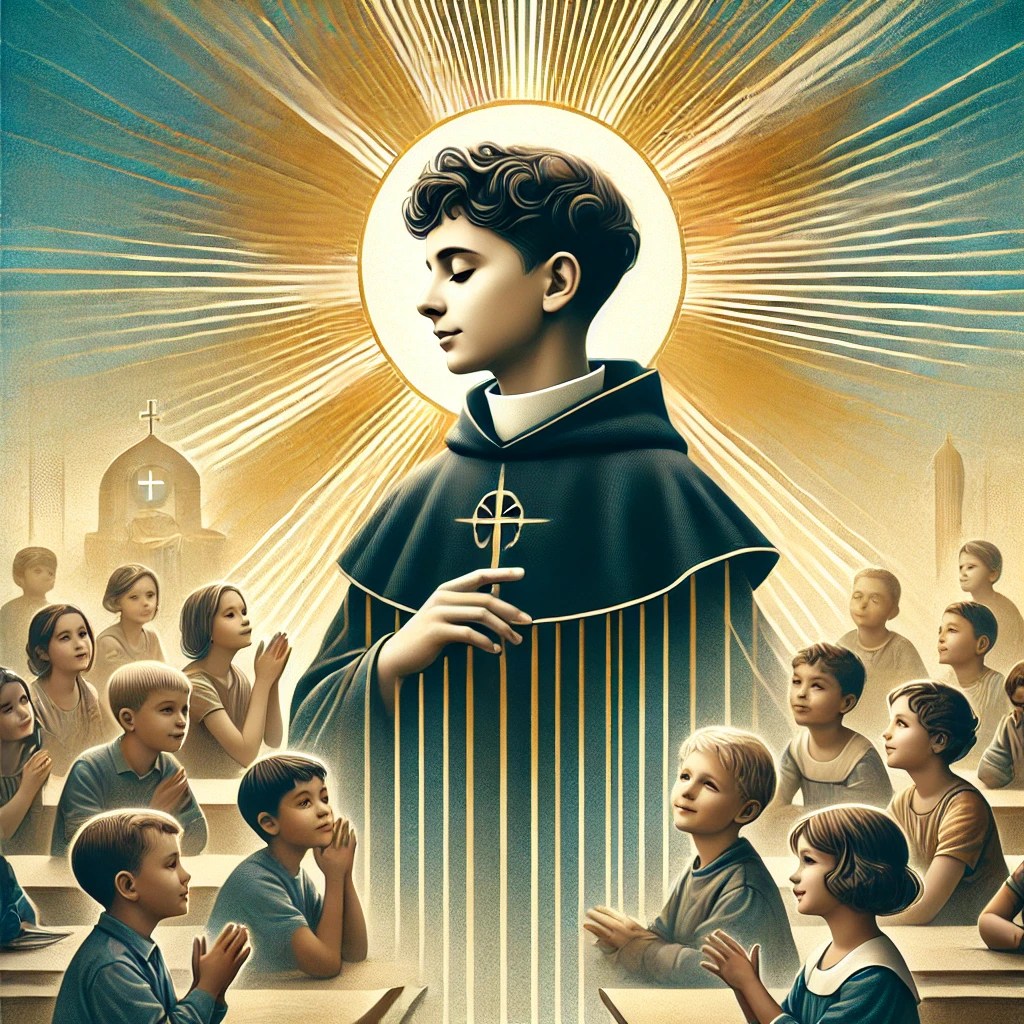
A Heart on Fire for Young Souls
Saint John Baptist de La Salle is one of the Church’s great visionaries in the world of education and spiritual formation. Born into nobility, he could have lived a comfortable and prestigious life, yet he chose the path of humility, service, and radical trust in Divine Providence. He is best known for founding the Institute of the Brothers of the Christian Schools (De La Salle Brothers), a religious congregation devoted entirely to teaching. His bold reform of educational practices—particularly for the poor—forever transformed not only the classroom but also the way the Church participates in forming the whole human person: mind, body, and soul. In 1950, Pope Pius XII named him the Patron Saint of All Teachers of Youth, recognizing that through his life and witness, Christ the Teacher had found a faithful servant.
A Priest’s Unlikely Mission
John Baptist de La Salle was born on April 30, 1651, in Reims, France, to a wealthy and devout family. As the eldest of eleven children, he was expected to carry on the family’s name and hold a prominent position in society. From an early age, he showed signs of deep faith, receiving the clerical tonsure at age eleven and being named Canon of Reims Cathedral at sixteen. He later entered the Seminary of Saint-Sulpice in Paris and was ordained a priest in 1678. By all appearances, his future pointed toward a dignified ecclesiastical career within the higher ranks of the Church.
But God had other plans. A seemingly chance encounter with a layman named Adrian Nyel—who had a vision of opening schools for poor boys—would awaken in De La Salle a vocation within a vocation. As he began assisting with these schools, his heart became fully inflamed with love for Christ in the poor. He realized that to truly live out the Gospel, he had to descend from his social position and live among the very people he served. He resigned from his canonry, gave away his inheritance during a famine, and began living in community with the teachers.
Saint John Baptist de La Salle introduced numerous educational innovations: teaching in the vernacular rather than Latin, grouping students by ability, setting up structured school days, and establishing the first training programs for lay teachers—what we now call teacher education. These weren’t just clever ideas; they were responses to the dignity of each child created in the image of God. His mission was not simply to educate minds but to form saints.
Miracles in Chalk and Charity
While Saint John Baptist de La Salle is not primarily remembered for supernatural miracles during his life, his very approach to education and evangelization could be called miraculous. In a time when the poor were largely neglected and literacy was a luxury, he created a system that treated education as a sacred right, not a privilege. He believed that through education rooted in Christ, children could break free from poverty and sin and come to know the One who created them.
The most profound miracle of his life was the conversion of hearts—his own and those of countless students and teachers. One teacher wrote of him: “He was not merely our superior, he was our father and our friend in Christ.” His ability to inspire and spiritually guide both educators and pupils transformed simple schoolhouses into temples of grace.
Trials in the Classroom of Christ
Saint John Baptist de La Salle’s radical mission was not without resistance. He was criticized by church officials who felt he was stepping beyond his priestly role and by lay educators who resented his structured approach. Some objected to his insistence that schools should be free, viewing it as a threat to traditional, fee-based systems. He also endured severe internal challenges within his own community of brothers—betrayals, defections, and even lawsuits.
What makes his endurance remarkable was the peace with which he accepted these trials. He believed deeply in divine providence and often reminded his brothers: “Do not be discouraged by anxieties and troubles. Life is full of them.” He modeled Christ-like perseverance, not retaliating when attacked, and consistently urging his community to respond with love, humility, and trust in God’s plan.
Though not a martyr by blood, De La Salle lived a white martyrdom—a life of self-sacrifice, misunderstandings, and interior suffering offered entirely for the salvation of souls. His hardships weren’t obstacles to his mission; they were part of the curriculum written by the Master Teacher.
Graces Flowing from a Holy Legacy
After Saint John Baptist de La Salle’s death on April 7, 1719—Good Friday that year—the miracles didn’t stop. Devotion to him grew rapidly, particularly among educators and the poor. His intercession was credited with multiple healings, two of which were officially recognized for his canonization.
In 1832, a young nurse named Vittoria Ferry was viciously attacked in Orléans, France, and left with mortal wounds. After prayers to De La Salle, she was completely and inexplicably healed. In 1905, Brother Miguel, a member of the De La Salle Brothers in Spain, was diagnosed with terminal tuberculosis. When doctors had given up hope, the community turned to their founder for intercession—and Brother Miguel was fully restored to health.
These miracles led to Saint John Baptist de La Salle’s beatification in 1888 and canonization by Pope Leo XIII in 1900. His body now rests in Rome, in the Generalate of the Brothers, while his spirit lives on in the over 1,000 Lasallian educational institutions that stretch across more than 80 countries today. These schools continue to be places of academic excellence, spiritual formation, and social justice—truly miracles in motion.
Lessons from a Saintly Educator
Saint John Baptist de La Salle invites us to live lives of holy disruption. He teaches us that true faith leads to bold action—especially for the poor, the forgotten, and the young. His commitment to education wasn’t just about school; it was about salvation. He believed that every child had an eternal soul worth shaping.
In our world today, where education is still a battleground and many young people lack hope or direction, his witness is more relevant than ever. How are we using our gifts to lift others up? How are we forming not just minds, but hearts? How might our daily work become a ministry of love and formation?
To live like De La Salle means embracing discomfort, trusting in divine providence, and building communities rooted in Christ. Whether you’re a parent, teacher, mentor, or friend, you are called to be a guide for others in the spiritual classroom of life. And in everything—do it with love.
Engage with Us!
We invite you to reflect and share your thoughts:
- How has education shaped your personal faith journey?
- In what ways can you contribute to the education or mentorship of those less fortunate in your community?
- How can you integrate faith and innovation in your work, relationships, or ministry?
Let’s support one another in becoming builders of hearts, not just minds—and strive to do everything with love, as our Lord Jesus did.
Saint John Baptist de La Salle, pray for us!
Follow us on Instagram and Facebook for more insights and reflections on living a faith-filled life.

 Holy Manna!
Leave a comment