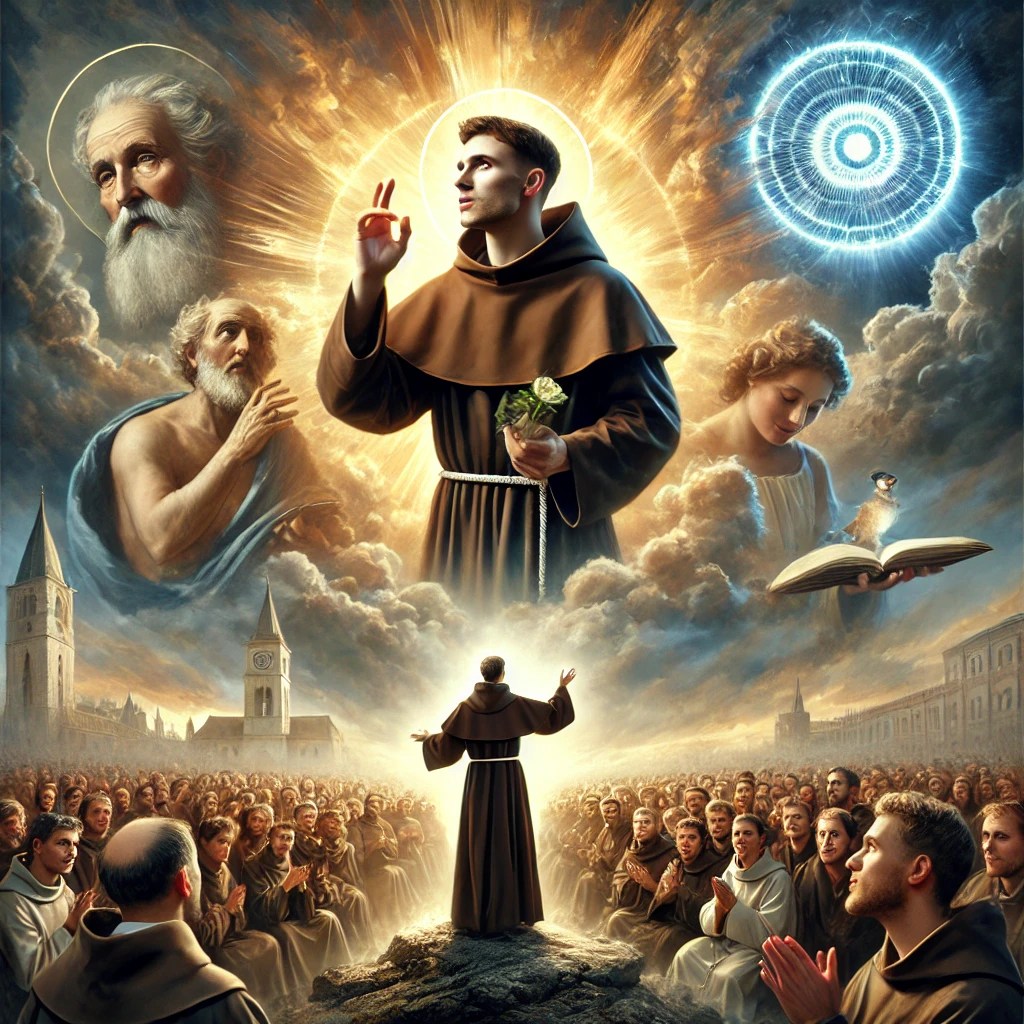
The Angel of the Apocalypse
In a time of confusion, division, and deep spiritual hunger, Saint Vincent Ferrer rose as a radiant beacon of truth and mercy. Born into the turbulence of the late 14th century, he earned the nickname “The Angel of the Apocalypse” not only because of his powerful preaching but also due to his bold proclamations of repentance and the coming of Christ. As a Dominican friar, missionary, miracle worker, and theologian, Vincent became one of the most well-known and revered saints in Western Europe. During his lifetime, he called people back to God with conviction, but never without compassion. His legacy lies not only in the thousands who converted through his preaching, but in the way he modeled unwavering fidelity to the Church in one of her most fragmented eras. His canonization in 1455 affirmed what so many had already believed: that Vincent was not only a voice crying out in the wilderness—but a messenger of heaven.
The Flame in Valencia
Saint Vincent Ferrer was born on January 23, 1350, in the vibrant city of Valencia, then part of the Crown of Aragon in modern-day Spain. His parents, Guillem Ferrer and Constança Miquel, were devout Catholics who raised Vincent in a household steeped in faith. From early childhood, he showed signs of a deep spiritual life, fasting regularly and devoting himself to prayer. His intellect and zeal led him to the Dominican Order at age 18, despite initial resistance from his family. He believed he was called to serve God as a friar, not to pursue the worldly honors his academic gifts might have afforded him.
Vincent immersed himself in the Summa Theologiae of Saint Thomas Aquinas and became a master of Sacred Theology. But it was not just his studies that deepened his faith—it was his radical openness to the will of God. During the crisis of the Western Schism, which split the Church between multiple claimants to the papacy, Vincent initially supported Benedict XIII, believing him to be the legitimate pope. However, over time, and through divine illumination, Vincent became convinced that the division was harming the Church, and he began to call for unity and reconciliation, even at great personal cost.
Though he was offered bishoprics and high honors, Vincent refused them all to continue the work he believed God had given him: to preach, to teach, and to bring souls back to Christ. His passion for evangelization sent him throughout Spain, France, Switzerland, and Italy. His sermons, delivered in his native Valencian, were miraculously understood by people of all languages—a divine sign of his apostolic mission.
Heaven’s Power on Earth
The life of Saint Vincent Ferrer was drenched in the miraculous. Eyewitnesses and chroniclers recount hundreds of miracles worked through him, many of which were recorded in the official documentation for his canonization. According to the Acta Sanctorum, 873 miracles were attributed to him during his lifetime alone.
Among the most astonishing stories is the account of a man who fell from scaffolding and was suspended mid-air by Vincent’s prayer until he could be gently lowered to the ground. In another instance, when a fire threatened to consume a town, Vincent stood before the flames and made the Sign of the Cross—the fire ceased immediately. He healed the blind, the deaf, and the lame. He exorcised demons and raised at least 28 people from the dead. His presence alone brought conversion: hardened criminals repented, towns returned to confession, and churches overflowed with the faithful.
Vincent’s preaching on the Four Last Things—death, judgment, heaven, and hell—was particularly powerful. He did not preach fear for its own sake, but always coupled warning with mercy, emphasizing that now was the time for conversion. His voice carried the urgency of the Gospel: “Repent, for the kingdom of heaven is at hand” (cf. The Gospel of Matthew 3:2).
A Cross Without Martyrdom
Though he did not die as a martyr, Saint Vincent Ferrer bore many crosses throughout his life. His commitment to truth and unity placed him at odds with powerful people, including former allies. When he withdrew support from Benedict XIII and denounced the ongoing schism, he faced backlash and slander. The very man he once served now opposed him.
Vincent also endured physical suffering from the exhausting pace of his missionary work. He traveled by foot across hostile territories, sometimes preaching to audiences exceeding 10,000 people—without the aid of modern amplification. Yet he pressed on, trusting in divine strength. He battled illness, criticism, and spiritual attacks, but never wavered. His courage was not rooted in pride but in a profound trust in Christ’s promise: “I am with you always, to the end of the age” (The Gospel of Matthew 28:20).
He died on April 5, 1419, in Vannes, Brittany, while still on mission. His final years had been spent preaching the Gospel daily, even in illness. His death marked the end of a life poured out completely for Christ and His Church.
The Saint Who Keeps on Giving
After his death, the miracles did not stop. Healings and conversions multiplied at his tomb in the Cathedral of Vannes. Pilgrims came seeking his intercession, and many returned with stories of physical and spiritual renewal. Reports of unexplainable cures and divine favors circulated quickly, solidifying his reputation as a powerful intercessor in heaven.
His canonization by Pope Callixtus III in 1455 was accompanied by widespread celebrations across Europe. The faithful venerated his relics, and shrines dedicated to Saint Vincent Ferrer became places of profound grace. His feast day, celebrated on April 5, invites us even now to turn our hearts to God, to repent, and to live with a sense of holy urgency.
His patronage includes builders, plumbers, and confessors, but more than anything, Saint Vincent Ferrer is a patron of spiritual clarity in confusing times. He calls us to focus on eternity, not out of fear, but out of love for the One who awaits us there.
Lessons from the Great Missionary
Saint Vincent Ferrer teaches us that holiness is not about comfort—it’s about commitment. He walked through storms of division, persecution, and fatigue, all the while proclaiming the Gospel with joy and boldness. His example invites us to ask: Are we truly living for heaven? Are we willing to be voices of truth, even when the world is divided?
Like Vincent, we are called to evangelize—not necessarily on street corners, but in our homes, our workplaces, and online. We are called to unity in a culture of division, to mercy in a culture of judgment, and to trust in God’s power in a culture of self-reliance.
We can take inspiration from Saint Vincent by embracing humility in our opinions, fervor in our prayer lives, and integrity in our daily witness. We don’t need to perform miracles to make an impact—but we do need to believe that God still does.
Let’s allow his words and life to echo in our hearts today: “Fear God and give Him glory, because the hour of His judgment has come” (cf. The Book of Revelation 14:7).
Engage with Us!
We invite you to share your thoughts and reflections in the comments below. Consider these questions to spark discussion:
- How can Saint Vincent Ferrer’s dedication to preaching inspire your own faith journey?
- In what ways can you promote unity and reconciliation within your community?
- Have you experienced moments where faith led to unexpected blessings or interventions?
Let’s support each other in our faith journeys and strive to do everything with love, as our Lord Jesus did.
Saint Vincent, pray for us! 🙏✨
Follow us on Instagram and Facebook for more insights and reflections on living a faith-filled life.

 Holy Manna!
Leave a comment