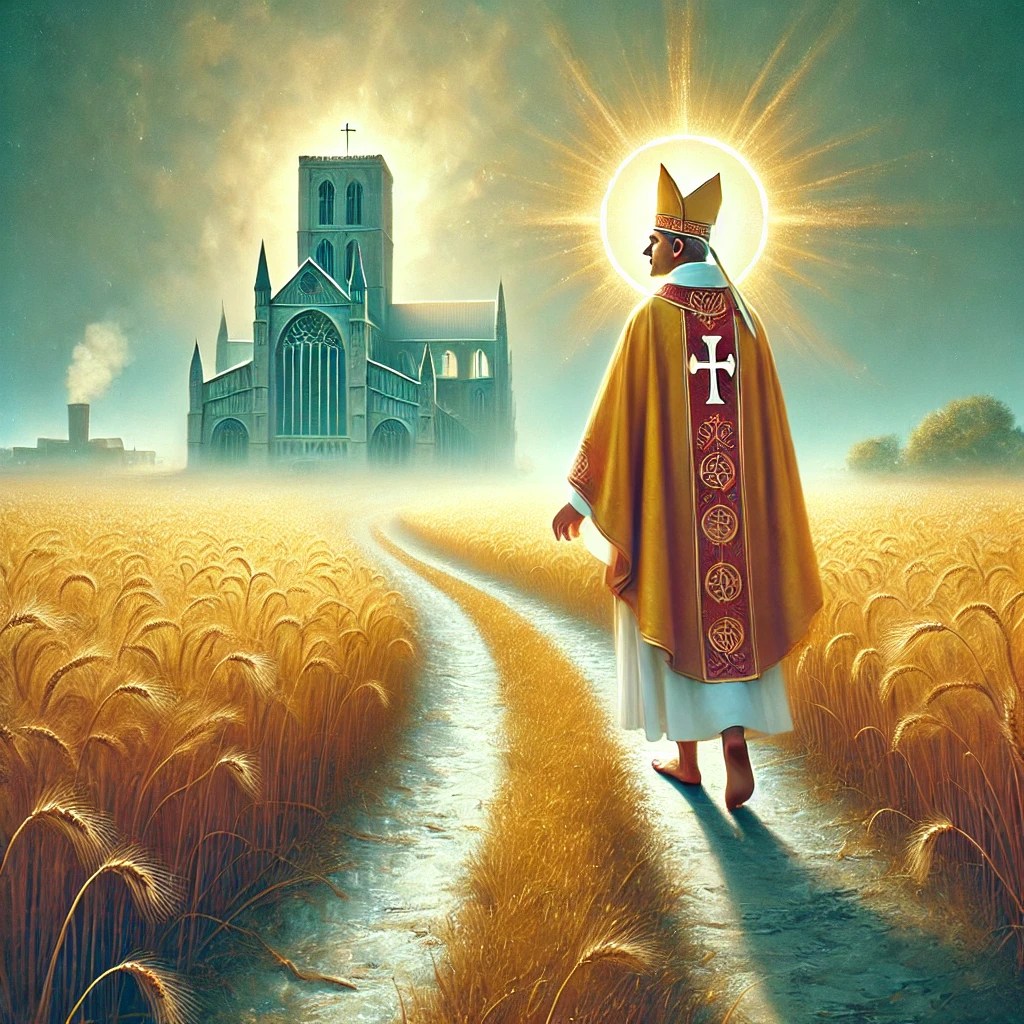
Illuminating the Path of Holiness
Saint Richard of Wyche, more commonly known as Saint Richard of Chichester, shines brightly in the communion of saints as a model of integrity, learning, and faithful service to the Church. Living in 13th-century England, he distinguished himself not through dramatic martyrdom or political influence, but through humble, unwavering devotion to the Gospel and a passionate commitment to the pastoral care of souls. His legacy lives on in the hearts of the faithful, in the miracles attributed to his intercession, and in the simple yet powerful prayer he left behind, still recited by many today: “Thanks be to Thee, my Lord Jesus Christ, for all the benefits which Thou hast given me…”
He is revered as a bishop who fearlessly defended the Church’s rights, a scholar whose intellect was matched by humility, and a holy man who prioritized the poor and the sacramental life of the Church. Saint Richard teaches us that sanctity is possible not only through suffering but also through daily, intentional faithfulness to God’s call.
The Early Life of Richard
Born around 1197 in the town of Droitwich in Worcestershire, England, Richard was the son of a land-owning family that soon fell into hardship. Orphaned young, he and his siblings faced financial struggles, but even then, Richard’s character showed signs of holiness. He chose to give up his legal claim to the family estate in favor of his brother, exemplifying detachment and generosity.
His intellect and thirst for truth led him to Oxford, where he encountered great minds and forged deep friendships—most notably with Saint Edmund Rich, the Archbishop of Canterbury. Richard later pursued studies in Paris and Bologna, excelling in Canon Law. When he returned to England, he served as Chancellor at Oxford and then as Chancellor to his mentor, Archbishop Edmund. Their time together deeply shaped Richard’s spirituality, particularly Edmund’s commitment to ecclesiastical reform and integrity.
After Edmund’s death, Richard entered the priesthood, a decision that would lead him to pastoral assignments where his holiness became evident to many. Eventually, he was appointed Bishop of Chichester in 1244, a role that would become both a cross and a crown in his life.
The Miracles of a Holy Bishop
While Saint Richard is best known for his pastoral zeal and defense of Church rights, his sanctity was affirmed by miraculous signs during his lifetime. One well-known miracle occurred during the celebration of Mass. Richard accidentally dropped the chalice, but miraculously, not a single drop of the Precious Blood was spilled. This event reinforced his profound reverence for the Holy Eucharist and reflected God’s favor on his ministry.
Richard was also credited with miracles of provision. During times of famine, his prayers reportedly brought relief to the poor, ensuring the sustenance of entire communities. His episcopal household was known for welcoming the needy, and food seemed to multiply in their stores, reminding the faithful of Christ’s miracle of the loaves and fishes.
His faith was not hidden—it was visible in both the mystical and the practical. He corrected abuses in his diocese, preached tirelessly, and lived a life of simplicity that testified to the power of a heart set solely on God.
Trials of a True Shepherd
Richard’s path to becoming bishop was fraught with political resistance. King Henry III had appointed another man to the position, and although Pope Innocent IV confirmed Richard’s election, the king refused to recognize him or allow him access to the diocesan revenues. For nearly two years, Richard lived in poverty, often relying on the hospitality of faithful clergy and laity.
Despite this, he continued his ministry. He traveled by foot to reach his parishes, confirmed children, preached the Gospel, and celebrated the sacraments wherever he was welcomed. His courage and constancy were a witness to both clergy and laypeople. Eventually, the king relented under pressure from the Pope, and Richard was able to serve fully as Bishop of Chichester.
Though not a martyr in the traditional sense, Richard’s suffering for the Church can be seen as a form of “white martyrdom”—enduring persecution without shedding blood, and offering his trials in union with Christ. “Blessed are those who are persecuted for righteousness’ sake, for theirs is the kingdom of heaven” (The Gospel of Matthew, 5:10).
The Legacy of Miracles Continues
Saint Richard passed into eternal life on April 3, 1253, in Dover, where he had traveled to consecrate a new church. Almost immediately, reports of miracles began to surface. Many who visited his tomb in Chichester Cathedral reported healings—of blindness, paralysis, and other infirmities. His shrine became one of the most popular pilgrimage sites in medieval England, rivaled only by those of Saint Thomas Becket and Our Lady of Walsingham.
Pope Urban IV canonized him in 1262, just nine years after his death. His remains were housed in a richly adorned shrine until the Reformation, when King Henry VIII ordered its destruction. Yet, the veneration of Saint Richard never ceased, and today, his memory is honored in the Diocese of Arundel and Brighton, which continues to see him as a patron and spiritual father.
One of his enduring legacies is the prayer attributed to him, which reflects his gentle, loving devotion to Christ:
“Thanks be to Thee, my Lord Jesus Christ, for all the benefits which Thou hast given me, for all the pains and insults which Thou hast borne for me. O most merciful Redeemer, Friend, and Brother, may I know Thee more clearly, love Thee more dearly, follow Thee more nearly.”
Living the Legacy of Saint Richard
Saint Richard of Wyche calls us to a life of joyful obedience, self-sacrificing love, and deep pastoral care for others. In a world that often prizes power and wealth, Richard reminds us of the beauty of humility and steadfastness. His courage in standing up to injustice, his devotion to the poor, and his passionate love for the Eucharist are virtues that each of us can imitate in our own state of life.
We can start by simplifying our lives, being generous with our time and resources, and defending the truths of the Church with charity and courage. Let us seek to serve those around us, especially the forgotten and the poor, and let our words be rooted in truth, seasoned with compassion.
Saint Richard’s life is proof that one person—anchored in prayer, guided by truth, and moved by love—can renew an entire community.
How can we emulate this holy bishop today? What injustices can we gently yet firmly oppose in our own circles? How can we deepen our love for Christ in the Eucharist, as Saint Richard did? Let us ask for his intercession as we strive to follow Christ more closely.
Engage with Us!
We invite you to reflect on Saint Richard’s journey and share your insights in the comments below. Consider these questions:
- How can you incorporate Saint Richard’s dedication to service in your community?
- What challenges have you faced in standing firm in your faith, and how did you overcome them?
- In what ways can continuous learning deepen your spiritual life?
Let’s support each other in our faith journeys, striving to emulate the love and devotion exemplified by Saint Richard of Wyche.
Saint Richard, pray for us!
Follow us on Instagram and Facebook for more insights and reflections on living a faith-filled life.

 Holy Manna!
Leave a comment