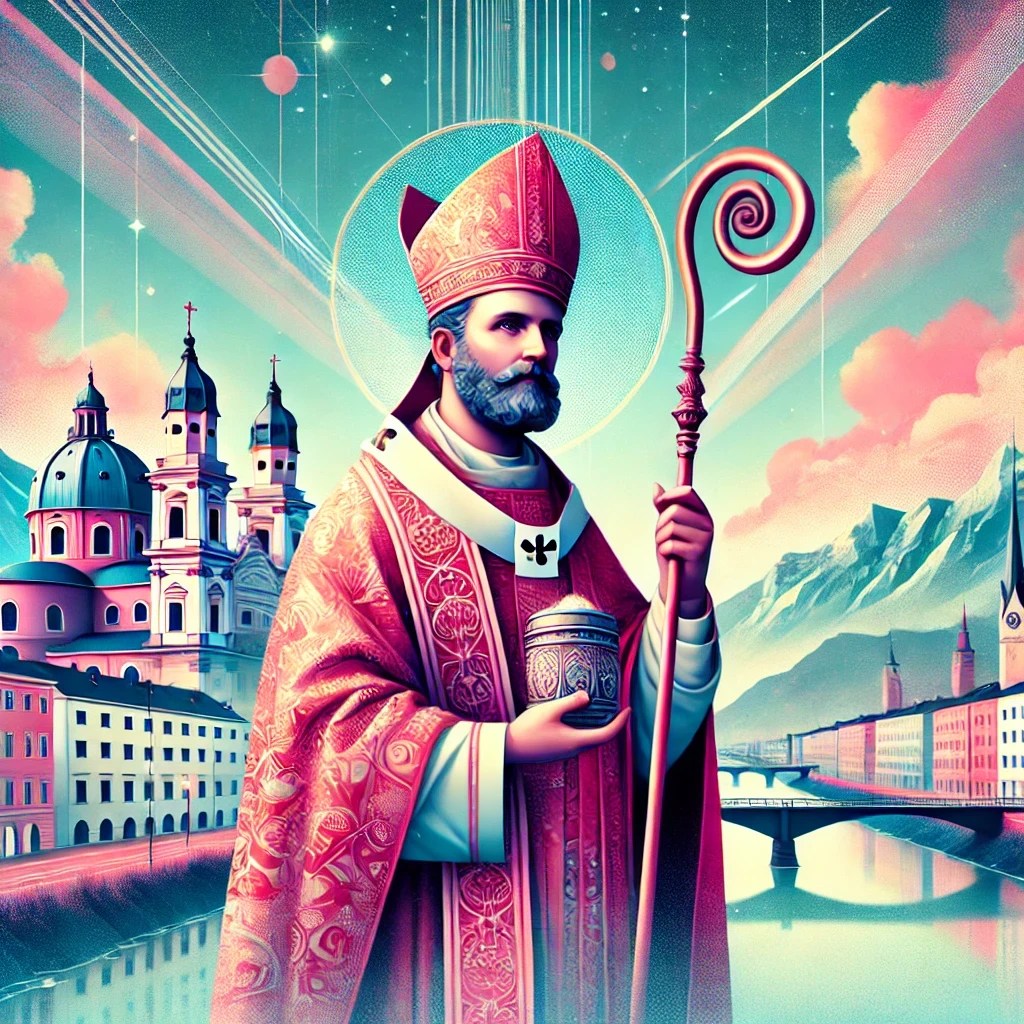
Apostle of the Alps
Saint Rupert of Salzburg, also known as Saint Robert of Hrodbert, stands as a towering figure in the history of Christian evangelization in Central Europe. Revered as the “Apostle of Bavaria and Austria,” his work laid the cornerstone for the spread of Christianity in regions deeply rooted in paganism during his time. Saint Rupert is particularly celebrated for founding the city of Salzburg and establishing its first Christian institutions. His feast day is celebrated on March 27th, and he is remembered not only as a bishop but as a bold missionary, teacher, and builder of both churches and communities. What makes Rupert a compelling saint is his vision of integrating Christian life into the social and economic spheres of the people he served, revitalizing towns, and caring for the poor while strengthening the faith.
Noble Blood, Humble Mission
Rupert was born around 660 AD into a noble Frankish family, possibly connected to the Merovingian dynasty, which was then the ruling royal house in much of what is now France and Germany. His upbringing was steeped in both privilege and piety, a combination that prepared him for leadership in the Church. He first served as the Bishop of Worms, where he labored to bring the Christian faith to the local population. However, resistance from the largely pagan peoples led him to seek new fields for evangelization.
A significant turning point came when Duke Theodo II of Bavaria invited Rupert to bring the light of the Gospel to the Bavarian people. Rupert answered this call with enthusiasm, embodying the missionary spirit so needed in his era. His travels eventually brought him to the decaying ruins of Juvavum, a former Roman settlement. Inspired by the Holy Spirit, Rupert saw potential where others saw desolation. He renamed the area Salzburg, meaning “Salt Fortress,” referencing the nearby salt mines that would economically sustain the community. Here, Rupert founded monasteries, churches, and schools, firmly planting the seeds of Christian life in the region. His most significant foundation was St. Peter’s Abbey, which became a center of monastic life and learning.
Signs of Heaven
Saint Rupert’s missionary efforts were marked by divine favor, as many miracles accompanied his work. One of the most renowned stories speaks of his gift of healing. Wherever Rupert traveled, reports spread of him curing those afflicted by disease and injury. These healings not only relieved physical suffering but also served as profound signs of God’s presence, softening hearts and opening doors to the Gospel. One chronicled instance tells of Rupert praying over a severely ill man who was restored to health almost instantly, leading to the conversion of the man’s entire household.
Another miracle involved the salt mines near Salzburg. Rupert, recognizing their economic potential, blessed them and helped organize the trade around them, securing livelihoods for the people of the region. Though this act may appear practical, the faithful believed Rupert’s prayers and blessing ensured the mines’ prosperity for generations. In these and other works, Rupert mirrored Christ’s compassion, blending charity with missionary zeal. As The Catechism reminds us, “By His compassion, Christ drew near to all human suffering” (CCC 1503), a truth Rupert lived with every act of service.
Rupert’s Endurance
Unlike many early missionaries who faced violent martyrdom, Rupert endured his hardships without shedding blood. Nevertheless, the path he walked was not free from opposition and sacrifice. The resistance he faced in Worms, where paganism still had a stronghold, was a test of his patience and fortitude. Even in Bavaria, Rupert initially faced skepticism and suspicion from local populations wary of abandoning their ancestral beliefs.
Yet, Rupert’s approach, which combined firm proclamation of the faith with genuine care for people’s material and spiritual needs, gradually won hearts. His humility and resilience allowed him to stay the course. In The Catechism, we are reminded that “The way of perfection passes by way of the Cross” (CCC 2015), and Rupert’s cross was the slow, patient labor of planting the Gospel where it was not yet welcome. He ultimately died peacefully around 710 AD, having laid the foundations of the Church in the region.
The Legacy Lives On
After his death, Rupert’s intercession continued to manifest in miraculous ways. His relics, first entombed at St. Peter’s Abbey, became objects of veneration, credited with many healings and divine interventions. The most notable site associated with Rupert today is Salzburg Cathedral, where his relics were transferred. This cathedral became, and remains, a site of pilgrimage for countless faithful.
The feast of Rupertitag, celebrated annually on September 24th, commemorates the translation of his relics and is a time of great celebration in Salzburg. Numerous reports over the centuries tell of pilgrims healed through Saint Rupert’s intercession, families reconciled, and communities spiritually renewed. His posthumous miracles highlight the Church’s belief in the Communion of Saints, as expressed in The Catechism: “Being more closely united to Christ, those who dwell in heaven fix the whole Church more firmly in holiness” (CCC 956).
A Reflection on Saint Rupert
Saint Rupert’s story is one of courage, patience, and unwavering dedication to evangelization. His ability to see God’s hand at work in every aspect of life—from the salt mines to the monasteries—teaches us to integrate our faith into all areas of life, not merely within church walls. In our modern world, we are called to be missionaries, too, even if our mission fields look more like our workplaces, neighborhoods, or digital platforms.
How might we, like Rupert, create communities that uplift both spiritually and materially? How can we be agents of healing, whether through acts of mercy or words of encouragement? Rupert’s witness encourages us to persevere when we encounter resistance to our faith and to patiently sow seeds, trusting that God will bring the harvest.
How can you bring missionary zeal into your home, workplace, or parish today? In what ways does Rupert’s ability to renew a broken community inspire your personal mission? Are you willing to serve even when the fruits of your labor are not immediately visible?
May we, inspired by Saint Rupert, strive to be instruments of God’s grace, building up His kingdom wherever He calls us.
Engage with Us!
We invite you to reflect on Saint Rupert’s legacy and consider the following questions:
- How can you incorporate missionary zeal into your everyday interactions?
- In what ways can you transform challenges into opportunities to strengthen and share your faith?
- How does Saint Rupert’s dedication inspire you to contribute to your community’s spiritual growth?
By reflecting on these questions, we can support each other in our faith journeys and strive to emulate the love and dedication exemplified by our Lord Jesus.
Saint Rupert, pray for us! 🙏✨
Follow us on Instagram and Facebook for more insights and reflections on living a faith-filled life.

 Holy Manna!
Leave a comment