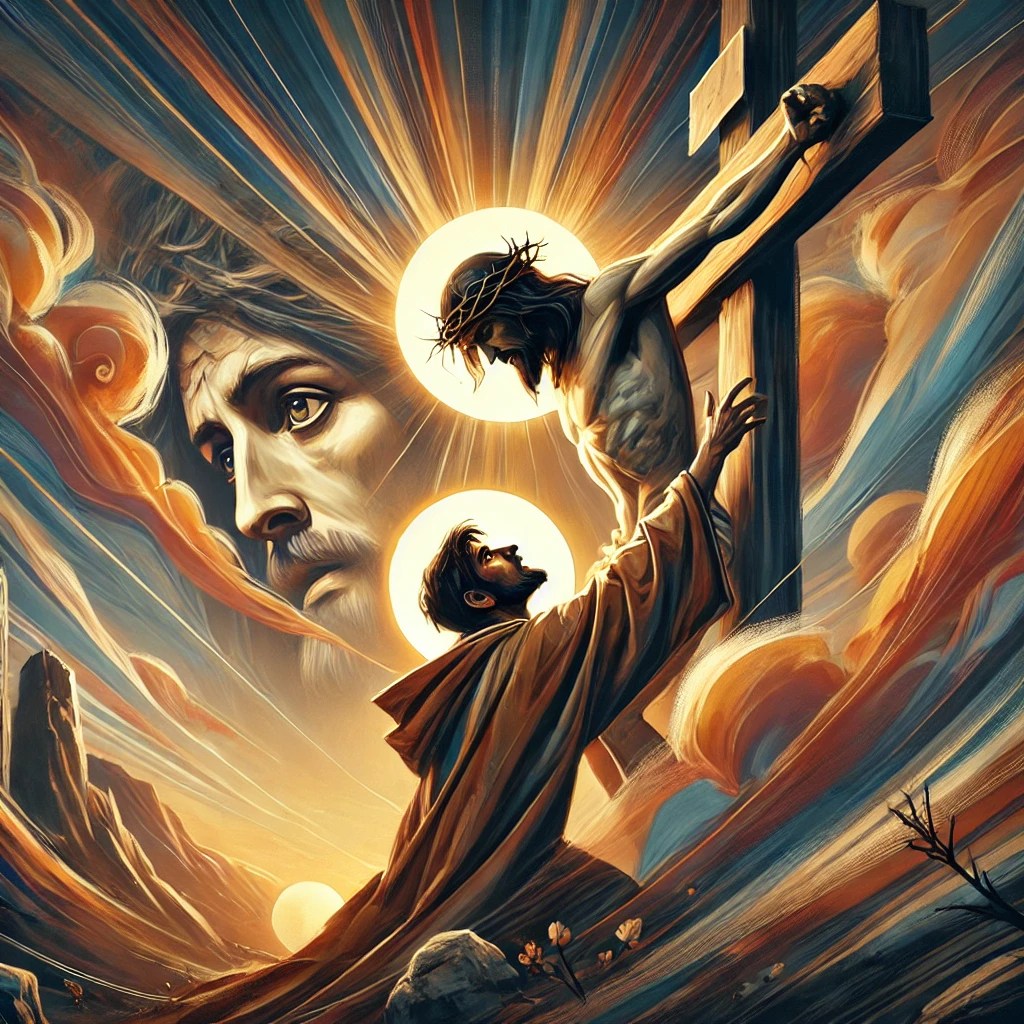
The Good Thief Who Stole Heaven
Saint Dismas is a figure who captivates the hearts of many Christians. Known as the “Good Thief,” Dismas stands as one of the most unexpected saints in the Church’s rich history. His is the story of a man who, in his final breath, encountered the mercy and promise of Jesus Christ. Tradition holds that Saint Dismas was canonized directly by Jesus on the cross, making him the first to enter paradise following the crucifixion. Dismas’s significance lies not in a lifetime of miracles or apostolic labors, but in his incredible act of faith and repentance at the hour of death. His story challenges us to never despair of God’s mercy and to recognize that sainthood is not only for the seemingly righteous but also for the sinner who repents.
A Rebel’s Road to Redemption
Very little is known about Saint Dismas’s early life. The Gospel of Luke does not mention his name, nor do we have any biographical details about his upbringing, family, or where he was born. His name, “Dismas,” comes to us through apocryphal sources, particularly the Gospel of Nicodemus. What we do know is that he lived as a criminal, condemned to crucifixion alongside Jesus at Golgotha, a punishment reserved for the most serious offenders under Roman law.
In one of the most profound moments recorded in Scripture, as he hung on the cross, Dismas rebuked the other thief who mocked Jesus. He openly acknowledged his guilt, declaring that they were receiving their just punishment, but Jesus was innocent. Then, with sincere humility, Dismas turned to Jesus and uttered the words that would secure his eternal destiny: “Jesus, remember me when you come into your kingdom.” (Luke 23:42). To this, Christ gave one of the most hope-filled promises in all of Scripture: “Truly, I say to you, today you will be with me in paradise.” (Luke 23:43).
This singular act of repentance and faith is why Dismas is revered throughout the Church. He is a reminder of the truth taught in The Catechism of the Catholic Church, paragraph 982: “There is no offense, however serious, that the Church cannot forgive. There is no one, however wicked and guilty, who may not confidently hope for forgiveness, provided his repentance is honest.”
Legends of Mercy
Although the canonical Gospels do not describe any miracles performed by Dismas, several early Christian traditions, particularly the Arabic Infancy Gospel, attribute a remarkable act of mercy to him. According to this apocryphal account, as the Holy Family fled to Egypt to escape King Herod’s wrath, they were intercepted by a band of robbers. Dismas, moved with compassion, prevented his fellow outlaws from harming Mary, Joseph, and the Infant Jesus. In gratitude, the Infant Jesus is said to have prophesied that Dismas would be crucified beside Him and promised him paradise.
While this account does not carry the weight of canonical Scripture, it highlights a core attribute associated with Dismas: mercy. His compassion, even as a bandit, foreshadows his ultimate repentance and the mercy he himself would receive from Christ. These legends, though not doctrinal, align with the Church’s understanding that even the gravest sinners are capable of acts of great goodness, planting seeds for future conversion.
A Cross of Suffering
The crucifixion of Dismas was not just the legal consequence of his crimes but also the stage for his spiritual victory. His death sentence brought him to Calvary, where the most significant encounter of his life occurred. As he endured unimaginable pain, he witnessed the suffering of Jesus, who bore the wounds of humanity’s sins.
Unlike the other thief, Dismas did not curse God or wallow in self-pity. Instead, he publicly professed Jesus’s innocence and messianic kingship. The early Church Fathers, including Saint Augustine and Saint Cyprian, saw this act as an extraordinary confession of faith. Saint Augustine reflects on this moment in one of his sermons, teaching that the Good Thief “believed when even the disciples doubted.” Some theologians and saints consider Dismas a martyr, as he bore witness to Christ amidst personal agony and societal rejection.
This display of unwavering faith under persecution makes Dismas an icon for those facing suffering and imminent death. His endurance and courage, forged in the crucible of pain, reveal that salvation is possible even in life’s final and darkest moments.
The Echoes of Redemption
While there are no formally documented posthumous miracles attributed to Saint Dismas, his story has become a miracle of grace to countless souls through the centuries. The Church has honored his legacy by dedicating numerous chapels, prisons, and ministries to his name, particularly those focused on prison ministry and the rehabilitation of former offenders.
Saint Dismas’s conversion has inspired countless sinners to turn back to Christ, especially in their final hours. His legacy lives on in every individual who finds hope in Christ’s mercy at the eleventh hour. Sites dedicated to him, such as chapels within prisons or organizations like the Dismas Ministry, continue to foster healing and spiritual renewal.
Pilgrimages to these places or invoking his intercession reminds us that, as The Catechism teaches in paragraph 1037, “God predestines no one to go to hell; for this, a willful turning away from God (a mortal sin) is necessary, and persistence in it until the end.” Saint Dismas embodies the truth that repentance can be chosen, even at life’s conclusion.
Engage with Us!
We invite you to reflect on Saint Dismas’s journey and consider how his story resonates with your own faith experience. Share your thoughts and reflections in the comments below. To spark discussion, here are three reflection questions:
- In what ways can we practice humility and seek forgiveness in our daily lives?
- How can we support others on their path to redemption and spiritual growth?
- What does Saint Dismas’s story teach us about the power of last-minute repentance and God’s boundless mercy?
Let us support each other in our faith journey and strive to do everything with love, as our Lord Jesus did.
Saint Dismas, pray for us!
Follow us on Instagram and Facebook for more insights and reflections on living a faith-filled life.

 Holy Manna!
Leave a comment