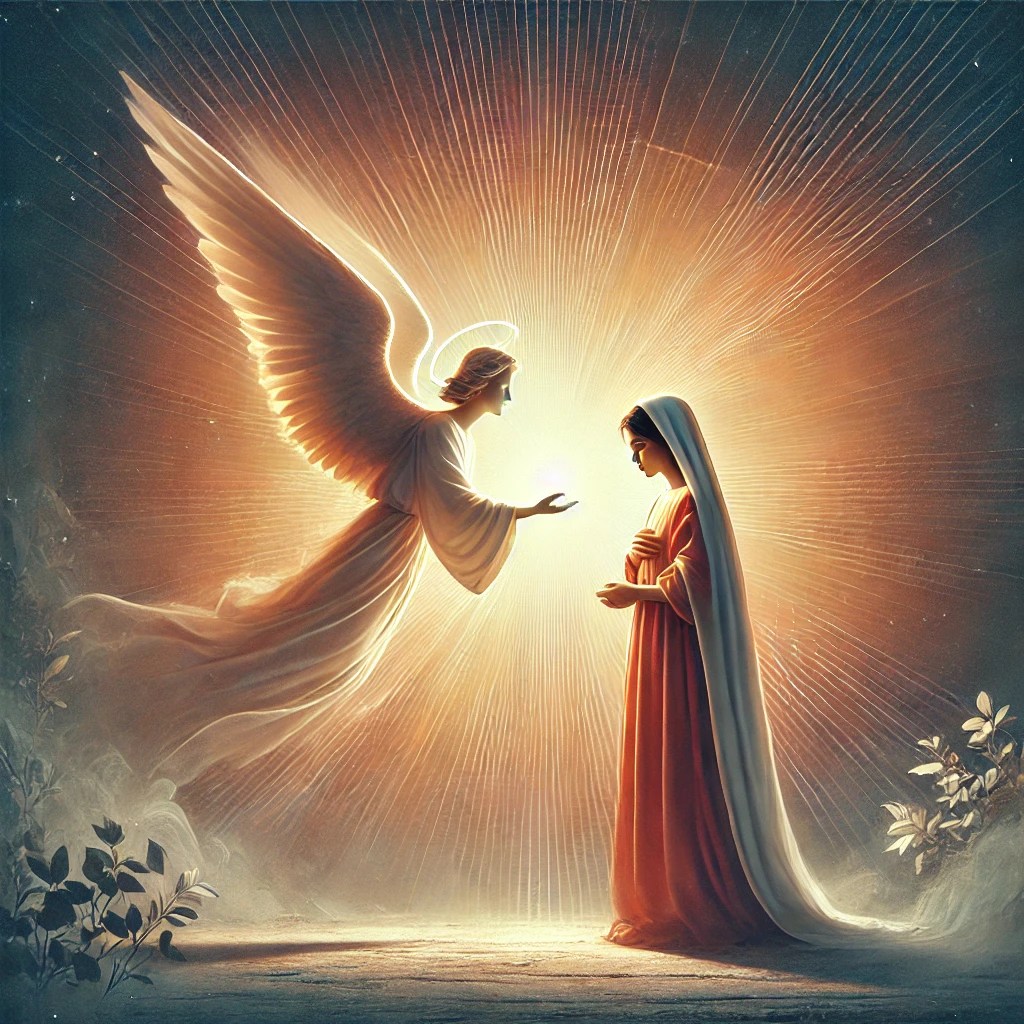
“Behold, I Come to Do Your Will”
In every journey of faith, there is a decisive moment where trust and surrender collide—a moment when heaven touches earth, inviting us to say “yes” to the divine plan. Today’s readings bring us into such sacred moments, where God’s will is revealed and humanity is invited into His mystery. From the ancient echoes of Isaiah’s prophecy to Mary’s humble fiat in The Gospel of Luke, we are immersed in God’s unfolding story, where divine promises are fulfilled through simple but profound obedience.
The backdrop of these readings is deeply rooted in Israel’s longing for salvation and deliverance. The people of Judah, facing political and military threats in Isaiah’s time, are promised a sign: “the young woman, pregnant and about to bear a son, shall name him Emmanuel”—God with us. This prophecy, shrouded in anticipation, finds its perfect fulfillment in Mary, the young virgin of Nazareth, who receives the angel’s message with courageous faith. Centuries later, the Letter to the Hebrews unveils the depth of Christ’s mission, emphasizing that it is not burnt offerings, but the total gift of Himself, “the offering of the body of Jesus Christ once for all”, that accomplishes God’s will. Psalm 40 echoes this disposition of heart, delighting in surrender to God rather than mere ritual.
Together, these passages converge to reveal the heart of salvation history: the Incarnation as the supreme act of divine initiative and human cooperation. God does not impose; He invites. Mary’s “yes” mirrors Christ’s own self-offering and calls us to ponder the ways we are called to embody this obedience in our daily lives. Are we open to God’s will, even when it disrupts our plans? As we reflect on today’s readings, we are challenged to trust like Mary, to offer ourselves like Christ, and to proclaim boldly, “Behold, I come to do your will, O God”.
First Reading – Isaiah 7:10-14; 8:10
A Sign Beyond Imagination
The Book of Isaiah is a cornerstone of prophetic literature, particularly renowned for its messianic prophecies that shaped Israel’s hope for redemption. Written during a turbulent period of political instability around the 8th century BC, Isaiah addresses King Ahaz of Judah, who faces threats from neighboring kingdoms. Fearful and tempted to rely on foreign alliances rather than on God, Ahaz embodies a crisis of faith. Yet Isaiah, the mouthpiece of God, offers a radical promise: Emmanuel, “God with us.” This promise transcends immediate political concerns, projecting forward to the Incarnation. Today’s reading fits beautifully into the central theme of obedience to God’s will and trust in divine providence. The sign Isaiah foretells reaches its fullness in Mary and the birth of Christ, who perfectly fulfills God’s promise to dwell with His people.
Isaiah 7:10-14; 8:10
New American Bible (Revised Edition)
Emmanuel. 10 Again the Lord spoke to Ahaz: 11 Ask for a sign from the Lord, your God; let it be deep as Sheol, or high as the sky! 12 But Ahaz answered, “I will not ask! I will not tempt the Lord!” 13 Then he said: Listen, house of David! Is it not enough that you weary human beings? Must you also weary my God? 14 Therefore the Lord himself will give you a sign; the young woman, pregnant and about to bear a son, shall name him Emmanuel.
10 Form a plan, it shall be thwarted;
make a resolve, it shall not be carried out,
for “With us is God!”
Detailed Exegesis
Verse 10 – “Again the Lord spoke to Ahaz”
God, through Isaiah, persists in communicating with Ahaz despite his wavering heart. This reflects God’s relentless desire to guide His people, even when they resist His plans.
Verse 11 – “Ask for a sign from the Lord, your God; let it be deep as Sheol, or high as the sky!”
Here, God invites Ahaz to request a sign of any magnitude, emphasizing God’s boundless power. The invitation shows divine generosity, willing to meet Ahaz’s fear with reassurance.
Verse 12 – “But Ahaz answered, ‘I will not ask! I will not tempt the Lord!’”
Ahaz’s refusal may appear pious, but it reveals a lack of trust. His words echo Deuteronomy 6:16—“You shall not put the Lord, your God, to the test”—yet his heart is closed to God’s intervention, preferring political maneuvering over faith.
Verse 13 – “Then he said: Listen, house of David! Is it not enough that you weary human beings? Must you also weary my God?”
Isaiah addresses not only Ahaz but the entire Davidic lineage, exposing their spiritual fatigue and resistance. The prophet expresses divine frustration over their reluctance to trust fully in God’s promises.
Verse 14 – “Therefore the Lord himself will give you a sign; the young woman, pregnant and about to bear a son, shall name him Emmanuel.”
This is the prophetic climax. The sign is not one Ahaz asks for, but one God provides. The “young woman,” later understood by the Church as Mary, will bear Emmanuel—“God with us”—the ultimate reassurance that God accompanies His people.
Verse 10 (Isaiah 8:10) – “Form a plan, it shall be thwarted; make a resolve, it shall not be carried out, for ‘With us is God!’”
This verse serves as a divine guarantee: human strategies, however well-devised, cannot stand against God’s will. Emmanuel ensures victory not by military might but by the enduring presence of God.
Teachings
The Catechism of the Catholic Church teaches that “The coming of God’s Son to earth is an event of such immensity that God willed to prepare for it over centuries” (CCC 522). The prophecy in Isaiah is part of this divine preparation, setting the stage for the Incarnation. The Church sees in the figure of Emmanuel the mystery of Christ, who fulfills God’s eternal promise to dwell with humanity. Further, CCC 712 highlights how prophetic texts like Isaiah’s reveal the characteristics of the awaited Messiah, especially His divine sonship and His mission as the Savior.
St. Irenaeus of Lyon reflects deeply on this passage in Against Heresies, declaring, “The Lord himself will give you a sign… manifested by the birth from a virgin, pointing to the Lord’s incarnation and the salvation of the human race” (Book III, Chapter 21). Irenaeus emphasizes that God’s sign surpasses human expectations—it is not merely political rescue but the very entrance of God into human history through Mary.
Historically, this prophecy resonates at the heart of Advent and Marian theology. The Church Fathers consistently interpreted Isaiah 7:14 as foretelling the Virgin Birth, making it integral to the early Creeds. The Council of Chalcedon (AD 451) declared Christ “born of the Virgin Mary, the Mother of God” as an affirmation of this mystery. This reading, then, is foundational to our understanding of Christology and Marian devotion.
Reflection
How often do we, like Ahaz, hesitate to trust in God’s promises when faced with uncertainty? The reading calls us to confront the ways we rely on our own “alliances” and strategies instead of surrendering fully to God’s will. Emmanuel—God with us—is not a distant reality but a present invitation to let divine love guide our choices. In a world where we often measure success by immediate outcomes, Isaiah reminds us that God’s plans far exceed human calculation. Today, consider the areas of your life where fear or control might be blocking you from saying “yes” to God’s invitation. What sign might God be offering you today that calls for a leap of faith? Like Mary, who fulfills this prophecy with her humble fiat, we are invited to trust in God’s abiding presence and to recognize Emmanuel in both the extraordinary and ordinary moments of life.
Responsorial Psalm – Psalm 40:7-11
A Heart Aligned with God’s Will
The Book of Psalms holds a unique place in the spiritual treasury of Israel and the Church, acting as both prayer and prophecy. Psalm 40 is a psalm of thanksgiving and trust, traditionally attributed to King David. It reflects a heart that recognizes true worship is not found in external rituals alone but in a sincere desire to fulfill God’s will. In the context of today’s readings, this psalm becomes a bridge linking the prophecy of Emmanuel to Christ’s obedience and Mary’s fiat. It echoes the same disposition God seeks in both Mary and Christ—a heart ready to say, “Behold, I come to do your will”. This psalm fits seamlessly into our theme of surrender to divine providence, calling us to embody this trust in our own lives.
Psalm 40:7-11
New American Bible (Revised Edition)
7 Sacrifice and offering you do not want;
you opened my ears.
Holocaust and sin-offering you do not request;
8 so I said, “See; I come
with an inscribed scroll written upon me.
9 I delight to do your will, my God;
your law is in my inner being!”
10 When I sing of your righteousness
in a great assembly,
See, I do not restrain my lips;
as you, Lord, know.
11 I do not conceal your righteousness
within my heart;
I speak of your loyalty and your salvation.
I do not hide your mercy or faithfulness from a great assembly.
Detailed Exegesis
Verse 7 – “Sacrifice and offering you do not want; you opened my ears. Holocaust and sin-offering you do not request”
This verse emphasizes that external sacrifices, while part of the Law, are not God’s deepest desire. What God longs for is an open heart, a spirit attuned to His voice. The phrase “you opened my ears” suggests a personal and intimate relationship where one listens attentively to God’s will.
Verse 8 – “So I said, ‘See; I come with an inscribed scroll written upon me.’”
Here, the psalmist declares readiness to act according to God’s law, internalized as part of one’s very being. The “scroll” symbolizes divine instruction, aligning one’s mission and purpose with God’s written Word.
Verse 9 – “I delight to do your will, my God; your law is in my inner being!”
True faith is marked by delight, not obligation. This verse highlights joy in surrendering to God’s plan. The internalization of God’s law—“in my inner being”—points to a heart transformed by love, not mere legal compliance.
Verse 10 – “When I sing of your righteousness in a great assembly, see, I do not restrain my lips; as you, Lord, know.”
The psalmist moves from personal commitment to public proclamation. Faith is not hidden but shared within the community. This openness mirrors Mary’s Magnificat and Christ’s public ministry—both are examples of proclaiming God’s righteousness openly.
Verse 11 – “I do not conceal your righteousness within my heart; I speak of your loyalty and your salvation. I do not hide your mercy or faithfulness from a great assembly.”
This final verse reinforces the call to evangelization. The psalmist is a witness to God’s faithfulness and mercy, refusing to keep this experience private. The communal dimension of faith—declaring God’s goodness before others—is essential to Christian discipleship.
Teachings
The Catechism teaches that “Sacrifice is first of all internal: the sacrifice of a broken and contrite heart” (CCC 2100). While the Old Covenant involved ritual offerings, Psalm 40 prefigures the New Covenant’s focus on interior conversion. This psalm finds ultimate expression in Christ, who perfectly fulfills God’s will by offering Himself on the Cross. CCC 614 states, “Christ’s death is both the Paschal sacrifice that accomplishes the definitive redemption of men, through the ‘Lamb of God, who takes away the sin of the world,’ and the sacrifice of the New Covenant”.
St. Augustine comments on this psalm in his Expositions on the Psalms, where he writes, “The sacrifices which were offered to God were figures of the one sacrifice to come, which is the body of Christ, and the Church is to imitate this sacrifice in her members.” Augustine invites us to see ourselves as participants in Christ’s mission, called to offer our daily lives as living sacrifices.
In early Christian communities, this psalm became associated with the mystery of Christ’s obedience and the Church’s role in continuing His mission. The Letter to the Hebrews, today’s second reading, even quotes this psalm directly to emphasize that Jesus came to do the Father’s will. Historically, this psalm shaped the Christian understanding of discipleship as a path of inner transformation, communal witness, and joyful surrender.
Reflection
How do we delight in doing God’s will today? This psalm challenges us to move beyond superficial practices and to cultivate a deep and joyful obedience. In a world where we often prioritize convenience or personal desires, God invites us to open our ears and hearts to His Word. Are there areas in your life where God is asking you to listen more closely? Like the psalmist, we are called to proclaim God’s mercy and faithfulness to others, not keeping His goodness to ourselves. Today, let us ask for the grace to internalize God’s law and, like Mary and Christ, respond with a willing heart, ready to say “I delight to do your will, my God”.
Second Reading – Hebrews 10:4-10
The Perfect Offering
The Letter to the Hebrews offers one of the richest theological reflections on the mystery of Christ’s priesthood and sacrifice. Written to a community familiar with the Temple cult and the Jewish sacrificial system, Hebrews presents Jesus as both the High Priest and the perfect sacrifice that surpasses the limitations of the Old Covenant. The author contrasts the repeated animal sacrifices, which could never fully remove sin, with Christ’s singular self-offering. This reading fits seamlessly with today’s theme of obedience to God’s will, as it reveals Christ’s voluntary surrender and fulfillment of the Father’s plan for humanity’s redemption. It bridges the prophetic promise of Emmanuel and Mary’s fiat by showing that Jesus, the Son of God, fully embodies the psalmist’s declaration: “Behold, I come to do your will, O God”.
Hebrews 10:4-10
New American Bible (Revised Edition)
4 for it is impossible that the blood of bulls and goats take away sins. 5 For this reason, when he came into the world, he said:
“Sacrifice and offering you did not desire,
but a body you prepared for me;
6 holocausts and sin offerings you took no delight in.
7 Then I said, ‘As is written of me in the scroll,
Behold, I come to do your will, O God.’”
8 First he says, “Sacrifices and offerings, holocausts and sin offerings, you neither desired nor delighted in.” These are offered according to the law. 9 Then he says, “Behold, I come to do your will.” He takes away the first to establish the second. 10 By this “will,” we have been consecrated through the offering of the body of Jesus Christ once for all.
Detailed Exegesis
Verse 4 – “For it is impossible that the blood of bulls and goats take away sins.”
This opening statement dismantles any notion that ritual sacrifices could bring about true reconciliation with God. While part of the Mosaic Law, these sacrifices were preparatory, pointing toward the ultimate sacrifice in Christ.
Verse 5 – “For this reason, when he came into the world, he said: ‘Sacrifice and offering you did not desire, but a body you prepared for me.’”
The author quotes Psalm 40 to show that the Messiah’s mission was foretold: God desired not mere external offerings but the complete self-gift of Christ, whose body becomes the true instrument of redemption.
Verse 6 – “Holocausts and sin offerings you took no delight in.”
Reiterating the inadequacy of temple sacrifices, this verse emphasizes that God is not pleased with ritual alone. It foreshadows Christ’s perfect offering—an act of love that surpasses legal observance.
Verse 7 – “Then I said, ‘As is written of me in the scroll, Behold, I come to do your will, O God.’”
Jesus steps forward in complete submission to the Father’s will. This verse reflects Christ’s interior disposition, rooted in obedience and love, echoing Mary’s own fiat.
Verse 8 – “First he says, ‘Sacrifices and offerings, holocausts and sin offerings, you neither desired nor delighted in.’ These are offered according to the law.”
The author highlights that these rituals were lawful yet insufficient. The New Covenant surpasses the old by establishing a relationship of personal surrender rather than transactional offerings.
Verse 9 – “Then he says, ‘Behold, I come to do your will.’ He takes away the first to establish the second.”
Christ abolishes the old sacrificial system by fulfilling its deepest intention: total surrender to God’s will. The “first” (the old rites) gives way to the “second” (the offering of Christ Himself).
Verse 10 – “By this ‘will,’ we have been consecrated through the offering of the body of Jesus Christ once for all.”
This powerful conclusion proclaims that through Christ’s obedience, all believers are sanctified. The phrase “once for all” underlines the definitive nature of Christ’s sacrifice—no further offerings are needed.
Teachings
The Catechism teaches that “The sacrifice of Christ is unique; it completes and surpasses all other sacrifices” (CCC 614). This passage from Hebrews brings this truth to life by drawing attention to the insufficiency of prior sacrifices and the fullness found in Christ’s act of love. In CCC 606, we read: “The desire to embrace his Father’s plan of redeeming love inspired Jesus’ whole life”. From His Incarnation to His Passion, Jesus embodies total obedience to the Father.
St. Thomas Aquinas, in his Summa Theologiae, affirms, “The principal act of the priest is to offer sacrifice, and the principal sacrifice is that of Christ’s own body” (ST III, Q22, A1). Aquinas teaches that Christ, as both priest and victim, fulfills the deepest longing of humanity for reconciliation with God. His offering is not merely physical but spiritual, uniting divine and human wills in a perfect harmony.
Historically, this teaching shaped early Christian worship, where the Eucharist became understood as the re-presentation of Christ’s once-for-all sacrifice. The Fathers of the Church, such as St. John Chrysostom, emphasized that the liturgy is not a new sacrifice but a participation in the eternal sacrifice of Christ. This deepens our understanding of every Mass as a moment where heaven and earth meet in Christ’s obedience.
Reflection
How does Christ’s total surrender inspire your own approach to God’s will? Today’s reading invites us to examine how we offer ourselves in our daily lives. Like Christ, we are called to move beyond mere obligation and toward a heartfelt gift of self. Are there areas where you are clinging to rituals or routines but holding back true surrender? The invitation is clear: to consecrate our lives through small, daily acts of love, sacrifice, and obedience. Let us echo the words of Christ and Mary, choosing to say “Behold, I come to do your will, O God” even when the path ahead seems uncertain.
Holy Gospel – Luke 1:26-38
“The Fiat That Changed History”
The Gospel of Luke is known for its tender focus on the role of Mary and the Holy Spirit in salvation history. Luke, a physician and companion of St. Paul, carefully highlights God’s intervention in the ordinary lives of people, bringing forth the extraordinary. Today’s passage, the Annunciation, is pivotal not only in the liturgical calendar but also in the narrative of redemption itself. Set in Nazareth, a small and seemingly insignificant town, the angel Gabriel’s message to Mary is the fulfillment of the prophecy given through Isaiah centuries earlier. This moment is where heaven’s promise and humanity’s freedom meet, as Mary freely consents to become the Mother of God. The Annunciation is at the very heart of today’s theme: radical obedience to God’s will, which initiates the mystery of the Incarnation.
Luke 1:26-38
New American Bible (Revised Edition)
26 In the sixth month, the angel Gabriel was sent from God to a town of Galilee called Nazareth, 27 to a virgin betrothed to a man named Joseph, of the house of David, and the virgin’s name was Mary. 28 And coming to her, he said, “Hail, favored one! The Lord is with you.” 29 But she was greatly troubled at what was said and pondered what sort of greeting this might be. 30 Then the angel said to her, “Do not be afraid, Mary, for you have found favor with God. 31 Behold, you will conceive in your womb and bear a son, and you shall name him Jesus. 32 He will be great and will be called Son of the Most High, and the Lord God will give him the throne of David his father, 33 and he will rule over the house of Jacob forever, and of his kingdom there will be no end.” 34 But Mary said to the angel, “How can this be, since I have no relations with a man?” 35 And the angel said to her in reply, “The holy Spirit will come upon you, and the power of the Most High will overshadow you. Therefore the child to be born will be called holy, the Son of God. 36 And behold, Elizabeth, your relative, has also conceived a son in her old age, and this is the sixth month for her who was called barren; 37 for nothing will be impossible for God.” 38 Mary said, “Behold, I am the handmaid of the Lord. May it be done to me according to your word.” Then the angel departed from her.
Detailed Exegesis
Verse 26 – “In the sixth month, the angel Gabriel was sent from God to a town of Galilee called Nazareth”
The “sixth month” refers to Elizabeth’s pregnancy with John the Baptist. Gabriel’s visit to Nazareth—a town not known for its religious or political significance—illustrates that God often chooses the humble and unexpected.
Verse 27 – “To a virgin betrothed to a man named Joseph, of the house of David, and the virgin’s name was Mary.”
Mary’s betrothal to Joseph of David’s line fulfills the Messianic prophecy tied to the Davidic covenant. Mary’s virginity underlines the miraculous nature of the conception, prefigured in Isaiah’s words: “the young woman, pregnant and about to bear a son”.
Verse 28 – “And coming to her, he said, ‘Hail, favored one! The Lord is with you.’”
Gabriel greets Mary with “Hail” (chaire in Greek), a salutation that carries royal overtones. She is “favored,” meaning filled with grace, prepared uniquely for this divine mission.
Verse 29 – “But she was greatly troubled at what was said and pondered what sort of greeting this might be.”
Mary’s reaction is one of humility and discernment. Rather than being fearful of Gabriel’s presence, she reflects on the meaning of his words, showing her contemplative nature.
Verse 30 – “Then the angel said to her, ‘Do not be afraid, Mary, for you have found favor with God.’”
Gabriel reassures Mary, echoing God’s comforting words throughout salvation history. Her “favor” is a gift from God, not based on merit but on divine grace.
Verse 31 – “Behold, you will conceive in your womb and bear a son, and you shall name him Jesus.”
The name “Jesus” (Yeshua) means “God saves,” revealing His mission from the outset. This verse directly fulfills the promise of a son foretold to Ahaz and the house of David.
Verse 32 – “He will be great and will be called Son of the Most High, and the Lord God will give him the throne of David his father.”
Gabriel reveals Jesus’ divine identity and kingship. “Son of the Most High” links Jesus to God Himself, while the mention of David’s throne ties to messianic expectation.
Verse 33 – “And he will rule over the house of Jacob forever, and of his kingdom there will be no end.”
The eternal nature of Christ’s reign fulfills the covenantal promise to David in 2 Samuel 7:16—a kingdom that transcends earthly boundaries and lasts forever.
Verse 34 – “But Mary said to the angel, ‘How can this be, since I have no relations with a man?’”
Mary’s question is not one of disbelief but of seeking understanding. It reflects her purity and her deep openness to God’s plan, even in mystery.
Verse 35 – “And the angel said to her in reply, ‘The holy Spirit will come upon you, and the power of the Most High will overshadow you. Therefore the child to be born will be called holy, the Son of God.’”
Gabriel reveals the Trinitarian action in the Incarnation. The “overshadowing” recalls the cloud of God’s presence over the Ark of the Covenant (Exodus 40:34), positioning Mary as the new Ark.
Verse 36 – “And behold, Elizabeth, your relative, has also conceived a son in her old age, and this is the sixth month for her who was called barren.”
Gabriel offers Mary a sign—Elizabeth’s miraculous pregnancy—as a witness to God’s power at work.
Verse 37 – “For nothing will be impossible for God.”
This declaration is central to understanding divine providence. God’s plans are not constrained by human limitations.
Verse 38 – “Mary said, ‘Behold, I am the handmaid of the Lord. May it be done to me according to your word.’ Then the angel departed from her.”
Mary’s fiat is the climax of this passage. Her “yes” initiates the Incarnation and invites all of humanity to imitate her openness to God’s will.
Teachings
The Catechism teaches that “The Father’s only Son, conceived as man in the womb of the Virgin Mary, is ‘Christ,’ that is to say, the anointed one by the Holy Spirit, from the beginning of his human existence” (CCC 486). Mary’s consent is pivotal, not just for her own life, but for the salvation of all. CCC 494 further states, “The knot of Eve’s disobedience was untied by Mary’s obedience: what the virgin Eve bound through her disbelief, Mary loosened by her faith”. Mary becomes the “new Eve,” whose fiat counteracts the disobedience of the Fall.
St. Bernard of Clairvaux, in one of his most famous homilies, urges us to consider the significance of Mary’s response: “The whole world awaits Mary’s answer. We too are waiting, O Lady, for the word of mercy.” In Mary’s humility and courage, heaven and earth are reconciled. This moment, Bernard explains, represents the hinge of salvation history.
The Council of Ephesus (AD 431) declared Mary as Theotokos, “God-bearer” or “Mother of God,” affirming that Jesus is one Person with two natures—divine and human. This dogma safeguards the truth that the child Mary bears is fully God and fully man. Thus, Mary’s fiat is not merely personal; it is profoundly ecclesial, making her the Mother of the Church and of all believers.
Reflection
What is God asking of you today that might require a leap of faith? Mary’s openness challenges us to be receptive to God’s invitations, even when they seem impossible or overwhelming. Like Mary, we may encounter moments when God’s will disrupts our expectations and calls for a deeper trust. Where in your life are you being invited to say “yes” to something you don’t fully understand? Mary teaches us that surrendering to God’s will, even with uncertainty, bears fruit beyond imagination. Today, let us echo her words, “Behold, I am the handmaid of the Lord. May it be done to me according to your word”, and trust that nothing is impossible for God.
Emmanuel: The Call to Trust and Obedience
Today’s readings weave together a profound narrative of God’s faithfulness and humanity’s response to His will. From Isaiah’s ancient prophecy of Emmanuel, “God with us”, to the psalmist’s joyful proclamation, “I delight to do your will, my God”, and culminating in Mary’s courageous fiat, the Scriptures invite us into the heart of salvation history. They reveal that God’s plans are not shaped by human logic but by divine love, and they unfold through the humble, trusting obedience of those who say “yes” to Him.
At the center of this message is the invitation to surrender. Christ’s perfect offering, “once for all”, fulfills the deepest longing for reconciliation between God and humanity. Mary’s openness allows the Word to become flesh, and the psalmist’s delight in doing God’s will models the interior posture we are called to imitate. Together, these readings challenge us to examine our own readiness to trust, to listen, and to respond with generosity when God speaks.
How is God asking you to say “yes” today? Like Mary, like Christ, we are invited to participate in the unfolding of God’s plan through simple but radical trust. As we leave these readings behind and return to our daily lives, let us carry their message within us: Emmanuel is with us. May we, too, be willing to say “Behold, I come to do your will, O God” and allow His grace to bear fruit in our hearts and in the world around us.
Engage with Us!
We would love to hear how today’s readings spoke to your heart. Share your thoughts, prayers, or personal reflections in the comments below. Let’s journey together as a community, growing in faith and learning from one another. Below are some questions to help you dive deeper into today’s Word:
First Reading – Isaiah 7:10-14; 8:10:
In what areas of your life do you struggle to trust in God’s promises, as Ahaz did? How might Emmanuel—God with us—be inviting you to surrender more fully to His will?
Responsorial Psalm – Psalm 40:7-11:
How does this psalm challenge your understanding of what it means to “delight in doing God’s will”? Are there moments when you’ve found joy in saying “yes” to God, even when it wasn’t easy?
Second Reading – Hebrews 10:4-10:
How does Christ’s perfect self-offering inspire you to make sacrifices in your daily life? Where might God be asking you to let go of superficial routines and embrace deeper spiritual surrender?
Holy Gospel – Luke 1:26-38:
Mary’s fiat changed the course of salvation history. What is God inviting you to say “yes” to in this season of your life? How can you imitate Mary’s trust and openness to the Holy Spirit’s work?
May we all strive to live each day in faith, offering our hearts to God and loving others with the mercy and compassion that Jesus taught us. Go forth today trusting that “nothing will be impossible for God” and let His love guide your every step.
Follow us on Instagram and Facebook for more insights and reflections on living a faith-filled life.

 Holy Manna!
Leave a comment