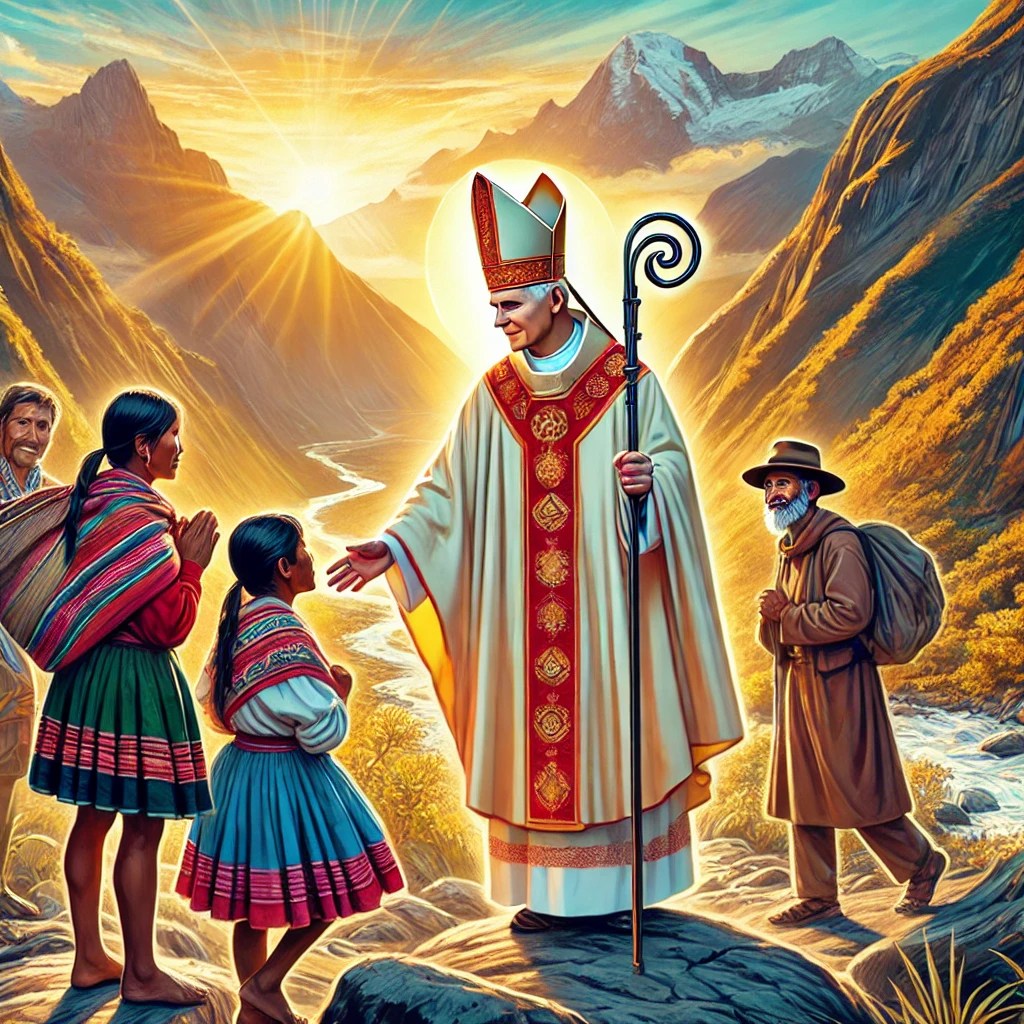
The Fearless Shepherd of the New World
Saint Toribio Alfonso de Mogrovejo stands as one of the greatest missionary bishops of the Catholic Church, a shepherd who tirelessly defended the indigenous people of Peru and reformed the local clergy. Unlike many saints, he was not born into the religious life, but rather, he was a learned scholar and judge, called unexpectedly into a role that would shape the future of Catholicism in Latin America. His zeal for justice, unwavering faith, and profound humility made him an extraordinary bishop whose legacy continues to inspire Christians worldwide. He did not merely preach the Gospel—he lived it, walking thousands of miles through treacherous terrain to bring the love of Christ to those who had never heard His name.
An Unexpected Calling
Toribio Alfonso de Mogrovejo was born on November 16, 1538, in Mayorga, Spain, into a noble family with deep Christian roots. Gifted with intellect and a strong moral compass, he pursued law at the University of Salamanca, quickly rising to prominence as a professor. His reputation for wisdom and integrity led to his appointment as the chief judge of the Inquisition in Granada—a role that emphasized his deep knowledge of canon law and his commitment to justice.
Though his career was flourishing, God had other plans for him. In 1580, King Philip II of Spain nominated Toribio as the Archbishop of Lima, Peru, despite the fact that he was not yet a priest. This was an unusual but divinely inspired decision. Seeing the desperate state of the Church in the Spanish colonies, where corruption and abuse were rampant, Toribio was chosen as the man to reform and restore. Though he initially resisted the appointment, citing his unworthiness, he eventually submitted to God’s will. He was quickly ordained a priest, consecrated as a bishop, and sent to the New World to take on the enormous task ahead.
A Missionary Who Walked With His Flock
When Toribio arrived in Peru in 1581, he found a Church in crisis. Many clergy members were more concerned with wealth than with their pastoral duties, and the indigenous people suffered under unjust colonial policies. From the moment he set foot on Peruvian soil, he dedicated himself to reforming the Church and defending the native population.
Unlike many bishops who remained in the safety of their cathedrals, Toribio traveled tirelessly across his vast archdiocese, covering more than 40,000 miles on foot and horseback. He visited remote villages, climbed mountains, crossed rivers, and endured harsh climates—all to bring the Gospel to people who had never heard it before. He did not merely convert and baptize; he learned the indigenous languages of Quechua and Aymara so he could preach to the people in their own tongues. It is said that he baptized nearly half a million people, including the future saints Saint Rose of Lima and Saint Martin de Porres.
His love for the poor was evident in everything he did. He ensured that native people were treated with dignity, often intervening in legal matters to protect them from exploitation. He insisted that priests be properly trained, disciplined those who abused their power, and worked tirelessly to establish seminaries and schools. His leadership was not about authority—it was about service.
The Silent Miracles of a Faithful Servant
Unlike some saints known for spectacular miracles, Saint Toribio’s greatest miracle was his perseverance and unwavering faith in the face of extreme hardship. However, accounts of his deep holiness suggest that God worked through him in extraordinary ways. One such instance was his ability to endure severe journeys without food or rest, sustained only by prayer. Many also reported being moved to conversion simply by the presence of his holiness.
His fluency in Quechua and Aymara, despite never having formally studied them, was also considered by many to be a divine gift. His ability to communicate the Gospel so effectively in these native languages led to the widespread conversion of thousands. His life itself was a miracle—a bishop who abandoned comfort and security to embrace a missionary’s life, pouring out everything for his flock.
Trials and Triumphs of a Faithful Shepherd
Saint Toribio faced immense opposition throughout his ministry. His efforts to reform the Church in Peru were met with hostility from colonial officials, who resented his interference in matters of governance. Many of the Spanish settlers and clergy saw his push for indigenous rights as a threat to their power and wealth. Despite this, he never wavered in his commitment to justice.
He was also no stranger to physical suffering. His long missionary journeys often left him exhausted and ill. Yet he never complained, believing that suffering was a part of his calling. He saw hardship as an opportunity to share in Christ’s passion, embracing it with a heart full of love for God and His people.
His final journey was his most difficult. In 1606, while traveling through his diocese, he fell seriously ill. Knowing his time was near, he continued to pray and offer his suffering for the Church he loved so deeply. On March 23, 1606, in the town of Saña, Peru, he peacefully passed into eternal life, having poured out every ounce of his strength in the service of Christ.
A Saint Whose Light Still Shines
After his death, the miracles began. People who prayed for his intercession reported incredible healings and divine interventions. Stories spread of the sick being cured and prayers answered through his intercession. Pilgrims began visiting his tomb, and devotion to him grew rapidly.
Recognizing his extraordinary holiness, Pope Innocent XI beatified him in 1679, and Pope Benedict XIII canonized him in 1726. Today, his relics rest in the Lima Cathedral, where countless faithful come to seek his intercession. He was declared the patron saint of Latin American bishops, a fitting title for a man who had given everything to shepherd his people with love and humility.
Walking in the Footsteps of Saint Toribio
Saint Toribio’s life challenges us to reflect on our own mission as Catholics. He did not wait for comfort or convenience to preach the Gospel—he carried Christ to the farthest corners of the earth, enduring hardship with joy. His love for justice calls us to examine how we treat others, especially the marginalized. His unwavering faith reminds us that our strength does not come from human effort alone, but from the grace of God.
We may not be called to travel thousands of miles on foot, but we are all called to bring Christ to others in our own ways. Perhaps it is by standing up for those who have no voice. Perhaps it is by learning about and embracing those who are different from us. Perhaps it is simply by living a life so rooted in Christ that others cannot help but be drawn to His love through us.
How can we follow his example today? Are we willing to step outside our comfort zones to bring Christ to others? Do we advocate for justice, even when it is unpopular? Do we have the courage to live out our faith boldly, even when faced with opposition?
Engage with Us!
We invite you to reflect on Saint Toribio’s legacy and share your thoughts in the comments below. Consider these questions:
- How can we advocate for marginalized communities in our own environments?
- In what ways can we commit to lifelong learning to better serve others?
- How does Saint Toribio’s integration of faith and justice inspire you in your personal journey?
Let us support each other in our faith journeys, striving to act with love and compassion, following the example of our Lord Jesus Christ.
Saint Toribio, pray for us!
Follow us on Instagram and Facebook for more insights and reflections on living a faith-filled life.

 Holy Manna!
Leave a comment