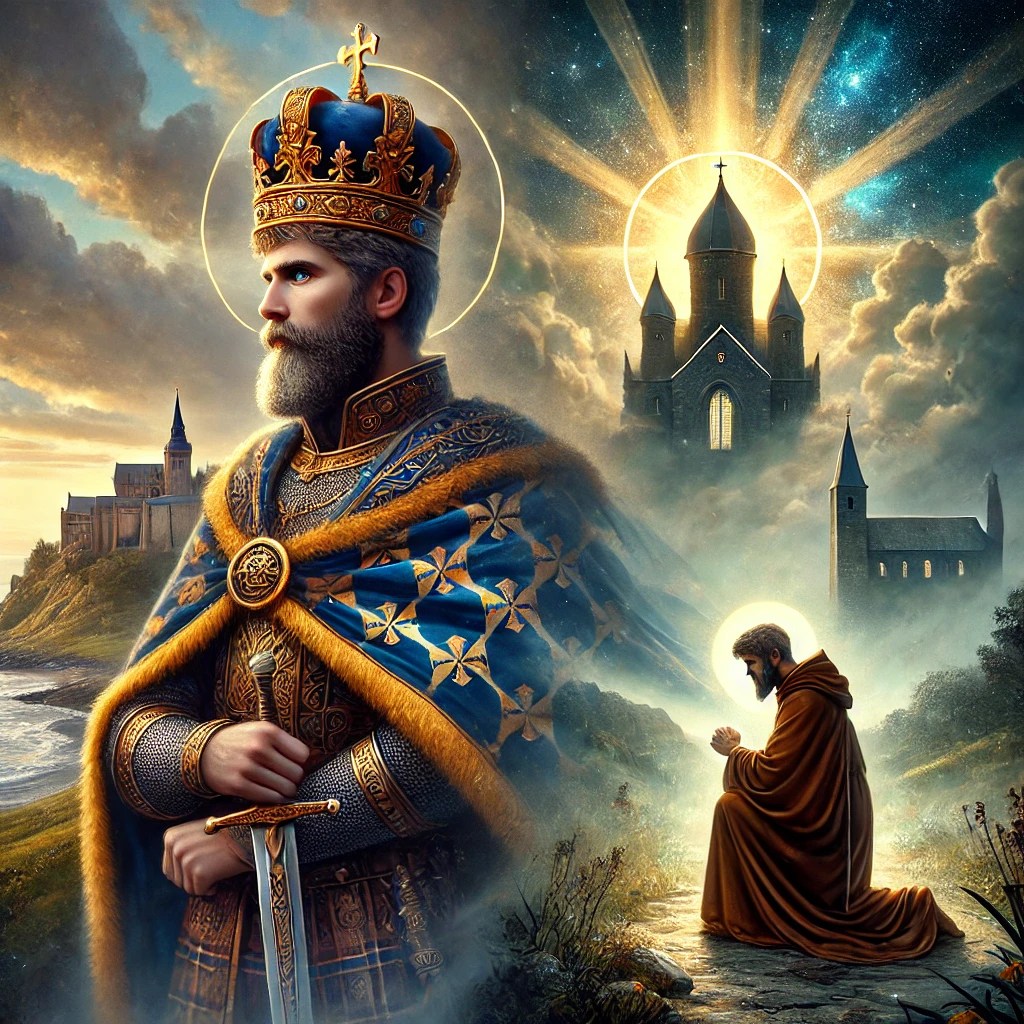
The King Who Became a Servant of Christ
Saint Constantine of Scotland stands as a unique and powerful figure in the history of Christianity. Unlike many saints who were born into humble beginnings or monastic settings, Constantine began his life in royalty, wielding power as a king before ultimately renouncing his throne in pursuit of a greater calling. He is celebrated for his dramatic transformation from ruler to missionary and, finally, martyr. His story is one of humility, faith, and unwavering commitment to Christ. Though lesser known than other saints, his legacy is still honored, particularly in Scotland and Ireland, where his impact on the spread of Christianity was profound. His feast days are observed on March 11th and April 2nd, particularly in Saint Andrews, Scotland, where his devotion and sacrifice are remembered with deep reverence.
A Throne Forsaken
Born in the mid-9th century into Scottish nobility, Constantine’s early life was defined by power and privilege. He ascended the throne of Scotland in 862, leading his kingdom in a time of war and instability. As king, he sought to uphold Christian values, encouraging the construction of churches and monastic institutions, which played a vital role in evangelizing his people. However, despite the grandeur of his rule, Constantine felt an emptiness that worldly power could not satisfy.
The turning point in his life came after the death of his wife. Grief-stricken and seeking deeper meaning, Constantine experienced a profound spiritual awakening. He realized that his true calling was not to wield earthly power but to serve God in humility. This revelation led him to make a radical decision—he abdicated his throne, entrusting the kingdom to his son, and withdrew from the world to live as a humble monk.
His journey led him to the monastery at Rahan in Ireland, where he dedicated himself to prayer, manual labor, and the study of Scripture. The once-powerful king, now dressed in the simple robes of a monk, took on the humblest of tasks, finding joy in serving others. Over time, his devotion deepened, and he was ordained a priest. With newfound purpose, he returned to Scotland, not as a ruler but as a missionary. Under the guidance of Saints Columba and Kentigern, Constantine embarked on his final mission: spreading the Gospel to his homeland.
A Hidden Light
Though no specific miracles from Constantine’s lifetime are well-documented, his very life was a testament to God’s transformative power. His renunciation of wealth and power for a life of service was itself a miraculous act of grace. Few rulers have willingly surrendered their thrones, but Constantine did so not out of despair, but out of love for Christ. His ability to inspire others, to lead with humility, and to spread the Gospel in a land where faith was often challenged demonstrates the quiet yet powerful miracles of conversion and dedication.
There are also stories of his influence in healing the spiritual blindness of those who resisted Christianity, not through force but through his example of holiness. His presence in Scotland as a missionary was seen as a beacon of light, guiding the lost to faith. Many who witnessed his work believed that God’s hand was upon him, using him to restore Christianity in places where pagan practices had begun to take hold.
The Blood of the Martyr
Constantine’s life of faith and service was met with fierce opposition. In the late 9th century, Scotland faced ongoing threats from invading forces, particularly Viking raiders who sought to dismantle the Christian faith in the region. Even as a former king, Constantine remained on the front lines, not as a warrior but as a shepherd of souls.
In 874, he found himself leading his people once again—this time, not as a king with an army, but as a priest offering spiritual leadership to those defending their homeland. During a battle against these invading forces, Constantine was captured and ultimately killed for his faith. Some traditions recount that he was brutally executed because he refused to renounce Christianity, making his death an act of martyrdom. His sacrifice was mourned deeply by the Christian community, who saw in him a man who had given up everything—his power, his wealth, his very life—for the sake of the Gospel.
His body was taken to Iona, the sacred island that had long been a center of Christian monasticism in Scotland. There, he was laid to rest among other saints and Christian leaders, his name forever honored as one who had shed his blood for Christ.
A Legacy of Holiness
After his martyrdom, Constantine’s influence did not fade. His story spread across Scotland and Ireland, and he quickly became venerated as a saint. Over the centuries, people began reporting miracles associated with his intercession. Many who prayed at his resting place on the island of Iona claimed to have experienced healings and divine interventions. Pilgrims traveled to sites associated with him, seeking his guidance and protection.
One of the most enduring aspects of his legacy is the town of Saint Andrews, Scotland, where his feast day is still observed. Churches and monastic communities have honored him for centuries, and his name remains etched in the history of Christian Scotland. Though the full details of the miracles attributed to him remain scattered in oral tradition, the greatest miracle of all remains the transformation of his own life—from a powerful king to a humble servant, and finally to a saint whose example continues to inspire.
A Call to True Discipleship
The life of Saint Constantine offers a profound reflection on the nature of true discipleship. In a world that values power, wealth, and prestige, he reminds us that the greatest calling is to follow Christ with humility and faith. His decision to forsake his throne teaches us that no earthly position or status can compare to the riches of heaven.
His life also challenges us to remain steadfast in our faith, even in the face of adversity. Constantine could have lived a life of comfort, but he chose to preach the Gospel even when it put him in danger. How often do we shy away from our faith because of fear or discomfort? His martyrdom reminds us that true faith requires courage—the willingness to stand firm in what we believe, no matter the cost.
Finally, Saint Constantine’s story invites us to consider what we are willing to surrender for Christ. While most of us are not called to renounce a throne, we are all called to let go of the things that keep us from God. Whether it is our pride, our attachment to material goods, or our fear of the unknown, we are invited to trust in the Lord and follow where He leads.
His journey from king to monk, missionary, and martyr is a testament to the power of God’s grace at work in a willing heart. May his life inspire us to seek holiness, serve others with humility, and remain faithful no matter the cost.
Engage with Us!
We invite you to share your thoughts and reflections on Saint Constantine’s life and legacy. Consider the following questions to spark discussion:
- Transformation through Faith: How can we, in our contemporary lives, emulate Saint Constantine’s profound transformation and dedication to faith?
- Balancing Authority and Humility: What lessons can leaders today learn from Saint Constantine’s decision to relinquish power in pursuit of spiritual growth?
- Courage in Adversity: How does Saint Constantine’s martyrdom inspire us to stand firm in our beliefs when confronted with challenges?
Join the conversation in the comments below, and let’s support each other in our faith journeys, striving to embody the virtues exemplified by Saint Constantine. Together, let us endeavor to do everything with love, as our Lord Jesus Christ taught us.
Saint Constantine, pray for us!
Follow us on Instagram and Facebook for more insights and reflections on living a faith-filled life.

 Holy Manna!
Leave a comment