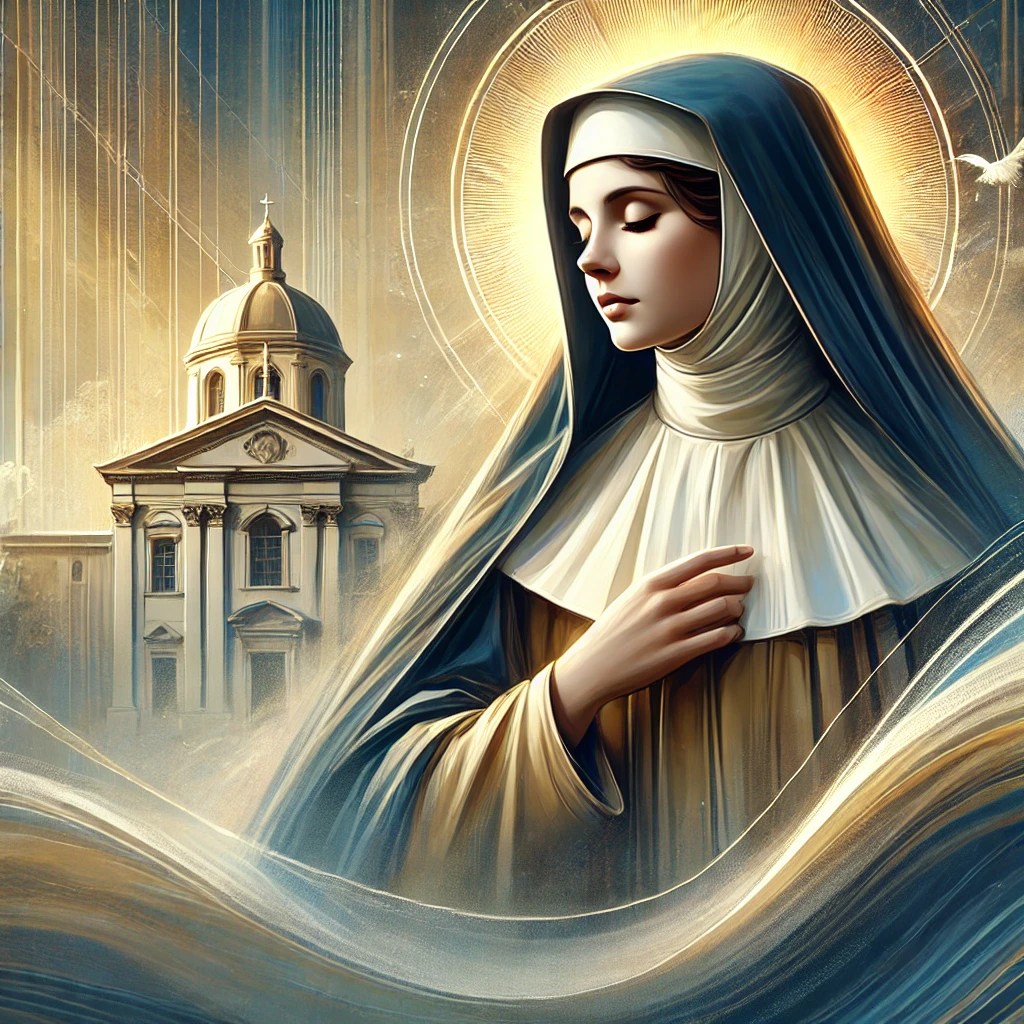
A Visionary of Faith and Education
Saint Marie-Eugénie de Jésus, born Anne-Eugénie Milleret de Brou, is a beacon of light in the Catholic Church, known for her profound commitment to education and the formation of Christian leaders. She founded the Religious of the Assumption, a congregation that sought to transform society by educating young women in a way that integrated faith, reason, and action. Her work was driven by a deep conviction that education should not merely inform but should shape individuals into disciples of Christ, preparing them to build a more just and compassionate world.
Despite the many challenges she faced, Marie-Eugénie remained faithful to God’s call, trusting in divine providence to sustain her mission. Today, the Religious of the Assumption continue her work, spreading the Gospel through education in numerous countries. Canonized by Pope Benedict XVI in 2007, she stands as an example of how personal faith can become a powerful force for change.
From Privilege to Profound Faith
Born on August 25, 1817, in Metz, France, Anne-Eugénie Milleret de Brou was raised in a wealthy and politically influential family. Her father was a banker and a follower of the Enlightenment thinker Voltaire, which meant that religion played little to no role in her upbringing. Though baptized Catholic, her family practiced the faith only nominally, and she had no deep understanding of its teachings.
At the age of 15, her life took a tragic turn when her mother died suddenly of cholera. This devastating loss shattered her childhood security and forced her to confront life’s deeper questions. In the midst of her grief, she was sent to Paris to live with relatives, and it was there that she encountered Christ in a way that would change everything.
During Lent in 1836, at the age of 19, she attended a series of sermons by the Dominican preacher Henri Lacordaire at Notre Dame Cathedral. Lacordaire, a key figure in the revival of Catholicism in post-revolutionary France, spoke about the beauty and depth of the faith, emphasizing its power to transform both individuals and societies. His words resonated deeply within her soul, sparking a conversion that was not just intellectual but profoundly personal. She realized that her life was meant to serve Christ, and she began seeking a way to dedicate herself entirely to Him.
Her calling became clearer when she met Abbé Théodore Combalot, a passionate priest who dreamed of founding a religious congregation devoted to the Christian education of young women. Seeing in Anne-Eugénie a kindred spirit, he encouraged her to take up this mission. Though the road ahead would not be easy, she embraced the challenge with courage, founding the Religious of the Assumption in 1839 at just 22 years old.
A Life of Grace
Though there are no widely documented miracles performed by Saint Marie-Eugénie during her lifetime, her life itself was a testimony to divine grace at work. The mere fact that she, a young woman with no prior religious training, could establish and lead a congregation that would flourish internationally was nothing short of extraordinary.
Throughout her life, she exhibited a profound trust in God’s providence, which often resulted in unexpected blessings. Whether it was financial aid arriving just when the congregation needed it most, or the transformation of the young women she educated, these moments bore witness to God’s hand guiding her mission. Many of her sisters and students would later attest that simply being in her presence and receiving her counsel was an experience of deep spiritual renewal.
Marie-Eugénie also demonstrated a remarkable ability to discern God’s will and inspire others to follow it. She emphasized that education should be holistic, developing not only the intellect but also the heart and soul. This vision, which was radical in her time, continues to shape the educational philosophy of the Assumption sisters to this day.
Enduring Hardships with Faith and Fortitude
The foundation of the Religious of the Assumption was not without trials. Financial instability, opposition from secular authorities, and internal difficulties all threatened the young congregation’s survival. There were times when it seemed as though the mission might collapse before it had truly begun. But Marie-Eugénie’s faith remained steadfast. She saw every difficulty as an opportunity to trust in God’s plan.
She also suffered personal hardships, including poor health and the deaths of many of her early sisters from tuberculosis. Watching those she loved die was a heavy cross to bear, yet she continued to trust that God was leading her work. Her unwavering commitment to the Assumption mission inspired countless others to dedicate their lives to Christ through education and service.
Though she did not face persecution in the way that many early Christian martyrs did, she was a martyr of perseverance—dying to herself daily so that she could live fully for Christ. Every sacrifice she made was offered with love, and it is this love that continues to bear fruit long after her death.
A Legacy of Miracles
Saint Marie-Eugénie died on March 10, 1898, leaving behind a thriving congregation and a powerful spiritual legacy. After her death, numerous miracles were attributed to her intercession, particularly healings that defied medical explanation.
One of the most notable miracles occurred in the 1920s when a Sister of the Assumption, suffering from advanced pulmonary tuberculosis, was miraculously healed after praying for Marie-Eugénie’s intercession. Doctors could not explain her sudden recovery, and this event became one of the key miracles considered in the saint’s beatification process.
Another extraordinary case involved a young man who had been diagnosed with a terminal brain tumor. His family, devoted to Saint Marie-Eugénie, prayed fervently for her intercession, and against all medical expectations, he was completely cured.
These and other miracles contributed to her eventual canonization by Pope Benedict XVI on June 3, 2007. Today, pilgrims visit her tomb in Auteuil, France, seeking her intercession, and the Religious of the Assumption continue to carry forth her mission, witnessing to the transformative power of Christ-centered education.
Living Her Legacy
Saint Marie-Eugénie’s life teaches us that faith is not just a private devotion but a force that can shape society. She saw education as a means of renewing the world, and her conviction that faith and reason must go hand in hand remains relevant today.
Her example calls us to ask: How are we using our knowledge and gifts to serve God? Are we allowing Christ to be at the center of our work, our studies, and our relationships? Do we recognize that faith is not separate from the world but is meant to transform it?
One practical way to live out her legacy is by ensuring that education—whether in schools, churches, or families—leads people closer to Christ. Parents, teachers, and mentors can take inspiration from her by fostering environments where faith is not just taught but lived.
Her life also challenges us to persevere in our own spiritual journeys. No matter what obstacles we face, we can follow her example of trusting completely in God’s providence, knowing that He will provide for our needs in ways we cannot even imagine.
Engage with Us!
We invite you to share your thoughts and reflections on Saint Marie-Eugénie’s life and legacy in the comments below. Consider these reflection questions:
- How can you integrate your faith into your daily work and interactions?
- What steps can you take to promote holistic education in your community?
- In what ways can Saint Marie-Eugénie’s perseverance inspire you to overcome challenges in your own faith journey?
Let us support each other in our faith journeys, striving to do everything with love, as our Lord Jesus did.
Saint Marie-Eugénie, pray for us!
Follow us on Instagram and Facebook for more insights and reflections on living a faith-filled life.

 Holy Manna!
Leave a comment