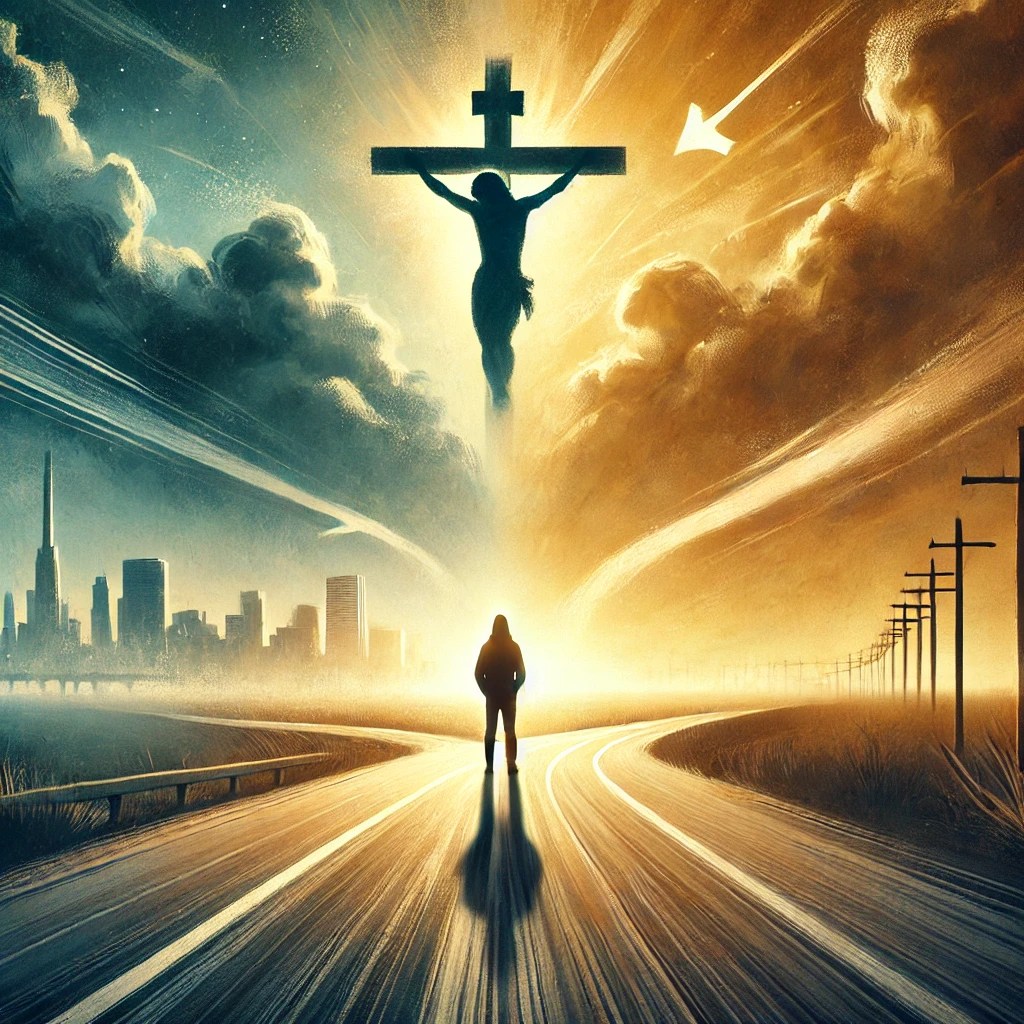
Choosing Life: The Cross, Obedience, and True Discipleship
Every day, we make choices—some small, some life-changing. But at the heart of it all, there is one fundamental decision that shapes everything else: Will we choose the path of life that God sets before us, or will we be led astray by the ways of the world? Today’s readings place this choice before us in a profound way. In Deuteronomy, Moses speaks to the Israelites on the threshold of the Promised Land, urging them to embrace life by loving and obeying God. The Psalmist echoes this message, contrasting the righteous, who delight in God’s law and flourish, with the wicked, who are blown away like chaff. And in the Gospel of Luke, Jesus reveals the ultimate choice of life: embracing the cross and following Him, even when it means losing everything by worldly standards.
For the Israelites, Moses’ words were more than a spiritual encouragement—they were a matter of survival. Ancient Israel was about to enter a land filled with pagan influences, where the temptation to abandon the Lord for false gods would be constant. To “choose life” wasn’t just about personal piety; it was about remaining faithful to the covenant that bound them to God. The same holds true for us today. In a world that offers countless distractions, alternative “truths,” and self-serving ideologies, we, too, must choose whom we will serve. Will we root ourselves in God’s Word, like the tree planted by streams of water in Psalm 1? Or will we chase fleeting gains and risk losing our souls, as Jesus warns in Luke 9:25?
The Lenten journey is a time to renew our choice for life—true life, found only in Christ. But Jesus makes it clear that this life doesn’t come without sacrifice. He invites us to take up our cross daily, denying ourselves for the sake of something far greater. This is the paradox of the Gospel: in losing our lives for Him, we find them. As we reflect on today’s readings, let’s ask ourselves: Are we truly choosing life, or are we merely avoiding death? Are we following Christ with our whole hearts, or only when it’s convenient? The choice is before us. Now is the time to decide.
First Reading – Deuteronomy 30:15-20
A Crossroads of Life and Death
The Israelites stood on the edge of the Promised Land, about to enter a new chapter in their history. After forty years of wandering in the wilderness, they were finally ready to claim what had been promised to their ancestors—Abraham, Isaac, and Jacob. But before they stepped forward, Moses issued a final call to faithfulness. His words in Deuteronomy were not just a farewell speech; they were a solemn covenant renewal, a reminder that their survival depended on their obedience to God. In a culture surrounded by pagan nations with their own gods and moral codes, Israel had to make a choice: to follow the one true God and live or turn away and perish.
This passage fits perfectly into today’s theme because it presents a stark reality—obedience to God brings life, while rejecting Him leads to destruction. The choice is not merely about physical survival but about spiritual fidelity. Just as Moses set this choice before Israel, Jesus presents the same decision in Luke 9:23-25—will we take up our cross and follow Him, or will we seek our own way and lose our souls? In every generation, God’s people must decide whom they will serve.
Deuteronomy 30:15-20
New American Bible (Revised Edition)
The Choice Before Israel. 15 See, I have today set before you life and good, death and evil. 16 If you obey the commandments of the Lord, your God, which I am giving you today, loving the Lord, your God, and walking in his ways, and keeping his commandments, statutes and ordinances, you will live and grow numerous, and the Lord, your God, will bless you in the land you are entering to possess. 17 If, however, your heart turns away and you do not obey, but are led astray and bow down to other gods and serve them, 18 I tell you today that you will certainly perish; you will not have a long life on the land which you are crossing the Jordan to enter and possess. 19 I call heaven and earth today to witness against you: I have set before you life and death, the blessing and the curse. Choose life, then, that you and your descendants may live, 20 by loving the Lord, your God, obeying his voice, and holding fast to him. For that will mean life for you, a long life for you to live on the land which the Lord swore to your ancestors, to Abraham, Isaac, and Jacob, to give to them.
Detailed Exegesis
Verse 15 – “See, I have today set before you life and good, death and evil.”
Moses makes it clear: the people are at a crossroads. The choice is simple yet profound—life and goodness through obedience, or death and destruction through rebellion. The language here reflects covenantal blessings and curses found throughout Deuteronomy (see Deuteronomy 28), emphasizing that Israel’s destiny hinges on their faithfulness to God’s law.
Verse 16 – “If you obey the commandments of the Lord, your God, which I am giving you today, loving the Lord, your God, and walking in his ways, and keeping his commandments, statutes and ordinances, you will live and grow numerous, and the Lord, your God, will bless you in the land you are entering to possess.”
Obedience is not just about following rules—it is an expression of love for God. To “walk in His ways” means to live in alignment with His will. The promise of blessings echoes God’s original covenant with Abraham in Genesis 12:2-3, where faithfulness leads to fruitfulness.
Verse 17 – “If, however, your heart turns away and you do not obey, but are led astray and bow down to other gods and serve them,”
Here, Moses warns of the great danger—idolatry. Throughout their history, Israel struggled with turning to false gods, often lured by the surrounding nations (Judges 2:11-13). This verse reminds us that disobedience begins in the heart. Before actions stray, the heart turns away.
Verse 18 – “I tell you today that you will certainly perish; you will not have a long life on the land which you are crossing the Jordan to enter and possess.”
God’s blessings are not automatic; they require fidelity. This verse foreshadows Israel’s future exile. When they later abandoned God’s law, they were conquered by Assyria (722 BC) and Babylon (586 BC). This serves as a warning for us today—rejecting God’s ways has consequences.
Verse 19 – “I call heaven and earth today to witness against you: I have set before you life and death, the blessing and the curse. Choose life, then, that you and your descendants may live,”
Heaven and earth serve as witnesses, a common legal practice in ancient Israel (Deuteronomy 4:26). The command to “choose life” is not just an individual choice but one that impacts future generations. Holiness is meant to be passed down.
Verse 20 – “By loving the Lord, your God, obeying his voice, and holding fast to him. For that will mean life for you, a long life for you to live on the land which the Lord swore to your ancestors, to Abraham, Isaac, and Jacob, to give to them.”
The passage concludes with a call to cling to God. True life is found not just in external obedience but in deep, faithful relationship. This verse ties back to God’s promise to the patriarchs, showing His faithfulness despite human failure.
Teachings
The Catechism of the Catholic Church reinforces the call to obedience and love for God as the path to life. “Man is rational and therefore like God; he is created with free will and is master over his acts” (CCC 1730). God does not force us to love Him—we must freely choose. This makes our decision to follow Christ all the more meaningful.
Saint Augustine echoes this in his famous words: “You have made us for yourself, O Lord, and our heart is restless until it rests in you.” Our fulfillment is found in God alone. Choosing life means aligning our desires with Him, rather than being swayed by the fleeting temptations of the world.
Historically, this passage was foundational for Israel’s identity, but it is also foundational for us as Christians. Jesus, the New Moses, reiterates this choice when He speaks of the narrow gate in Matthew 7:13-14. The early Church Fathers, such as Saint Irenaeus, saw this as a foreshadowing of Christ’s call to discipleship. True life is found only in God’s will.
Reflection
Every day, we are faced with choices—some small, some significant. But at the core of our lives, the greatest choice remains: Will we follow God, or will we turn away? Choosing life means more than just avoiding sin; it means actively seeking Him, loving Him, and holding fast to Him.
This passage challenges us to reflect on our own spiritual fidelity. Do we truly walk in God’s ways, or do we allow our hearts to be led astray? The world offers many “false gods”—wealth, comfort, status, pleasure. But none of these lead to life. Moses’ words remind us that faith is not just personal; it shapes the generations that follow. Our choices matter.
As we continue through Lent, let’s ask ourselves: What areas of my life need to be more aligned with God’s will? Am I truly choosing life in the way I live, speak, and love? The invitation is before us. The choice is ours. Now is the time to decide.
Responsorial Psalm – Psalm 1:1-4, 6
Rooted in God: The Path to True Happiness
The Book of Psalms is the prayer book of Israel, a collection of hymns, petitions, and praises that have shaped Jewish and Christian spirituality for centuries. Psalm 1 serves as the gateway to the entire Psalter, establishing a fundamental truth: true happiness comes from following God’s law. This psalm is more than a poetic reflection; it is a declaration of two distinct paths—one leading to blessing, the other to ruin. It echoes Moses’ words in Deuteronomy 30:15-20, where he sets before Israel the choice between life and death. The psalmist, like Moses, calls God’s people to delight in His law, meditate on it, and allow it to shape their lives.
In today’s readings, Psalm 1 reinforces the theme of choosing life by staying rooted in God. The image of the tree planted by streams of water beautifully illustrates what it means to live in communion with the Lord. Just as a tree’s strength and fruitfulness depend on its roots, our spiritual vitality depends on being deeply grounded in God’s Word. Meanwhile, the contrast between the righteous and the wicked reminds us of the fleeting nature of worldly pursuits. Jesus reiterates this truth in Luke 9:25, warning that gaining the world at the cost of one’s soul is a tragic exchange.
Psalm 1:1-4, 6
New American Bible (Revised Edition)
True Happiness in God’s Law
1 Blessed is the man who does not walk
in the counsel of the wicked,
Nor stand in the way of sinners,
nor sit in company with scoffers.
2 Rather, the law of the Lord is his joy;
and on his law he meditates day and night.
3 He is like a tree
planted near streams of water,
that yields its fruit in season;
Its leaves never wither;
whatever he does prospers.
4 But not so are the wicked, not so!
They are like chaff driven by the wind.
6 Because the Lord knows the way of the just,
but the way of the wicked leads to ruin.
Detailed Exegesis
Verse 1 – “Blessed is the man who does not walk in the counsel of the wicked, nor stand in the way of sinners, nor sit in company with scoffers.”
The psalm opens with a beatitude, much like Jesus’ Sermon on the Mount (Matthew 5:1-12). The word “blessed” (Hebrew: ashrei) signifies deep, abiding happiness—not mere fleeting emotion, but the joy of being in right relationship with God. The progression from “walking” to “standing” to “sitting” shows how sin gradually entraps a person. First, one listens to worldly advice, then lingers in sinful ways, and finally settles into a lifestyle opposed to God. The psalmist warns against such gradual compromise.
Verse 2 – “Rather, the law of the Lord is his joy; and on his law he meditates day and night.”
Here, the contrast is clear: the blessed person delights in God’s law. The Hebrew word for “law” (Torah) refers to divine instruction, not just legal codes. True happiness is found not in avoiding sin alone but in actively pursuing God. To “meditate day and night” means internalizing God’s Word so deeply that it becomes the foundation of every thought and action.
Verse 3 – “He is like a tree planted near streams of water, that yields its fruit in season; its leaves never wither; whatever he does prospers.”
This powerful metaphor shows the stability and fruitfulness of a life rooted in God. A tree by water remains nourished even in drought, just as those who trust in God remain steadfast in trials. This recalls Jesus’ words in John 15:5: “I am the vine, you are the branches. Whoever remains in me and I in him will bear much fruit.” True prosperity is not material wealth but spiritual flourishing.
Verse 4 – “But not so are the wicked, not so! They are like chaff driven by the wind.”
The wicked are compared to chaff—the dry, useless husks separated from grain. Unlike the deeply rooted tree, chaff is weightless and directionless, easily blown away. This image underscores the emptiness of a life apart from God. What seems secure today—power, wealth, pleasure—will ultimately be scattered in the wind.
Verse 6 – “Because the Lord knows the way of the just, but the way of the wicked leads to ruin.”
To be “known” by the Lord is not just intellectual awareness but deep, personal care. The just are under God’s guidance and protection, while the wicked are on a path of self-destruction. This aligns with Jesus’ teaching in Matthew 7:13-14, where He describes the narrow way that leads to life and the broad way that leads to destruction.
Teachings
The Catechism teaches that true happiness is found in God alone. “The desire for happiness is of divine origin: God has placed it in the human heart in order to draw man to the One who alone can fulfill it.” (CCC 1718). This echoes Psalm 1’s message—those who delight in the Lord will be truly fulfilled, while those who follow the ways of the world will ultimately find only emptiness.
Saint Thomas Aquinas expands on this by teaching that happiness is not found in wealth, pleasure, or human approval but in knowing and loving God. “Man is not perfectly happy, so long as something remains for him to desire and seek.” (Summa Theologica, I-II, q. 3, a. 8). This aligns with Jesus’ call to take up the cross in Luke 9:23—true life is found not in self-indulgence but in self-giving love.
Historically, Psalm 1 was used in Jewish worship and teaching to form the spiritual identity of God’s people. Early Christian monastic communities, such as those led by Saint Benedict, built their way of life around this psalm, meditating on Scripture “day and night.” Even today, the Church continues this tradition in the Liturgy of the Hours, where the Psalms remain central to prayer and reflection.
Reflection
Where are you rooted? In a world filled with distractions, false promises, and fleeting pleasures, this psalm invites us to examine where we are placing our trust. Are we delighting in God’s law, allowing it to shape our thoughts and actions? Or are we being subtly drawn into the ways of the world, settling into patterns that pull us away from Him?
Jesus calls us to be trees planted by streams of living water. This means making time for prayer, Scripture, and the sacraments—not just occasionally, but daily. Are you nourishing your soul with God’s Word, or are you running on spiritual emptiness? Just as a tree must be rooted to withstand storms, we must be anchored in faith to navigate the trials of life.
As we continue our Lenten journey, let us ask ourselves: What steps can I take to meditate on God’s law more deeply? How can I detach from worldly things that leave me empty? The way of the righteous leads to life, while the way of the wicked leads to ruin. The choice is ours. Let’s choose wisely.
Holy Gospel – Luke 9:22-25
The Cross and the Cost of Discipleship
As Jesus journeyed toward His Passion, He spoke openly to His disciples about the suffering that awaited Him. In Luke 9:22-25, He makes the first prediction of His Passion, revealing that He will be rejected, suffer greatly, be killed, and rise on the third day. This revelation must have shocked His followers, who expected the Messiah to establish an earthly kingdom. Instead, Jesus presents them with a paradox: to follow Him means to embrace suffering, self-denial, and even death. His words challenge not only His disciples but all of us who seek to walk in His footsteps.
The Gospel of Luke emphasizes Jesus’ journey to Jerusalem, where He will fulfill His mission. This passage fits perfectly into today’s readings because it presents the same choice Moses set before Israel in Deuteronomy 30:15-20: life or death, blessing or curse. Jesus deepens this teaching by showing that true life is found not in self-preservation but in self-sacrifice. This is the radical call of discipleship—to lose our lives for Christ so that we may truly live. In a world obsessed with comfort, status, and personal success, these words remain just as challenging today as they were 2,000 years ago.
Luke 9:22-25
New American Bible (Revised Edition)
The First Prediction of the Passion. 22 He said, “The Son of Man must suffer greatly and be rejected by the elders, the chief priests, and the scribes, and be killed and on the third day be raised.”
The Conditions of Discipleship. 23 Then he said to all, “If anyone wishes to come after me, he must deny himself and take up his cross daily and follow me. 24 For whoever wishes to save his life will lose it, but whoever loses his life for my sake will save it. 25 What profit is there for one to gain the whole world yet lose or forfeit himself?
Detailed Exegesis
Verse 22 – “He said, ‘The Son of Man must suffer greatly and be rejected by the elders, the chief priests, and the scribes, and be killed and on the third day be raised.’”
Jesus refers to Himself as the “Son of Man,” a title from Daniel 7:13-14 that signifies both His humanity and His divine authority. The use of “must” (dei in Greek) shows that His suffering is not accidental but part of God’s divine plan. His rejection by Jewish leaders foreshadows the Passion, where He will stand trial before the Sanhedrin. Yet, the suffering is not the end—resurrection will follow. This verse reminds us that the cross and resurrection are inseparable; suffering leads to glory.
Verse 23 – “Then he said to all, ‘If anyone wishes to come after me, he must deny himself and take up his cross daily and follow me.’”
This is one of the most radical demands of the Gospel. Discipleship is not merely intellectual belief or occasional religious practice; it is a total surrender. To “deny oneself” means to renounce self-centered desires and put God’s will first. Taking up the cross daily implies perseverance—our commitment to Christ is not a one-time decision but a daily choice. This echoes Deuteronomy 30:19, where Moses urges Israel to “choose life” by remaining faithful to God.
Verse 24 – “For whoever wishes to save his life will lose it, but whoever loses his life for my sake will save it.”
Jesus presents a divine paradox: in trying to cling to life on our own terms, we ultimately lose it. But in surrendering to Christ, we gain eternal life. This goes against worldly logic, where self-preservation and personal success are prioritized. The early Christians, including martyrs like St. Ignatius of Antioch, embraced this truth, willingly laying down their lives for the Gospel.
Verse 25 – “What profit is there for one to gain the whole world yet lose or forfeit himself?”
This verse calls to mind Psalm 1:4, where the wicked are like chaff blown away by the wind. No earthly success—wealth, power, fame—can compensate for the loss of one’s soul. Jesus warns against prioritizing temporary gains over eternal life. Many saints, including St. Francis of Assisi, took these words literally, abandoning material wealth to pursue holiness.
Teachings
The Catechism teaches that suffering is part of the Christian journey. “By his passion and death on the cross, Christ has given a new meaning to suffering: it can henceforth configure us to him and unite us with his redemptive Passion.” (CCC 1505). This means that when we take up our crosses, we are not alone—our suffering is joined to Christ’s, transforming it into a path of grace.
St. John Paul II emphasized that the cross is central to Christian life: “The cross is not a stumbling block, but a ladder to heaven.” He urged believers to see suffering not as meaningless but as an opportunity to grow in holiness. This aligns with St. Paul’s teaching in Romans 8:17: “If we suffer with him, we will also be glorified with him.” The cross leads to resurrection.
Historically, the early Church lived this teaching courageously. The first Christians, facing persecution under the Roman Empire, chose to lose their lives rather than renounce their faith. The martyrs understood that eternal life was worth more than temporary security. Today, we may not face physical persecution, but the call remains the same—are we willing to sacrifice comfort, ambition, and even reputation for the sake of the Gospel?
Reflection
Jesus’ words confront us with a fundamental question: What am I living for? In a culture that prioritizes success, comfort, and self-fulfillment, the idea of self-denial seems radical. Yet, Jesus calls us to something greater—true life found in surrender. Are you clinging to things that ultimately do not satisfy? Are you trying to “save” your life in ways that lead to emptiness?
Taking up our cross daily does not always mean grand heroic acts. It can be as simple as choosing patience over frustration, love over selfishness, or faithfulness over convenience. Where is Jesus asking you to deny yourself today? The choice before us is the same one Moses gave to Israel: life or death, blessing or curse. Choosing life means choosing Christ—even when it costs us everything.
As we reflect on today’s Gospel, let’s ask ourselves: Am I truly following Christ, or am I merely a spectator? Am I willing to embrace the cross, trusting that it leads to resurrection? The way of the world offers temporary gain but ultimate loss. The way of the cross offers temporary struggle but eternal life. The choice is ours. Will we choose life?
The Choice Before Us: Will We Choose Life?
Today’s readings present us with a clear and urgent choice: life or death, blessing or curse, the way of the righteous or the way of the wicked. In Deuteronomy 30:15-20, Moses calls Israel to embrace life by remaining faithful to God’s commands. Psalm 1 reinforces this message, showing us the contrast between the fruitful tree planted by living water and the chaff that is blown away. Finally, in Luke 9:22-25, Jesus deepens the call, revealing that true life is found not in self-preservation but in self-denial, in taking up our cross daily and following Him.
This is the paradox of faith: to truly live, we must first die to ourselves. The world tells us that happiness is found in success, wealth, and comfort, but Jesus tells us that real joy is found in surrender. Just as a tree must be rooted in deep soil to withstand the storms, we must be anchored in God’s Word to navigate the challenges of life. And just as Jesus embraced the cross to bring resurrection, we too must be willing to let go of worldly attachments in order to receive the fullness of life that He offers.
So today, we must ask ourselves: What path am I walking? Am I rooted in God’s law, or am I drifting like chaff in the wind? Am I choosing comfort over discipleship, self-preservation over surrender? The invitation is before us. The way of the world is easy, but it leads to emptiness. The way of Christ is demanding, but it leads to eternal life. The choice is ours. Today, let’s choose life. Let’s choose Christ. Let’s take up our cross and follow Him.
Engage with Us!
We’d love to hear from you! How did today’s readings speak to your heart? Share your thoughts in the comments below and join the conversation. Your reflections may inspire and encourage others on their faith journey.
Reflection Questions:
🔹 First Reading (Deuteronomy 30:15-20) – What does it mean for you to “choose life” in your daily decisions? Are there areas where you struggle to remain faithful to God’s commandments?
🔹 Responsorial Psalm (Psalm 1:1-4, 6) – Are you rooted in God’s Word, or do you find yourself being influenced by worldly distractions? What steps can you take to meditate on Scripture more consistently?
🔹 Gospel (Luke 9:22-25) – What is the “cross” that Jesus is asking you to take up today? How is God calling you to deny yourself and follow Him more closely?
May today’s readings challenge and encourage us to walk in the way of Christ with unwavering faith. As we continue our journey through Lent, let’s strive to live each day with purpose, seeking holiness in all we do. Let’s love more deeply, serve more selflessly, and embrace the cross with courage, knowing that it leads to the fullness of life in Christ.
Follow us on Instagram and Facebook for more insights and reflections on living a faith-filled life.

 Holy Manna!
Leave a comment