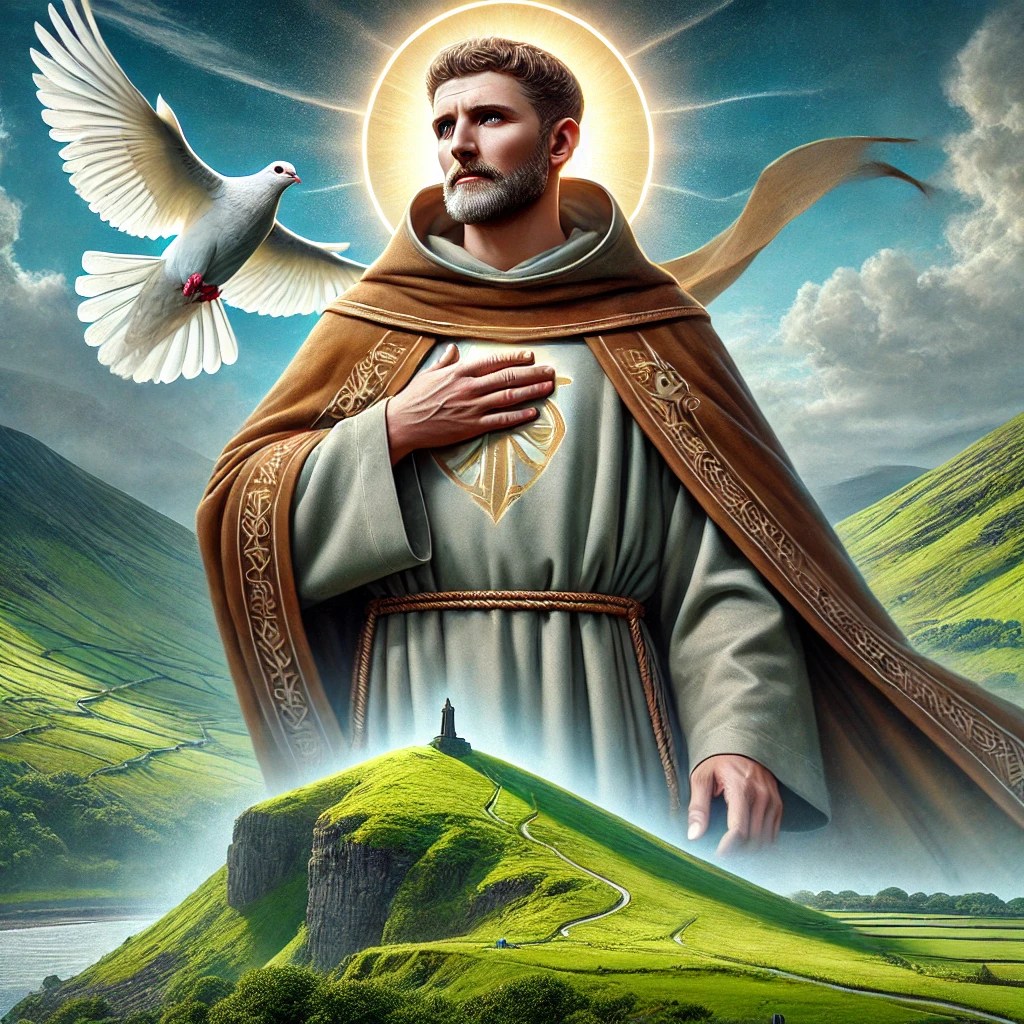
A Beacon of Faith in Wales
Today, we celebrate Saint David of Wales, a shining light of early Christianity in the British Isles. Known in Welsh as Dewi Sant, he is revered as the patron saint of Wales and one of the most influential figures in the spread of Christianity throughout the region. His life was marked by deep piety, unwavering devotion, and a commitment to asceticism that inspired generations of monks and laypeople alike.
Saint David’s impact was so profound that his followers ensured his memory endured for centuries, leading to widespread veneration not just in Wales but throughout the Christian world. His teachings emphasized simplicity, humility, and the power of prayer, values that remain relevant today. March 1st, the day of his passing, is celebrated as Dydd Gŵyl Dewi (St. David’s Day), a national holiday in Wales where people honor his legacy with parades, feasts, and religious observances.
Let’s journey through the life, miracles, and legacy of this remarkable saint.
A Royal Birth and a Holy Calling
Saint David was born around the year 500 AD in what is now Pembrokeshire, Wales. His father, Sant, was a noble chieftain of Ceredigion, while his mother, Non, was a woman of deep faith who later became venerated as Saint Non. Legend tells that David’s birth was foretold by an angel, and his mother gave birth to him amidst a violent storm, symbolizing the strength and divine purpose he would carry throughout his life.
From an early age, David was drawn to a life of faith. He received his religious education at the monastery of Henfynyw, under the instruction of Saint Paulinus, one of the most esteemed teachers of the time. David was a brilliant student, excelling in both Scripture and monastic discipline. He quickly grew in spiritual wisdom and became a priest, dedicating his life to God’s service.
Feeling the call to spread the Gospel, David became a missionary, traveling across Wales, Cornwall, Brittany, and even Ireland. Everywhere he went, he preached the Word of God, performing miracles and inspiring conversions. His charisma, holiness, and ability to heal the sick attracted many followers.
A Monastic Life of Extreme Simplicity
David is most renowned for his monastic reforms. He founded numerous monastic settlements, the most famous being Glyn Rhosyn, known today as St. Davids. His monasteries followed an austere and rigorous lifestyle, mirroring the practices of the Desert Fathers of Egypt.
David and his monks lived under a strict rule of simplicity and self-denial. They engaged in manual labor, plowing fields without oxen, eating only bread, vegetables, and water, and maintaining long hours of prayer and study. Unlike other monastic communities, they did not consume meat or drink alcohol. They lived in silence for much of the day, focusing entirely on spiritual discipline and the service of others.
David’s teachings emphasized humility, self-sacrifice, and devotion to God. He often reminded his followers of the importance of “Do the little things”—a simple yet profound phrase that encouraged faithfulness in small acts of love, kindness, and discipline. This saying remains a cherished part of his legacy.
Signs of Divine Favor
Saint David’s life was filled with miraculous occurrences, reinforcing his role as a chosen servant of God.
One of the most famous miracles took place at the Synod of Brefi (Llanddewi Brefi), a gathering of clergy where David was called to speak against the heresies threatening the Church. As he stood to preach, the ground beneath him miraculously rose up, forming a hill, so that the entire crowd could see and hear him. A white dove descended onto his shoulder, symbolizing the Holy Spirit’s presence. This moment solidified David’s reputation as a divinely guided leader.
Another well-known miracle occurred when David healed the blind. A man who had lost his sight approached David, and after a simple prayer, his sight was restored. Many other miracles were attributed to David, including raising the dead, providing food for the hungry, and driving out evil spirits. These wonders testified to his holiness and deep connection to God.
A Life of Persecution and Perseverance
David’s work in spreading Christianity was not without challenges. Pagan chieftains opposed his teachings, fearing that Christianity would weaken their power. He faced numerous threats, yet he never wavered in his faith. Instead of responding with hostility, he continued his mission with humility and peace, trusting that God would protect him.
Unlike many saints of his time, David was not martyred, but he did endure intense spiritual and physical hardships. His austere way of life was a form of self-martyrdom, demonstrating that true devotion requires sacrifice. His monks followed his example, strengthening the foundation of the Christian faith in Wales.
A Legacy That Lives Beyond Death
Saint David passed away on March 1, 589 AD, leaving behind a flourishing Christian community. His final words to his followers were:
“Be joyful, keep the faith, and do the little things you have seen and heard me do.”
After his death, his tomb at Glyn Rhosyn became a major pilgrimage site. Many reported miracles at his grave, including healings and divine interventions. During the Middle Ages, Pope Callixtus II declared that two pilgrimages to St. Davids Cathedral were equivalent to one pilgrimage to Rome, further solidifying its sacred status.
Today, Saint David remains one of the most beloved saints in Wales. Churches, towns, and religious institutions across the world are dedicated to him, and his feast day—St. David’s Day—is celebrated with great joy. His legacy endures, calling the faithful to live lives of prayer, simplicity, and steadfast faith.
Living Like Saint David
Saint David’s life offers us valuable lessons for our spiritual journey. His commitment to humility, his trust in God, and his discipline in prayer and fasting challenge us to deepen our own faith.
- How often do we take time to “do the little things” for God and others?
- Are we willing to simplify our lives and detach from material comforts to focus more on God?
- Do we stand boldly for our faith, even when facing opposition?
In today’s fast-paced world, David’s teachings remind us that small acts of kindness, discipline, and faithfulness matter. Whether it’s praying daily, helping a neighbor, or embracing humility, we can honor his legacy by living out the Gospel in our own lives.
Engage with Us!
What are your thoughts on Saint David’s life? Have you ever visited a site dedicated to him, or do you celebrate St. David’s Day? Share your reflections in the comments below!
Reflection Questions:
- Saint David emphasized doing “the little things.” What small acts of faith and love can you commit to today?
- How can you incorporate more simplicity and prayer into your daily life, following David’s monastic example?
- Have you ever faced opposition because of your faith? How did you respond, and what can you learn from Saint David’s perseverance?
Let’s support one another in growing deeper in faith and striving to follow Christ in all that we do. “Be joyful, keep the faith, and do the little things.”
Saint David, pray for us!
Follow us on Instagram and Facebook for more insights and reflections on living a faith-filled life.

 Holy Manna!
Leave a comment