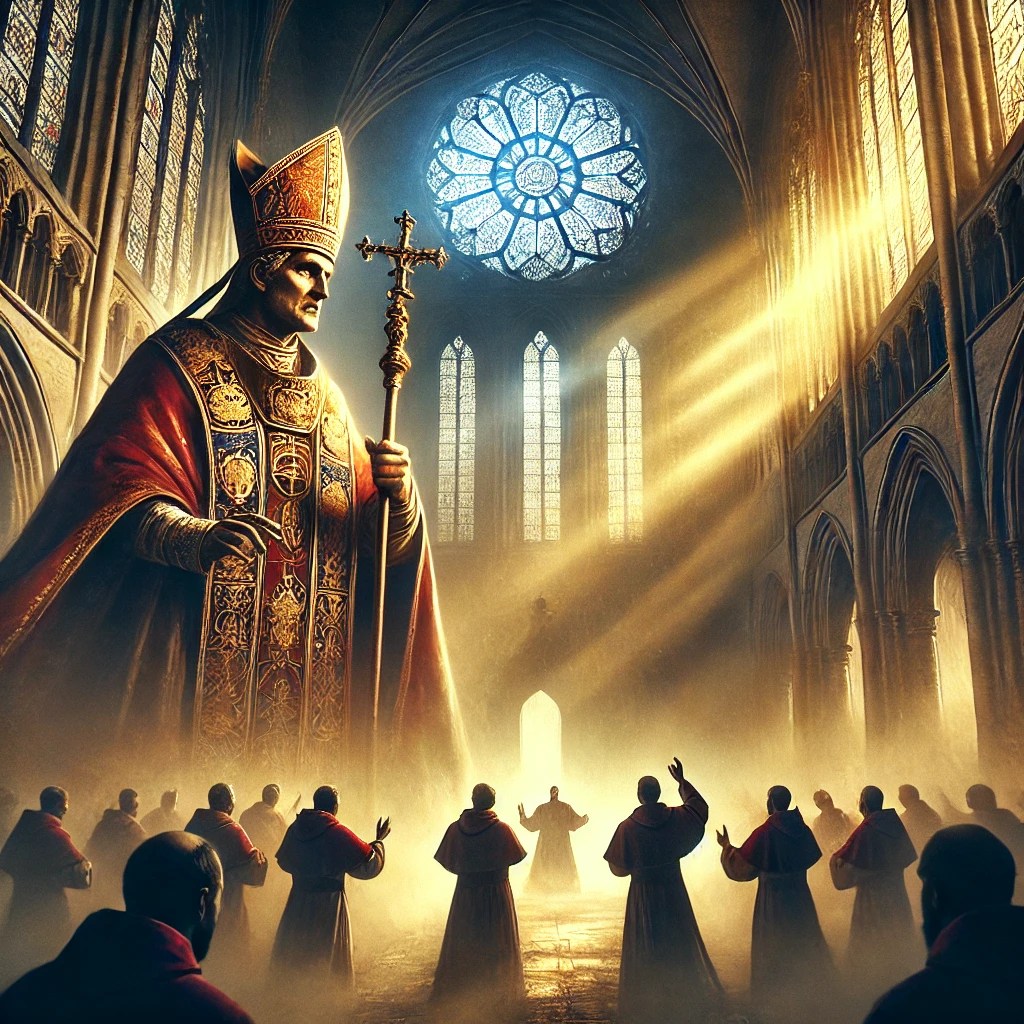
A Pillar of Orthodoxy
Today, we honor Pope Saint Hilary, a steadfast defender of Church unity and orthodoxy during the 5th century. Serving as the Bishop of Rome from 461 to 468, his unwavering commitment to the faith and courageous leadership left an indelible mark on the Church’s history.
At a time when theological disputes threatened to divide the Body of Christ, Hilary emerged as a beacon of truth, ensuring that the doctrines established by the early Church remained unshaken. His dedication to preserving Catholic orthodoxy, coupled with his strong leadership, made him a formidable pope whose contributions continue to inspire Catholics today.
A Shepherd from Sardinia
Pope Saint Hilary was born in Sardinia, Italy, though little is recorded about his early years. Nevertheless, it is evident that he was well-formed in the faith, demonstrating a profound understanding of Catholic doctrine and an unwavering commitment to Christ.
His intellectual acumen and theological depth caught the attention of Church leaders, and he was soon entrusted with the important role of a papal legate under Pope Leo I the Great. This position required him to act as the pope’s representative, particularly in matters of theological debate and Church governance.
Hilary’s mission would lead him into the heart of one of the most tumultuous theological controversies of the time—the dispute over Christ’s nature, which would play a pivotal role in shaping his legacy.
A Lone Voice Against Heresy
In 449, Hilary was sent as a papal legate to the Second Council of Ephesus, later infamously known as the “Robber Council” due to its deviation from orthodox teaching. This gathering was heavily influenced by Dioscorus of Alexandria, who supported the heretical Monophysite position, which claimed that Christ had only one divine nature, rather than two natures—divine and human—as affirmed at the Council of Chalcedon (451).
Hilary, standing firm in his role as an envoy of Pope Leo I, vigorously opposed the council’s decisions, which sought to reject the Chalcedonian doctrine and unjustly depose Patriarch Flavian of Constantinople, a staunch defender of the true faith. When Hilary refused to sign the council’s rulings, he was threatened with violence, and his life was in grave danger.
Despite facing hostility, Hilary remained resolute in defending the integrity of Christological teachings. Through what he later attributed to the intercession of St. John the Evangelist, he miraculously escaped from Ephesus and returned to Rome, bringing firsthand accounts of the council’s grave errors. This act of courage solidified his reputation as a defender of orthodoxy.
From Defender to Supreme Pontiff
Following the death of Pope Leo I the Great, Hilary was elected Bishop of Rome on November 19, 461. His time as pope was marked by a strong emphasis on Church discipline, doctrinal integrity, and unity. He worked tirelessly to ensure that the teachings upheld at the Councils of Nicaea, Ephesus, and Chalcedon remained the foundation of Catholic belief.
One of his primary concerns was the growing autonomy of bishops in Gaul and Spain, where certain Church leaders were beginning to act independently of papal authority. Through a series of synods, particularly in 462 and 465, Hilary issued strict decrees reinforcing that bishops were subject to the authority of Rome, ensuring the unity of the Catholic Church.
His deep concern for preserving Catholic doctrine and order shows how his papacy was not one of mere governance but one of profound pastoral care, striving to safeguard the flock from division and error.
A Builder of Faith
Pope Hilary did not only strengthen the Church through theological defense—he also left a tangible legacy in Rome through the construction and restoration of several churches and religious buildings. His architectural contributions were a visible expression of his faith, demonstrating that the Church’s spiritual strength must be reflected in its sacred spaces.
One of his most notable contributions was the commissioning of an oratory dedicated to St. John the Evangelist at the Lateran Palace, in gratitude for his miraculous escape from Ephesus. Additionally, he played a role in enhancing the Basilica of St. Peter and restoring other key churches that had suffered damage.
Through these efforts, Hilary provided future generations of Christians with places of worship that continue to stand as symbols of unity, faith, and resilience.
Endurance Amidst Trials
Though Hilary was not a martyr in the traditional sense, his papacy was filled with hardships and opposition, particularly from bishops who resisted his efforts to uphold Church unity and discipline. Enforcing orthodoxy in a time of political and theological turmoil was no easy task, and he often faced resistance from both civil and ecclesiastical leaders.
Yet, throughout these challenges, Hilary remained unwavering. His ability to balance firm leadership with pastoral compassion ensured that he was not merely enforcing rules but shepherding souls toward Christ.
Hilary’s commitment to truth ultimately led to the strengthening of the Papal Primacy, a doctrine asserting the supreme authority of the Pope in guiding and governing the Church—a foundational belief still upheld in Catholicism today.
Legacy Beyond the Grave
Even after his death on February 29, 468, the influence of Pope Saint Hilary did not wane. His teachings, writings, and ecclesiastical decrees continued to guide the Church, reinforcing the foundations laid by his predecessors.
Over time, he was venerated as a saint, particularly in recognition of his role in defending orthodox Christology, his dedication to strengthening the Church’s governance, and his contributions to sacred architecture. While there are no widely documented miracles attributed to him after death, his legacy itself is a testament to the miraculous endurance of faith amid great trials.
To this day, his relics and memory are honored, particularly in Rome, where his papacy left a lasting mark. His feast day is celebrated on February 28 (or 29 in leap years), a rare and unique occurrence, making him a truly special figure in the liturgical calendar.
Lessons from Pope Saint Hilary
Pope Saint Hilary’s life is a powerful witness to the necessity of standing firm in the truth, even when facing overwhelming opposition. His unwavering defense of orthodoxy and his dedication to Church unity offer valuable lessons for modern Catholics:
- Defend the Faith Boldly – Just as Hilary did not waver in the face of heresy, we too must stand firm in defending the teachings of the Church, even when society challenges them.
- Remain Rooted in Prayer – Hilary attributed his escape to divine intervention, reminding us of the power of trusting in God’s providence.
- Build Up the Church – Whether through spiritual contributions (like teaching the faith) or physical efforts (such as supporting our parishes), we are called to strengthen the Body of Christ.
His life reminds us that while the path of faith may not always be easy, God gives strength to those who persevere.
Engage with Us!
We invite you to share your thoughts and reflections in the comments!
Here are a few questions to ponder:
- How can we remain steadfast in our faith when confronted with opposition?
- In what ways can we actively contribute to strengthening the Church today?
- Pope Saint Hilary built both theological and physical foundations for the Church. How can we balance both faith and action in our own lives?
Let us encourage one another in our journey of faith, standing firm in the truth as Pope Saint Hilary did. May we always strive to serve the Lord with unwavering devotion and love. Amen.
Pope Saint Hilary, pray for us!
Follow us on Instagram and Facebook for more insights and reflections on living a faith-filled life.

 Holy Manna!
Leave a comment