A Miraculous Encounter That Changed the World
Every year on February 11th, the Catholic Church celebrates the Feast of Our Lady of Lourdes, a commemoration of the Blessed Virgin Mary’s apparitions to Saint Bernadette Soubirous in 1858. This feast is one of the most beloved in Catholic tradition, highlighting Mary’s motherly compassion, her call to prayer and penance, and the miraculous healing power of God’s grace.
More than just a historical event, the apparitions at Lourdes have become a living testament to faith, reminding us of God’s boundless love and Mary’s intercession. This feast holds a special place in the heart of Marian devotion because it is deeply connected to the doctrine of the Immaculate Conception and to the Church’s mission of caring for the sick and the suffering. Millions of pilgrims continue to visit Lourdes each year, seeking both physical and spiritual healing. As we reflect on this feast, we are invited to deepen our trust in God, embrace penance, and turn to Mary as our loving mother and guide.
A Poor Girl, a Heavenly Visitor, and a Message for the World
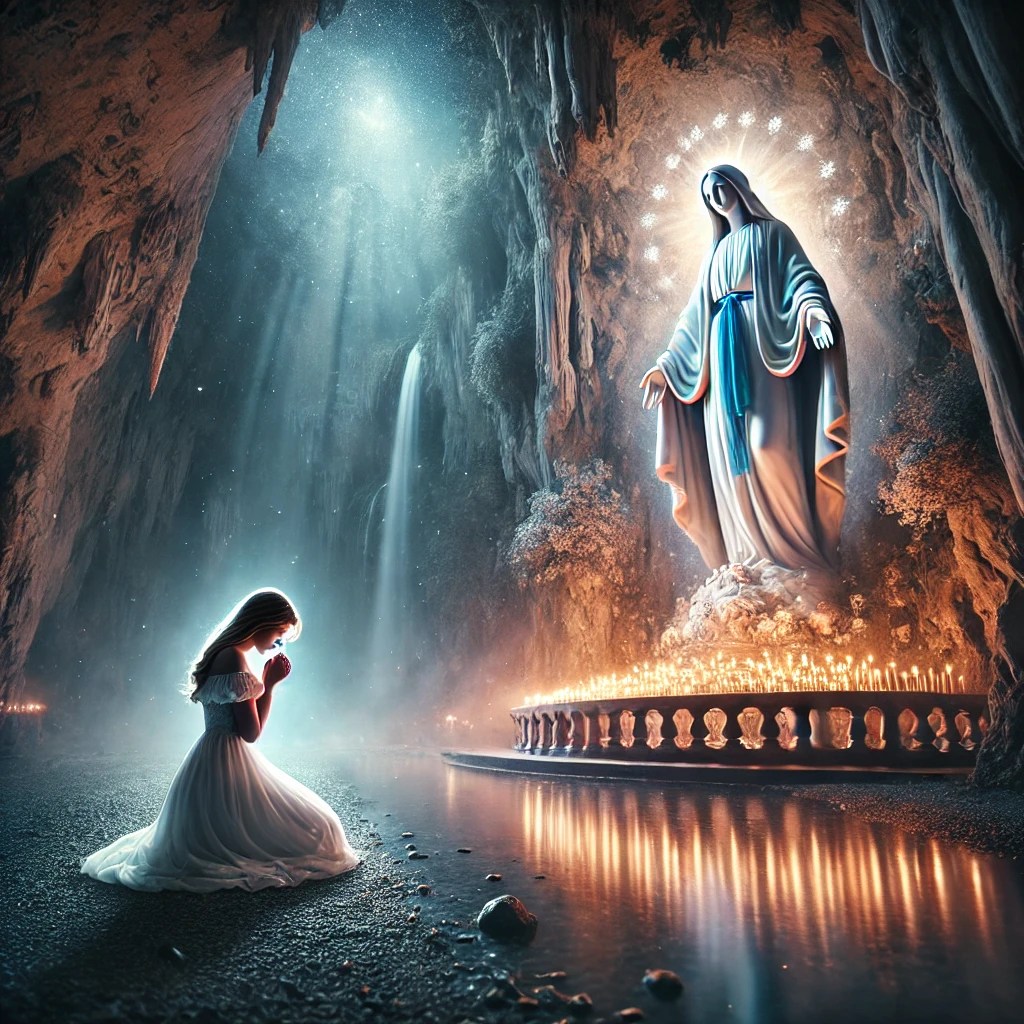
The story of Our Lady of Lourdes takes us to Lourdes, a small town in southern France, where in 1858, a 14-year-old peasant girl named Bernadette Soubirous experienced a series of 18 apparitions of the Blessed Virgin Mary at a grotto called Massabielle.
Bernadette came from an extremely poor family, and she had little formal education. She was frail, asthmatic, and often overlooked. Yet, Mary appeared to her—a simple girl, humble and unassuming. This choice alone carries a powerful message: God often chooses the smallest and least likely to reveal His greatest truths.
During these apparitions, Mary spoke with tenderness and authority, calling for prayer, penance, and a renewal of faith. On March 25, 1858, she revealed her identity to Bernadette with the words: “I am the Immaculate Conception.” This statement was profound, as just four years earlier, in 1854, Pope Pius IX had solemnly declared the dogma of the Immaculate Conception—that Mary was conceived without original sin. This miraculous confirmation left no doubt that the apparitions were from God.
As news of the visions spread, many people, including local officials and clergy, were skeptical. Bernadette was interrogated, mocked, and even pressured to retract her story. But she remained steadfast, firm in her faith and committed to her testimony. Eventually, the Church conducted a careful investigation and, in 1862, officially recognized the apparitions as authentic.
The Spring of Healing and the Miraculous Waters
One of the most remarkable moments in the Lourdes apparitions occurred on February 25, 1858, when Mary instructed Bernadette to dig in the ground at the grotto. To the surprise of the onlookers, a small spring emerged. At first, the water was muddy, but as it flowed, it became clear and pure.
Soon after, people who bathed in or drank from the spring began experiencing extraordinary healings—both physical and spiritual. These miracles were investigated carefully, and over time, the Church has officially recognized 69 healings as scientifically inexplicable miracles. But thousands more pilgrims have testified to personal healings, conversions, and graces received at the waters of Lourdes.
Mary’s message at Lourdes was simple yet urgent: Pray the Rosary, do penance for sinners, and seek true conversion of heart. Through her apparitions, she reminds us that God’s mercy is limitless, and His grace is available to all who seek it with faith.
The Immaculate Conception and Mary’s Role in Salvation
The Feast of Our Lady of Lourdes is deeply connected to the doctrine of the Immaculate Conception, a teaching that declares Mary was conceived without original sin, preserved from corruption by the merits of Christ’s future Passion. This is why Mary’s words to Bernadette—“I am the Immaculate Conception”—were so powerful. She did not just say she was immaculately conceived; she identified herself with this truth.
The Catechism of the Catholic Church affirms: “Through the centuries the Church has become ever more aware that Mary, ‘full of grace’ through God, was redeemed from the moment of her conception” (CCC 491). This means that from her very first moment, Mary was set apart to be the Mother of Jesus and, by extension, the Mother of the Church.
Pope St. John Paul II emphasized Mary’s maternal role in our spiritual lives, stating: “Mary’s appeal for prayer and penance at Lourdes is still relevant today, as the world continues to struggle with sin and suffering” (Message on Lourdes, 2004). In this way, the feast of Our Lady of Lourdes is a reminder that Mary walks with us, calling us to holiness and interceding for our needs.
A Place of Pilgrimage and a Call to Healing
Since the apparitions, Lourdes has become one of the most visited pilgrimage sites in the world. Millions of people, especially the sick and suffering, travel there in hope of healing and peace.
At the Sanctuary of Our Lady of Lourdes, pilgrims participate in Mass, Eucharistic Adoration, the Rosary Procession, and the Blessing of the Sick. One of the most moving traditions is the Torchlight Marian Procession, where thousands gather with candles, praying and singing in honor of the Blessed Virgin.
For those unable to travel, Lourdes remains a spiritual destination of hope. Through prayer and devotion, the graces of Lourdes can be received anywhere.
How the World Honors Our Lady of Lourdes
The Feast of Our Lady of Lourdes is celebrated worldwide with special Masses, processions, and healing services. In many countries, parishes dedicated to Our Lady of Lourdes hold novenas leading up to February 11th.
In France, Lourdes becomes a center of pilgrimage during the feast, with thousands participating in Mass at the grotto and receiving the Sacrament of the Sick. In the Philippines, Italy, Latin America, and beyond, Catholics honor Mary through rosary rallies, candlelit processions, and acts of charity to the sick.
Lourdes has also inspired music, literature, and film, further spreading Mary’s message of faith and healing to the world.
Bringing Lourdes Into Our Daily Lives
Mary’s message at Lourdes is one we can live out every day:
- Pray the Rosary—Mary asked Bernadette to pray the Rosary daily. Can we set aside time to do the same?
- Do acts of penance—We can offer small sacrifices for the conversion of sinners, just as Mary requested.
- Trust in God’s mercy—Lourdes reminds us that God heals and restores us. Are there wounds in our lives we need to surrender to Him?
May we turn to Our Lady of Lourdes for guidance, healing, and strength, trusting that she leads us always to her Son, Jesus Christ.
Engage with Us!
We invite you to share your thoughts and reflections on the Feast of Our Lady of Lourdes in the comments below. How has Mary’s message at Lourdes touched your life? Let’s grow together in faith under the guidance of our Blessed Mother.
Reflection Questions:
- In what ways can you incorporate prayer and penance into your daily routine to deepen your relationship with God?
- How does the example of Saint Bernadette inspire you to live out your faith amidst challenges and skepticism?
- What steps can you take to offer compassion and support to those who are suffering in your community?
May we all strive to live lives of faith, embodying the love and mercy that Jesus taught us, and following the example of our Blessed Mother.
Our Lady of Lourdes, pray for us!
Follow us on Instagram and Facebook for more insights and reflections on living a faith-filled life.

 Holy Manna!
Leave a comment