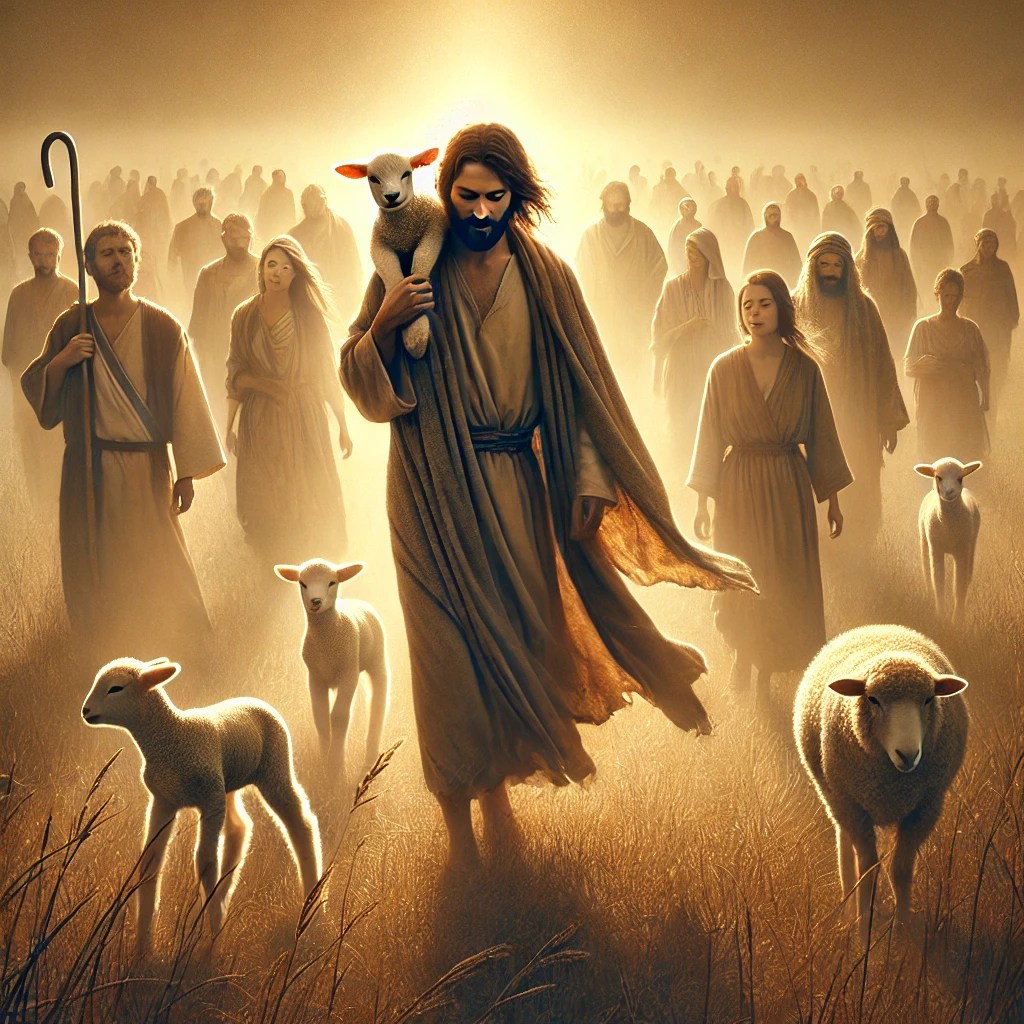
Guided, Provided For, and Called to Serve
Have you ever felt lost, exhausted, or in need of direction? In today’s readings, we see a powerful reminder that we are never alone—Christ, our Good Shepherd, watches over us, provides for our needs, and calls us to do the same for others.
The image of the shepherd is one of the most profound in Scripture. In biblical times, shepherding was not a glamorous profession—it was demanding, requiring constant vigilance, care, and sacrifice. A good shepherd not only provided food and water but also protected his flock from predators and kept them on the right path. This is the image God chooses to describe His relationship with us. He leads, nourishes, and safeguards His people.
In Hebrews, we are encouraged to trust in God’s provision and respond with “a sacrifice of praise and a life of service” (Hebrews 13:15-16). Psalm 23 then paints a beautiful picture of God’s care: “The Lord is my shepherd; there is nothing I lack.” Finally, in Mark’s Gospel, we see Jesus gazing at the crowd with deep compassion—“they were like sheep without a shepherd”—and responding by teaching and guiding them.
Today’s readings invite us to reflect: Do we trust in the care of our Shepherd? Are we willing to follow where He leads? And how are we called to shepherd others in our lives?
First Reading – Hebrews 13:15-17, 20-21
A Sacrifice of Praise and a Life of Obedience
The Letter to the Hebrews was written to early Jewish Christians who were struggling with persecution and tempted to return to the old covenant. The author emphasizes Christ as the eternal High Priest, who has offered the perfect sacrifice—His own life—once and for all. This reading comes from the final chapter of Hebrews, a section filled with exhortations on how Christians should live in response to Christ’s sacrifice.
Within today’s passage, we see a clear call to trust in God, to offer Him a continual sacrifice of praise, and to remain obedient to those He has placed in leadership. These exhortations remind us that our faith is not passive but requires action—a life of gratitude, service, and trust in the Shepherd who leads us.
Hebrews 13:15-17, 20-21
New American Bible (Revised Edition)
15 Through him [then] let us continually offer God a sacrifice of praise, that is, the fruit of lips that confess his name. 16 Do not neglect to do good and to share what you have; God is pleased by sacrifices of that kind.
17 Obey your leaders and defer to them, for they keep watch over you and will have to give an account, that they may fulfill their task with joy and not with sorrow, for that would be of no advantage to you.
20 May the God of peace, who brought up from the dead the great shepherd of the sheep by the blood of the eternal covenant, Jesus our Lord, 21 furnish you with all that is good, that you may do his will. May he carry out in you what is pleasing to him through Jesus Christ, to whom be glory forever [and ever]. Amen.
Detailed Exegesis
Verse 15: “Through him [then] let us continually offer God a sacrifice of praise, that is, the fruit of lips that confess his name.”
The phrase “through him” emphasizes that our worship is only acceptable through Christ. He is our mediator, and just as He offered Himself on the cross, we are called to offer a sacrifice—not of animals or material goods, but of praise. The expression “fruit of lips” echoes Hosea 14:3, where the prophet speaks of offering “the fruit of our lips” instead of sacrifices. True worship is not just ritual; it is an outpouring of love and thanksgiving from a heart transformed by Christ.
Verse 16: “Do not neglect to do good and to share what you have; God is pleased by sacrifices of that kind.”
Worship is not just about words but action. The early Christians faced severe hardships, and mutual support was essential. This verse connects worship with works of charity, reminding us that acts of kindness and generosity are also sacrifices pleasing to God. This teaching reflects Jesus’ words in Matthew 25:40: “Whatever you did for one of these least brothers of mine, you did for me.”
Verse 17: “Obey your leaders and defer to them, for they keep watch over you and will have to give an account, that they may fulfill their task with joy and not with sorrow, for that would be of no advantage to you.”
This verse underscores the importance of spiritual authority. Leaders in the Church are responsible for the souls entrusted to them, and they will have to give an account before God. The call to obedience does not imply blind submission but rather a trust in the guidance of those who shepherd God’s people. This aligns with 1 Thessalonians 5:12-13, where Paul urges believers to respect and love those who labor among them in the Lord.
Verse 20: “May the God of peace, who brought up from the dead the great shepherd of the sheep by the blood of the eternal covenant, Jesus our Lord,”
Here, the author reminds us that it is God Himself who raised Jesus, the “great shepherd of the sheep.” This is a reference to John 10:11, where Jesus declares, “I am the good shepherd.” The mention of “the blood of the eternal covenant” connects directly to the Eucharist, where Christ’s sacrifice is made present to us.
Verse 21: “Furnish you with all that is good, that you may do his will. May he carry out in you what is pleasing to him through Jesus Christ, to whom be glory forever [and ever]. Amen.”
This final blessing echoes the idea that it is God who equips us to do His will. We are not left to navigate the Christian life alone—He provides what we need and accomplishes His purposes through us. This aligns with Philippians 2:13: “For God is the one who, for his good purpose, works in you both to desire and to work.”
Teachings
The Catechism of the Catholic Church reinforces the call to worship through both praise and good works. CCC 2097 states:
“To adore God is to acknowledge, in respect and absolute submission, the ‘nothingness of the creature’ who would not exist but for God. To adore God is to praise and exalt him and to humble oneself, as Mary did in the Magnificat, confessing with gratitude that he has done great things and holy is his name.”
This aligns with today’s call to offer a “sacrifice of praise.” Worship is not about feeling but about acknowledging who God is and responding with humility and thanksgiving.
The call to obey leaders is also echoed in CCC 1548, which states:
“In the ecclesial service of the ordained minister, it is Christ himself who is present to his Church as Head of his Body, Shepherd of his flock, high priest of the redemptive sacrifice, Teacher of Truth.”
Thus, when we respect and follow the Church’s spiritual leaders, we are ultimately following Christ, the Good Shepherd.
Reflection
This reading challenges us to examine how we worship. Is our praise confined to Sunday Mass, or do we live a life of gratitude? Are we willing to make sacrifices for others—offering not just words but actions of love? And do we trust in the leadership of those Christ has placed over His Church, recognizing that they, too, are called to shepherd us?
A life of faith requires more than passive belief. It is a daily offering—a continual sacrifice of praise and a commitment to serving others. As we reflect on this passage, let us ask ourselves:
What sacrifices of praise can I offer to God today? In what ways can I better serve those around me? And do I trust that the Good Shepherd is leading me, even when I do not see the full path ahead?
Responsorial Psalm – Psalm 23
The Lord, Our Shepherd and Provider
Psalm 23 is one of the most beloved passages in Sacred Scripture, often recited in times of distress and uncertainty. Written by King David, this psalm reflects the deep trust and confidence he had in God’s providence. In ancient Israel, shepherding was an essential part of life, and the image of a shepherd caring for his sheep was a powerful metaphor for God’s relationship with His people. Unlike hired hands, a shepherd was wholly responsible for the well-being of his flock, guiding them to green pastures, protecting them from danger, and seeking out the lost.
This psalm perfectly aligns with today’s theme of Christ as our Good Shepherd. Just as the author of Hebrews calls us to obedience and trust in God’s provision, and Mark’s Gospel reveals Jesus’ deep compassion for His people, Psalm 23 gives us the words to proclaim our confidence in the Lord’s care. It is an invitation to rest in the assurance that our Shepherd lacks nothing and leads us exactly where we need to be.
Psalm 23
New American Bible (Revised Edition)
The Lord, Shepherd and Host
1 A psalm of David.
The Lord is my shepherd;
there is nothing I lack.
2 In green pastures he makes me lie down;
to still waters he leads me;
3 he restores my soul.
He guides me along right paths
for the sake of his name.
4 Even though I walk through the valley of the shadow of death,
I will fear no evil, for you are with me;
your rod and your staff comfort me.
5 You set a table before me
in front of my enemies;
You anoint my head with oil;
my cup overflows.
6 Indeed, goodness and mercy will pursue me
all the days of my life;
I will dwell in the house of the Lord
for endless days.
Detailed Exegesis
Verse 1: “The Lord is my shepherd; there is nothing I lack.”
This opening declaration sets the tone for the entire psalm. God is not just a distant ruler but an intimate caregiver who knows and provides for His flock. The phrase “there is nothing I lack” is a statement of complete trust, echoing Jesus’ words in Matthew 6:31-33: “Do not worry and say, ‘What are we to eat?’ or ‘What are we to drink?’ or ‘What are we to wear?’ Your heavenly Father knows that you need them all.”
Verse 2: “In green pastures he makes me lie down; to still waters he leads me.”
Green pastures and still waters symbolize peace, rest, and nourishment. Sheep are known to be anxious animals, easily startled and restless, yet a good shepherd ensures they can safely rest. Likewise, God calls us to trust in Him, finding peace even amid life’s uncertainties. John 10:9 reinforces this: “I am the gate. Whoever enters through me will be saved and will come in and go out and find pasture.”
Verse 3: “He restores my soul. He guides me along right paths for the sake of his name.”
Restoration is at the heart of God’s work. When we stray, He gently brings us back, much like Jesus’ parable of the lost sheep (Luke 15:4-7). The phrase “for the sake of his name” reminds us that God’s faithfulness is rooted in His very identity—He is always true to His promises.
Verse 4: “Even though I walk through the valley of the shadow of death, I will fear no evil, for you are with me; your rod and your staff comfort me.”
This verse acknowledges the reality of suffering but also the presence of God within it. The “valley of the shadow of death” represents any trial, danger, or darkness we face. Yet, fear is banished by the Shepherd’s presence. His rod (a tool for correction) and staff (a guide for leading) symbolize both discipline and protection. This recalls Isaiah 41:10: “Do not fear: I am with you; do not be anxious: I am your God.”
Verse 5: “You set a table before me in front of my enemies; You anoint my head with oil; my cup overflows.”
This powerful imagery shifts from that of a shepherd to a banquet scene. To “set a table” implies honor, provision, and victory, even in the presence of adversaries. The anointing of the head signifies God’s blessing and favor, while the overflowing cup represents abundance. This foreshadows the Eucharistic feast, where God nourishes us with His very self.
Verse 6: “Indeed, goodness and mercy will pursue me all the days of my life; I will dwell in the house of the Lord for endless days.”
Unlike enemies who might pursue to destroy, God’s goodness and mercy relentlessly chase after us. The promise to “dwell in the house of the Lord” is ultimately fulfilled in eternity, where Christ, our Shepherd, welcomes us into the heavenly banquet (John 14:2-3).
Teachings
The Catechism beautifully echoes the truths found in Psalm 23. CCC 754 describes the Church as the sheepfold of Christ:
“The Church is, accordingly, the sheepfold, the sole and necessary gateway to which is Christ. It is also the flock of which God himself foretold that he would be the shepherd, and whose sheep, even though governed by human shepherds, are unfailingly nourished and led by Christ himself, the Good Shepherd and Prince of Shepherds.”
This aligns perfectly with the message of today’s readings—God Himself is our Shepherd, guiding and sustaining us. Additionally, CCC 2700 teaches about prayer as a response to God’s care:
“Through his Word, God speaks to man. Prayer is the response of faith to the free promise of salvation and also a response of love to the thirst of the only Son of God.”
Psalm 23 is ultimately a prayer—a declaration of trust in the Shepherd who leads us through every season of life. The words of this psalm have comforted countless saints and martyrs, reminding them that they were never abandoned.
Reflection
This psalm challenges us to consider whether we truly trust in God’s guidance. Do we believe that He leads us to “green pastures,” even when we cannot see the way? Do we allow His rod and staff to correct and comfort us? And when we walk through dark valleys, do we cling to the promise that He is with us?
A life of faith is a life of surrender. We are called to follow the Shepherd wherever He leads, trusting that He knows what we need. If we are anxious, Psalm 23 reminds us to rest in Him. If we are suffering, it assures us that He is walking beside us. And if we feel lost, it calls us to listen for the voice of the One who knows us by name.
How can you trust more fully in the Good Shepherd today? In what areas of your life do you need to surrender control and let Him lead? And how can you reflect His goodness and mercy to those around you?
Holy Gospel – Mark 6:30-34
Jesus, the Compassionate Shepherd
The Gospel of Mark is the shortest of the four Gospels, but it is known for its fast-paced narrative and vivid details. Written primarily for a Gentile audience, Mark presents Jesus as the powerful yet deeply compassionate Son of God. Today’s passage takes place shortly after the apostles have returned from their missionary journey. They have been teaching, healing, and casting out demons in Jesus’ name, and now they gather to report everything to Him. However, the crowds are relentless, and Jesus sees the exhaustion of His disciples. Instead of immediately sending them out again, He invites them to rest.
Yet, even in seeking solitude, Jesus is met by a vast crowd longing for His presence. His heart is moved with pity because they are like sheep without a shepherd. This passage highlights Christ’s dual nature—He is both the divine teacher and the tender shepherd who cares for His people. It fits seamlessly with today’s theme: Jesus, the Good Shepherd, not only provides but also deeply understands the needs of His flock.
Mark 6:30-34
New American Bible (Revised Edition)
The Return of the Twelve. 30 The apostles gathered together with Jesus and reported all they had done and taught. 31 He said to them, “Come away by yourselves to a deserted place and rest a while.” People were coming and going in great numbers, and they had no opportunity even to eat. 32 So they went off in the boat by themselves to a deserted place. 33 People saw them leaving and many came to know about it. They hastened there on foot from all the towns and arrived at the place before them.
The Feeding of the Five Thousand. 34 When he disembarked and saw the vast crowd, his heart was moved with pity for them, for they were like sheep without a shepherd; and he began to teach them many things.
Detailed Exegesis
Verse 30: “The apostles gathered together with Jesus and reported all they had done and taught.”
This verse marks the return of the Twelve after their first mission. Jesus had previously sent them out two by two (Mark 6:7-13), giving them authority over unclean spirits and instructing them to rely entirely on God’s providence. Now, they come back, eager to share their experiences. This moment reflects the intimacy of discipleship—Christ invites His followers to participate in His mission, yet He also listens and cares for their well-being.
Verse 31: “He said to them, ‘Come away by yourselves to a deserted place and rest a while.’ People were coming and going in great numbers, and they had no opportunity even to eat.”
Jesus recognizes the exhaustion of His disciples. Their ministry has been fruitful, but they are physically and spiritually drained. His invitation to rest is significant—true discipleship requires both service and solitude. Even Christ Himself withdrew frequently to pray (Luke 5:16). This verse reminds us that rest is not a sign of weakness but an essential part of the spiritual life.
Verse 32: “So they went off in the boat by themselves to a deserted place.”
Jesus leads them away to a place of solitude, likely along the shores of the Sea of Galilee. The Greek word used for “deserted place” (erēmos) often refers to the wilderness, evoking images of Israel’s journey through the desert and the prophets who sought God in solitude. This emphasizes that encountering God often requires stepping away from the noise of the world.
Verse 33: “People saw them leaving and many came to know about it. They hastened there on foot from all the towns and arrived at the place before them.”
Despite Jesus’ attempt to withdraw, the crowd pursues Him. Their hunger for His presence is undeniable, and they are willing to go to great lengths to be near Him. This relentless pursuit mirrors the human soul’s innate longing for God. As St. Augustine famously wrote in his Confessions: “You have made us for Yourself, O Lord, and our hearts are restless until they rest in You.”
Verse 34: “When he disembarked and saw the vast crowd, his heart was moved with pity for them, for they were like sheep without a shepherd; and he began to teach them many things.”
The phrase “his heart was moved with pity” comes from the Greek word splanchnizomai, which signifies a deep, gut-wrenching compassion. Jesus does not see the crowd as an inconvenience but as lost sheep in desperate need of a shepherd. His response? He teaches them. This is a profound moment—before providing physical nourishment (which He will do in the miracle of the feeding of the five thousand, immediately following this passage), Jesus feeds them spiritually. This reflects the priority of God’s Word in our lives—before anything else, we need the nourishment of truth.
Teachings
The Catechism affirms Christ’s role as the Good Shepherd. CCC 754 states:
“The Church is, accordingly, the sheepfold, the sole and necessary gateway to which is Christ. It is also the flock of which God himself foretold that he would be the shepherd, and whose sheep, even though governed by human shepherds, are unfailingly nourished and led by Christ himself, the Good Shepherd and Prince of Shepherds.”
This passage in Mark reveals Christ’s deep concern for His people. His role as Shepherd is not merely figurative; He actively leads, teaches, and provides. The Church, as His body on earth, continues this mission through her pastors, who are entrusted with the care of souls.
St. John Paul II often spoke of Christ’s compassionate leadership, saying:
“To be pastors after Jesus’ heart means to walk in the midst of and behind the flock, able to hear the silent story of those who suffer and to support their faith.” (Pastores Dabo Vobis, 1992)
This challenges every Christian, especially those in leadership, to embody the Shepherd’s heart—a heart that listens, teaches, and responds with compassion.
Reflection
This passage invites us to examine both our hunger for Christ and our role in shepherding others. Do we, like the crowds, pursue Him relentlessly, or do we allow distractions to pull us away? Jesus desires to feed us, to teach us, and to give us rest, but we must come to Him with open hearts.
At the same time, we are also called to reflect the Shepherd’s heart in our own lives. Christ looked upon the crowd with compassion—do we look upon those around us with the same love? When we see people struggling, do we take the time to teach, guide, or support them?
The rhythm of today’s Gospel is one we must embrace: come away and rest, but also be ready to serve. We cannot give what we do not have, and yet, once nourished by Christ, we must turn outward to feed others.
How can you seek moments of solitude with Christ in your daily life? Where do you see people around you in need of guidance, and how can you be a shepherd to them? And do you trust that the Good Shepherd is leading you, even when you do not fully understand the path ahead?
Following the Good Shepherd
Today’s readings beautifully intertwine to reveal a central truth: Christ is our Good Shepherd, and He calls us to trust in His care, rest in His presence, and follow His example.
In Hebrews, we are reminded to offer a “sacrifice of praise” and to trust in the leaders God has placed over us. Psalm 23 reassures us that the Lord provides, protects, and leads us through every valley. And in Mark’s Gospel, we see Jesus moved with compassion for His people, responding to their needs with both spiritual and physical nourishment.
Together, these passages challenge us to ask: Do we trust in the Good Shepherd’s guidance? Are we willing to rest in Him and allow Him to restore our souls? And how can we reflect His heart of compassion to those around us?
The invitation today is clear—come to the Shepherd. Whether we are weary from our labor, lost in the chaos of life, or longing for deeper intimacy with God, He is waiting to lead us. But following the Shepherd requires a response. It calls for trust, surrender, and a willingness to be led, even when the path is uncertain.
Will you allow the Good Shepherd to guide your heart today? Where is He calling you to rest, and where is He calling you to serve? And how can you be a reflection of His love to those who are like sheep without a shepherd?
Take a moment today to pray with Psalm 23. Let its words sink into your heart. And then, with confidence, take the next step forward—knowing that wherever the Shepherd leads, goodness and mercy will follow.
Engage with Us!
We would love to hear your thoughts and reflections! How did today’s readings speak to your heart? Share your insights, prayers, or experiences in the comments below—your testimony may inspire someone else on their faith journey.
Here are some reflection questions to help guide your thoughts:
First Reading – Hebrews 13:15-17, 20-21: What are some ways you can offer a “sacrifice of praise” in your daily life? How do you respond to spiritual authority—do you see it as guidance from the Good Shepherd?
Responsorial Psalm – Psalm 23: Do you trust that God is leading you to green pastures, even when life feels uncertain? How can you rest more deeply in His care this week?
Holy Gospel – Mark 6:30-34: Jesus had compassion for the crowd—who in your life needs that same love and guidance from you? How can you make space for both rest and service in your faith journey?
As you go about your day, remember that Christ, the Good Shepherd, is always leading you with love and mercy. Let us follow Him wholeheartedly, trusting in His care, resting in His presence, and becoming vessels of His compassion to the world. May everything we do be done with the love of Jesus. Amen!
Follow us on Instagram and Facebook for more insights and reflections on living a faith-filled life.

 Holy Manna!
Leave a comment