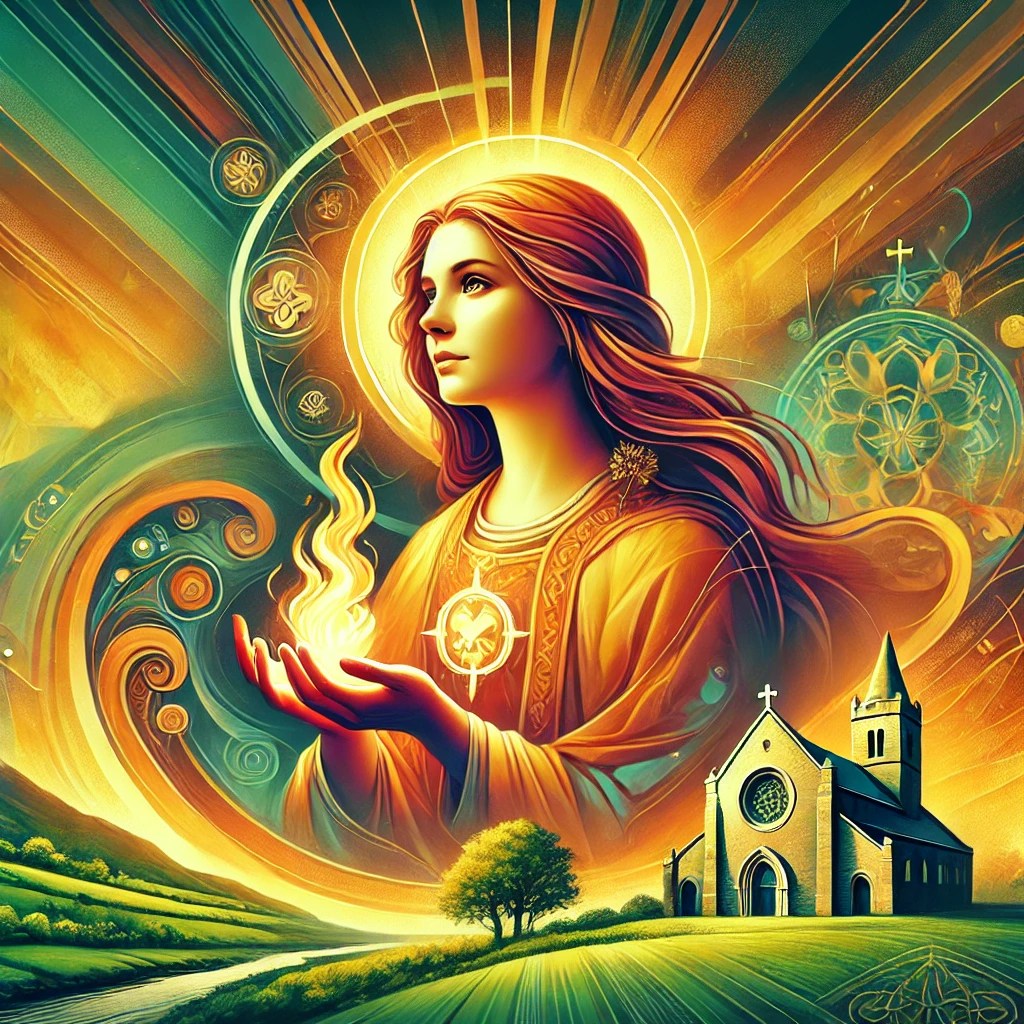
The Flame of Faith in Ireland’s Heart
Saint Brigid of Ireland, also known as Brigid of Kildare, is one of the most beloved figures in Irish Christianity. Alongside Saint Patrick and Saint Columba, she is one of the three patron saints of Ireland, often referred to as “Mary of the Gael.” Her life was a testament to faith, charity, and leadership. She founded the famous Kildare Monastery, which became one of the most important religious and educational centers in Ireland. Brigid’s deep compassion for the poor, her unwavering trust in God, and her countless miracles made her a symbol of Christian virtue, and her legacy continues to inspire generations.
Her life teaches us that holiness is not just about extraordinary events but about living out our faith in practical ways—caring for the poor, trusting in God’s providence, and leading with wisdom and humility. Whether through miraculous acts of charity or her fearless leadership, Saint Brigid left an indelible mark on Christian history, proving that one person’s faith can transform an entire nation.
A Heart That Knew No Limits
Brigid was born around 451 AD in Faughart, near Dundalk, in what is now County Louth, Ireland. She came from a complex background—her father, Dubhthach, was a wealthy chieftain, while her mother, Brocca, was a Christian slave. This unique heritage positioned her between two worlds: the privileges of nobility and the hardships of servitude. From a young age, Brigid displayed an extraordinary spirit of generosity, often giving away her family’s food, livestock, and belongings to the poor.
Her father, frustrated with her constant charity, attempted to sell her to the king. However, the king, recognizing something special in Brigid, told Dubhthach, “Her merit before God is greater than ours.” The transaction never took place, and Brigid was freed.
Brigid felt an undeniable calling to dedicate her life entirely to Christ. Rejecting marriage, she chose religious life, taking vows as a nun. In 480 AD, she founded the Monastery of Kildare, one of the first in Ireland. What made Kildare unique was that it housed both men and women, with Brigid serving as its abbess. This was groundbreaking in early Christian Ireland, as it positioned Brigid as a powerful spiritual leader in a male-dominated society. Under her leadership, Kildare became a center for learning, hospitality, and evangelization. She established a school of art, known for producing beautiful illuminated manuscripts, and her influence helped shape Ireland into a thriving center of Christian scholarship.
Brigid was more than just a founder of monasteries—she was a spiritual mother to Ireland. She transformed communities, cared for the sick, and taught that faith must be lived through action.
A Life Overflowing with Grace
Saint Brigid’s life was filled with miraculous events that testified to her deep connection with God. One of the most famous stories recounts how she gave away all her mother’s butter to the poor. When her mother returned and found the storeroom empty, she was distressed. But Brigid, full of faith, prayed to God—and the butter was miraculously replenished, overflowing beyond what had been given away.
Another miracle tells of how Brigid turned water into beer. When a group of clerics visited her monastery, there was nothing to offer them. Unwilling to turn them away empty-handed, she prayed over a vessel of water, and it was transformed into beer—enough for all to drink.
Brigid also performed numerous healings, restoring sight to the blind and curing the sick. In one account, she healed a man who had been mute, allowing him to speak for the first time. Another story tells of her calming a raging storm to protect travelers.
Her miracles were always rooted in love and generosity. She did not seek power or recognition; she simply trusted that God would provide for those in need. Through these acts, she became a living example of Christ’s teaching: “Give, and it will be given to you. A good measure, pressed down, shaken together and running over, will be poured into your lap.” (Luke 6:38).
Breaking Barriers with Faith
As a woman in early Christian Ireland, Brigid’s leadership faced opposition from those who believed that spiritual authority should be reserved for men. Yet, through wisdom and faith, she commanded the respect of kings and bishops alike. It is even said that, due to a clerical error, she was accidentally consecrated as a bishop—a mistake that some believe was divinely orchestrated.
Brigid was a fierce advocate for justice, frequently intervening on behalf of the oppressed. She often confronted chieftains and rulers, pleading for the release of slaves or the fair treatment of the poor. Despite resistance, she never wavered, believing that God had placed her in a position of influence to uplift those who had no voice.
Her monasteries became places of refuge, offering food, education, and safety to those in need. The fire she lit in Kildare—symbolizing the light of Christ—was said to have burned continuously for centuries, tended by her successors. This fire, known as the Eternal Flame of Brigid, became a powerful symbol of faith and perseverance.
A Saint Who Still Walks With Us
Even after her passing around 525 AD, Saint Brigid’s intercession continued to be a source of miracles. Her relics became objects of veneration, with many reporting miraculous healings after praying for her help.
One of the most well-known pilgrimage sites dedicated to her is the Cathedral of Kildare, where her legacy is still honored. Another significant site is in Lumiar, Portugal, where her skull is enshrined in the Church of St. John the Baptist. Many pilgrims travel there seeking her intercession, particularly for healing and protection.
Saint Brigid’s influence extended far beyond Ireland. Churches and schools bearing her name can be found across the world, and her feast day, February 1st, marks the beginning of spring in the Irish tradition—a fitting reminder that she brought new life to the faith.
Living the Spirit of Saint Brigid Today
Saint Brigid’s life is a call to action. She teaches us that faith must be lived out in daily acts of kindness, courage, and generosity.
How can we embody her spirit in our modern world? First, through charity—caring for the poor, giving selflessly, and trusting that God will provide. Second, through leadership—using our influence, no matter how small, to advocate for justice and mercy. Third, through faith—believing that God is always at work, even in the smallest details of our lives.
Saint Brigid’s fire still burns today—not just in Kildare but in the hearts of those who seek to live as she did. May we carry that flame forward, becoming beacons of Christ’s love in our own communities.
Engage with Us!
We invite you to share your thoughts and reflections on Saint Brigid’s life. How does her story inspire you? In what ways can we embody her virtues in our modern world? Join the conversation in the comments below.
Reflection Questions:
- In what areas of your life can you practice greater generosity, following Saint Brigid’s example?
- How can you demonstrate unwavering faith in challenging circumstances, as Saint Brigid did?
- What steps can you take to lead with compassion and serve your community more effectively?
As we reflect on Saint Brigid’s legacy, let us support one another in our faith journeys, striving to act with the love and mercy exemplified by our Lord Jesus Christ.
Saint Brigid, pray for us!
Follow us on Instagram and Facebook for more insights and reflections on living a faith-filled life.

 Holy Manna!
Leave a comment