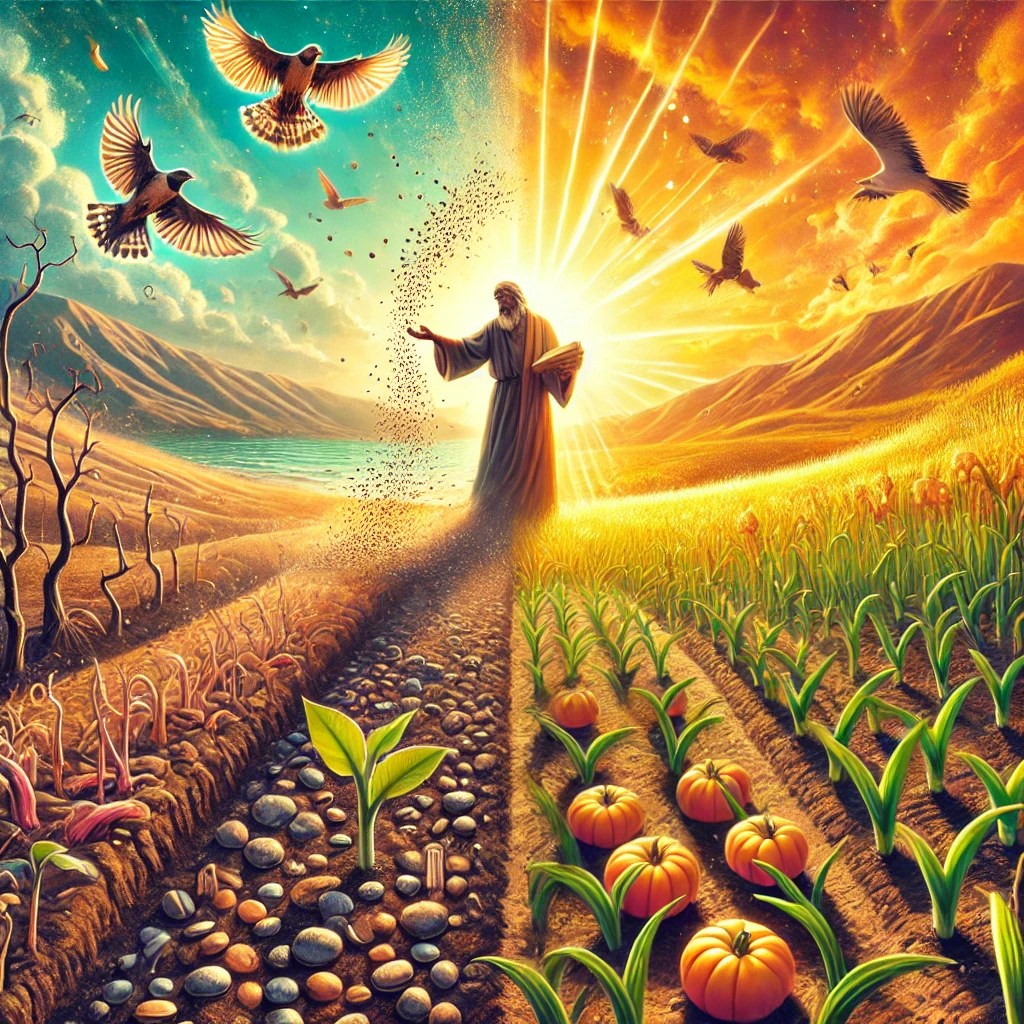
Rooted in Christ to Bear Fruit
In the quiet of our hearts, have we ever paused to consider how deeply Christ’s sacrifice changes everything? Today’s readings invite us to reflect on the transformative power of God’s covenant through Jesus Christ, our eternal priest and king. From the promises of the Old Testament to the teaching of Jesus in The Gospel of Mark, we witness the unfolding of God’s divine plan—a plan that calls us to receive His Word and allow it to bear abundant fruit in our lives.
The Letter to the Hebrews reminds us that Jesus, the ultimate high priest, offered the perfect and final sacrifice, rendering the Old Covenant’s repeated rituals unnecessary. This fulfillment was foretold through the prophetic words of the psalms, which declare, “You are a priest forever in the manner of Melchizedek” (Psalm 110:4). Jesus, seated at the right hand of God, extends this eternal covenant, writing His law upon our hearts and calling us to live as people forgiven and consecrated in Him.
In The Gospel of Mark, Jesus takes this covenant further, teaching us through the Parable of the Sower. Here, He urges us to be like the rich soil—receptive to the Word of God so that it can take root and flourish in our lives. Yet, as the parable illustrates, obstacles abound: hardness of heart, shallow faith, and the distractions of the world can hinder us from bearing fruit for the Kingdom of God.
Together, these passages highlight the gift of God’s covenant and the responsibility we have to nurture it. Historically, this shift from the Old to the New Covenant marked a revolutionary turning point in salvation history. Christ’s priesthood fulfilled and transcended the rituals of the Old Law, establishing a path for all to enter into a deeply personal relationship with God.
How does God’s covenant challenge us to live differently today? Are we nurturing the seeds of His Word in our hearts, or allowing the world to choke their growth? As we explore today’s readings, may we reflect on what it means to receive the gift of forgiveness and respond to it with a life rooted in Christ.
First Reading – Hebrews 10:11-18
Christ’s Perfect Sacrifice: A Covenant Written on Our Hearts
The Letter to the Hebrews stands as a theological masterpiece in the New Testament, addressing Jewish Christians who wrestled with maintaining their faith in Christ amidst persecution and the pull of their ancestral traditions. This epistle reveals how the Old Testament sacrificial system, centered on the Temple and the Levitical priesthood, served as a shadow of the ultimate sacrifice fulfilled in Christ. The author presents Jesus as the eternal high priest, whose offering of Himself surpasses and completes the daily sacrifices prescribed by the Mosaic Law. This reading captures the essence of today’s theme: the transformative power of God’s covenant, established through Christ’s singular sacrifice, which writes His law upon our hearts and calls us into a life of holiness and reconciliation.
In its historical context, the repeated sacrifices offered by Jewish priests reflected humanity’s ongoing struggle with sin and the need for atonement. Yet these sacrifices could never fully cleanse or perfect the human soul. They pointed toward something greater—a definitive act of redemption that only Christ could accomplish. By referencing the Old Covenant’s limitations and quoting Jeremiah’s prophecy of the New Covenant, this passage illustrates how Jesus inaugurates a new era, one in which the law is no longer external but internalized through the Holy Spirit. This truth not only redefines humanity’s relationship with God but also calls us to reflect on how Christ’s sacrifice transforms us into His consecrated people.
Hebrews 10:11-18
New American Bible (Revised Edition)
11 Every priest stands daily at his ministry, offering frequently those same sacrifices that can never take away sins. 12 But this one offered one sacrifice for sins, and took his seat forever at the right hand of God; 13 now he waits until his enemies are made his footstool. 14 For by one offering he has made perfect forever those who are being consecrated. 15 The holy Spirit also testifies to us, for after saying:
16 “This is the covenant I will establish with them after those days, says the Lord:
‘I will put my laws in their hearts,
and I will write them upon their minds,’”
17 he also says:
“Their sins and their evildoing
I will remember no more.”
18 Where there is forgiveness of these, there is no longer offering for sin.
Detailed Exegesis
Verse 11: “Every priest stands daily at his ministry, offering frequently those same sacrifices that can never take away sins.”
This verse underscores the repetitive nature of Old Testament sacrifices, which were insufficient to provide ultimate redemption. The priests’ standing posture symbolizes ongoing work—an endless cycle of offerings that could not fully reconcile humanity to God. These sacrifices were meant to prefigure Christ’s definitive act of salvation, which would bring this cycle to completion. The Church teaches that these rituals served as a tutor, preparing God’s people for the coming of the Messiah (CCC 1964).
Verse 12: “But this one offered one sacrifice for sins, and took his seat forever at the right hand of God.”
Unlike the Levitical priests, Jesus does not stand repeatedly at His ministry; He sits, signifying the completion and permanence of His redemptive work. The phrase “right hand of God” conveys both authority and victory, fulfilling the messianic prophecy of Psalm 110:1. His sacrifice is not one of many—it is the singular, all-sufficient offering for the forgiveness of sins.
Verse 13: “Now he waits until his enemies are made his footstool.”
This imagery, again rooted in Psalm 110:1, points to the eschatological reality of Christ’s victory over sin, death, and Satan. While His work of redemption is complete, the final consummation of His Kingdom will occur when all opposition to God is defeated. This verse reminds us of the already-but-not-yet nature of salvation: Christ reigns, yet the fullness of His victory is still unfolding.
Verse 14: “For by one offering he has made perfect forever those who are being consecrated.”
This verse captures the dual reality of salvation. Christ’s offering has already made believers perfect in God’s eyes—redeemed, forgiven, and justified—while we are still being sanctified daily by the Holy Spirit. This ongoing process of consecration calls us to cooperate with grace, allowing God to transform us into His likeness (CCC 1995).
Verse 16: “This is the covenant I will establish with them after those days, says the Lord: ‘I will put my laws in their hearts, and I will write them upon their minds.’”
By quoting Jeremiah 31:33, the author draws attention to the revolutionary nature of the New Covenant. Unlike the Old Covenant, which was external and reliant on written laws, the New Covenant is internal and personal. The Holy Spirit enables believers to know and follow God’s will intimately, transforming our hearts and minds into vessels of His love and truth.
Verse 17: “Their sins and their evildoing I will remember no more.”
This verse highlights the radical forgiveness offered through Christ. When we turn to God in repentance, our sins are not only forgiven but forgotten—a profound expression of divine mercy. The Church teaches that this forgiveness restores us to communion with God, healing the wounds of sin (CCC 1468).
Verse 18: “Where there is forgiveness of these, there is no longer offering for sin.”
The sufficiency of Christ’s sacrifice is reiterated here. Unlike the continual sacrifices of the Old Covenant, which served as reminders of sin, Jesus’ offering is final and complete. His death on the cross eradicates the need for further atonement, opening the way for eternal reconciliation with God.
Teachings
The Catechism teaches that Christ’s sacrifice is unique in its perfection, “accomplishing the definitive redemption of men” (CCC 616). This singular act of love fulfills the Old Covenant’s sacrificial system, offering forgiveness that is absolute and transformative (CCC 614). St. Augustine reflects on this truth, noting that the New Covenant’s law, written on our hearts, invites us into a deeper, interior relationship with God. The priesthood of Christ, eternal and unchanging, is also a central theme of the Church’s liturgical life, as the Mass re-presents this one sacrifice in an unbloody manner (CCC 1367). Historically, this understanding shaped early Christian identity, as believers recognized the Eucharist as a participation in Christ’s redemptive work.
Reflection
Christ’s sacrifice calls us into a life of gratitude and transformation. How often do we cling to guilt or sin, forgetting that God has forgiven and forgotten our past? This reading invites us to embrace the freedom offered by the New Covenant and to live as people made holy by His grace.
In daily life, this might mean making a conscious effort to seek God’s will, allowing Him to write His law on our hearts. Consider spending time in prayer, reflecting on where worldly distractions or past failures may be preventing you from fully receiving God’s Word. The sacrament of reconciliation provides a tangible opportunity to experience the mercy described in this reading.
What steps can you take today to cultivate a deeper awareness of God’s transformative grace in your life? Are you open to letting His Word take root and grow in your heart? Let us respond to Christ’s perfect sacrifice by living as people consecrated to Him, bearing the fruit of His covenant in our thoughts, actions, and relationships.
Responsorial Psalm – Psalm 110:1-4
Christ, the Eternal King and Priest
Psalm 110 is one of the most frequently quoted psalms in the New Testament, deeply revered in Jewish and Christian traditions as a messianic prophecy. Attributed to King David, this psalm speaks of the Lord appointing the Messiah as both King and eternal Priest, establishing His dominion over all enemies and His priesthood “in the manner of Melchizedek.” Rooted in Israel’s understanding of kingship and worship, the psalm reveals God’s plan for a Savior who would unite these roles perfectly. In today’s theme, it reflects the triumph of Christ’s singular priesthood and the establishment of His eternal Kingdom through His perfect sacrifice.
Historically, this psalm was recited in royal contexts, celebrating the enthronement of a king as God’s anointed. Yet its language goes beyond an earthly ruler, describing a divine figure whose priesthood transcends time and whose authority extends over all creation. The early Church identified Jesus Christ as the fulfillment of these verses, pointing to His exaltation at the right hand of the Father and His eternal intercession as our High Priest. This psalm beautifully complements the other readings, emphasizing the eternal and universal nature of Christ’s priestly and kingly mission.
Psalm 110:1-4
New American Bible (Revised Edition)
God Appoints the King both King and Priest
1 A psalm of David.
The Lord says to my lord:
“Sit at my right hand,
while I make your enemies your footstool.”
2 The scepter of your might:
the Lord extends your strong scepter from Zion.
Have dominion over your enemies!
3 Yours is princely power from the day of your birth.
In holy splendor before the daystar,
like dew I begot you.
4 The Lord has sworn and will not waver:
“You are a priest forever in the manner of Melchizedek.”
Detailed Exegesis
Verse 1: “The Lord says to my lord: ‘Sit at my right hand, while I make your enemies your footstool.’”
This verse opens with a declaration from God (“The Lord”) to “my lord,” a reference traditionally interpreted as the Messiah. To “sit at my right hand” is a position of honor, authority, and co-rulership, signifying Christ’s exaltation after His resurrection. The phrase “make your enemies your footstool” conveys the ultimate victory of Christ over sin, death, and Satan, fulfilling the prophecy in Genesis 3:15 and aligning with the New Testament’s depiction of Christ as the triumphant King (1 Corinthians 15:25-26).
Verse 2: “The scepter of your might: the Lord extends your strong scepter from Zion. Have dominion over your enemies!”
The “scepter” symbolizes royal authority and power. This verse underscores the Messiah’s kingship and His divine mandate to rule with justice and strength. Zion, representing Jerusalem and the place of God’s dwelling, becomes the launching point for His reign, extending over all nations. In Christ, this dominion is spiritual, encompassing the hearts of believers and bringing peace and justice through His redemptive work.
Verse 3: “Yours is princely power from the day of your birth. In holy splendor before the daystar, like dew I begot you.”
This verse highlights the divine origin and eternal nature of the Messiah’s kingship. The imagery of the “daystar” and “dew” evokes purity, renewal, and divine favor, reflecting Christ’s pre-existence and eternal generation by the Father. This verse connects with the doctrine of Christ as the “only begotten Son of God,” as affirmed in CCC 254-256, emphasizing His divine sonship and mission.
Verse 4: “The Lord has sworn and will not waver: ‘You are a priest forever in the manner of Melchizedek.’”
Here, the focus shifts to the Messiah’s priesthood. Melchizedek, introduced in Genesis 14:18-20, was both king of Salem and priest of God Most High. Unlike the Levitical priesthood, Melchizedek’s priesthood was universal, eternal, and not based on lineage. Christ fulfills this role perfectly, becoming the eternal High Priest who intercedes for humanity. The unchangeable nature of this priesthood is echoed in Hebrews 7:24-25, which declares that Christ’s priesthood is everlasting and His intercession unending.
Teachings
The Church teaches that Christ is the eternal King and High Priest who fulfills the prophecy of Psalm 110. According to the Catechism, “Christ, high priest and unique mediator, has made of the Church ‘a kingdom, priests for his God and Father’” (CCC 1546). As priest in the order of Melchizedek, Jesus’ priesthood transcends time, offering an eternal sacrifice that reconciles humanity to God (CCC 1544-1545). St. Ambrose reflects on this psalm, describing the unity of Christ’s priesthood and kingship: “The power of the scepter is divine, and the splendor of holiness establishes His eternal reign.” The Eucharist, celebrated in every Mass, is a participation in this eternal priesthood, where Christ continues to offer Himself for the salvation of all.
Reflection
This psalm invites us to recognize Christ’s authority as King and Priest in our lives. Do we truly submit to His reign, or do we resist, allowing worldly distractions to rule over us? Christ’s dominion is not one of force but of love and mercy, inviting us into a relationship of trust and surrender.
In daily life, we can honor Christ’s kingship by seeking His will and reflecting His justice in our actions. His priesthood calls us to unite our struggles, joys, and sacrifices with His, especially through participation in the Eucharist. How can we allow Christ to exercise His priestly role in our lives, interceding for us and sanctifying us through His grace?
Consider meditating on this psalm during prayer, allowing its words to deepen your awareness of Christ’s majesty and mercy. What steps can you take today to align your heart with His kingship and priesthood? Let this psalm inspire you to live as a faithful member of His Kingdom, bearing witness to His eternal reign in all that you do.
Holy Gospel – Mark 4:1-20
The Parable of the Sower: Receptivity to the Word of God
The Gospel of Mark is the earliest and most concise of the four Gospels, written for a Christian community facing persecution. It presents Jesus as the suffering Messiah and Son of God, emphasizing His authority, teaching, and ultimate sacrifice. Today’s Gospel focuses on the Parable of the Sower, one of Jesus’ most well-known teachings, which invites listeners to reflect on how they receive and respond to God’s Word. This passage is set within the broader context of Jesus’ ministry in Galilee, where large crowds followed Him, seeking wisdom, healing, and hope.
The parable uses agricultural imagery familiar to Jesus’ audience, reflecting the everyday life of farmers in first-century Palestine. However, the message transcends time, challenging believers to examine their spiritual receptivity. Are our hearts fertile soil for God’s Word, or do we allow distractions, fear, or superficiality to hinder spiritual growth? In today’s theme, this Gospel complements the other readings by showing how God’s transformative covenant takes root in those who are open and prepared to receive His Word.
Mark 4:1-20
New American Bible (Revised Edition)
The Parable of the Sower. 1 On another occasion he began to teach by the sea. A very large crowd gathered around him so that he got into a boat on the sea and sat down. And the whole crowd was beside the sea on land. 2 And he taught them at length in parables, and in the course of his instruction he said to them, 3 “Hear this! A sower went out to sow. 4 And as he sowed, some seed fell on the path, and the birds came and ate it up. 5 Other seed fell on rocky ground where it had little soil. It sprang up at once because the soil was not deep. 6 And when the sun rose, it was scorched and it withered for lack of roots. 7 Some seed fell among thorns, and the thorns grew up and choked it and it produced no grain. 8 And some seed fell on rich soil and produced fruit. It came up and grew and yielded thirty, sixty, and a hundredfold.” 9 He added, “Whoever has ears to hear ought to hear.”
The Purpose of the Parables. 10 And when he was alone, those present along with the Twelve questioned him about the parables. 11 He answered them, “The mystery of the kingdom of God has been granted to you. But to those outside everything comes in parables, 12 so that
‘they may look and see but not perceive,
and hear and listen but not understand,
in order that they may not be converted and be forgiven.’”
13 Jesus said to them, “Do you not understand this parable? Then how will you understand any of the parables? 14 The sower sows the word. 15 These are the ones on the path where the word is sown. As soon as they hear, Satan comes at once and takes away the word sown in them. 16 And these are the ones sown on rocky ground who, when they hear the word, receive it at once with joy. 17 But they have no root; they last only for a time. Then when tribulation or persecution comes because of the word, they quickly fall away. 18 Those sown among thorns are another sort. They are the people who hear the word, 19 but worldly anxiety, the lure of riches, and the craving for other things intrude and choke the word, and it bears no fruit. 20 But those sown on rich soil are the ones who hear the word and accept it and bear fruit thirty and sixty and a hundredfold.”
Detailed Exegesis
Verse 3: “Hear this! A sower went out to sow.”
Jesus begins with a call to attention, emphasizing the importance of the parable. The sower represents God or Jesus Himself, generously spreading His Word. The act of sowing reflects God’s abundant grace, given freely to all, regardless of the condition of their hearts.
Verse 4: “And as he sowed, some seed fell on the path, and the birds came and ate it up.”
The seed that falls on the path symbolizes those who hear the Word but fail to understand or embrace it. The hardened path reflects a heart closed off by sin, pride, or indifference. The birds, representing Satan, snatch the Word away before it has any chance to take root, as described in Mark 4:15.
Verse 5: “Other seed fell on rocky ground where it had little soil. It sprang up at once because the soil was not deep.”
This seed represents those who initially receive the Word with enthusiasm but lack depth in their faith. The rocky ground reflects a superficial commitment, unable to endure challenges or hardships. As Mark 4:17 explains, these individuals fall away when faced with trials or persecution.
Verse 7: “Some seed fell among thorns, and the thorns grew up and choked it, and it produced no grain.”
The thorns symbolize worldly anxieties, materialism, and the lure of riches that choke the Word, preventing it from bearing fruit. In Mark 4:19, Jesus identifies these as obstacles that crowd out God’s presence in our lives. This verse warns against divided priorities, reminding us of the need to focus on God’s Kingdom above all else.
Verse 8: “And some seed fell on rich soil and produced fruit. It came up and grew and yielded thirty, sixty, and a hundredfold.”
This verse describes the ideal response to God’s Word: a heart that is open, receptive, and nurtured by faith. The rich soil symbolizes those who hear, accept, and live out the Word, bearing abundant spiritual fruit. The extraordinary yield reflects the transformative power of God’s grace in a life fully surrendered to Him.
Verse 9: “Whoever has ears to hear ought to hear.”
Jesus concludes with an invitation to reflect deeply and respond to the parable. The call to “hear” goes beyond passive listening, urging active engagement and transformation. This echoes Deuteronomy 6:4, where God commands His people to listen and love Him with all their hearts.
Verse 11: “The mystery of the kingdom of God has been granted to you.”
Jesus explains to His disciples that the “mystery” of the Kingdom is revealed to those who are open to God’s truth. This mystery is not something hidden but a reality made known through Jesus’ life, death, and resurrection.
Verse 20: “But those sown on rich soil are the ones who hear the word and accept it and bear fruit thirty and sixty and a hundredfold.”
The rich soil illustrates the ultimate goal of discipleship: to hear, accept, and act on God’s Word. This verse underscores the importance of perseverance, prayer, and trust in God’s grace to bear lasting fruit.
Teachings
The Catechism teaches that the Word of God is living and effective, calling each person to conversion and growth in holiness. According to CCC 546, parables like this one invite listeners to enter the Kingdom of God but require a decision. They challenge the listener’s heart, prompting self-examination and a response to God’s call.
Additionally, CCC 2837 explains that God’s Word, like the “daily bread” of the Lord’s Prayer, nourishes the soul and strengthens us for the spiritual journey. The rich soil described in the parable reflects the interior disposition necessary to receive this nourishment and allow it to transform our lives. Saints such as St. Augustine emphasize that the Word of God must be actively cultivated through prayer, study, and obedience. “God’s grace is freely given, but we must prepare our hearts to receive it,” St. Augustine reminds us in his reflections on Scripture.
Reflection
The Parable of the Sower invites us to examine our hearts and the barriers that prevent God’s Word from taking root. Is your heart like the hardened path, the rocky ground, or the thorny soil? What steps can you take to cultivate a heart that is rich and receptive to God’s Word?
In practical terms, this might mean creating space for silence and prayer, where God’s Word can be deeply heard and reflected upon. It could also involve setting aside time for Scripture study or participating in a faith-sharing group to nurture and grow in understanding.
This parable reminds us that faith is not static; it requires continual effort and perseverance. What worldly distractions or anxieties might be choking God’s Word in your life? Consider ways to simplify, prioritize, and focus on God’s Kingdom above all else.
Ultimately, the call is to bear fruit—not just for ourselves but for the benefit of others. How can you let the Word of God shine through your actions today? Let us strive to be the rich soil that responds to God’s grace, producing fruit in abundance for His glory.
Cultivating Hearts for God’s Covenant
Today’s readings invite us to reflect on the profound ways God’s covenant transforms us, calling us into a deeper relationship with Him. From the Letter to the Hebrews, we see the finality and perfection of Christ’s sacrifice, which establishes a new covenant written on our hearts. Psalm 110 declares Christ as both eternal King and High Priest, seated at the right hand of God and interceding for us forever. In the Gospel of Mark, Jesus teaches the Parable of the Sower, challenging us to examine whether we are truly open to receiving His Word and allowing it to bear fruit in our lives.
Together, these passages illuminate a central truth: God’s love and mercy are freely given, but we are called to respond actively. Christ’s sacrifice has opened the way for us to enter into this covenant, but it is our responsibility to nurture the soil of our hearts, rooting out distractions, deepening our faith, and living out His Word.
What is the condition of your heart today? Are you prepared to embrace God’s Word and let it flourish within you?
This week, take some time to reflect on what might be preventing you from fully receiving God’s grace. Seek ways to simplify your life, set aside worldly concerns, and focus on cultivating a closer relationship with Christ. Make space for daily prayer and Scripture, participate in the sacraments, and ask God to help you grow in faith and holiness.
God’s covenant is not merely a promise; it is a transformation—a call to become His consecrated people. Let us open our hearts to His Word and allow His grace to bear abundant fruit in our lives. As we go forth, may we strive to live as witnesses to His eternal priesthood, His perfect sacrifice, and His boundless love. How will you respond to God’s invitation today?
Engage with Us!
We’d love to hear your thoughts and reflections on today’s readings! Share in the comments how God’s Word spoke to your heart and what steps you are inspired to take in response. Let’s encourage one another as we grow in faith and live out the love and mercy Jesus taught us.
Here are some reflection questions to guide your thoughts:
- First Reading (Hebrews 10:11-18): How does knowing that Christ’s sacrifice is perfect and complete change the way you view forgiveness and your relationship with God? What does it mean for you personally to have God’s law written on your heart?
- Responsorial Psalm (Psalm 110:1-4): In what ways do you recognize Christ as both King and Priest in your life? How can you honor His authority and trust in His eternal priesthood?
- Holy Gospel (Mark 4:1-20): Which type of soil best represents your heart right now? What practical steps can you take to nurture a heart that is open and ready to bear fruit for God’s Kingdom?
As you reflect on these questions, remember that living a life of faith is a journey—one rooted in grace and strengthened by daily choices to trust in God. May we go forth today with hearts open to His Word, living each moment with the love, mercy, and compassion that Jesus taught us. Together, let us strive to be the rich soil that bears abundant fruit for the glory of God!
Follow us on Instagram and Facebook for more insights and reflections on living a faith-filled life.

 Holy Manna!
Leave a comment