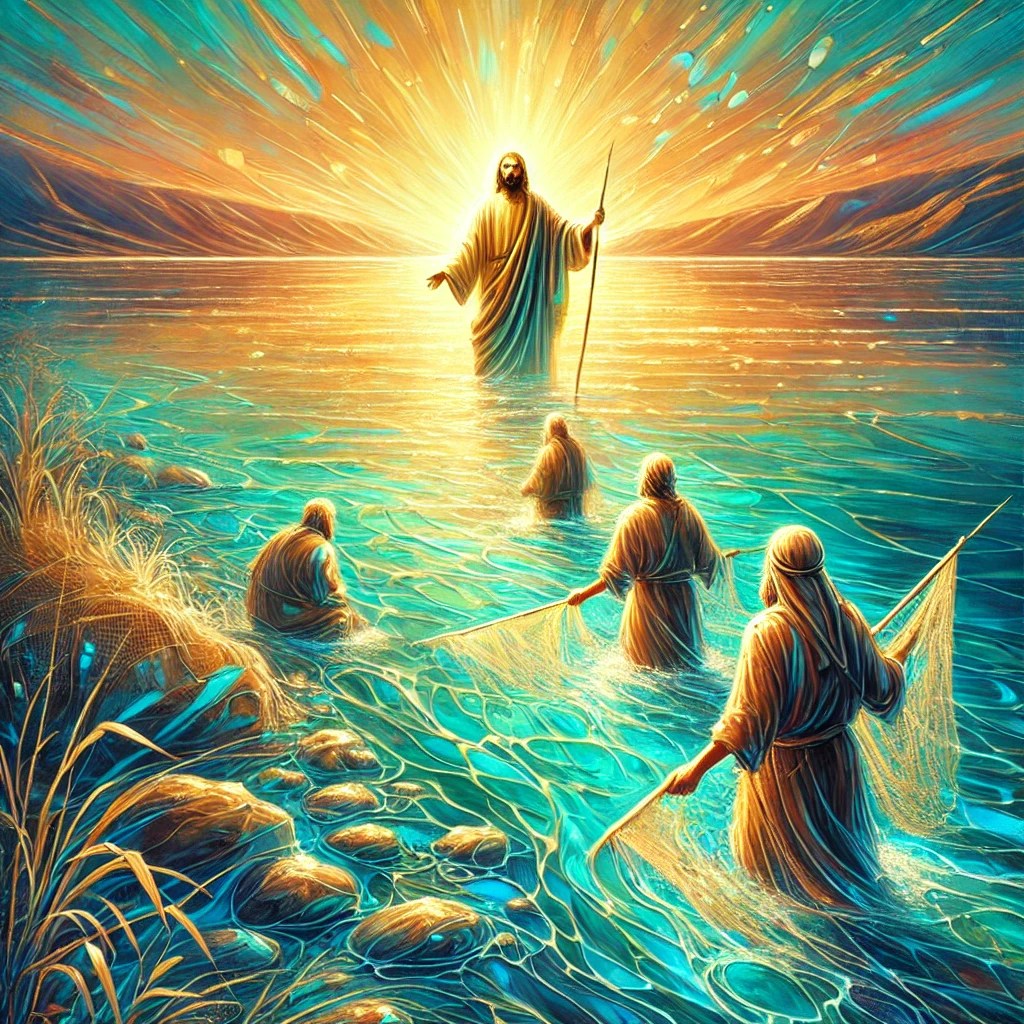
Recognizing and Responding to Christ
Have you ever paused to marvel at the grandeur of God’s revelation? In today’s readings, we’re invited to contemplate the breathtaking truth that Jesus Christ is not only the radiance of God’s glory but also the fulfillment of His divine plan. He calls us to acknowledge His authority, embrace repentance, and follow Him as His disciples.
The first reading from Hebrews sets the stage by proclaiming that God has spoken definitively through His Son, who is far superior to the angels. “When he had accomplished purification from sins, he took his seat at the right hand of the Majesty on high” (Hebrews 1:3). This breathtaking declaration reveals the glory and kingship of Christ, the Word made flesh, through whom the universe was created.
In the Responsorial Psalm, we echo this awe, exalting the Lord as King and declaring, “The heavens proclaim his justice; all peoples see his glory” (Psalm 97:6). The psalm underscores the futility of idolatry and the supremacy of God, a reminder that all creation must bow before Him.
The Gospel of Mark invites us to move from recognition to action. Jesus, proclaiming the Kingdom of God, calls us to “Repent, and believe in the gospel” (Mark 1:15). He then calls Simon, Andrew, James, and John to leave everything behind and follow Him, transforming them into “fishers of men.” Their immediate response exemplifies the radical call to discipleship that Jesus extends to each of us.
Culturally and historically, these passages resonate deeply with the Jewish expectation of the Messiah and the early Christian recognition of Jesus as the fulfillment of the Old Covenant. The Jewish people awaited a Savior, and Hebrews bridges this expectation with the reality of Christ’s divinity and mission. The psalm reflects the monotheistic proclamation of God’s kingship in contrast to the pagan idolatry of the surrounding nations, while the Gospel highlights the shift from John the Baptist’s preparatory ministry to the active mission of Christ.
How do we respond to the radiance of God’s glory revealed in Jesus Christ? Today’s readings invite us to recognize His kingship, turn from sin, and embrace His call to radical discipleship. Let’s explore these passages in greater depth to see how they speak to our lives today.
First Reading – Hebrews 1:1-6
God’s Final Word: The Radiance of the Son
In the opening chapter of Hebrews, we are drawn into a grand vision of Jesus Christ as the ultimate and perfect revelation of God. This epistle was written to early Jewish Christians who were struggling under persecution and were tempted to revert to the familiar practices of the Old Covenant. The author of Hebrews offers an urgent and eloquent exhortation: the promises of the Old Covenant find their fulfillment in Jesus, who is far superior to the prophets and angels that the Jewish faith deeply revered. Today’s reading highlights the shift from the partial revelations of the past to the definitive Word spoken through the Son. This ties beautifully into the day’s theme of God’s glory revealed in Christ, who calls us to repentance and discipleship. The epistle also reflects the deep connection between creation, salvation, and worship, pointing us toward the ultimate truth that all of history and existence find their meaning in Christ.
Hebrews 1:1-6
New American Bible (Revised Edition)
1 In times past, God spoke in partial and various ways to our ancestors through the prophets; 2 in these last days, he spoke to us through a son, whom he made heir of all things and through whom he created the universe,
3 who is the refulgence of his glory,
the very imprint of his being,
and who sustains all things by his mighty word.
When he had accomplished purification from sins,
he took his seat at the right hand of the Majesty on high,
4 as far superior to the angels
as the name he has inherited is more excellent than theirs.
The Son Higher Than the Angels
Messianic Enthronement. 5 For to which of the angels did God ever say:
“You are my son; this day I have begotten you”?
Or again:
“I will be a father to him, and he shall be a son to me”?
6 And again, when he leads the first-born into the world, he says:
“Let all the angels of God worship him.”
Detailed Exegesis
Verse 1: “In times past, God spoke in partial and various ways to our ancestors through the prophets;”
This opening verse establishes the continuity between the Old and New Testaments. God’s communication through the prophets, such as Isaiah, Jeremiah, and Ezekiel, was vital for preparing His people for the Messiah. However, these revelations were “partial,” limited in scope and understanding. Each prophet revealed a piece of God’s plan, but the fullness of His will and character remained hidden. This verse invites us to appreciate the progressive nature of salvation history, where God patiently unfolded His divine plan step by step.
Verse 2: “In these last days, he spoke to us through a son, whom he made heir of all things and through whom he created the universe.”
Here, the author contrasts the former modes of revelation with the new and definitive one: Jesus Christ. Referring to Christ as the “heir of all things” emphasizes His authority over creation, reflecting the imagery in Psalm 2:8: “Ask of me, and I will make the nations your heritage.” By identifying Jesus as the one “through whom he created the universe,” this verse also connects Him to the eternal Word spoken of in John 1:1: “In the beginning was the Word.” This dual role as Creator and Redeemer underscores Jesus’ divine identity and mission, showing that He is central to both the origins and destiny of all things.
Verse 3: “Who is the refulgence of his glory, the very imprint of his being, and who sustains all things by his mighty word. When he had accomplished purification from sins, he took his seat at the right hand of the Majesty on high.”
This verse beautifully portrays Jesus as the visible manifestation of God’s glory. The term “refulgence” conveys the image of light radiating from its source, illustrating that Jesus perfectly reflects God’s essence. The “imprint” imagery further emphasizes that Jesus is not a mere reflection but the exact representation of God’s being. He is fully divine, sharing in the Father’s nature. Jesus’ role in sustaining creation “by his mighty word” echoes the sustaining power of God’s Word in Genesis. The purification of sins refers to His sacrificial death on the cross, through which humanity is reconciled to God. His exaltation “at the right hand” signifies His eternal kingship and intercessory role as High Priest.
Verse 4: “As far superior to the angels as the name he has inherited is more excellent than theirs.”
Angels were revered in Jewish thought as God’s messengers and servants, yet this verse establishes Jesus as infinitely greater. The “name” Jesus inherited is “Son,” a title that signifies His divine nature and relationship with the Father. Unlike angels, who serve, Jesus rules as King and Savior. This distinction challenges any tendency to equate Jesus with created beings, reaffirming His unique status as fully God and fully man.
Verse 5: “For to which of the angels did God ever say: ‘You are my son; this day I have begotten you’? Or again: ‘I will be a father to him, and he shall be a son to me’?”
The rhetorical questions draw from Old Testament messianic prophecies (Psalm 2:7 and 2 Samuel 7:14) to highlight Jesus’ unique relationship with the Father. These verses were long understood as promises to David and his descendants, but they find their ultimate fulfillment in Christ. No angel ever received such declarations. This underscores that Jesus’ sonship is not metaphorical but ontological, rooted in His eternal divine nature.
Verse 6: “And again, when he leads the first-born into the world, he says: ‘Let all the angels of God worship him.’”
Referring to Jesus as “first-born” denotes His preeminence, not chronological origin. This term reflects His authority as the heir of all creation. The command for angels to worship Him affirms His divinity, as worship is due to God alone. This verse also points to the incarnation, where Jesus entered the world as both fully God and fully man, uniting heaven and earth in His person.
Teachings
The Catechism of the Catholic Church emphasizes that Christ is the fullness of revelation: “By sending his only Son and the Spirit of Love in the fullness of time, God has revealed his innermost secret: God himself is an eternal exchange of love, Father, Son, and Holy Spirit, and he has destined us to share in that exchange” (CCC 221). This reading also resonates with the Church’s teaching on Jesus’ kingship, reflected in CCC 668: “Christ is Lord of the cosmos and of history. In him human history and indeed all creation are ‘set forth’ and transcendently fulfilled.”
Saint Athanasius, in his work On the Incarnation, described the mission of Christ beautifully: “The Word became flesh so that we might contemplate the glory of the Father.” This highlights how Jesus, by taking on our humanity, brings us into communion with God. Historically, the Church has continually defended the divinity of Christ, from the early councils of Nicaea and Chalcedon to modern proclamations, affirming that Jesus is not merely a great teacher but the very Son of God.
Reflection
This reading calls us to marvel at the beauty and mystery of Christ’s identity as the radiance of God’s glory. How often do we take time to contemplate who Jesus is—the Creator, Redeemer, and Sustainer of all things? Recognizing Him as the definitive Word of God challenges us to respond with reverence, worship, and obedience.
In daily life, this passage invites us to reflect on how we allow Christ to illuminate our hearts. Do we fully trust in His sustaining power when life feels overwhelming? Are there areas in our lives where we fail to see His kingship? A practical way to live out this passage is to spend time in Eucharistic adoration, worshipping Christ as the radiance of God’s glory and entrusting Him with your burdens.
Consider these questions: How can you more intentionally listen to God’s Word? How does Jesus’ divine kingship inspire your faith? In what ways can you reflect His glory to those around you? As you meditate on this reading, allow it to deepen your awe and gratitude for the Son of God, who speaks directly to your heart.
Responsorial Psalm – Psalm 97:1-2, 6-7, 9
The Lord Reigns: Proclaiming His Justice and Glory
Psalm 97 is a powerful hymn celebrating the kingship and justice of God. It belongs to a collection of enthronement psalms that declare God’s sovereign rule over creation and His ultimate triumph over idolatry and evil. Written in a time when Israel was surrounded by nations worshipping false gods, this psalm calls the faithful to recognize and rejoice in the Lord’s supreme authority. It speaks to the universal scope of God’s reign, where all peoples and even the heavens bear witness to His glory. This message aligns with today’s theme by emphasizing the divine kingship of Jesus Christ, the one through whom God’s justice is made manifest, and who calls all creation to worship.
Psalm 97:1-2, 6-7, 9
New American Bible (Revised Edition)
The Divine Ruler of All
1 The Lord is king; let the earth rejoice;
let the many islands be glad.
2 Cloud and darkness surround him;
justice and right are the foundation of his throne.
6 The heavens proclaim his justice;
all peoples see his glory.
7 All who serve idols are put to shame,
who glory in worthless things;
all gods bow down before him.
9 For you, Lord, are the Most High over all the earth,
exalted far above all gods.
Detailed Exegesis
Verse 1: “The Lord is king; let the earth rejoice; let the many islands be glad.”
This opening verse establishes the Lord’s universal kingship and invites the whole earth to rejoice. The phrase “many islands” symbolizes the farthest reaches of the earth, highlighting the inclusivity of God’s reign. The psalmist’s call for joy reflects the proper response to God’s authority: not fear, but gladness in knowing that His rule is just and righteous. In the light of Christ, this verse anticipates the proclamation of the Gospel to all nations, as foretold in Matthew 28:19.
Verse 2: “Cloud and darkness surround him; justice and right are the foundation of his throne.”
The imagery of “cloud and darkness” evokes the theophany at Mount Sinai, where God’s presence was revealed amid clouds, fire, and thunder (Exodus 19:16-18). These elements convey both mystery and majesty, reminding us that God’s ways are beyond human comprehension. Despite this mystery, His throne is founded on “justice and right,” affirming that His rule is not arbitrary but perfectly aligned with His divine nature. This verse invites us to trust in God’s justice, even when His plans are beyond our understanding.
Verse 6: “The heavens proclaim his justice; all peoples see his glory.”
This verse echoes the universal reach of God’s kingship. The “heavens” serve as a cosmic witness to His justice, reflecting the belief that creation itself reveals God’s character (Psalm 19:1). The declaration that “all peoples see his glory” underscores the inclusivity of God’s revelation. In Christ, this glory becomes incarnate, as John testifies: “We saw his glory, the glory as of the Father’s only Son” (John 1:14).
Verse 7: “All who serve idols are put to shame, who glory in worthless things; all gods bow down before him.”
This verse confronts the futility of idolatry, a recurring theme in the Psalms and prophetic literature. To “glory in worthless things” is to place hope in what cannot save. The psalmist proclaims that even the so-called gods of the nations will bow before the true God. This foreshadows the New Testament teaching in Philippians 2:10-11, where every knee bows to Jesus Christ.
Verse 9: “For you, Lord, are the Most High over all the earth, exalted far above all gods.”
The psalm concludes with a triumphant affirmation of God’s supremacy. The title “Most High” emphasizes His transcendence and authority over all creation. For Christians, this verse points to the exaltation of Jesus, who reigns as King of kings and Lord of lords (Revelation 19:16).
Teachings
The Catechism teaches that God’s kingship is inseparable from His justice: “His almighty power is in no way arbitrary: ‘In God, power, essence, will, intellect, wisdom, and justice are all identical’” (CCC 271). The psalm’s call to worship aligns with the Catechism’s emphasis on idolatry as a distortion of true worship: “Man commits idolatry whenever he honors and reveres a creature in place of God” (CCC 2113). Saint Augustine, reflecting on the psalms, wrote: “The Lord reigns, not as one who takes over a kingdom, but as one who always reigns, yet is newly acknowledged.” This underscores the timelessness of God’s kingship and the continual invitation for humanity to recognize His rule.
Reflection
This psalm invites us to rejoice in the Lord’s kingship and to trust in His justice. How often do we pause to consider God’s reign over our lives and the world? When life feels chaotic, this psalm reminds us that God’s throne is founded on justice and right. It challenges us to examine our own hearts: Are there idols—“worthless things”—that we are tempted to place before God? These could be material possessions, ambitions, or even relationships that distract us from His glory.
In daily life, we can live out this psalm by dedicating time to worship and praise, acknowledging God’s authority over all aspects of our lives. Spend a moment each day reflecting on God’s glory revealed in creation and in the face of Christ. Ask yourself: What idols might I need to let go of to fully embrace God’s kingship? How can I make worship a more intentional part of my life? In what ways can I proclaim His justice and glory to others?
Rejoicing in God’s reign doesn’t mean ignoring life’s struggles, but finding peace in the assurance that His justice and love prevail. Let this psalm inspire you to trust in God’s sovereignty, live with greater faith, and proclaim His glory with joy.
Holy Gospel – Mark 1:14-20
The Kingdom Is at Hand: A Call to Repentance and Discipleship
The Gospel of Mark begins with urgency, reflecting the immediacy of Jesus’ mission and message. Written for a community facing persecution, Mark emphasizes Jesus’ identity as the Son of God and the transformative power of His call. In today’s reading, we see the transition from John the Baptist’s preparatory ministry to the public mission of Christ. Jesus begins proclaiming the Kingdom of God, calling for repentance and faith, and inviting the first disciples to follow Him. This passage ties directly to today’s theme by showing how God’s glory is revealed in Christ and how His kingship demands a personal and active response. The call to follow Jesus—leaving behind old ways and embracing a new mission—resonates deeply with every believer’s journey of faith.
Mark 1:14-20
New American Bible (Revised Edition)
The Mystery of Jesus
The Beginning of the Galilean Ministry. 14 After John had been arrested, Jesus came to Galilee proclaiming the gospel of God: 15 “This is the time of fulfillment. The kingdom of God is at hand. Repent, and believe in the gospel.”
The Call of the First Disciples. 16 As he passed by the Sea of Galilee, he saw Simon and his brother Andrew casting their nets into the sea; they were fishermen. 17 Jesus said to them, “Come after me, and I will make you fishers of men.” 18 Then they abandoned their nets and followed him. 19 He walked along a little farther and saw James, the son of Zebedee, and his brother John. They too were in a boat mending their nets. 20 Then he called them. So they left their father Zebedee in the boat along with the hired men and followed him.
Detailed Exegesis
Verse 14: “After John had been arrested, Jesus came to Galilee proclaiming the gospel of God.”
This verse marks a pivotal moment in salvation history. John’s arrest signifies the close of his prophetic ministry and the beginning of Jesus’ public mission. Jesus starts in Galilee, a region significant for its diversity and association with both Jews and Gentiles. This geographical choice highlights the universal nature of Jesus’ message. The phrase “gospel of God” reflects the Good News of God’s plan for salvation, fulfilled in Jesus.
Verse 15: “This is the time of fulfillment. The kingdom of God is at hand. Repent, and believe in the gospel.”
Jesus’ proclamation is both an invitation and a challenge. The “time of fulfillment” refers to the culmination of God’s promises in the person of Christ. The “kingdom of God” is not a physical territory but the reign of God’s will and justice in human hearts and in the world. Repentance, a turning away from sin, is the necessary first step to entering this kingdom, while faith in the gospel represents complete trust in God’s redemptive plan. This verse sets the foundation for Jesus’ entire ministry.
Verse 16: “As he passed by the Sea of Galilee, he saw Simon and his brother Andrew casting their nets into the sea; they were fishermen.”
The Sea of Galilee serves as the backdrop for Jesus’ calling of the first disciples. Simon (later Peter) and Andrew are ordinary fishermen, engaged in their daily work. This detail underscores that Jesus calls people from all walks of life, transforming the mundane into the extraordinary.
Verse 17: “Jesus said to them, ‘Come after me, and I will make you fishers of men.’”
Jesus’ invitation is personal and direct: “Come after me.” This phrase not only calls for physical following but also implies a deeper commitment to discipleship. The metaphor “fishers of men” signifies their new mission to bring others into the kingdom of God. It reflects the transformative nature of discipleship, where one’s ordinary skills are elevated for divine purposes.
Verse 18: “Then they abandoned their nets and followed him.”
The immediacy of their response is striking. Leaving their nets symbolizes a total surrender of their livelihood and security. This verse highlights the radical nature of discipleship, where following Christ takes precedence over all else.
Verse 19: “He walked along a little farther and saw James, the son of Zebedee, and his brother John. They too were in a boat mending their nets.”
Jesus continues to call others, this time James and John, who are similarly engaged in their work as fishermen. The detail of “mending their nets” suggests that discipleship requires both preparation and readiness to respond when called.
Verse 20: “Then he called them. So they left their father Zebedee in the boat along with the hired men and followed him.”
James and John’s response mirrors that of Simon and Andrew. Leaving their father and the hired men behind signifies the cost of discipleship, which often involves leaving behind family ties, possessions, or societal expectations. Their willingness to follow immediately reflects the power of Jesus’ call and their openness to God’s will.
Teachings
The Catechism emphasizes the call to discipleship as central to Christian life: “By his call, God invites men to become free and responsible collaborators in his plan of salvation” (CCC 307). The urgency of Jesus’ message in this passage reflects the Church’s teaching on repentance: “Interior repentance is a radical reorientation of our whole life, a return, a conversion to God with all our heart” (CCC 1431).
Saint John Chrysostom, reflecting on this Gospel, wrote: “To follow Christ is to enter into His mission. The apostles left their nets to catch not fish, but souls, bringing others into the life of grace.” This teaching underscores the transformative power of discipleship, where ordinary lives are redirected toward extraordinary purposes. Historically, this passage inspired countless missionaries and saints, from Saint Francis Xavier to modern evangelists, who responded to the call to be “fishers of men.”
Reflection
This Gospel challenges us to reflect on our own response to Christ’s call. How readily do we leave behind our “nets”—the things that tether us to the world and prevent us from fully following Jesus? The disciples’ immediate response serves as a model of trust and surrender.
In daily life, this might mean reexamining our priorities to ensure they align with God’s will. Are we willing to make sacrifices, whether of time, comfort, or security, to deepen our relationship with Christ? This passage also invites us to consider how we are called to be “fishers of men” in our own contexts. How do we share the Good News with others, whether through words, actions, or the witness of our lives?
Practical steps could include setting aside dedicated time for prayer and reflection on God’s call, actively seeking opportunities to serve others, and sharing the Gospel with those who may not yet know Christ. Consider these questions: What nets are you being called to leave behind? How can you respond more fully to Jesus’ invitation to follow Him? In what ways can you bring others closer to God’s kingdom?
This Gospel reminds us that discipleship is not just a one-time decision but a daily choice to follow Jesus and participate in His mission. May we, like the first disciples, have the courage to abandon our nets and trust fully in the one who calls us.
Called to See His Glory and Follow Him
Today’s readings present a unified and awe-inspiring message: Jesus Christ is the radiance of God’s glory, the fulfillment of His promises, and the one who calls us to repentance, faith, and discipleship. In the First Reading, we are reminded of the majesty of Jesus as the definitive Word of God, superior to the prophets and angels, and the very imprint of God’s being. The Responsorial Psalm invites us to proclaim God’s justice and glory, rejecting the idols that vie for our attention and turning our hearts to worship the Lord, the Most High. Finally, in the Gospel, we see Jesus inaugurating His ministry, proclaiming the nearness of God’s Kingdom, and calling His first disciples to leave everything behind and follow Him.
Each reading builds on the central theme of God’s revelation and our response. God has spoken definitively through His Son, who invites us into His Kingdom, not as passive observers but as active participants in His mission. The call to repent, believe, and follow requires trust, sacrifice, and a willingness to let go of what holds us back.
How is God calling you to respond today? Perhaps it’s a call to deeper trust in His justice, an invitation to let go of distractions and idols, or a nudge to share the Good News with others. Reflect on the disciples’ courage to leave their nets and ask yourself what “nets” in your life need to be left behind so you can fully embrace the life Christ has planned for you.
As you go forth today, take time to marvel at the glory of God revealed in Christ. Let the words of the psalm echo in your heart: “The heavens proclaim his justice; all peoples see his glory” (Psalm 97:6). Pray for the grace to respond with the same faith and readiness as Simon, Andrew, James, and John, who abandoned everything to follow Jesus.
God is always calling us—calling us to see His glory, trust in His justice, and follow Him into the abundant life He promises. Will you answer? Today is the time of fulfillment. The Kingdom of God is at hand. Repent, believe, and follow the one who is the radiance of God’s glory.
Engage with Us!
We’d love to hear your thoughts! How did today’s readings speak to your heart? Share your reflections in the comments below and join the conversation about how God’s Word is transforming our lives. To help guide your reflection, here are a few questions to consider:
- First Reading (Hebrews 1:1-6): How does recognizing Jesus as the “radiance of God’s glory” inspire your faith? What does it mean to you that Jesus is God’s final Word to humanity?
- Responsorial Psalm (Psalm 97:1-2, 6-7, 9): Are there any “idols” in your life that need to be surrendered so you can focus more fully on God’s glory and justice? How can you make worship a more central part of your daily life?
- Holy Gospel (Mark 1:14-20): What “nets” in your life might Jesus be calling you to leave behind? How can you respond more fully to His call to follow Him and share His love with others?
As we reflect on today’s Word, let’s commit to living a life rooted in faith, guided by love, and filled with the mercy Jesus teaches us. Let everything we do flow from a heart that seeks to glorify God and bring others closer to His Kingdom. Go forth today with courage, joy, and a renewed desire to follow the one who calls us by name.
Follow us on Instagram and Facebook for more insights and reflections on living a faith-filled life.

 Holy Manna!
Leave a comment