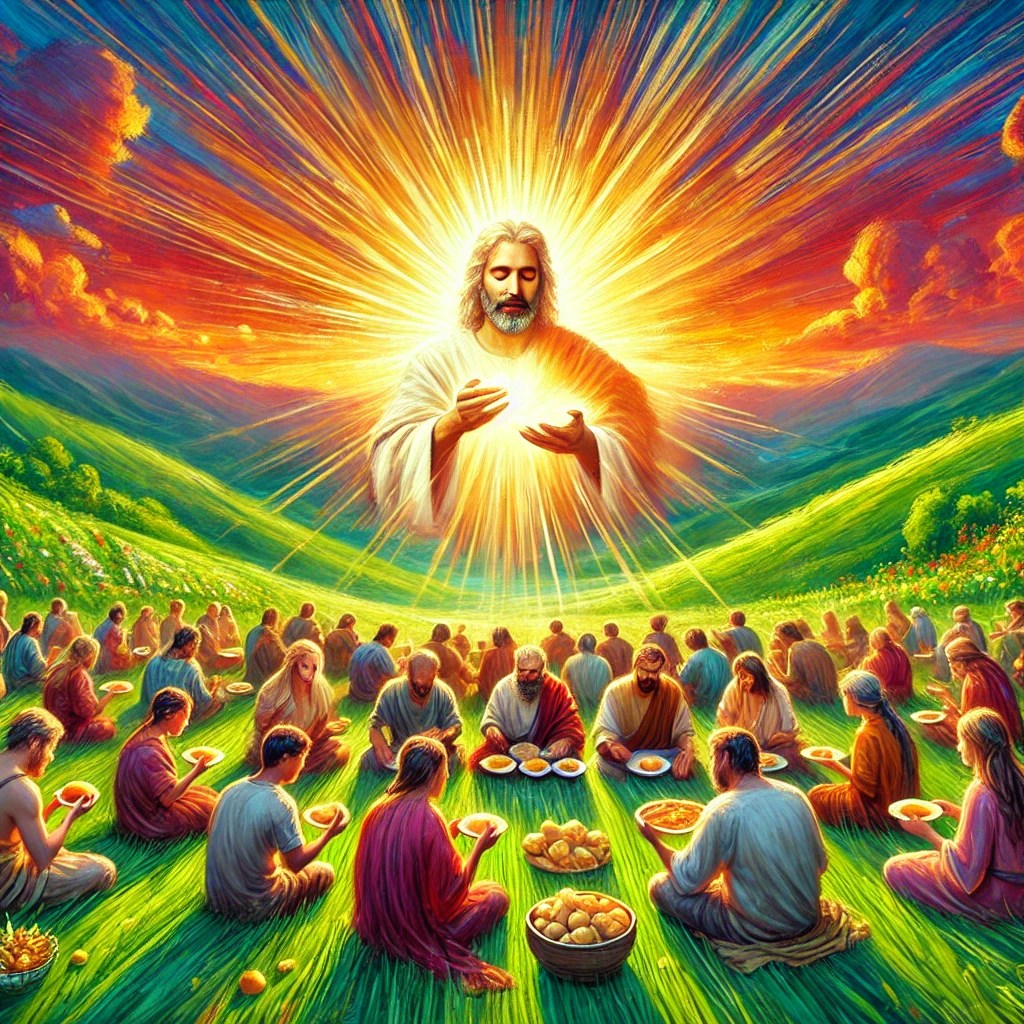
Called to Receive and Reflect His Abundance
Have you ever marveled at the sheer abundance of God’s love in your life? Today’s readings draw us into the heart of this divine love—a love so profound that it shapes our identity, nourishes our souls, and calls us to share it with others. Through these passages, we encounter the God who is love itself, who provides for His people with tender care, and who invites us into a life of justice and generosity.
The first reading from 1 John reminds us that the very essence of God is love, and this love is not passive or abstract. It is active, sacrificial, and redemptive, as revealed in the sending of His Son to expiate our sins. The responsorial psalm, Psalm 72, echoes this love in the form of just and compassionate leadership, praying for a king who reflects God’s care for the poor and oppressed. Finally, in the Gospel of Mark, we witness this love in action through the miraculous feeding of the five thousand—a tangible sign of God’s providence and abundant mercy.
Culturally and religiously, these readings highlight themes central to the Jewish and Christian understanding of God’s covenantal relationship with His people. In the ancient Near East, kings were expected to embody justice and care for the marginalized—a concept rooted in God’s identity as the ultimate King. Likewise, the Gospel recounts the profound significance of sharing a meal, a symbol of communion and divine provision in both Jewish and Christian traditions. Jesus’ multiplication of the loaves and fish fulfills Old Testament images of God providing manna in the wilderness, underscoring His identity as the Good Shepherd who feeds His flock.
As we dive into today’s readings, let’s reflect on how God’s love transforms our lives. How does He invite us to trust in His providence, care for others, and reflect His justice in a world often starved for love and compassion?
First Reading – 1 John 4:7-10
God’s Love: The Foundation of Our Lives
The first reading from 1 John is a profound reflection on the essence of God as love. Written by the Apostle John, often called the “Apostle of Love,” this epistle was addressed to the early Christian communities struggling with false teachings and divisions. John emphasizes the centrality of love in the Christian life, reminding believers that love is not just an attribute of God but His very essence. This passage ties into today’s theme by revealing that God’s love is not only the source of our existence but also the model for how we are to live.
Historically, the early Church was navigating questions about what it meant to live as followers of Christ, and John’s letters served as a guiding light. In Jewish tradition, love was deeply tied to the covenant relationship between God and His people, and John expands this understanding to show how this love is fulfilled in Jesus Christ. As we unpack this passage, we’ll see how it calls us to live out God’s love in practical and sacrificial ways.
1 John 4:7-10
New American Bible (Revised Edition)
God’s Love and Christian Life. 7 Beloved, let us love one another, because love is of God; everyone who loves is begotten by God and knows God. 8 Whoever is without love does not know God, for God is love. 9 In this way the love of God was revealed to us: God sent his only Son into the world so that we might have life through him. 10 In this is love: not that we have loved God, but that he loved us and sent his Son as expiation for our sins.
Detailed Exegesis
Verse 7: “Beloved, let us love one another, because love is of God; everyone who loves is begotten by God and knows God.”
This verse opens with an affectionate call to action: to love one another. John grounds this command in the nature of God Himself—love originates from Him. To love is to reflect our identity as God’s children, born of Him through baptism and sustained by His grace. Love here is not merely emotional but active, rooted in self-giving and service.
Verse 8: “Whoever is without love does not know God, for God is love.”
John draws a stark conclusion: to lack love is to lack knowledge of God. This verse challenges us to examine the authenticity of our relationship with God. Knowing God is not intellectual alone but experiential—if we truly know Him, His love will be evident in our actions and relationships.
Verse 9: “In this way the love of God was revealed to us: God sent his only Son into the world so that we might have life through him.”
John points to the Incarnation as the ultimate revelation of God’s love. By sending His only Son, God demonstrates love in its fullest form—self-sacrifice for the sake of others. This verse ties directly to the Gospel theme of provision and abundance, showing that God’s love is not distant but profoundly present in Christ’s life, death, and resurrection.
Verse 10: “In this is love: not that we have loved God, but that he loved us and sent his Son as expiation for our sins.”
This verse reminds us that God’s love is unearned and unconditional. Our relationship with Him begins not with our love for Him, but with His initiating love for us. The term “expiation” underscores the sacrificial nature of Christ’s mission—He came to atone for our sins and reconcile us with the Father.
Teachings
The Catechism of the Catholic Church teaches that “God’s very being is love” (CCC 221) and that He reveals this love in its fullest form through Jesus Christ (CCC 458). St. Augustine famously wrote, “God loves each of us as if there were only one of us,” emphasizing the personal and intimate nature of His love. The self-giving love of God challenges us to reflect this divine love in our relationships with others, as seen in Deus Caritas Est by Pope Benedict XVI, which calls Christians to live out love in charity and truth.
In the broader historical context, this reading ties to the theology of the Sacred Heart of Jesus—a devotion that celebrates Christ’s burning love for humanity. The feast of the Sacred Heart reminds us that God’s love is both tender and transformative.
Reflection
How does this reading shape the way we live? It begins by calling us to acknowledge God’s unconditional love for us, which should be the foundation of our identity and actions. In daily life, this might mean extending forgiveness to someone who has wronged us, showing kindness to a stranger, or offering support to a friend in need. Love, as John describes, is not passive; it requires effort and sacrifice.
Take a moment to reflect: How do you experience God’s love in your life? Do you struggle to share that love with others? What is one way you can imitate God’s love today—especially toward someone who may be difficult to love?
By embracing God’s love, we become vessels of His grace, drawing others closer to Him through our actions. Let this reading inspire us to live out our calling to love as He loves us. “Beloved, let us love one another, because love is of God.”
Responsorial Psalm – Psalm 72:1-4, 7-8
The Justice and Abundance of God’s Kingdom
Psalm 72 is a prayer attributed to Solomon or written for his coronation as king, making it both a royal psalm and a reflection on the ideal ruler. In its historical context, the psalm emphasizes the king’s role as a servant of God, called to govern with justice and compassion, especially for the marginalized. The king’s reign was understood as a reflection of God’s justice, and his care for the poor and oppressed was seen as a sign of divine favor.
This psalm fits beautifully into today’s theme of God’s providential love, as it expresses hope for a ruler whose justice mirrors God’s own. Ultimately, the psalm points to the perfect fulfillment of this ideal in Jesus Christ, the King of Kings, whose reign brings true justice, peace, and abundance. As we explore this psalm, we are invited to reflect on God’s call for us to work toward a world marked by justice and care for those in need.
Psalm 72:1-4
New American Bible (Revised Edition)
A Prayer for the King
1 Of Solomon.
2 O God, give your judgment to the king;
your justice to the king’s son;
That he may govern your people with justice,
your oppressed with right judgment,
3 That the mountains may yield their bounty for the people,
and the hills great abundance,
4 That he may defend the oppressed among the people,
save the children of the poor and crush the oppressor.
7 That abundance may flourish in his days,
great bounty, till the moon be no more.
8 May he rule from sea to sea,
from the river to the ends of the earth.
Detailed Exegesis
Verse 1: “O God, give your judgment to the king; your justice to the king’s son.”
This opening verse is a petition for divine wisdom and justice to guide the king. In the biblical tradition, a king’s authority came from God, and his ability to rule justly depended on his relationship with Him. This prayer acknowledges that true justice originates from God, not human effort alone.
Verse 2: “That he may govern your people with justice, your oppressed with right judgment.”
Here, the psalmist emphasizes the king’s responsibility to reflect God’s justice by protecting the vulnerable. Justice is not merely a political concept but a sacred duty that ensures the dignity and well-being of all, especially the oppressed.
Verse 3: “That the mountains may yield their bounty for the people, and the hills great abundance.”
This verse invokes imagery of abundance, symbolizing the blessings that come when a ruler governs justly. The mountains and hills producing bounty reflect the harmony that results from aligning leadership with God’s will.
Verse 4: “That he may defend the oppressed among the people, save the children of the poor and crush the oppressor.”
The psalmist outlines the king’s divine mandate: to protect the weak, save the most vulnerable, and confront those who exploit others. This verse reflects the heart of God’s justice, which prioritizes the needs of the marginalized.
Verse 7: “That abundance may flourish in his days, great bounty, till the moon be no more.”
This verse expresses a longing for a reign of peace and prosperity that lasts forever. In Christian tradition, this is seen as a foreshadowing of Christ’s eternal reign, where abundance and justice are perfected.
Verse 8: “May he rule from sea to sea, from the river to the ends of the earth.”
This verse envisions the universality of the king’s reign, reflecting the hope that God’s justice and peace will extend to all nations. For Christians, this is fulfilled in the universal kingship of Jesus Christ.
Teachings
The Catechism of the Catholic Church teaches that justice is “the moral virtue that consists in the constant and firm will to give their due to God and neighbor” (CCC 1807). Psalm 72 embodies this teaching, calling for leadership that prioritizes justice and care for the vulnerable.
The writings of St. Augustine highlight how earthly rulers should imitate Christ, the servant king, by promoting justice and protecting the weak. Similarly, Pope Leo XIII’s Rerum Novarum emphasizes the Church’s commitment to social justice, calling for leaders to address the needs of the poor and defend human dignity.
In the broader biblical context, this psalm finds its ultimate fulfillment in the messianic reign of Christ. Jesus, as the perfect King, embodies the justice and compassion described in Psalm 72, bringing God’s kingdom to earth through His life, death, and resurrection.
Reflection
Psalm 72 challenges us to reflect on how we live out God’s justice in our daily lives. Do we advocate for the vulnerable in our communities? Are we willing to confront injustice and work toward a world that reflects God’s kingdom of peace and abundance?
Consider this: How can you bring God’s justice into your workplace, family, or neighborhood? Are there ways you can support the poor, defend the oppressed, or contribute to a more just society?
This psalm also invites us to pray for our leaders, that they may govern with wisdom, compassion, and justice. Finally, it calls us to place our ultimate trust in Christ, the perfect King, who reigns with love and abundance. Let us echo the psalmist’s prayer: “O God, give your judgment to the king; your justice to the king’s son.”
Holy Gospel – Mark 6:34-44
The Bread of Life: God’s Abundance for His People
The Gospel of Mark recounts the miraculous feeding of the five thousand, a profound moment that reveals both Jesus’ compassion for the crowd and His divine power to provide abundantly. This event takes place after the apostles return from their missionary journey, weary and in need of rest. Yet, when Jesus sees the crowd, “like sheep without a shepherd,” He responds with love, teaching and feeding them both spiritually and physically.
Culturally, meals held great significance in Jewish life, symbolizing community, covenant, and God’s provision. The miracle of the loaves and fish would have immediately reminded the Jewish audience of God providing manna in the wilderness during the Exodus, pointing to Jesus as the fulfillment of God’s promises. This passage also ties to the Eucharist, where Jesus continues to feed His people with His very self, offering spiritual nourishment. Today’s reading highlights God’s providence, abundance, and His call for us to participate in His work of caring for others.
Mark 6:34-44
New American Bible (Revised Edition)
The Feeding of the Five Thousand. 34 When he disembarked and saw the vast crowd, his heart was moved with pity for them, for they were like sheep without a shepherd; and he began to teach them many things. 35 By now it was already late and his disciples approached him and said, “This is a deserted place and it is already very late. 36 Dismiss them so that they can go to the surrounding farms and villages and buy themselves something to eat.” 37 He said to them in reply, “Give them some food yourselves.” But they said to him, “Are we to buy two hundred days’ wages worth of food and give it to them to eat?” 38 He asked them, “How many loaves do you have? Go and see.” And when they had found out they said, “Five loaves and two fish.” 39 So he gave orders to have them sit down in groups on the green grass. 40 The people took their places in rows by hundreds and by fifties. 41 Then, taking the five loaves and the two fish and looking up to heaven, he said the blessing, broke the loaves, and gave them to [his] disciples to set before the people; he also divided the two fish among them all. 42 They all ate and were satisfied. 43 And they picked up twelve wicker baskets full of fragments and what was left of the fish. 44 Those who ate [of the loaves] were five thousand men.
Detailed Exegesis
Verse 34: “When he disembarked and saw the vast crowd, his heart was moved with pity for them, for they were like sheep without a shepherd; and he began to teach them many things.”
Jesus’ response to the crowd reveals His compassionate heart. The imagery of sheep without a shepherd emphasizes the people’s vulnerability and need for guidance. Jesus, as the Good Shepherd, not only teaches them but also prepares to provide for their physical needs, showing that God’s love addresses the whole person.
Verse 35-36: “By now it was already late and his disciples approached him and said, ‘This is a deserted place and it is already very late. Dismiss them so that they can go to the surrounding farms and villages and buy themselves something to eat.’”
The disciples see the practical problem of feeding such a large crowd in a remote area. Their suggestion to send the people away reflects a natural human response but also reveals their limited understanding of Jesus’ power and provision.
Verse 37: “He said to them in reply, ‘Give them some food yourselves.’ But they said to him, ‘Are we to buy two hundred days’ wages worth of food and give it to them to eat?’”
Jesus’ command challenges the disciples to take responsibility and trust in God’s power working through them. Their response, focused on the logistical impossibility, contrasts with the trust and faith Jesus seeks to cultivate in them.
Verse 38: “He asked them, ‘How many loaves do you have? Go and see.’ And when they had found out they said, ‘Five loaves and two fish.’”
Jesus begins with what the disciples have, however small. This reminds us that God can multiply our humble offerings when we surrender them to Him.
Verse 39-40: “So he gave orders to have them sit down in groups on the green grass. The people took their places in rows by hundreds and by fifties.”
The orderly arrangement reflects God’s care and intention. The green grass recalls Psalm 23: “The Lord is my shepherd; there is nothing I lack. In green pastures he makes me lie down.” Jesus, the Good Shepherd, leads His people to rest and receive His provision.
Verse 41: “Then, taking the five loaves and the two fish and looking up to heaven, he said the blessing, broke the loaves, and gave them to [his] disciples to set before the people; he also divided the two fish among them all.”
This verse echoes the Eucharistic formula, foreshadowing the Last Supper and the institution of the Eucharist. Jesus’ blessing and breaking of the bread symbolize His offering of Himself for the life of the world.
Verse 42: “They all ate and were satisfied.”
The crowd’s satisfaction highlights the abundance of God’s provision. When we turn to Him, He fulfills not only our physical needs but also our deepest spiritual hunger.
Verse 43: “And they picked up twelve wicker baskets full of fragments and what was left of the fish.”
The twelve baskets symbolize completeness and abundance. This detail reminds us that God’s provision is not only sufficient but overflowing, inviting us to trust in His generosity.
Verse 44: “Those who ate [of the loaves] were five thousand men.”
The sheer size of the crowd underscores the magnitude of the miracle. Jesus demonstrates that no need is too great for God to meet.
Teachings
The Catechism of the Catholic Church teaches that the multiplication of the loaves prefigures the Eucharist, where Jesus offers Himself as the Bread of Life to nourish His people (CCC 1335). The Eucharist is the ultimate sign of God’s providence and love, uniting us to Christ and to one another in the Body of Christ.
St. John Chrysostom highlights how Jesus uses the disciples to distribute the bread, emphasizing the importance of human cooperation in God’s work. This miracle also calls to mind the Church’s mission to care for the poor and hungry, as outlined in Gaudium et Spes and other social teachings.
Historically, the feeding of the five thousand resonates with God’s provision of manna in the desert (Exodus 16) and Elijah’s miraculous feeding of the widow (1 Kings 17). These events reveal a consistent theme of God’s faithfulness and generosity throughout salvation history.
Reflection
This Gospel passage invites us to trust in God’s providence, even in situations that seem overwhelming. How often do we, like the disciples, focus on what we lack rather than on what God can do with the little we have?
Reflect on this: What “five loaves and two fish” can you offer to God today? Is it your time, talents, or resources? How can you trust God to multiply your efforts to serve others?
This reading also calls us to see Christ as the Bread of Life, who satisfies our deepest hunger in the Eucharist. Let us approach Him with gratitude and faith, trusting in His ability to provide for all our needs. “They all ate and were satisfied.” May we, too, be satisfied in the abundance of God’s love and share that love with others.
Living in the Overflow of God’s Love
Today’s readings invite us to marvel at the depth and abundance of God’s love—a love that not only defines who He is but also transforms who we are called to be. From 1 John, we learn that God’s love is the foundation of our faith, revealed fully in the sending of His Son. Psalm 72 reminds us of God’s call for justice, urging us to reflect His compassion and care for the vulnerable. Finally, the Gospel of Mark shows us the miraculous generosity of Jesus, who nourishes and satisfies the multitudes with an overflowing abundance that prefigures the Eucharist.
The thread connecting these passages is clear: God’s love is abundant, self-giving, and deeply personal. He does not withhold His love from us but calls us to receive it, reflect it, and share it with others. Whether it is through acts of justice, trust in His providence, or participation in the Eucharist, we are invited to live as vessels of His grace, bringing His love to a world in need.
How will you respond to God’s love today? Perhaps it’s by deepening your prayer life, serving someone in need, or trusting Him more fully in the challenges you face. Like the disciples, God asks us to offer what little we have—our “five loaves and two fish”—so He can work wonders through our faith and generosity.
Let us leave today inspired to live in the overflow of God’s love. Trust in His providence, act with justice and mercy, and reflect His abundant love in all that you do. As 1 John exhorts us: “Beloved, let us love one another, because love is of God.” May we embrace this love and become its living witnesses in the world.
Engage with Us!
We’d love to hear how today’s readings spoke to your heart! Share your reflections in the comments below—your insights could inspire and uplift someone else on their faith journey. To guide your thoughts, consider these reflection questions for each reading:
- First Reading (1 John 4:7-10): How have you experienced God’s love in your life? What steps can you take to reflect His love more fully to others?
- Responsorial Psalm (Psalm 72:1-4, 7-8): How can you work for justice and advocate for the vulnerable in your community? What does it mean to you to live in God’s abundance?
- Holy Gospel (Mark 6:34-44): What are your “five loaves and two fish” that you can offer to God? How can you trust Him to multiply your efforts to serve those in need?
We encourage you to take these reflections into your week and remember that God’s love is abundant and overflowing. Let His love transform your heart and inspire you to live a life of faith, sharing His mercy and compassion with everyone you encounter. Let us do all things with the love and mercy Jesus taught us, trusting that through Him, even the smallest offering can lead to great abundance.
Follow us on Instagram and Facebook for more insights and reflections on living a faith-filled life.

 Holy Manna!
Leave a comment