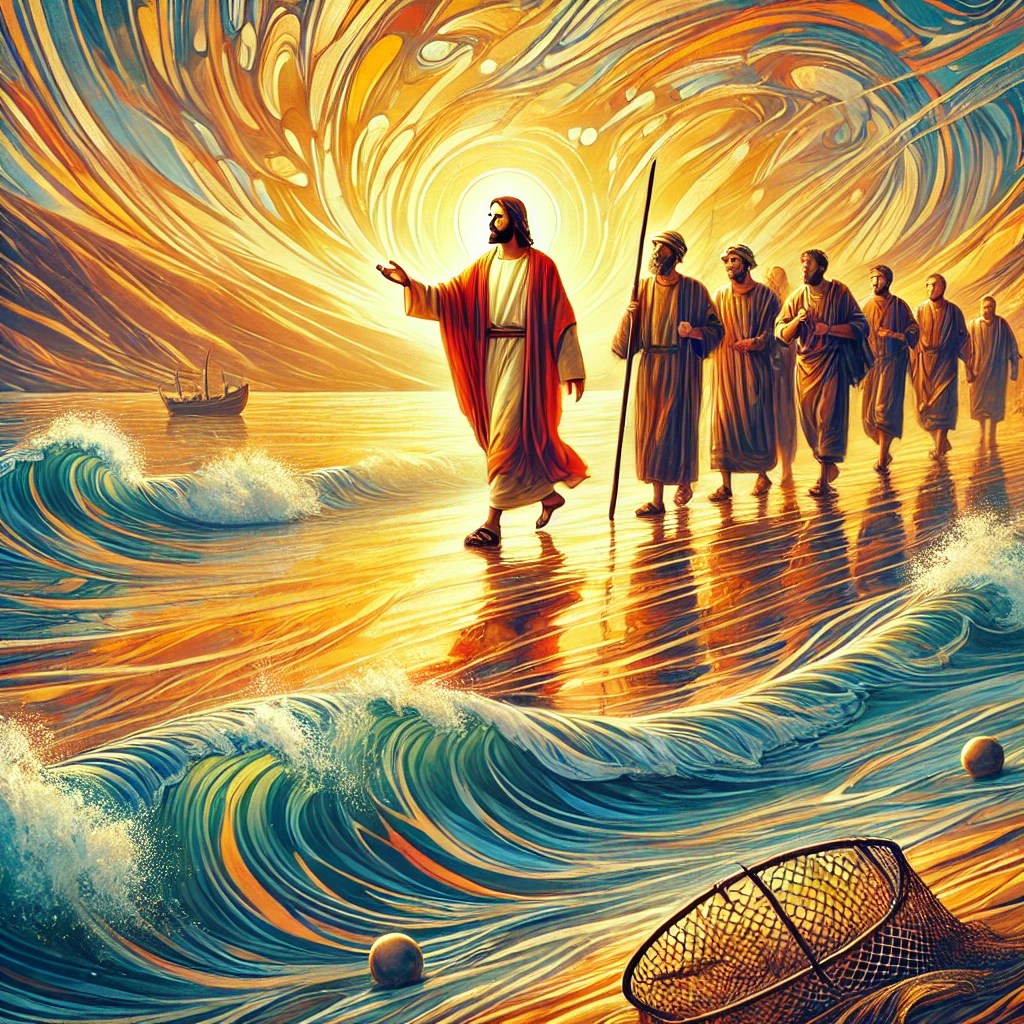
The Call That Echoes Across the Ages
Have you ever felt the tug of a deeper purpose, a voice whispering in your heart, “Come, follow me”? Today’s readings invite us to ponder this universal call—a call that transcends time and space, reaching every corner of the earth. It’s the call to faith, to discipleship, and to share the life-transforming message of Jesus Christ with others.
From the Apostle Paul’s proclamation in Romans of the power of hearing and believing in the Word, to the Psalmist’s poetic meditation on the sweetness of God’s precepts, to Jesus’ first invitation to Simon Peter and Andrew by the Sea of Galilee in The Gospel of Matthew, today’s Scripture reveals an unbroken thread. The Good News is not only meant to be received but shared—a mission that begins in the heart and extends to the ends of the world.
Historically, the readings reflect the urgency of spreading the Gospel. In the early Church, Paul’s letters addressed a community hungry for guidance, where the boundaries between Jews and Gentiles were collapsing under the unifying lordship of Christ. Meanwhile, the call of Jesus to fishermen like Peter and Andrew symbolizes a radical shift: ordinary lives transformed into extraordinary vessels of God’s mission. The Psalm reminds us that the Word of God has always been a treasure, grounding His people in truth and joy throughout generations.
As we reflect on these passages, ask yourself: What is God calling me to today? Am I ready to leave behind my “nets” to follow Him? How can I proclaim His Word in my life, so others may come to know His love?
First Reading – Romans 10:9-18
Proclaiming the Word That Saves
The Letter to the Romans, written by St. Paul, is often considered his theological masterpiece, laying out the foundation of salvation through faith in Jesus Christ. Today’s passage, Romans 10:9-18, is part of Paul’s reflection on the inclusivity of the Gospel message: salvation is available to all, Jew and Gentile alike. Paul addresses the universality of the faith and the necessity of proclaiming the Good News for others to hear and believe. This message would have resonated deeply in the first-century Roman Empire, a society marked by divisions of class, culture, and religion. For the early Christians, the radical message that faith—not heritage or the law—leads to salvation was both liberating and challenging.
This passage fits seamlessly into today’s theme of the universal call to faith and discipleship. It reminds us of our mission to hear the Word of God and proclaim it to others so that they too may come to believe in Christ.
Romans 10:9-18
New Revised Standard Version Catholic Edition
9 because if you confess with your lips that Jesus is Lord and believe in your heart that God raised him from the dead, you will be saved. 10 For one believes with the heart and so is justified, and one confesses with the mouth and so is saved. 11 The scripture says, “No one who believes in him will be put to shame.” 12 For there is no distinction between Jew and Greek; the same Lord is Lord of all and is generous to all who call on him. 13 For, “Everyone who calls on the name of the Lord shall be saved.”
14 But how are they to call on one in whom they have not believed? And how are they to believe in one of whom they have never heard? And how are they to hear without someone to proclaim him? 15 And how are they to proclaim him unless they are sent? As it is written, “How beautiful are the feet of those who bring good news!” 16 But not all have obeyed the good news; for Isaiah says, “Lord, who has believed our message?” 17 So faith comes from what is heard, and what is heard comes through the word of Christ.
18 But I ask, have they not heard? Indeed they have; for
“Their voice has gone out to all the earth,
and their words to the ends of the world.”
Detailed Exegesis
Verse 9
“Because if you confess with your lips that Jesus is Lord and believe in your heart that God raised him from the dead, you will be saved.”
Here, Paul outlines the core of Christian salvation: a public confession of faith in Jesus and belief in His resurrection. Confession (Greek: homologeo) signifies more than words—it’s an open acknowledgment of one’s allegiance to Christ, essential in a society where calling Jesus “Lord” opposed the emperor’s claim to divine authority. Believing in the resurrection underscores its centrality to the faith (see Catechism of the Catholic Church §651: “The Resurrection above all constitutes the confirmation of all Christ’s works and teachings.”).
Verse 10
“For one believes with the heart and so is justified, and one confesses with the mouth and so is saved.”
Faith and confession work together: internal belief justifies, while outward confession confirms one’s salvation. The heart represents the seat of one’s will and emotions, aligning one’s entire being with God’s truth.
Verse 11
“The scripture says, ‘No one who believes in him will be put to shame.’”
Paul quotes Isaiah 28:16 to affirm that faith in Christ brings honor, not disgrace. This is a reassurance for persecuted Christians that trusting in God will never lead to ultimate failure or rejection.
Verses 12-13
“For there is no distinction between Jew and Greek; the same Lord is Lord of all and is generous to all who call on him. For, ‘Everyone who calls on the name of the Lord shall be saved.’”
Paul stresses the universal nature of salvation. The inclusivity of the Gospel shatters ethnic and cultural boundaries. Quoting Joel 2:32, he emphasizes that salvation is for all who genuinely call upon the Lord.
Verses 14-15
“But how are they to call on one in whom they have not believed? And how are they to believe in one of whom they have never heard? And how are they to hear without someone to proclaim him? And how are they to proclaim him unless they are sent? As it is written, ‘How beautiful are the feet of those who bring good news!’”
Paul highlights the necessity of evangelization. The faith journey begins with hearing the Gospel, which requires faithful messengers who are sent to proclaim it. The quote from Isaiah 52:7 emphasizes the joy and beauty of bringing God’s message to others.
Verse 17
“So faith comes from what is heard, and what is heard comes through the word of Christ.”
Faith is not self-generated; it arises from hearing the Gospel. The Church teaches that this hearing occurs through Scripture, tradition, and the Church’s proclamation (CCC §76-77).
Verse 18
“But I ask, have they not heard? Indeed they have; for, ‘Their voice has gone out to all the earth, and their words to the ends of the world.’”
Citing Psalm 19:4, Paul affirms the global reach of the Gospel, echoing the Psalm’s theme of creation itself proclaiming God’s glory.
Teachings
The Catechism of the Catholic Church teaches that the proclamation of the Word is central to the Church’s mission: “The Church was made manifest to the world on the day of Pentecost by the outpouring of the Holy Spirit. The gift of the Spirit ushers in a new era in the ‘dispensation of the mystery’—the age of the Church, during which Christ manifests, makes present, and communicates his work of salvation through the liturgy of his Church, ‘until he comes’” (CCC §1076). Saints like St. Augustine remind us of the transformative power of hearing the Word: “Faith is to believe what you do not see; the reward of this faith is to see what you believe.” Evangelization remains the Church’s lifeblood, ensuring that the voice of the Gospel continues to resonate across the earth.
Reflection
Paul’s words challenge us to reflect on our role in spreading the Good News. Do we fully embrace the call to proclaim Christ in our words and actions? The mission isn’t reserved for clergy or missionaries; each baptized person is sent to be Christ’s ambassador in their own context. Whether in our families, workplaces, or communities, we are called to live out and share our faith.
Are you willing to confess Jesus as Lord openly, even when it’s inconvenient or countercultural? How can you better listen to and act upon God’s Word in your daily life? Perhaps start by sharing a simple testimony of faith with someone in need of encouragement. Let us pray for the courage and conviction to bring the beauty of the Gospel to those around us, remembering that “faith comes from what is heard.”
Responsorial Psalm – Psalm 19:8-11
The Treasure of God’s Word
Psalm 19 is a poetic masterpiece that celebrates the glory of God revealed in creation and His law. Today’s passage focuses on the second half of the Psalm, which extols the perfection, purity, and life-giving power of God’s commandments. Written by King David, this Psalm reflects Israel’s deep reverence for the Torah—the divine instruction given to God’s people. For the Israelites, the law was not a burden but a precious gift that guided them toward righteousness and communion with God.
This Psalm beautifully complements the theme of today’s readings by highlighting the transformative impact of God’s Word on the human heart. As St. Paul emphasizes the necessity of proclaiming the Gospel in Romans, Psalm 19 reminds us why: God’s Word enlightens, rejoices, and rewards those who embrace it.
Psalm 19:8-11
New Revised Standard Version Catholic Edition
8 the precepts of the Lord are right,
rejoicing the heart;
the commandment of the Lord is clear,
enlightening the eyes;
9 the fear of the Lord is pure,
enduring forever;
the ordinances of the Lord are true
and righteous altogether.
10 More to be desired are they than gold,
even much fine gold;
sweeter also than honey,
and drippings of the honeycomb.
11 Moreover by them is your servant warned;
in keeping them there is great reward.
Detailed Exegesis
Verse 8
“The precepts of the Lord are right, rejoicing the heart; the commandment of the Lord is clear, enlightening the eyes.”
David begins by praising the precepts (or instructions) of God as “right,” meaning morally upright and life-giving. These laws are not arbitrary but designed to lead us into joy. The clarity of God’s commands brings enlightenment, opening our spiritual eyes to see truth and live accordingly.
Verse 9
“The fear of the Lord is pure, enduring forever; the ordinances of the Lord are true and righteous altogether.”
“Fear of the Lord” refers to a deep reverence and awe for God. It is pure because it cleanses the heart of pride and leads to wisdom (see Proverbs 9:10: “The fear of the Lord is the beginning of wisdom”). God’s ordinances are unchanging and eternally just, reflecting His unchanging nature.
Verse 10
“More to be desired are they than gold, even much fine gold; sweeter also than honey, and drippings of the honeycomb.”
God’s Word is compared to gold and honey—symbols of wealth and delight. This verse reflects the ancient Hebrew understanding of Scripture as both precious and satisfying, far surpassing material wealth or earthly pleasures.
Verse 11
“Moreover by them is your servant warned; in keeping them there is great reward.”
The Psalmist acknowledges the practical benefits of God’s Word: it warns us of danger, protects us from sin, and offers a path to eternal reward. The commandments are not restrictive but protective, providing wisdom that leads to a fulfilled life.
Teachings
The Catechism of the Catholic Church teaches that God’s law is rooted in His love and serves as a guide for moral living. In CCC §2057, we learn that the Decalogue “expresses man’s fundamental duties toward God and toward his neighbor.” St. Jerome, the great translator of Scripture, wrote: “Ignorance of the Scriptures is ignorance of Christ.” By meditating on God’s Word, we align our lives with His divine will and are transformed into His image.
Saint Thomas Aquinas saw the sweetness of Scripture reflected in its ability to satisfy the deepest longings of the soul. For Aquinas, the law of God is not only directive but transformative, lifting us toward our ultimate goal of union with God.
Reflection
Psalm 19 challenges us to ask ourselves: How much do I treasure God’s Word in my daily life? Do I approach the Scriptures as a source of delight and wisdom, or do I see them as a mere obligation? This Psalm invites us to rediscover the joy of immersing ourselves in God’s precepts, allowing them to guide our thoughts, words, and actions.
Consider practical ways to integrate God’s Word into your daily routine. Perhaps start by setting aside time each morning to read and meditate on a passage of Scripture. Let its truth “enlighten your eyes” as you navigate the challenges of the day. Reflect on the ways God’s Word has served as a “warning” or a “reward” in your life.
How can you share this treasure with others? Who in your life needs to hear the sweetness of God’s promises today? Let us pray for a renewed hunger for God’s Word, trusting that in keeping it, we will find lasting joy and great reward.
Holy Gospel – Matthew 4:18-22
Called to Follow, Called to Fish
The Gospel of Matthew introduces us to the first disciples of Jesus with simplicity and profound significance. In today’s reading, Matthew 4:18-22, we see Jesus beginning His public ministry by calling Simon Peter, Andrew, James, and John. These ordinary fishermen by the Sea of Galilee are chosen for an extraordinary mission: to leave their nets and become “fishers of people.” The Sea of Galilee, a bustling center of trade and life in first-century Palestine, serves as the backdrop for this transformative moment.
This passage captures the heart of today’s theme: discipleship begins with a response to the call of Jesus, requiring trust, surrender, and action. The disciples’ immediate response—leaving everything behind—teaches us about the radical commitment required to follow Christ.
Matthew 4:18-22
New Revised Standard Version Catholic Edition
Jesus Calls the First Disciples
18 As he walked by the Sea of Galilee, he saw two brothers, Simon, who is called Peter, and Andrew his brother, casting a net into the sea—for they were fishermen. 19 And he said to them, “Follow me, and I will make you fish for people.” 20 Immediately they left their nets and followed him. 21 As he went from there, he saw two other brothers, James son of Zebedee and his brother John, in the boat with their father Zebedee, mending their nets, and he called them. 22 Immediately they left the boat and their father, and followed him.
Detailed Exegesis
Verse 18
“As he walked by the Sea of Galilee, he saw two brothers, Simon, who is called Peter, and Andrew his brother, casting a net into the sea—for they were fishermen.”
The Sea of Galilee, also known as Lake Gennesaret, was a vital economic hub. Fishing was a demanding profession, requiring skill, patience, and teamwork. Jesus approaches Simon Peter and Andrew in the midst of their daily labor, showing that His call often meets us in the ordinariness of life.
Verse 19
“And he said to them, ‘Follow me, and I will make you fish for people.’”
Jesus invites the brothers to follow Him, not just physically but spiritually. The metaphor of fishing for people indicates their future role as evangelists, spreading the Gospel and drawing souls to God. The authority of Jesus’ words underscores His divine mission, transforming ordinary fishermen into extraordinary apostles.
Verse 20
“Immediately they left their nets and followed him.”
The word “immediately” emphasizes the urgency and wholeheartedness of their response. Leaving their nets symbolizes not just their occupation but their past lives. This act of surrender reveals the depth of their trust in Jesus, even without fully understanding what lay ahead.
Verse 21
“As he went from there, he saw two other brothers, James son of Zebedee and his brother John, in the boat with their father Zebedee, mending their nets, and he called them.”
Jesus calls James and John while they are mending their nets, highlighting the ordinary nature of their work. The presence of their father, Zebedee, suggests the familial and societal ties they would need to leave behind in order to follow Jesus.
Verse 22
“Immediately they left the boat and their father, and followed him.”
Once again, the word “immediately” signals a decisive and total commitment. Leaving their father and their boat signifies a radical break from their old life and a willingness to prioritize Jesus above all else, including family and livelihood.
Teachings
The Catechism of the Catholic Church emphasizes the universal call to discipleship in CCC §542: “Christ stands at the heart of this gathering of men into the ‘family of God.’ By his word, through signs that manifest the reign of God, and by sending out his disciples, Jesus calls all people to come together around him.” This Gospel reminds us that discipleship is not limited to a select few but is a call extended to all baptized Christians.
The lives of the saints reflect the radical nature of this call. St. Francis of Assisi, for example, left his family’s wealth and business to follow Christ in poverty and service. Similarly, St. Teresa of Calcutta responded to the call to serve “the poorest of the poor,” leaving behind the security of her previous religious life to embrace a new mission.
Reflection
The call of the first disciples challenges us to reflect on how we respond to Jesus in our own lives. Are we willing to leave behind the “nets” that entangle us—whether they be fears, attachments, or distractions—and follow Him wholeheartedly?
Discipleship is not a one-time event but a daily choice to trust and follow Jesus. How is Jesus calling you today? Is there a specific area of your life where He is asking you to surrender and trust Him more deeply? Consider starting with small steps: dedicating time to prayer, seeking opportunities to serve others, or sharing your faith with someone in need.
Let us pray for the grace to respond “immediately” to Jesus’ call, trusting that He will transform our ordinary lives into vessels for His extraordinary mission. Will you allow Him to make you a “fisher of people” in your own unique way?
Answering the Call
Today’s readings weave a beautiful tapestry of faith, discipleship, and mission. From Paul’s exhortation in Romans to proclaim the Gospel so that all may hear and believe, to the Psalmist’s poetic celebration of the transformative power of God’s Word, to Jesus’ call to His first disciples by the Sea of Galilee, we are reminded that God’s invitation is both universal and deeply personal. He calls us wherever we are—in the middle of our ordinary lives—and invites us into an extraordinary journey with Him.
Each reading reinforces a central truth: faith is not passive; it requires hearing, responding, and acting. Just as the first disciples left their nets to follow Jesus, we too are invited to leave behind whatever holds us back and embrace the mission to share His love with others. Proclaiming the Good News isn’t just a task for apostles, saints, or clergy—it’s a mission for every believer, empowered by the Holy Spirit to live out and share the Gospel.
As you reflect on today’s Scriptures, what is God calling you to do? Is there a “net” you need to leave behind to follow Him more fully? How can you make His Word a greater part of your daily life? Start by listening—whether in prayer, Scripture, or the quiet stirrings of your heart—and then respond with courage and trust.
Let us take today’s readings as both a challenge and a comfort. God equips those He calls, and He walks with us every step of the way. Embrace the sweetness of His Word, the beauty of His call, and the joy of sharing His love. Together, as one body in Christ, let us proclaim: “Their voice has gone out to all the earth, and their words to the ends of the world.” Will you let your voice be among them? The journey begins today.
Engage with Us!
We’d love to hear your thoughts and reflections on today’s readings! Share how these passages speak to your heart and how they challenge or inspire you. Here are some questions to help guide your reflection:
- First Reading (Romans 10:9-18): What does it mean for you to “confess with your lips that Jesus is Lord”? How can you be a messenger of the Good News in your daily life?
- Responsorial Psalm (Psalm 19:8-11): How do you experience the sweetness and richness of God’s Word in your life? What steps can you take to make Scripture a greater source of joy and wisdom for you?
- Holy Gospel (Matthew 4:18-22): What “nets” might you need to leave behind to follow Jesus more fully? How can you respond to His call with immediacy and trust?
Let us encourage one another to grow in faith and mission. As we journey together, may we strive to live out the love and mercy that Jesus teaches us. Remember, every act of kindness, every word of hope, and every moment of surrender to God’s will is a powerful proclamation of His kingdom. Let’s go forth, inspired and empowered, to be His disciples in the world today.
Follow us on Instagram and Facebook for more insights and reflections on living a faith-filled life.

 Holy Manna!
Leave a comment