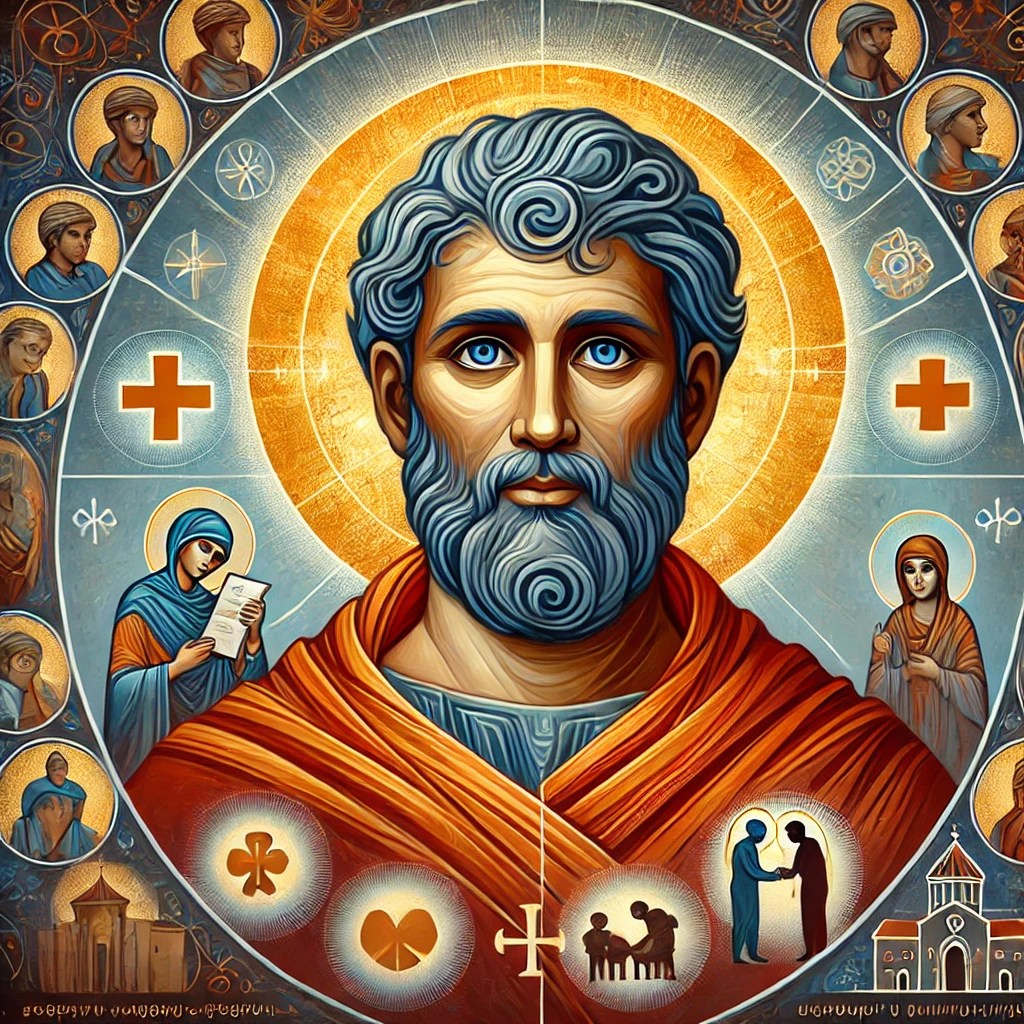
The Shepherd of Armenia
Saint Nerses the Great is remembered as one of the most influential figures in the Christian history of Armenia and beyond. Serving as the Catholicos (chief bishop) of the Armenian Church during the 4th century, he was a true shepherd who sought not only to reform the Church but also to uplift the lives of his people. His legacy stands out due to his commitment to charity, social reform, and the establishment of Christian institutions across Armenia. Saint Nerses introduced groundbreaking changes, such as the foundation of hospitals, orphanages, and hospices, aiming to alleviate suffering and embody Christ’s love for all people.
In a world marked by social and political upheaval, Nerses’s leadership illuminated the path of Christian compassion, demonstrating that faith could bring about real, transformative change. Recognized for his profound empathy, organizational vision, and unwavering commitment to social justice, he left an enduring mark on the Armenian Church and laid the foundation for a Christian Armenia. Venerated by both the Catholic and Armenian Apostolic traditions, Saint Nerses is a model of courage, resilience, and pastoral care whose example still inspires the faithful to work for justice, unity, and mercy.
Roots in a Noble Armenian Family
Saint Nerses was born into a noble Armenian family with deep ties to both political power and spiritual lineage. His family background was distinguished: he was a descendant of Saint Gregory the Illuminator, the missionary who converted Armenia to Christianity in 301 AD. This connection to Armenia’s Christian heritage influenced him from an early age, shaping his perspective on faith, leadership, and service to his people. Raised in a time when Armenia was strengthening its Christian identity, Nerses received a comprehensive education that included both classical knowledge and a grounding in the emerging Christian doctrines.
As he grew older, Nerses’s life initially seemed poised for a career in politics or noble service. However, his faith began to deepen, drawing him away from the typical pursuits of the nobility. This internal calling led him to embrace a life of service to God and the Church, setting him on a path toward ministry. Nerses’s ordination as a priest marked the beginning of his profound influence on Armenian Christianity. When he was later consecrated as the Catholicos of Armenia, he committed himself to bringing the principles of the Gospel to every facet of Armenian life. He envisioned a Church that served as a beacon of hope and charity, not only in spiritual matters but in social and practical concerns as well.
A Heart for the People
Saint Nerses’s miracles were not the traditional supernatural signs but were rather extraordinary acts of compassion, care, and social reform that revealed the transformative power of Christian charity. His primary concern was for the wellbeing of the Armenian people, especially those who were suffering, marginalized, or vulnerable. His efforts to establish hospitals, orphanages, and hospices were almost miraculous in themselves, as these kinds of social institutions were rare at that time. By founding these centers of healing and care, Nerses showed a devotion to alleviating human suffering that echoed the compassionate ministry of Jesus Christ.
One notable “miracle” was the impact of his efforts on Armenian society. His initiatives were transformative, ensuring that the sick received proper care, the orphaned had homes, and the poor were provided for. In an age when charitable infrastructure was scarce, these institutions were seen as beacons of hope, and many people experienced healing, peace, and a renewed sense of purpose through Nerses’s work. His followers reported that his prayers brought comfort and relief to the sick, and his mere presence brought a sense of divine peace and security to those around him. Nerses’s acts of compassion—coupled with his profound faith and dedication—demonstrated how a life committed to God could bring about miraculous changes in society.
Trials of Faith and Endurance
Saint Nerses’s visionary approach and dedication to social reform did not come without significant resistance and hardship. His unwavering commitment to Christian principles often put him at odds with the Armenian nobility and even the ruling king, Pap. The reforms Nerses promoted included a call for ethical governance, personal accountability, and just treatment of the people. These demands challenged the established power dynamics and threatened those who benefitted from corruption and exploitation. Nerses’s courage in speaking against injustices—whether they stemmed from the nobility or the monarchy—reflected his prophetic role within Armenian society. Like the prophets of old, he was willing to suffer persecution for the sake of truth.
His firm stance on Christian morality eventually led to severe consequences. Tradition holds that Nerses was poisoned by King Pap in 373 AD, who viewed him as a disruptive force threatening his authority. This act of martyrdom marked Saint Nerses as a figure of immense spiritual resilience. His death was a tragic testimony to his commitment to faith and justice, demonstrating that he was willing to sacrifice everything for the truth of the Gospel. His martyrdom left a lasting impact on the Armenian Church, inspiring future generations to remain steadfast in their faith, even in the face of opposition.
The Legacy of Saint Nerses the Great
After his death, the influence of Saint Nerses only continued to grow. His tomb became a pilgrimage site where many traveled to seek his intercession and pray for miracles. Numerous reports of healings and divine interventions at his burial place served to strengthen the belief that he continued to intercede for his people from heaven. These miracles included stories of physical healings and spiritual conversions, with pilgrims experiencing a profound sense of peace and faith after visiting his relics. The presence of his relics was believed to offer protection and blessings to those who approached them with sincere faith.
Saint Nerses’s legacy was also reflected in the continued operation of the hospitals, orphanages, and hospices he established. These institutions remained long after his death, acting as centers of Christian charity and kindness, testaments to his enduring impact on Armenian society. His followers continued his mission of compassion and service, preserving his vision of a faith that was not only spiritual but also profoundly practical. Saint Nerses’s life and legacy are celebrated annually on November 19th in the Armenian Church, where he is honored as a patron of the poor, a model of moral courage, and a beloved shepherd of the faithful.
Learning from Saint Nerses’s Compassionate Leadership
The life of Saint Nerses the Great teaches us valuable lessons about the power of faith, compassion, and perseverance in the face of adversity. His commitment to justice and social reform, rooted in the teachings of Jesus, reminds us that our faith calls us to action, especially in serving those in need. Here are some ways we can apply Saint Nerses’s virtues in our own lives:
- Show Compassion Daily: Like Saint Nerses, we are called to help those around us, especially the marginalized. We can start with small acts of kindness, such as visiting the sick, comforting the lonely, or volunteering at a local shelter. These acts of mercy reflect Christ’s love and help build a more compassionate society.
- Stand Firm in Faith and Integrity: Saint Nerses faced many challenges because he refused to compromise on his Christian values. Today, we are also called to live out our faith with integrity, even when it is difficult or unpopular. We can draw strength from his example, knowing that God is with us in our efforts to live out the truth.
- Promote Justice and Fairness: Saint Nerses’s legacy of advocating for justice and ethical leadership speaks to the importance of fairness in all areas of life. Whether in our families, workplaces, or communities, we can uphold principles of justice, respect, and kindness. By doing so, we contribute to a world that reflects God’s love and righteousness.
Through the life of Saint Nerses, we see how deeply our faith can impact the world around us. His example encourages us to live boldly and compassionately, trusting that even small acts of love and justice can bring about miraculous transformations.
Engage with Us!
We’d love to hear how Saint Nerses’s life inspires you. Share your thoughts in the comments:
- What aspect of Saint Nerses’s life most resonates with you?
- How do you feel called to serve others, as Saint Nerses did?
- Are there ways you can show resilience in your faith, especially in difficult situations?
Let’s support each other in embodying Saint Nerses’s virtues and striving to “do everything with love” (1 Corinthians 16:14), as our Lord Jesus did. Together, may we continue to grow in faith, compassion, and unity.
Saint Nerses the Great, pray for us!
Follow us on Instagram and Facebook for more insights and reflections on living a faith-filled life.

 Holy Manna!
Leave a comment