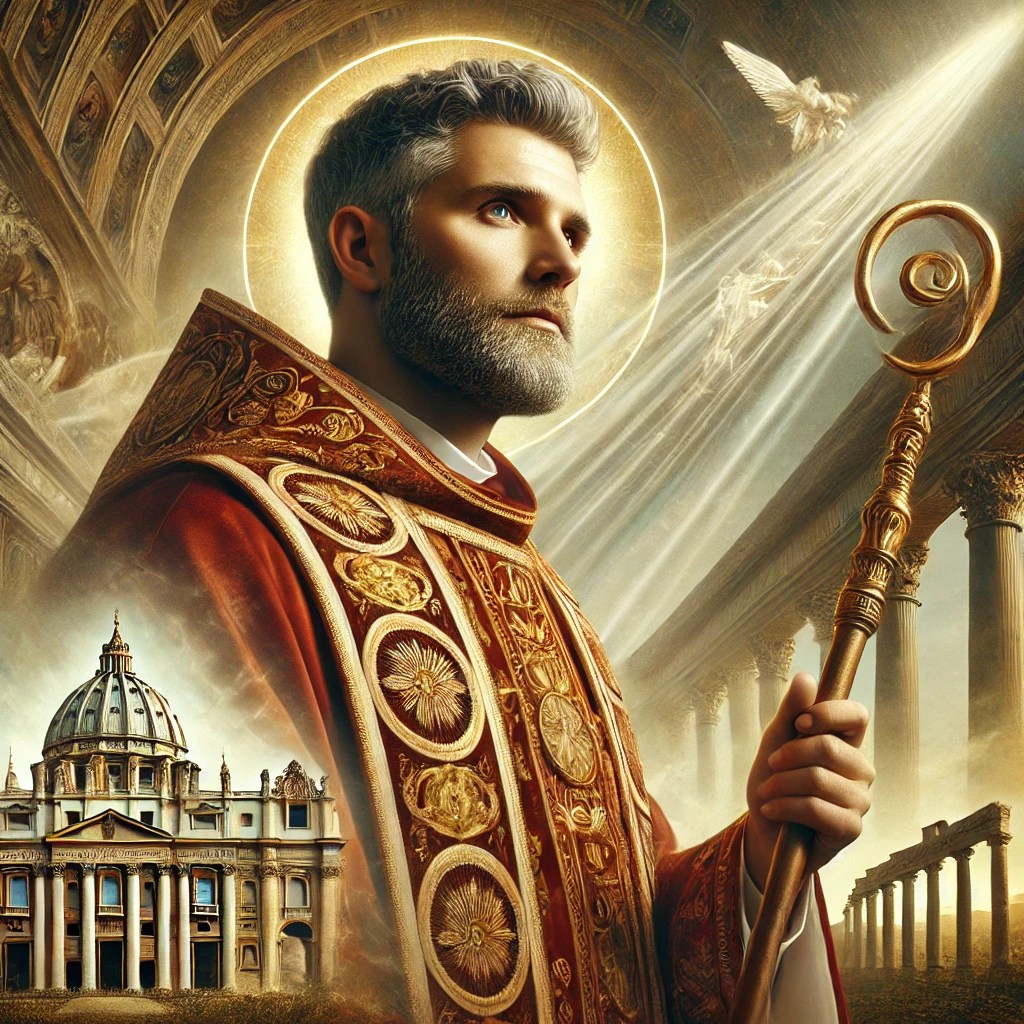
The Champion of Christ’s Divinity and Defender of the Church
Saint Leo the Great, who served as pope from 440 to 461, is remembered as one of the Church’s greatest leaders, earning him the title “Great” for his unmatched contributions to Christian doctrine, pastoral care, and defense of the Church. As a Doctor of the Church, he established foundational teachings on the nature of Christ, affirming that Christ is both fully divine and fully human, a doctrine that remains central to Catholic belief. In his role as Pope, he faced both theological challenges, such as heresies that threatened the unity of Christian teaching, and physical dangers from invasions threatening Rome itself. His theological writings, particularly his “Tome of Leo,” were instrumental in defining orthodox Christian teaching during the Council of Chalcedon in 451. Known for his eloquence and devotion, Pope Leo embodied the strength of a faithful shepherd, standing as a courageous leader in times of crisis and earning veneration as a saint whose teachings continue to inspire Catholics today.
From Humble Beginnings to the Heights of Ecclesiastical Power
Leo was born around 400 AD in Tuscany, Italy, to a Christian family. Little is known about his childhood, but he was raised with strong values, displaying an early inclination toward spiritual and intellectual pursuits. Tuscany at that time was a region of relative peace and strong Christian influence, which likely nurtured Leo’s early devotion to the faith. Although he grew up during a period of increasing instability in the Roman Empire, Leo’s talents and moral character allowed him to rise in the ranks of the Church.
He began his ecclesiastical career as a deacon, a role that would shape his understanding of both the theological and pastoral needs of the Church. His keen intellect, combined with his dedication to serving God and the faithful, soon brought him recognition. Leo’s abilities in diplomacy and deep theological knowledge were well-regarded, especially by Popes Celestine I and Sixtus III, who entrusted him with sensitive missions. His calling to the priesthood and to a greater leadership role grew stronger as he witnessed the trials facing the Church, including heretical teachings that contradicted core Christian beliefs. By the time he was elected Pope in 440, Leo had developed into a formidable leader, ready to defend the integrity of the faith and lead the Church through challenging times.
A Leader of Faith, Defender Against Destruction
One of the most famous stories from Saint Leo’s life is his legendary encounter with Attila the Hun in 452. At the time, Attila’s forces were sweeping through Italy, causing devastation in their wake and striking fear into the hearts of the people of Rome. Rather than preparing for a physical confrontation, Pope Leo trusted in God’s protection and set out to meet Attila in person, accompanied by only a few Church officials. According to tradition, Leo’s words were so powerful that Attila agreed to turn back and spare Rome. However, some accounts describe a miraculous vision that influenced Attila’s decision: as Leo spoke, Attila reportedly saw Saints Peter and Paul standing beside him with swords drawn, ready to defend the city if he proceeded with his attack.
Whether by Leo’s boldness or divine intervention, Attila withdrew his troops, and Rome was saved from certain destruction. This miracle displayed Leo’s immense faith and reliance on God’s power. His courage showed the people of Rome that, in their most desperate hour, their leader would risk his own life rather than forsake them. For centuries, this story has served as a testament to Saint Leo’s remarkable trust in divine protection, inspiring countless Christians to rely on faith and courage in the face of danger.
The Struggles of a Faithful Shepherd
Pope Leo’s papacy was marked by intense theological and political challenges. Theological debates within the Church, especially regarding the nature of Christ, were causing division. The heresy of Nestorianism, which posited that Jesus existed as two separate persons—one human and one divine—posed a significant threat to orthodox Christian beliefs. At the same time, Monophysitism argued that Christ only had one nature, a fusion of divine and human. Both teachings undermined the doctrine of Christ’s dual nature, as fully God and fully man, which the Church upheld as fundamental to salvation.
To address these heresies, Leo wrote his famous “Tome of Leo,” a document that clarified the Catholic teaching on Christ’s nature. The document was sent to the Council of Chalcedon, where it was read aloud and received with unanimous approval, with the Council declaring, “Peter has spoken through Leo.” This powerful affirmation solidified the teaching on the hypostatic union—the union of Christ’s two natures in one Person—which is still central to Christian theology.
Beyond doctrinal issues, Leo faced the monumental task of providing for the people of Rome amidst ongoing invasions and political instability. Despite limited resources, he organized aid for the city’s poor and victims of war, demonstrating his compassion and pastoral care. The dedication with which he addressed these hardships exemplifies his role as a tireless shepherd, one who worked with courage, humility, and profound love for the Church and its people.
An Everlasting Legacy of Healing and Intercession
After his death on November 10, 461, Saint Leo’s tomb became a place of pilgrimage, and stories of miraculous healings and divine interventions soon emerged. Numerous accounts describe the faithful visiting his tomb to seek his intercession, often experiencing physical or spiritual healing. His relics, preserved in St. Peter’s Basilica, became a focal point of veneration for Christians who believed that Saint Leo’s holy life had granted him a special place in the communion of saints, making him a powerful intercessor.
Pilgrims throughout history have traveled to Rome to pray at the relics of Saint Leo, asking for his guidance and intercession. These miraculous occurrences, along with his enduring legacy as a theological and pastoral guide, have solidified his place as one of the Church’s most revered saints. His teachings, especially those found in the “Tome of Leo,” continue to be studied and respected by theologians worldwide. Pope Saint Leo’s feast day, November 10, offers a time to honor his contributions, drawing Catholics closer to the mysteries of Christ and to the strength of their faith through his example.
Lessons from Saint Leo’s Life for Today
Saint Leo the Great’s life is a powerful reminder that our faith calls us to courage, compassion, and steadfastness in truth. He stood firm in his beliefs, unyielding in the face of opposition, showing us that authentic faith requires resilience. In a world where it is often challenging to stand by our values, Saint Leo’s unwavering commitment to the Church’s teachings encourages us to embrace truth, regardless of the cost.
Practical Ways to Embrace Saint Leo’s Virtues:
- Stand Firm in Your Beliefs: Like Saint Leo, don’t waver in defending the truth. Take time to study the faith, diving deeper into Scripture and the Catechism to strengthen your understanding. With a strong foundation, you can confidently uphold your beliefs.
- Seek God’s Wisdom in Challenges: Saint Leo was known for his prayerful approach to decisions, especially during times of crisis. Make prayer a regular part of your daily life, particularly when faced with difficult choices. Trust in God’s guidance, knowing that He will provide you with wisdom when you seek Him.
- Serve with Compassion and Courage: Even amid personal and communal hardships, Leo dedicated himself to serving the people of Rome. Look for ways to serve others in your community, particularly those in need. Small acts of kindness and compassion, done with a courageous heart, can make a profound difference in someone’s life.
Engage with Us!
As we reflect on Saint Leo’s life, let’s take time to consider:
- Are there areas in your life where you feel called to stand firm in your beliefs, despite challenges?
- How can you make prayer a source of strength and wisdom, as Saint Leo did?
- In what ways can you show compassion and courage in serving others, even when it’s difficult?
Share your thoughts, questions, and insights in the comments below. Let us walk together in faith, inspired by Saint Leo’s example, and encourage one another in our journeys, striving to live each day with love, courage, and a commitment to Christ’s truth.
Saint Leo the Great, pray for us!
Follow us on Instagram and Facebook for more insights and reflections on living a faith-filled life.

 Holy Manna!
Leave a comment