Faith, Trust, and Sacrifice
Today’s readings speak to us about faith, humility, and the transforming power of sacrificial giving. Through the prophet Elijah’s encounter with a destitute widow, the Psalmist’s reminder of God’s care for the vulnerable, the Epistle’s insight into Christ’s perfect sacrifice, and Jesus’ lesson on the true meaning of generosity, we are called to examine the depth of our faith and our willingness to give of ourselves. These passages reveal a God who is moved by a heart of love, sacrifice, and trust, rather than by external appearances or grand gestures. Let’s explore each reading to uncover the wisdom it offers and see how it can guide our own journey of faith.
First Reading – 1 Kings 17:10-16
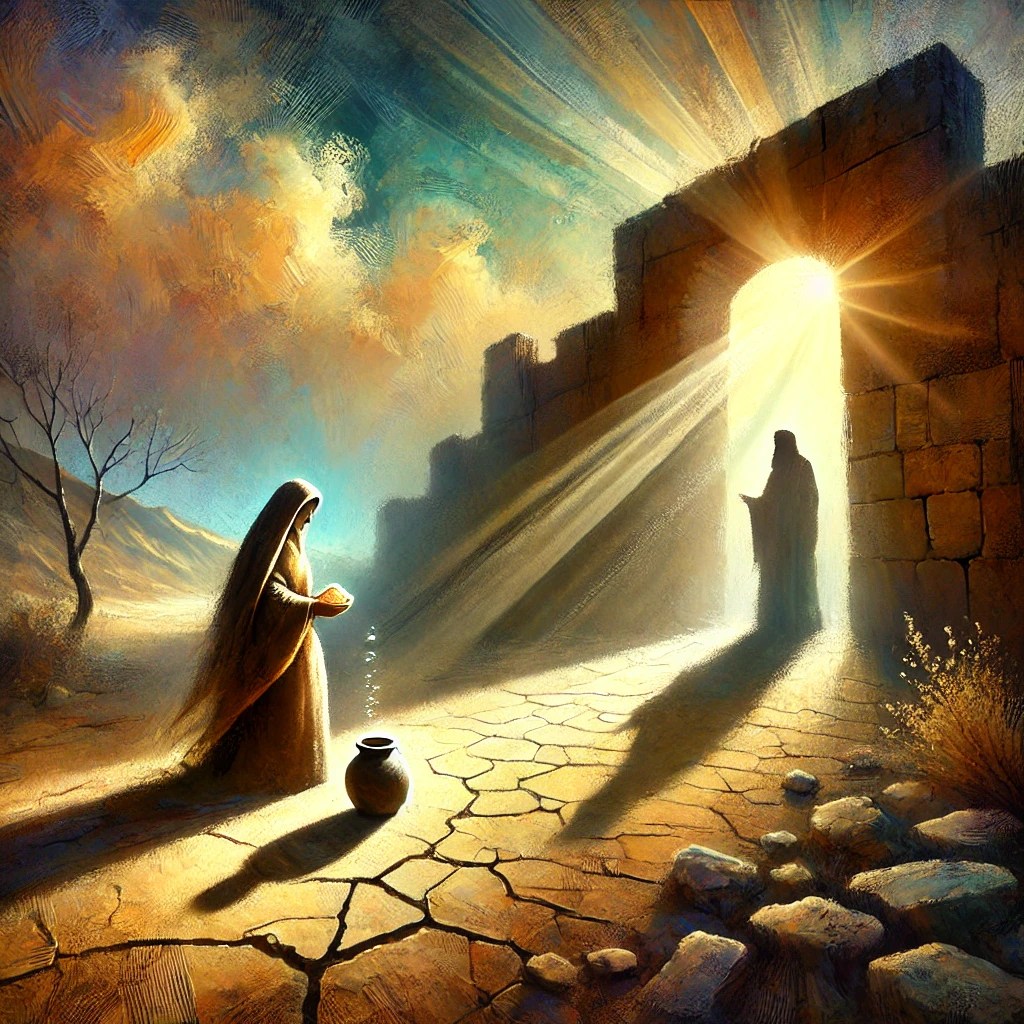
A Widow’s Last Meal in Faithful Trust
In 1 Kings 17, we find ourselves in a time of severe drought and famine in Israel. This crisis results from King Ahab’s and Queen Jezebel’s introduction of Baal worship, which angers God, leading Him to withhold rain. This drought not only impacts Israel but reaches across neighboring lands, bringing hardship to many. In the midst of this, God sends Elijah to a foreign land—Zarephath, in Sidon—where he meets a widow struggling with poverty. God’s choice to send Elijah to a vulnerable widow outside of Israel underscores the boundless reach of His compassion. This story echoes God’s tendency to work through humble, ordinary individuals, especially those who seem least likely to be chosen for divine purposes. God’s care for this widow foreshadows the way Jesus will later extend God’s grace to all people, regardless of their social or economic status.
1 Kings 17:10-16
New Revised Standard Version Catholic Edition
10 So he set out and went to Zarephath. When he came to the gate of the town, a widow was there gathering sticks; he called to her and said, “Bring me a little water in a vessel, so that I may drink.” 11 As she was going to bring it, he called to her and said, “Bring me a morsel of bread in your hand.” 12 But she said, “As the Lord your God lives, I have nothing baked, only a handful of meal in a jar, and a little oil in a jug; I am now gathering a couple of sticks, so that I may go home and prepare it for myself and my son, that we may eat it, and die.” 13 Elijah said to her, “Do not be afraid; go and do as you have said; but first make me a little cake of it and bring it to me, and afterwards make something for yourself and your son. 14 For thus says the Lord the God of Israel: The jar of meal will not be emptied and the jug of oil will not fail until the day that the Lord sends rain on the earth.” 15 She went and did as Elijah said, so that she as well as he and her household ate for many days. 16 The jar of meal was not emptied, neither did the jug of oil fail, according to the word of the Lord that he spoke by Elijah.
Detailed Exegesis
Verse 10: “So he set out and went to Zarephath. When he came to the gate of the town, a widow was there gathering sticks; he called to her and said, ‘Bring me a little water in a vessel, so that I may drink.’”
Elijah’s obedience to God’s direction shows his trust in God’s providence. God leads him to this widow, who, while destitute, is chosen to be a vessel of His mercy. Elijah’s simple request for water is significant; it reflects a basic human need, but during a drought, even water is precious. Elijah’s request reminds us that God sometimes invites us to give of what we have, however small, trusting that He will multiply it for His purposes.
Verse 11: “As she was going to bring it, he called to her and said, ‘Bring me a morsel of bread in your hand.’”
Elijah’s additional request deepens the challenge for the widow. She has barely enough for herself and her son, and yet, she is being asked to share it with a stranger. This encounter invites her to go beyond mere charity; it is an invitation to radical trust. St. John Chrysostom notes that this moment demonstrates how God “tests and purifies” the faith of His children, often asking for a seemingly impossible level of generosity to draw us closer to Him.
Verse 12: “But she said, ‘As the Lord your God lives, I have nothing baked, only a handful of meal in a jar, and a little oil in a jug; I am now gathering a couple of sticks, so that I may go home and prepare it for myself and my son, that we may eat it, and die.’”
Her response reflects her despair; she is at the end of her resources and prepared for death. Yet her statement, “As the Lord your God lives,” shows a recognition of the God of Israel, even though she doesn’t yet know Him personally. This moment of vulnerability highlights how, in our weakest moments, God often makes His presence known. As St. Augustine wrote, “God has chosen the weak things of this world,” showing us that His grace is made perfect in our weakness.
Verse 13: “Elijah said to her, ‘Do not be afraid; go and do as you have said; but first make me a little cake of it and bring it to me, and afterwards make something for yourself and your son.’”
Elijah’s reassurance, “Do not be afraid,” is a call to trust. By prioritizing Elijah’s request, she is showing an openness to God’s word. Her small act of faith will unlock a greater blessing. This instruction mirrors how God often calls us to surrender in faith before we see the outcome.
Verse 14: “For thus says the Lord the God of Israel: The jar of meal will not be emptied and the jug of oil will not fail until the day that the Lord sends rain on the earth.”
Elijah’s words reveal God’s promise of provision. By offering her limited resources in faith, she receives God’s assurance of sustenance through the drought. God’s promise echoes His provision of manna in the desert for the Israelites, a reminder that His care is unending.
Verse 15-16: “She went and did as Elijah said, so that she as well as he and her household ate for many days. The jar of meal was not emptied, neither did the jug of oil fail, according to the word of the Lord that he spoke by Elijah.”
Her obedience leads to a miracle. By giving her last meal, she receives an ongoing supply that meets the needs of her household and Elijah. This act demonstrates that God’s economy works differently; He multiplies when we give in faith.
Teachings and Reflections
The widow’s story illustrates the power of sacrificial trust. Despite her poverty, she acts in faith and receives divine abundance. The Catechism teaches that “God’s providence protects and governs all things which He has made” (CCC 302). Her story reminds us that God’s grace and provision are not limited by our material resources; rather, they are multiplied when we trust Him completely. In moments of scarcity, we are invited to place our confidence in God’s provision, offering even the little we have.
This reading encourages us to cultivate a spirit of selfless giving, trusting that God will sustain us. It challenges us to go beyond simply meeting our own needs and to look for ways to serve others, believing that God will care for us in return. St. Teresa of Calcutta often spoke of “giving until it hurts,” and this story demonstrates that such sacrificial generosity does not go unnoticed by God. It is a profound act of faith to give freely from limited resources, trusting in God’s endless bounty.
Personal Reflection
What areas of my life require greater trust in God’s provision? Think of a specific need or challenge you face today. Ask yourself how you can place this in God’s hands, perhaps by offering what you have, even if it seems insufficient, trusting that God will provide abundantly.
Responsorial Psalm – Psalm 146:7-10
The Lord, Defender of the Weak
Psalm 146 is a hymn celebrating God’s enduring love and justice, particularly for the oppressed and marginalized. Ancient Israelite society, like much of the ancient world, often failed to provide for the poor, and so God is presented as the ultimate provider and protector for those left defenseless. This psalm is a declaration that God’s love for the vulnerable and forgotten is central to His reign. It assures us that His justice is active and unfailing, promising care for those without advocates. This psalm celebrates the God who is faithful to His promises and works tirelessly on behalf of the poor and downtrodden. In it, we see the foreshadowing of Christ’s ministry, in which He proclaimed freedom to the oppressed, healing to the sick, and good news to the poor.
Psalm 146:7-10
New Revised Standard Version Catholic Edition
7 who executes justice for the oppressed;
who gives food to the hungry.
The Lord sets the prisoners free;
8 the Lord opens the eyes of the blind.
The Lord lifts up those who are bowed down;
the Lord loves the righteous.
9 The Lord watches over the strangers;
he upholds the orphan and the widow,
but the way of the wicked he brings to ruin.
10 The Lord will reign forever,
your God, O Zion, for all generations.
Praise the Lord!
Detailed Exegesis
Verse 7: “Who executes justice for the oppressed; who gives food to the hungry.”
God’s justice is not passive but transformative, actively righting wrongs and lifting up the oppressed. His provision of food for the hungry speaks of a deep compassion that goes beyond words and finds expression in concrete acts of care. The Catechism emphasizes that “God listens to the cry of the poor and hears the prayers of the brokenhearted” (CCC 2544), affirming that divine justice is marked by compassion.
Verse 8: “The Lord sets the prisoners free; the Lord opens the eyes of the blind. The Lord lifts up those who are bowed down; the Lord loves the righteous.”
This verse captures the liberating power of God’s love. He frees those bound by physical, spiritual, and social chains, lifting up those who are weighed down. Each of these actions foreshadows Jesus’ own mission as described in Luke 4:18: “He has sent me to proclaim release to the captives and recovery of sight to the blind.”
Verse 9: “The Lord watches over the strangers; he upholds the orphan and the widow, but the way of the wicked he brings to ruin.”
God’s concern for the “strangers, orphans, and widows” shows His heart for the vulnerable, those who lack advocates or support. In biblical terms, these groups were the most susceptible to exploitation, and God declares Himself as their protector. His defense of these groups serves as a call to each of us to uphold justice in our communities.
Verse 10: “The Lord will reign forever, your God, O Zion, for all generations. Praise the Lord!”
The psalmist closes with a declaration of God’s eternal kingship. This verse assures us that God’s justice and mercy are not fleeting but endure across generations. His reign is one of unwavering faithfulness, offering hope that His justice will ultimately prevail.
Teachings and Reflections
Psalm 146 emphasizes that God’s love for the vulnerable is an essential part of His nature, a theme that carries over into the New Testament and the teachings of the Church. As Catholics, we are called to reflect this love in our lives. The Catechism states, “True worship of God is inseparable from compassion toward the poor” (CCC 2449), urging us to see acts of mercy as a core expression of our faith. This psalm challenges us to adopt God’s own priorities and to act as His hands and feet, especially for those who are overlooked.
This call to justice is central to Catholic social teaching, which emphasizes the “preferential option for the poor.” We are reminded that we are part of God’s work in the world, advocating for those who have no voice. Pope Francis has often spoken of the “revolution of tenderness” that must define the Christian life, inspiring us to reach out to those on the peripheries, to become defenders of the weak and the marginalized.
Personal Reflection
How can I embody God’s mercy and compassion for the poor and vulnerable? Identify a tangible way to reach out to someone in need today, whether through a donation, volunteering, or even a simple act of kindness. Reflect on how you might incorporate this habit of compassion into your daily life.
Second Reading – Hebrews 9:24-28
Christ, the Perfect Sacrifice
The Letter to the Hebrews provides profound insights into Christ’s priesthood and His role as the ultimate high priest. Written to a Jewish-Christian audience, it explains how Jesus fulfills and transcends the sacrifices of the old covenant. The earthly high priests had to offer sacrifices continually for atonement, but Jesus, through His death and resurrection, offers Himself as a single, complete, and perfect sacrifice, uniting humanity with God once and for all. His offering is unique, as He does not enter an earthly temple but the heavenly sanctuary itself, establishing a new and everlasting covenant. This teaching reassures us of God’s mercy and His willingness to bridge the gap created by sin through Jesus’ perfect act of love.
Hebrews 9:24-28
New Revised Standard Version Catholic Edition
24 For Christ did not enter a sanctuary made by human hands, a mere copy of the true one, but he entered into heaven itself, now to appear in the presence of God on our behalf. 25 Nor was it to offer himself again and again, as the high priest enters the Holy Place year after year with blood that is not his own; 26 for then he would have had to suffer again and again since the foundation of the world. But as it is, he has appeared once for all at the end of the age to remove sin by the sacrifice of himself. 27 And just as it is appointed for mortals to die once, and after that the judgment, 28 so Christ, having been offered once to bear the sins of many, will appear a second time, not to deal with sin, but to save those who are eagerly waiting for him.
Detailed Exegesis
Verse 24: “For Christ did not enter a sanctuary made by human hands, a mere copy of the true one, but he entered into heaven itself, now to appear in the presence of God on our behalf.”
Christ’s ascension into heaven signifies the completion of His redemptive mission. Unlike earthly priests who minister in a human-made sanctuary, Jesus enters the true heavenly sanctuary, interceding for us directly in the presence of God. This unique intercession assures us of a permanent advocate who bridges the gap between humanity and the divine.
Verse 25: “Nor was it to offer himself again and again, as the high priest enters the Holy Place year after year with blood that is not his own.”
The repetition of sacrifices in the old covenant highlighted their insufficiency. In contrast, Christ’s singular sacrifice does not need to be repeated. His self-offering, once and for all, is sufficient to reconcile humanity to God, transforming the very nature of sacrifice and redemption.
Verse 26: “But as it is, he has appeared once for all at the end of the age to remove sin by the sacrifice of himself.”
Jesus’ death on the cross brings definitive forgiveness, erasing the power of sin and granting us access to the Father. His once-for-all sacrifice means that no other offering is needed; His love and mercy have accomplished what no other sacrifice could.
Verse 27-28: “And just as it is appointed for mortals to die once, and after that the judgment, so Christ, having been offered once to bear the sins of many, will appear a second time, not to deal with sin, but to save those who are eagerly waiting for him.”
This passage reminds us that, like Christ, we each face death and judgment. However, Christ’s second coming will bring not judgment, but salvation for those who await Him. His return promises redemption for those who live in hopeful expectation, calling us to live in readiness.
Teachings and Reflections
Christ’s sacrifice invites us to reflect on the boundless mercy of God and the depth of His love. The Catechism teaches, “The sacrifice of Christ is unique; it completes and surpasses all other sacrifices” (CCC 1545). Jesus’ perfect act of self-giving is not only a model of love but a transformative gift that renews us. Through His offering, He calls us into a life of gratitude, repentance, and devotion.
This passage encourages us to consider the gravity and beauty of Jesus’ sacrifice and what it means to live in response to such a gift. As St. Thomas Aquinas wrote, “The Eucharist is the Sacrament of Love; it signifies Love, it produces Love.” Every time we participate in the Eucharist, we are reminded of Jesus’ singular sacrifice and His abiding presence, which strengthens us to live as witnesses of His love.
Personal Reflection
How can I respond to Christ’s sacrifice with a heart full of gratitude? Reflect on ways to mirror Christ’s love in your daily life, through acts of forgiveness, patience, or self-giving. Consider how you might approach the Eucharist with a deeper sense of reverence and gratitude.
Holy Gospel – Mark 12:38-44
The Widow’s Offering
In this Gospel passage, Jesus contrasts the behavior of the scribes with the humble offering of a poor widow. The scribes, as religious leaders, were supposed to be stewards of God’s law, yet they sought social status and material gain, exploiting the very people they were called to serve. By drawing attention to the widow’s act, Jesus highlights that true worship is measured by sincerity, humility, and self-giving, rather than outward appearances. In a society where status and wealth often defined one’s worth, this widow’s offering redefines generosity and devotion. Her small contribution, given from a place of poverty, surpasses the gifts of the wealthy because it represents her complete surrender to God.
Mark 12:38-44
New Revised Standard Version Catholic Edition
Jesus Denounces the Scribes
38 As he taught, he said, “Beware of the scribes, who like to walk around in long robes, and to be greeted with respect in the marketplaces, 39 and to have the best seats in the synagogues and places of honor at banquets! 40 They devour widows’ houses and for the sake of appearance say long prayers. They will receive the greater condemnation.”
The Widow’s Offering
41 He sat down opposite the treasury, and watched the crowd putting money into the treasury. Many rich people put in large sums. 42 A poor widow came and put in two small copper coins, which are worth a penny. 43 Then he called his disciples and said to them, “Truly I tell you, this poor widow has put in more than all those who are contributing to the treasury. 44 For all of them have contributed out of their abundance; but she out of her poverty has put in everything she had, all she had to live on.”
Detailed Exegesis
Verse 38-40: “Beware of the scribes, who like to walk around in long robes, and to be greeted with respect in the marketplaces, and to have the best seats in the synagogues and places of honor at banquets! They devour widows’ houses and for the sake of appearance say long prayers. They will receive the greater condemnation.”
Jesus warns His disciples against the scribes’ hypocrisy, highlighting their focus on public status and appearances. Their desire for “long robes” and “places of honor” speaks to their need for social validation, while their exploitation of widows reveals a heart far from God. Jesus’ words are a stern reminder that true righteousness is not about appearances but about an authentic relationship with God.
Verse 41-42: “He sat down opposite the treasury, and watched the crowd putting money into the treasury. Many rich people put in large sums. A poor widow came and put in two small copper coins, which are worth a penny.”
Jesus deliberately observes the treasury, where people make their offerings, paying close attention to both the rich and the poor. The widow’s two coins, though of little monetary value, represent a gift of tremendous spiritual worth. Her gift, given from her poverty, challenges us to consider the spirit behind our own giving.
Verse 43-44: “Then he called his disciples and said to them, ‘Truly I tell you, this poor widow has put in more than all those who are contributing to the treasury. For all of them have contributed out of their abundance; but she out of her poverty has put in everything she had, all she had to live on.’”
Jesus emphasizes the widow’s offering, teaching that her small contribution is greater than the larger gifts because it is given out of love and trust. Her offering is a complete act of self-giving, a true sacrifice, and a powerful witness of faith.
Teachings and Reflections
The story of the widow’s offering invites us to reflect on the nature of true generosity. The Catechism explains, “It is by what we do for the poor that we demonstrate our love for Christ” (CCC 2443). This passage challenges us to give not from our excess but from our hearts, recognizing that even small acts of love are precious to God when offered with sincerity. Jesus’ recognition of the widow’s offering reminds us that God values our sacrifices, no matter how humble, and looks at our intention over our outward achievements.
St. Teresa of Ávila wrote, “Christ has no body now on earth but yours,” reminding us that our everyday actions serve as a testimony of God’s love in the world. The widow’s act of trust encourages us to live generously, not for recognition but for love’s sake, giving in a way that requires genuine sacrifice and faith. This type of giving, even if it’s as simple as our time or attention, becomes a powerful act of worship.
Personal Reflection
Am I willing to give of myself fully, trusting that God sees and values my efforts? Reflect on how you can offer not only material resources but also your time, energy, or presence to others. Consider how you might make small sacrifices, trusting that God will bless and multiply your efforts.
Called to a Life of Trust and Sacrificial Love
Today’s readings call us to examine our faith and our generosity, encouraging us to give from the heart. The widow of Zarephath and the poor widow in the Gospel both represent models of faith and surrender, showing us that God values trust and sacrifice above all else. The Psalmist reminds us that God is the ultimate defender of the weak, challenging us to join Him in acts of justice and mercy. In Hebrews, we see that Christ’s sacrifice is the supreme example of self-giving love, inviting us to respond with grateful hearts and lives of service.
Together, these readings reveal that God’s measure of our gifts is not the size or worth, but the depth of love and trust that inspire them. May we be inspired to live lives of generosity, trusting in God’s providence and giving from our hearts, regardless of how small our offerings may seem. Let us remember that God’s grace can work through our smallest acts of love and that true faith calls us to surrender fully to His care.
As we go forth today, may we ask for the grace to live as these widows did, with open hands and open hearts, trusting that God will see, honor, and multiply each act of love we offer in His name.
Engage with Us!
We invite you to share your thoughts and reflections on today’s readings in the comments! How did these passages speak to your heart?
Reflection Questions:
- What areas of your life call for a deeper trust in God’s provision?
- How can you reflect God’s love for the vulnerable and overlooked in your actions?
- What small act of sacrificial love might you offer today in gratitude for God’s love?
Let’s support one another in our journeys of faith, devoted to God’s calling. May we live boldly in faith and love, trusting that God will be with us in all we do.
Follow us on Instagram and Facebook for more insights and reflections on living a faith-filled life.

 Holy Manna!
Leave a comment