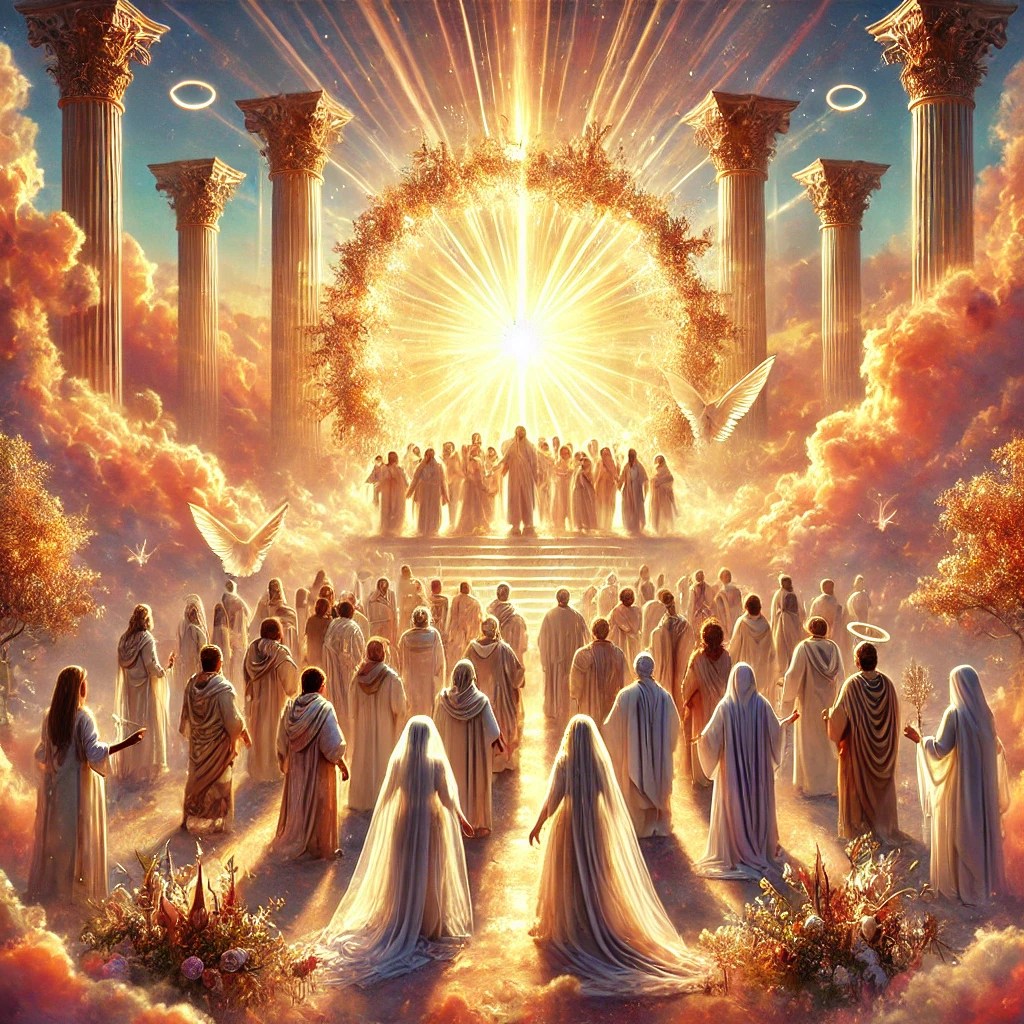
Journeying Toward Holiness
Today’s readings bring us to the core of Christian identity and mission: the call to holiness and unity in the Communion of Saints. Each reading presents a unique aspect of our journey to sainthood, inviting us to consider both the destination—our eternal communion with God in heaven—and the path, defined by love, sacrifice, and hope.
In the Book of Revelation, we glimpse a victorious scene in heaven, where a countless multitude of saints stands before God’s throne. This vision is a powerful reminder that those who remain faithful to God are eternally united with Him, marked by His seal and protected from ultimate harm. In Psalm 24, we see the high standards of purity and sincerity required of those who wish to enter God’s holy place. As we approach the Lord, we are reminded that integrity and honesty prepare us to be in His presence. Then, in 1 John, we receive the beautiful affirmation of our divine identity as children of God, called to a transformation that will ultimately make us like Him. Finally, Matthew 5 brings us Jesus’ words in the Beatitudes, setting forth a radical vision of happiness and holiness in God’s Kingdom. Each beatitude represents a countercultural blessing, offering comfort and hope to those who seek God’s ways in humility, purity, mercy, and peace.
Historically, these readings resonated profoundly with the early Church, where believers faced persecution and martyrdom for their faith. The vision of Revelation, in particular, provided comfort and hope, reminding the faithful that their sufferings were not in vain. For today’s Christians, these passages remain equally relevant as we navigate a world often indifferent or hostile to faith. They offer us a roadmap to holiness, a call to live courageously for Christ, and a reminder that we are not alone—we are part of a great multitude, the Communion of Saints, journeying toward God together.
First Reading – Revelation 7:2-4, 9-14
Marked by God: The Sealed Multitude
The Book of Revelation, written by the Apostle John during his exile on the island of Patmos, provides symbolic imagery meant to encourage early Christians who faced severe persecution under the Roman Empire. During John’s time, believers often experienced imprisonment, torture, and death for their faith in Jesus Christ. In this context of suffering, John’s visions served as a powerful reassurance of God’s sovereignty, offering a picture of the victory that awaits His faithful people. Chapter 7 describes the sealing of God’s servants, an act that symbolizes divine protection and assurance that they will be preserved through tribulation.
Revelation 7:2-4, 9-14
New Revised Standard Version Catholic Edition
2 I saw another angel ascending from the rising of the sun, having the seal of the living God, and he called with a loud voice to the four angels who had been given power to damage earth and sea, 3 saying, “Do not damage the earth or the sea or the trees, until we have marked the servants of our God with a seal on their foreheads.”
4 And I heard the number of those who were sealed, one hundred forty-four thousand, sealed out of every tribe of the people of Israel:
The Multitude from Every Nation
9 After this I looked, and there was a great multitude that no one could count, from every nation, from all tribes and peoples and languages, standing before the throne and before the Lamb, robed in white, with palm branches in their hands. 10 They cried out in a loud voice, saying,
“Salvation belongs to our God who is seated on the throne, and to the Lamb!”
11 And all the angels stood around the throne and around the elders and the four living creatures, and they fell on their faces before the throne and worshiped God, 12 singing,
“Amen! Blessing and glory and wisdom
and thanksgiving and honor
and power and might
be to our God forever and ever! Amen.”
13 Then one of the elders addressed me, saying, “Who are these, robed in white, and where have they come from?” 14 I said to him, “Sir, you are the one that knows.” Then he said to me, “These are they who have come out of the great ordeal; they have washed their robes and made them white in the blood of the Lamb.
Detailed Exegesis
Verse 2: “I saw another angel ascending from the rising of the sun, having the seal of the living God.”
The vision begins with an angel “ascending from the rising of the sun,” an image filled with hope and anticipation. The rising sun often symbolizes new beginnings and the dawn of salvation. Here, the angel’s role is to seal the faithful with the “seal of the living God,” marking them as God’s own. In ancient cultures, kings and rulers marked important items or people with seals to signify ownership and authority. In this vision, God’s seal represents His covenant of protection and ownership over His people. This detail would have offered great comfort to early Christians, assuring them that no matter the trials they faced, they were eternally secure in God’s hands.
Verse 3: “Do not damage the earth or the sea or the trees, until we have marked the servants of our God with a seal on their foreheads.”
The angel instructs other angels, who have been granted the power to bring destruction, to withhold their actions until God’s people are marked. This command to delay destruction is an act of divine mercy, allowing time for the faithful to be recognized and preserved. The seal on the forehead is a public declaration of belonging to God, much like the symbolic markings in the Old Testament where the faithful were protected during the plagues of Egypt. This visible mark reinforces the notion that those who belong to God are spiritually safeguarded, even if they must endure suffering in this world.
Verse 4: “And I heard the number of those who were sealed, one hundred forty-four thousand, sealed out of every tribe of the people of Israel.”
The number 144,000 is symbolic, representing completeness and perfection. This number is derived by squaring 12 (symbolizing the 12 tribes of Israel) and then multiplying by 1,000, indicating a vast multitude. Far from being a literal number, it represents the fullness of God’s people throughout history, encompassing all who faithfully follow Him. This imagery reassures believers that God’s promises to Israel are fulfilled, and His family includes people from every tribe, nation, and culture.
Verse 9: “After this I looked, and there was a great multitude that no one could count, from every nation, from all tribes and peoples and languages, standing before the throne and before the Lamb, robed in white, with palm branches in their hands.”
John’s vision expands to include a multitude beyond counting, representing the universality of salvation in Christ. This crowd is clothed in white robes, symbolizing purity and righteousness, as their sins have been cleansed by the blood of Christ. The palm branches they hold are a symbol of victory, reminiscent of ancient Roman triumphs, where victors carried palms as a sign of success. This scene reflects the Church’s inclusive nature, gathering people from every background and uniting them in worship before God’s throne.
Verse 10: “They cried out in a loud voice, saying, ‘Salvation belongs to our God who is seated on the throne, and to the Lamb!’”
The multitude’s cry of praise recognizes that salvation is a gift from God, offered through the Lamb—Jesus Christ. This affirmation underscores the Christian belief that redemption is achieved through God’s grace, rather than human efforts. It is a celebration of God’s mercy and a testament to the faith of those who trusted in His promises even through trials and persecution.
Verse 11: “And all the angels stood around the throne and around the elders and the four living creatures, and they fell on their faces before the throne and worshiped God.”
In response to the praise of the multitude, the entire heavenly host—the angels, elders, and four living creatures—joins in worship. This act of prostration reveals complete humility before God, a reminder that all creation acknowledges His supreme authority and holiness. The elders, representing the leaders of Israel and the Church, and the four living creatures, symbolizing all created life, unite in adoration of God.
Verse 12: “Amen! Blessing and glory and wisdom and thanksgiving and honor and power and might be to our God forever and ever! Amen.”
The sevenfold blessing given to God symbolizes completeness, listing every attribute that could be offered in praise. This doxology reflects the fullness of God’s divine qualities, acknowledging that He is the source of all goodness, wisdom, power, and honor. This expression of worship mirrors the liturgical praise we offer in Mass, joining us to the heavenly chorus.
Verse 13-14: “Then one of the elders addressed me, saying, ‘Who are these, robed in white, and where have they come from?’ I said to him, ‘Sir, you are the one that knows.’ Then he said to me, ‘These are they who have come out of the great ordeal; they have washed their robes and made them white in the blood of the Lamb.’”
The elder reveals that the multitude consists of those who have endured tribulations and have been purified through the sacrificial blood of Christ. This reference to the “blood of the Lamb” is a powerful reminder that true holiness is achieved through Jesus’ atoning sacrifice, transforming even the greatest suffering into a means of sanctification. It reminds us that our trials and sacrifices, when united with Christ, contribute to our spiritual transformation and journey toward sainthood.
Teachings and References
The idea of being marked or sealed by God has deep theological implications. In The Catechism of the Catholic Church (CCC 1296), the seal represents “the pledge of our inheritance,” a sign of the covenant and a promise of eternal life. Just as the Israelites were marked and saved in Exodus, early Christians saw themselves as spiritually marked by God, protected through His covenant. St. Augustine described this multitude as “the City of God,” a kingdom built by souls faithful to God’s call, whose ultimate citizenship is in heaven.
In Church history, this reading has often been a source of hope during times of widespread persecution. Early Christian martyrs, such as St. Ignatius of Antioch, saw themselves as marked by Christ, enduring suffering with the hope of heavenly reward. This passage also connects to modern times, as the Church today continues to recognize the “sealing” of believers in Baptism and Confirmation, marking them as members of God’s family and as witnesses of His promise.
Reflection
Reflecting on the multitude of saints reminds us that we are part of something greater than ourselves—a vast family united in faith. How do we see ourselves marked as God’s people? This passage invites us to embrace the call to holiness, despite any trials we face, confident that we are protected by God’s covenant. Consider ways to live out this “seal” in everyday actions: by deepening prayer, embracing God’s mercy, and committing to kindness, forgiveness, and compassion. Are there areas of your life where you need to reaffirm your commitment to Christ?
Responsorial Psalm – Psalm 24:1-6
Entering the Lord’s Holy Place
Psalm 24, traditionally attributed to King David, is a hymn of praise that celebrates God’s creation and His rightful sovereignty over the earth. The psalm begins by establishing God’s ownership of all creation, declaring that the earth and everything in it belong to Him. This foundational understanding of God as Creator and Lord sets the tone for the remainder of the psalm, which addresses the requirements for those who wish to enter into His holy presence. In ancient Israel, this psalm was likely sung during temple processions, preparing worshipers to enter God’s presence with reverence and purity. For us today, it serves as a reminder that approaching God requires a heart and life aligned with His holiness.
Psalm 24:1-6
New Revised Standard Version Catholic Edition
Entrance into the Temple
A Psalm of David
1 The earth is the Lord’s and all that is in it,
the world, and those who live in it;
2 for he has founded it on the seas,
and established it on the rivers.
3 Who shall ascend the hill of the Lord?
And who shall stand in his holy place?
4 Those who have clean hands and pure hearts,
who do not lift up their souls to what is false,
and do not swear deceitfully.
5 They will receive blessing from the Lord,
and vindication from the God of their salvation.
6 Such is the company of those who seek him,
who seek the face of the God of Jacob. Selah
Detailed Exegesis
Verse 1: “The earth is the Lord’s and all that is in it, the world, and those who live in it.”
The psalm opens with a powerful statement of God’s sovereignty, affirming that He is the Creator and owner of all things. This line reminds us that everything we possess is ultimately God’s, emphasizing our role as stewards of His creation. Recognizing God’s ownership invites us to treat the world and its inhabitants with respect, acknowledging that we are caretakers of what belongs to Him.
Verse 2: “For he has founded it on the seas, and established it on the rivers.”
This verse highlights God’s power over the waters, which were often seen as symbols of chaos in ancient cultures. By “founding” the earth on the seas, God demonstrates His authority to bring order from chaos. This image recalls the creation story in Genesis, where God’s Spirit hovers over the waters and brings forth life. It is a reminder that our lives are upheld by God’s sustaining power, even in times of turmoil.
Verse 3: “Who shall ascend the hill of the Lord? And who shall stand in his holy place?”
This question invites worshipers to consider what it means to be worthy of approaching God. The “hill of the Lord” and His “holy place” refer to the Temple in Jerusalem, but on a deeper level, they represent the very presence of God. In asking who may ascend, the psalmist underscores the sacredness of God’s dwelling and the purity required of those who seek intimacy with Him.
Verse 4: “Those who have clean hands and pure hearts, who do not lift up their souls to what is false, and do not swear deceitfully.”
Here, the psalmist answers the previous question, explaining that only those with “clean hands” and “pure hearts” are worthy to approach God. Clean hands represent righteous actions, while a pure heart reflects inner sincerity. Together, they signify a life lived with integrity, aligning outward actions with inner intentions. Avoiding falsehood and deceit is essential for those who seek to worship God in spirit and truth.
Verse 5: “They will receive blessing from the Lord, and vindication from the God of their salvation.”
The promise of blessing and vindication reveals that God rewards those who pursue righteousness and integrity. These blessings are both material and spiritual, including God’s favor and protection. Vindication implies that God will uphold their innocence and defend them against false accusations, emphasizing His role as the ultimate judge.
Verse 6: “Such is the company of those who seek him, who seek the face of the God of Jacob.”
The psalm concludes by identifying those who are truly worthy to stand in God’s presence as those who seek Him with sincere hearts. To “seek the face of God” is a poetic expression of longing for intimacy with Him. The phrase “God of Jacob” reminds us that God has been faithful to His people throughout history, calling us to join the generations of faithful who have sought His presence.
Teachings and References
The theme of purity in Psalm 24 is echoed in The Catechism (CCC 2518), which states, “the pure in heart shall see God.” This call to purity extends beyond actions, involving our entire being and a single-hearted devotion to God. St. Thomas Aquinas emphasized the importance of purity as a means to seeing God, explaining that it removes obstacles that cloud our spiritual vision. In Church history, figures like St. Francis of Assisi embodied the purity and humility that this psalm praises, living lives of simplicity and single-minded love for God.
Historically, this psalm was part of temple rituals, reminding worshipers of the holiness required to enter God’s sanctuary. For Christians today, it serves as a reminder that we are called to be temples of the Holy Spirit, requiring inner and outer purity as we approach God in prayer and in community.
Reflection
This psalm challenges us to reflect on our own integrity and purity. What steps can we take to ensure we approach God with “clean hands and pure hearts”? Psalm 24 calls us to examine our lives, striving for alignment between our actions and beliefs. Consider ways to cultivate this purity in daily life: dedicating time to prayer, avoiding gossip, and rejecting dishonesty. Take moments in prayer to ask God for the grace to live with sincerity and a pure heart. What habits or actions might need cleansing in your life to fully enter God’s presence with joy?
Second Reading – 1 John 3:1-3
Children of God: Called to Be Like Him
In 1 John, the Apostle John speaks to believers about their true identity as children of God, an identity that flows from the Father’s boundless love. Written to early Christians facing both doctrinal confusion and moral challenges, John’s words are a reminder of the extraordinary gift of divine sonship and the transformation it brings. By affirming their identity as God’s children, John encourages believers to live in hope and purity, striving to reflect God’s holiness in their lives.
1 John 3:1-3
New Revised Standard Version Catholic Edition
3 See what love the Father has given us, that we should be called children of God; and that is what we are. The reason the world does not know us is that it did not know him. 2 Beloved, we are God’s children now; what we will be has not yet been revealed. What we do know is this: when he is revealed, we will be like him, for we will see him as he is. 3 And all who have this hope in him purify themselves, just as he is pure.
Detailed Exegesis
Verse 1: “See what love the Father has given us, that we should be called children of God; and that is what we are.”
John’s opening words express amazement at the love God has shown in adopting us as His own children. This adoption is an act of divine grace, making us part of God’s family. In The Catechism (CCC 1265), baptism is described as the sacrament that brings us into this divine family, leaving an indelible mark on our souls. Being called children of God is not merely a title; it is a transformation that shapes our identity and purpose.
Verse 2: “Beloved, we are God’s children now; what we will be has not yet been revealed.”
John emphasizes that while we are already God’s children, our transformation is ongoing. The full reality of our identity will only be revealed in the next life, when we will see God as He truly is. This promise points to the Church’s teaching on “divinization” (CCC 460), where believers are gradually transformed to share in God’s divine nature. Our ultimate destiny is to be united with God, a mystery that fills us with hope.
Verse 3: “And all who have this hope in him purify themselves, just as he is pure.”
The hope of eternal life and union with God calls us to a life of purity. John reminds us that our journey as God’s children involves a commitment to holiness, striving to align our lives with God’s own purity. This verse underscores the active role we play in our sanctification, cooperating with God’s grace to purify our hearts and minds.
Teachings and References
The idea of divine sonship is foundational to the Christian faith, as noted in The Catechism (CCC 1265), where baptism is described as conferring the grace of “divine filiation,” making us part of God’s family. St. Athanasius famously said, “God became man so that man might become God,” highlighting the profound mystery of our transformation through Christ. This teaching encourages us to live as heirs of God’s Kingdom, a call to reflect His holiness and love in our daily lives.
Throughout Church history, saints and theologians have emphasized the transformative nature of this relationship with God. St. Thérèse of Lisieux wrote about her own identity as a child of God, focusing on “the Little Way,” a simple yet profound approach to holiness. She taught that even small acts of love and humility draw us closer to God, shaping us into His likeness.
Reflection
Reflecting on our identity as God’s children invites us to live with dignity and purpose. How does this identity influence our choices, actions, and relationships? This passage calls us to embrace our divine inheritance with joy, living in a way that reflects God’s love. Consider how you can more fully embody this identity: by treating others with respect, pursuing purity in relationships, and striving for humility. Take time in prayer to ask God for guidance in living as His child, letting go of doubts or fears that may cloud your understanding of His love for you. What areas of your life might need transformation to reflect your identity as a child of God?
Holy Gospel – Matthew 5:1-12
The Beatitudes: Pathway to Holiness
Jesus’ Sermon on the Mount, beginning with the Beatitudes, sets forth a vision of holiness that is radically different from the world’s values. Each beatitude is a blessing that reflects God’s favor upon those who live with humility, mercy, and righteousness. The Beatitudes serve as a blueprint for the Christian life, calling us to embody the heart of God’s Kingdom. Through these blessings, Jesus offers a pathway to true happiness, showing that holiness and joy are found in living according to God’s values, even when it means going against the grain of society.
Matthew 5:1-12
New Revised Standard Version Catholic Edition
The Beatitudes
5 When Jesus saw the crowds, he went up the mountain; and after he sat down, his disciples came to him. 2 Then he began to speak, and taught them, saying:
3 “Blessed are the poor in spirit, for theirs is the kingdom of heaven.
4 “Blessed are those who mourn, for they will be comforted.
5 “Blessed are the meek, for they will inherit the earth.
6 “Blessed are those who hunger and thirst for righteousness, for they will be filled.
7 “Blessed are the merciful, for they will receive mercy.
8 “Blessed are the pure in heart, for they will see God.
9 “Blessed are the peacemakers, for they will be called children of God.
10 “Blessed are those who are persecuted for righteousness’ sake, for theirs is the kingdom of heaven.
11 “Blessed are you when people revile you and persecute you and utter all kinds of evil against you falsely on my account. 12 Rejoice and be glad, for your reward is great in heaven, for in the same way they persecuted the prophets who were before you.
Detailed Exegesis
Verse 3: “Blessed are the poor in spirit, for theirs is the kingdom of heaven.”
Jesus begins by blessing the “poor in spirit”—those who recognize their dependence on God. This attitude of humility is the foundation of the Christian life, opening the way for God’s Kingdom. To be poor in spirit means to acknowledge our need for God’s grace, trusting in Him rather than in our own abilities.
Verse 4: “Blessed are those who mourn, for they will be comforted.”
Jesus promises comfort to those who mourn, speaking to those who grieve losses or the brokenness of the world. Mourning is a way of participating in God’s compassion, aligning our hearts with His sorrow over sin and suffering. God’s comfort offers healing and hope, affirming that He is present with us in our pain.
Verse 5: “Blessed are the meek, for they will inherit the earth.”
Meekness, often misunderstood as weakness, is a strength that comes from humility and gentleness. Those who are meek trust in God’s power rather than their own, allowing His will to guide them. Jesus promises that such individuals will inherit the earth, pointing to the ultimate reward for those who live with humility.
Verse 6: “Blessed are those who hunger and thirst for righteousness, for they will be filled.”
This beatitude calls us to desire justice and truth with the same intensity as hunger and thirst. Jesus assures us that those who seek God’s ways will find fulfillment, as God Himself will satisfy their longing for righteousness.
Verse 7: “Blessed are the merciful, for they will receive mercy.”
Mercy is central to the Christian life, as Jesus calls us to forgive as we have been forgiven. Those who show mercy reflect God’s own compassion, and Jesus promises that they will receive mercy in return. This beatitude challenges us to act with kindness and empathy, recognizing that we are all in need of God’s grace.
Verse 8: “Blessed are the pure in heart, for they will see God.”
Purity of heart is essential for intimacy with God. Those who strive for single-hearted devotion to God are promised the ultimate reward: to see Him face-to-face. This beatitude calls us to live with integrity, seeking to align our thoughts and actions with God’s will.
Verse 9: “Blessed are the peacemakers, for they will be called children of God.”
Peacemakers are those who work to restore harmony and unity, reflecting God’s reconciling love. In embodying this quality, they reveal their true identity as God’s children, participating in His mission of reconciliation.
Verse 10-12: “Blessed are those who are persecuted for righteousness’ sake, for theirs is the kingdom of heaven. Blessed are you when people revile you and persecute you and utter all kinds of evil against you falsely on my account. Rejoice and be glad, for your reward is great in heaven.”
Jesus calls for joy even in persecution, assuring believers that suffering for His sake leads to heavenly reward. Embracing persecution aligns believers with the prophets and saints, promising them a place in God’s Kingdom. This final beatitude offers encouragement to those facing opposition for their faith, reminding them that their loyalty to God will be rewarded.
Teachings and References
The Beatitudes are at the heart of Christian teaching on holiness. As The Catechism (CCC 1717) notes, they “depict the countenance of Jesus Christ and portray his charity.” St. Gregory of Nyssa described the Beatitudes as a ladder leading us to God, each step bringing us closer to the life of virtue and divine intimacy. The Church has continually upheld these teachings, recognizing that they call us to reflect the very character of Jesus.
The Beatitudes have inspired countless saints throughout history to live lives of simplicity, humility, and mercy. St. Teresa of Calcutta embodied the spirit of the Beatitudes, dedicating her life to serving “the poorest of the poor.” She once said, “We are not called to be successful but to be faithful.” Her life reminds us that the Beatitudes are a pathway to true happiness and holiness, inviting us to live with God’s heart for others.
Reflection
The Beatitudes challenge us to examine our own hearts and actions. Which beatitude resonates most deeply with you? Which one do you find challenging? This passage invites us to live out the values of God’s Kingdom, practicing humility, mercy, and peacemaking. Consider ways to incorporate the Beatitudes into daily life: by showing compassion to those in need, seeking to forgive rather than hold grudges, and choosing peace over conflict. Take a moment in prayer to ask God for the grace to live out these teachings, allowing the Beatitudes to shape your perspective and actions. How can you embody the spirit of the Beatitudes more fully in your life?
Walking the Path of Holiness Together
Today’s readings provide a beautiful roadmap for our journey of holiness as part of the Communion of Saints. The vision in Revelation gives us a glimpse of our heavenly destiny, where we are united with believers from every nation in worship of God. Psalm 24 calls us to a life of purity, reminding us that those who seek God must approach Him with clean hands and pure hearts. 1 John affirms our identity as God’s children, filling us with hope as we anticipate the transformation that awaits us. Finally, the Beatitudes in Matthew challenge us to live out our faith in ways that reflect the heart of God’s Kingdom.
Let us take to heart this call to holiness, committing ourselves to live as saints-in-progress. Holiness is not an individual pursuit but a journey we share as the Church, a journey that witnesses to God’s Kingdom in the world. Together, we are called to bring His love, mercy, and hope to a world that longs for His presence.
Engage with Us!
How do these readings speak to your heart today? Share your thoughts, reflections, and prayers in the comments below!
Reflection Questions:
- How do you see yourself marked as one of God’s people?
- What might you need to “purify” in your life to approach God with a clean heart?
- How does your identity as a child of God influence your actions?
- Which Beatitude do you find most challenging? Why?
Let’s journey toward holiness together, encouraging each other as the Communion of Saints!
Follow us on Instagram and Facebook for more insights and reflections on living a faith-filled life.

 Holy Manna!
Leave a comment