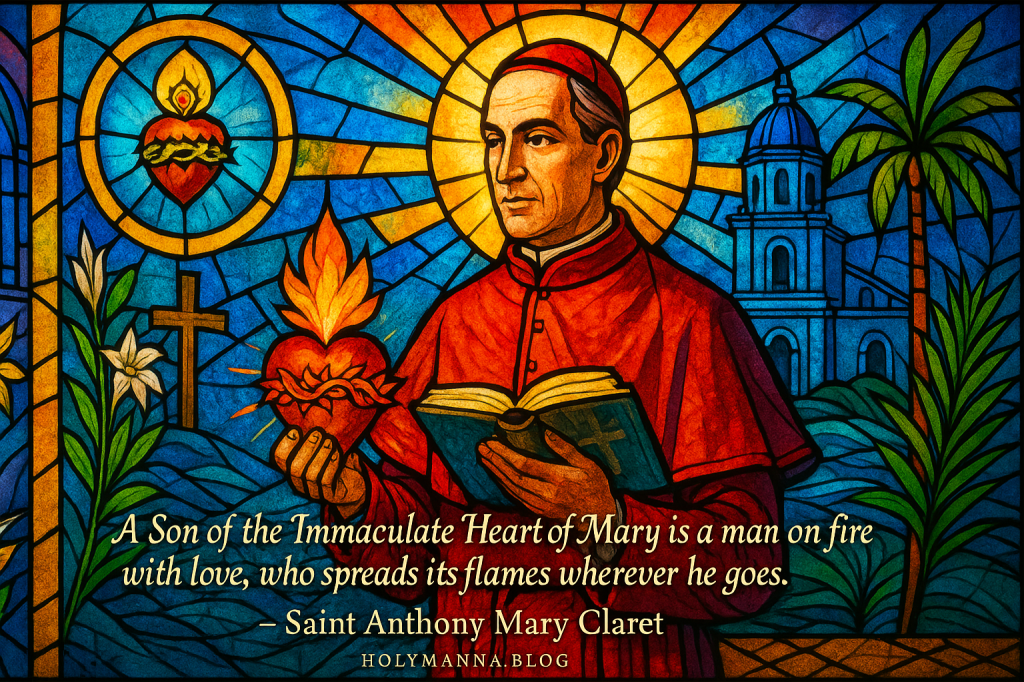
A Shepherd on Fire with Love
Saint Anthony Mary Claret shines as a missionary founder, reforming archbishop, spiritual author, and fearless evangelist whose whole life burned with zeal for Jesus and love for the Immaculate Heart of Mary. He founded the Missionary Sons of the Immaculate Heart of Mary, known as the Claretians, who continue his work across the world today through preaching, education, and service to the poor. His feast is celebrated on October 24, and his life still fuels Catholic renewal because he kept the Eucharist at the center, promoted devotion to Mary, and dedicated everything to saving souls. “A Son of the Immaculate Heart of Mary is a man on fire with love, who spreads its flames wherever he goes.” (Autobiography, 494). That line captures his entire identity and the spiritual DNA he handed on to the Church.
Claret preached with clarity, wrote more than a hundred works for ordinary people, and fought for the dignity of families and the formation of priests. He pushed for solid catechesis, reverent liturgy, strong sacramental life, and humble service of the most vulnerable. His legacy is not a museum piece. It is a living school of holiness for anyone who wants to love Jesus Christ with practical charity and courageous truth.
Woven by Providence: From Loom to Pulpit
Anthony was born in the Catalan town of Sallent, near Barcelona, on December 23, 1807, into a large family of textile workers. He learned the weaving trade and even managed machinery in Barcelona for a time, but a persistent interior call redirected his life from fabric to souls. He entered the seminary at Vic and was ordained a priest in 1835. With a heart longing for the missions, he tried religious life and experienced setbacks due to health, yet he kept offering himself to the Lord without complaint or drama.
The turning point came as he began preaching popular missions across Catalonia and, later, in the Canary Islands. People flocked to hear him because he combined simple explanations of the faith with a father’s tenderness and a prophet’s urgency. In 1849, convinced that the Church needed men who would belong wholly to Jesus through Mary, he founded the Claretians in Vic. A year later he was named Archbishop of Santiago de Cuba, where he poured himself out as a shepherd who would not rest while even one sheep wandered far from Christ.
Mission in Motion: What Made Him Matter
Claret’s reputation rests on his tireless missionary strategy and bold pastoral reforms. In Cuba he crisscrossed a sprawling archdiocese, often on foot or mule, preaching, hearing confessions for hours, and visiting parishes that had seen little priestly presence. He renewed the seminary to improve priestly formation, strengthened parish life, established schools for children and technical training for the poor, and supported works of mercy like hospitals. He promoted worthy reception of the sacraments, defended the permanence and beauty of Christian marriage, and helped regularize marriages to restore families to grace.
His Marian and Eucharistic spirituality anchored everything. He recommended frequent Communion when possible, encouraged Eucharistic adoration, and taught families to keep a small prayer corner at home where the names of Jesus and Mary were honored and invoked daily. He also founded, with Mother María Antonia París, a congregation of sisters later known as the Claretian Missionary Sisters, to educate youth and evangelize with gentle strength. Even after being recalled to Spain as confessor to Queen Isabella II, he lived austerely, advanced Catholic education at the Escorial, and promoted the apostolate of good books so that truth would circulate faster than lies.
Signs of Grace: Miracles in His Lifetime
The Lord confirmed Claret’s preaching with striking graces. During his years in Cuba, an assailant slashed his face in the city of Holguín. He recovered quickly, publicly forgave the attacker, and even interceded for his life. That forgiveness moved hearts more powerfully than any sermon and opened a new wave of conversions. Many people experienced deep compunction while he preached, reconciled with the Church after long absences, and returned to the sacraments with tears of relief and joy.
There were reports of healings and providential protection that surrounded his travels and missions, but the miracle that marked him most was interior. God gave him a capacity to speak to conscience with such fatherly love that men and women laid down bitterness, left sinful habits, repaired broken marriages, and embraced the demands of the Gospel step by step. He is a reminder that sanctity changes the atmosphere. “Let us be men of prayer and sacrifice; then our words will carry fire.” That line, taken from his spiritual counsel, explains why his missions bore fruit. The fire came from the tabernacle and returned to the tabernacle with grateful hearts.
Tried Like Gold: Hardships, Wounds, and Holy Courage
Claret’s holiness drew resistance. He confronted corruption, challenged injustice, and called Catholics to live what they professed. He endured calumnies, political hostility, and numerous attempts on his life. The Holguín attack left a permanent scar, but it also became a permanent testimony to Christian mercy. Back in Spain, his public role as confessor to the queen never changed his interior poverty. He continued fasting, sleeping little, and praying much, while using his influence to promote education, the Catholic press, and the reform of religious houses.
Political revolution forced him into exile in 1868. He made his way to Rome and took part in the First Vatican Council, firmly supporting the Church’s teaching on the primacy and infallibility of the Pope. Worn out by labor and illness, he withdrew to the Cistercian monastery of Fontfroide, near Narbonne, where he died on October 24, 1870, whispering the holy names of Jesus and Mary with serene trust. He was not a martyr by blood, but he lived a long martyrdom of charity, pouring himself out day after day until he had nothing left but love.
Heaven Confirms the Work: Miracles After Death and Veneration
After his death, many faithful sought his intercession and reported favors and healings. These testimonies grew over the years and were carefully examined by the Church, contributing to his beatification in 1934 and his canonization in 1950. His relics are honored in Vic, Spain, where pilgrims pray for missionary zeal, family renewal, and courage to witness in difficult times. The living fruit of his intercession is seen in the global Claretian family, in renewed parishes and schools, and in the quiet miracles that happen when a sinner turns back to God.
The Church proposes saints as models and intercessors, and Claret’s life is a clear invitation to let the Sacred Heart of Jesus and the Immaculate Heart of Mary shape thoughts, words, and daily decisions. His mission did not stop in 1870. It continues wherever someone asks for his prayers and then chooses to act with integrity, mercy, and apostolic creativity.
Living the Lesson: How to Walk with Saint Anthony Mary Claret Today
Claret teaches that authentic renewal starts with worship and spills into works of mercy. Make Sunday Mass the anchor of the week and, when possible, spend time in quiet adoration before the tabernacle. Learn to love Mary as a mother who forms disciples to look like her Son. Bring the Gospel into family routines with simple prayer at meals, a daily decade of the Rosary, and regular Confession that keeps the heart clean and courageous.
Let Claret’s pastoral priorities become practical goals. Strengthen marriages by encouraging real conversation, date nights, and quick forgiveness. Help the poor by supporting parish outreach or starting small initiatives with friends to meet concrete needs. Offer a friendly explanation of the faith when questions come up and do it without snark or pride. When opposition appears, remember how Claret faced wounds and slander with patience and mercy. Ask his help to respond with truth and charity together. “Love is the force that makes us apostles; without love, our words are empty.” That is the spirit of his counsel, and it is the path that changes hearts.
Engage with Us!
Share your thoughts and prayers below. How does Saint Anthony Mary Claret challenge and encourage your discipleship today?
- Where is Jesus inviting deeper Eucharistic devotion this week, and how can that concretely shape your schedule?
- What is one way to honor Mary’s Immaculate Heart at home, and how will you begin today?
- Who needs to hear the Gospel through your kindness and courage, and what first step will you take?
- How can you defend and strengthen family life in your circle, reflecting Claret’s pastoral priorities?
- Where is God asking you to forgive someone who has wounded you, and what grace do you need to do it?
Keep going. Live boldly. Let every word and work be aflame with the love and mercy Jesus taught us.
Saint Anthony Mary Claret, pray for us!
Follow us on Instagram and Facebook for more insights and reflections on living a faith-filled life.

 Holy Manna!
Leave a comment