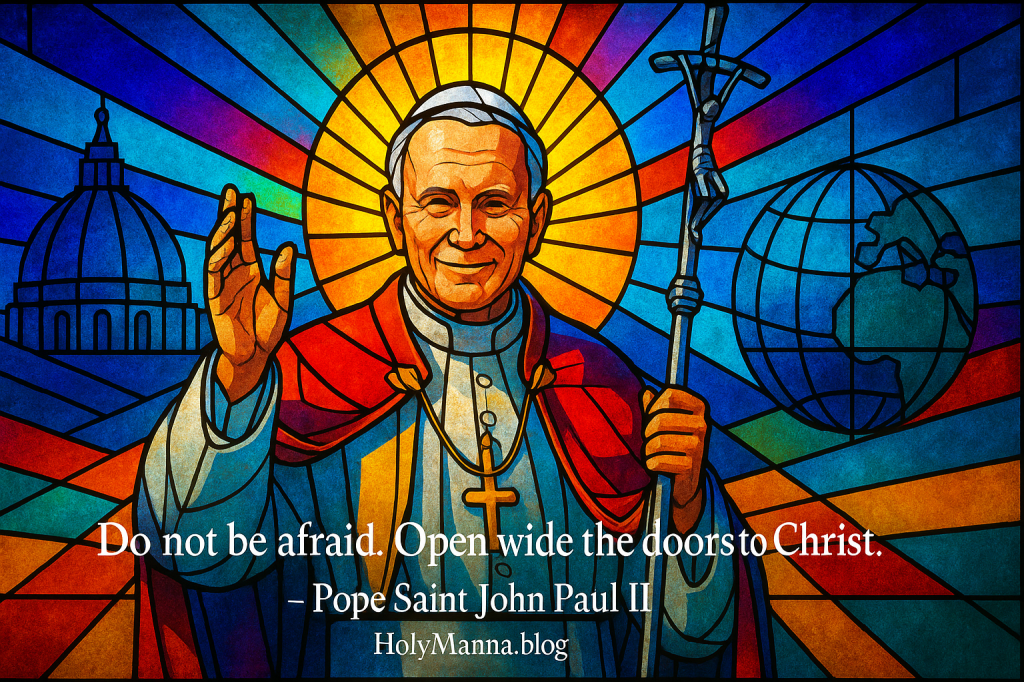
A Shepherd for Our Time
Pope Saint John Paul II stepped onto the world stage with a voice that was both fatherly and fearless. Born Karol Józef Wojtyła in 1920 and elected bishop of Rome in 1978, he invited the whole Church to a new evangelization that spoke confidently to modern doubts and desires. He defended the dignity of every human person, promoted a culture of life, and called the young to holiness through World Youth Day. His teaching still anchors hearts and minds through encyclicals like Redemptor Hominis, Veritatis Splendor, Evangelium Vitae, and Fides et Ratio, and through the Catechism of the Catholic Church, which he promulgated as a sure norm for the faith. From his very first homily one line continues to echo in souls today: “Do not be afraid. Open wide the doors to Christ.” He consistently framed the human search for truth with a luminous confidence about faith and reason, summarized so beautifully in the opening line of Fides et Ratio: “Faith and reason are like two wings on which the human spirit rises to the contemplation of truth.” He loved to remind Christians of our paschal identity: “We are the Easter people and Alleluia is our song.”
From Wadowice to the World
Karol grew up in Wadowice, Poland, marked early by grief at the deaths of his mother, brother, and father. Under Nazi occupation he studied at the Jagiellonian University until it was closed, worked at the Solvay chemical plant, and joined an underground theater that protected Polish culture. Guided by Archbishop Adam Sapieha, he entered the clandestine seminary and was ordained in 1946. After doctorates in Rome, he served as a parish priest and university chaplain, then taught ethics and philosophical personalism at the Catholic University of Lublin. His mind and heart were formed by deep prayer, hard work, and close friendship with students and families on hiking and canoeing trips. As a young bishop at the Second Vatican Council he helped shape Gaudium et Spes, especially its vision of the human person as called to communion. His pastoral and scholarly gifts converged in the book Love and Responsibility and later in the catecheses known as the Theology of the Body. Elevated to the cardinalate in 1967 and elected pope on October 16, 1978, he took as his motto Totus Tuus, entrusting his life completely to Jesus through Mary.
A Global Pastor with a Clear Voice
John Paul II traveled more than any previous pope, visiting the faithful across continents and speaking Christ into public life with joyful clarity. He gave the Church juridical stability by promulgating the 1983 Code of Canon Law and the 1990 Code for the Eastern Catholic Churches, and doctrinal clarity by approving the Catechism of the Catholic Church. His writings still guide conscience and culture. In Evangelium Vitae he proclaims, “The Gospel of life is at the heart of Jesus’ message.” In Fides et Ratio he sets the tone for Catholic intellectual life with that unforgettable first sentence, “Faith and reason are like two wings on which the human spirit rises to the contemplation of truth.” In the Theology of the Body he teaches, “The body, in fact, and it alone, is capable of making visible what is invisible.” He prepared the Church for the Great Jubilee of 2000, canonized and beatified men and women from every state of life to show holiness as the real measure of greatness, and launched World Youth Day so that young people could encounter Christ together in the heart of the Church. He loved to remind us of real freedom: “Freedom consists not in doing what we like, but in having the right to do what we ought.”
Grace in Motion During His Lifetime
While John Paul II is not remembered for working public miracles like some saints, the Lord’s grace flowed powerfully through his ministry. On May 13, 1981, he was shot in St. Peter’s Square and nearly died. He later visited his assailant in prison and forgave him, a living homily on mercy. He credited Our Lady of Fatima with protecting his life and placed a bullet from the attack in the crown of her statue at Fatima in thanksgiving. His first pilgrimage to Poland in 1979 awakened a spiritual movement that strengthened the resolve for freedom across Eastern Europe. He inspired countless priestly and religious vocations, reconciled hearts through the sacrament of Penance, and stirred millions to rediscover the Eucharist as the “source and summit” of Christian life, exactly as the Catechism teaches (CCC 1324). In Redemptor Hominis he gives the deepest reason why his words carried such power: “Man cannot live without love.”
Hard Roads and Holy Forgiveness
Suffering accompanied him from youth to his final days. He bore physical weakness after the 1981 attack and later lived publicly with Parkinson’s disease, turning his decline into a catechesis on redemptive suffering. In Salvifici Doloris he writes, “Suffering is present in the world in order to release love.” His patience and courage testified that dignity does not fade with age or illness, echoing the Catechism’s teaching on fortitude, which “ensures firmness in difficulties and constancy in the pursuit of the good” (CCC 1808). He promoted devotion to Divine Mercy, canonized Saint Faustina, and instituted Divine Mercy Sunday for the second Sunday of Easter. Near the end of his life he prayed often about entrusting everything to the Heart of Christ. He once preached, “There is nothing that man needs more than Divine Mercy.” He died on April 2, 2005, on the vigil of Divine Mercy Sunday, after a final earthly journey that taught the world how to suffer with faith and love.
Miracles After Death
After his death two healings were approved by the Church as miracles through his intercession. Sister Marie Simon Pierre, a French religious diagnosed with Parkinson’s disease, experienced a sudden and lasting cure in 2005 after praying for his help. A Costa Rican woman, Floribeth Mora Díaz, was healed in 2011 from a fatal brain aneurysm after invoking John Paul II while watching his beatification. These signs opened the way to his beatification in 2011 and canonization in 2014. Today pilgrims honor him at his tomb in St. Peter’s Basilica, at the Sanctuary of Saint John Paul II in Kraków, and in his hometown of Wadowice, where the house of his childhood helps visitors encounter the simple roots of a heroic life. The fruit that continues to ripen around the world is the best testimony to his holiness. He used to say with hopeful conviction, “The future starts today, not tomorrow.” Those words still stir hearts to surrender every moment to Christ.
Praying with a Saint Today
The life of John Paul II offers practical steps for discipleship that fit daily Catholic living. Begin with the Catechism, which teaches that “The desire for God is written in the human heart.” (CCC 27) Feed that desire through steady prayer, Scripture, and the sacraments. Approach the Eucharist often and let the Lord strengthen charity in your state of life, just as the Catechism teaches about the fruits of Holy Communion (CCC 1391). Practice mercy because forgiveness is not a suggestion; it is a command rooted in God’s own love (CCC 2842). Live true freedom by forming conscience according to the moral law so that choices become acts of love (CCC 1733). Make friends with the saints he loved and canonized, imitate his Marian trust with the simple prayer “Totus Tuus,” and carry his steady refrain into every decision: “Do not be afraid.” When courage feels costly, remember his reminder from Evangelium Vitae that the Gospel of life is the center of Christ’s message and therefore the center of Christian mission.
Engage with Us!
- Where do the words “Do not be afraid” challenge your choices, habits, or plans right now?
- What concrete step could draw you into the “new evangelization” in your family, parish, or workplace this week?
- How has the witness of John Paul II’s suffering shaped your view of dignity, aging, or illness?
- Which teaching of his encyclicals or of the Catechism is the Lord inviting you to study and live more deeply this month?
- When have you experienced forgiveness that felt like freedom, and what would it take to extend that same mercy to someone today?
Keep pressing on in faith. Live boldly, think with the mind of the Church, and do everything with the love and mercy Jesus taught us.
Pope Saint John Paul II, pray for us!
Follow us on Instagram and Facebook for more insights and reflections on living a faith-filled life.

 Holy Manna!
Leave a comment