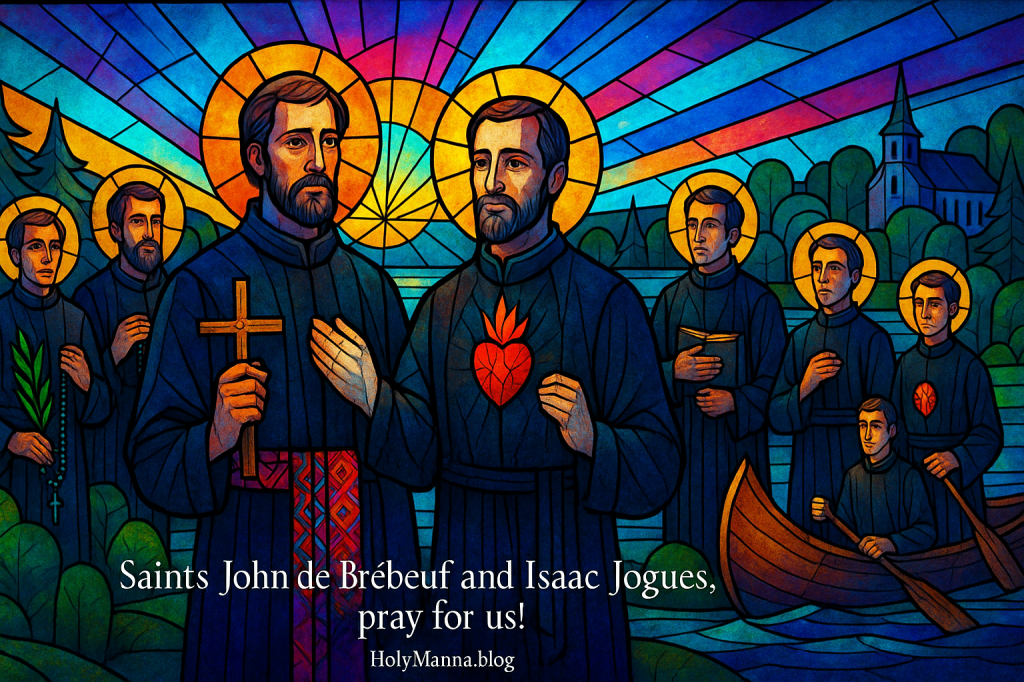
The Witness of the North American Martyrs
The Church venerates eight Jesuit missionaries who poured out their lives for the Gospel in seventeenth-century New France: John de Brébeuf, Isaac Jogues, Gabriel Lalemant, René Goupil, Jean de Lalande, Charles Garnier, Noël Chabanel, and Antoine Daniel. Their mission fields stretched across the Huron-Wendat and Iroquois homelands around the St. Lawrence and Great Lakes. They are honored together because their lives interwove into a single tapestry of charity, scholarship, and sacrifice. They labored to learn languages, preserve customs that were good, and preach Christ with reverence and clarity. They were beatified in 1925 and canonized on June 29, 1930. Their memorial is kept on October 19 in the United States, while in Canada they are commemorated on September 26 as the Canadian Martyrs. Their legacy invites us to evangelize as they did, with patience, cultural humility, and a love that costs something.
Roots and Rivers
John de Brébeuf was born in 1593 at Condé-sur-Vire in Normandy to a family of modest standing. He entered the Society of Jesus in 1617 and was ordained a priest in 1622. Despite fragile health early on, he possessed a formidable mind and a gift for languages. He sailed for New France in 1625 and soon lived among the Huron-Wendat, carefully observing their customs, recording vocabulary, and composing a grammar and catechetical materials. He did not try to erase what he encountered. He sought to elevate what was true and good by the light of Christ. His spiritual counsels to fellow missionaries reveal the tenderness that guided his zeal: “You must love them tenderly, looking upon them as ransomed by the blood of the Son of God.”
Isaac Jogues was born in 1607 in Orléans. He entered the Jesuits as a young man known for gentleness and resolve and was ordained in 1636, the very year he departed for New France. His missionary work took him among the Huron and Algonquin, where he learned languages, preached, baptized, and traveled immense distances by canoe and portage. Captured in 1642 by Mohawk warriors, he suffered the mutilation of several fingers and endured months of captivity. After a daring escape to France, he received a rare dispensation to celebrate Mass despite his injuries, and he returned to the very people among whom he had suffered, convinced that charity must be courageous. He later named a beautiful body of water “Lac du Saint-Sacrement,” Lake of the Blessed Sacrament, as an act of Eucharistic devotion.
Their companions filled out the company of witnesses. René Goupil, a surgeon and Jesuit oblate, offered medical care to captives and villagers alike and was the first of the group to die. Jean de Lalande, a young donné, accompanied Jogues and shared his fate. Antoine Daniel was a gifted preacher and pastor. Charles Garnier spent himself among the Petun and Huron peoples. Noël Chabanel, who struggled acutely with language and loneliness, made a solemn vow to remain in the mission and keep loving the people God entrusted to him. Gabriel Lalemant, scholarly and gentle, asked to be sent to the most difficult post. Their sanctity is not one note. It is a chorus of charisms ordered to one Lord.
Christ in a New Tongue
Brébeuf’s approach to evangelization was profoundly incarnational. He immersed himself in the Huron language, recorded customs with respect, and taught the Gospel through stories and images that resonated with the people he served. The Christmas hymn widely known as the Huron Carol reflects the heart of this approach, presenting the Nativity with imagery born of local life so that Christ could be contemplated as truly God-with-us. He wrote advice for missionaries that is as bracing as it is beautiful: “Try to be loved rather than feared.” “Bear with their faults in compassion.”
During his brief periods of respite, Jogues wrote letters that glow with gratitude for priestly life and for the privilege of suffering for Christ. At the start of his apostolic labors he confessed, “I do not know what it is to enter Heaven, but this I know, that it would be difficult to experience in this world a joy more excessive and more overflowing than I felt on setting foot in the New World and celebrating my first Mass there.” Even their “miracles during life” were most often miracles of grace rather than spectacle: the interior transformations of catechumens, reconciliations forged through patient listening, the baptism of the dying who desired Christ, the heroic forgiveness they extended to their captors, and the astonishing endurance with which they kept traveling, teaching, and consoling through hunger, cold, and danger. The Catechism of the Catholic Church reminds us that evangelization is always the work of the Holy Spirit and must be adapted wisely to cultures and circumstances (CCC 854; see also CCC 905).
Into the Storm
The story of their martyrdoms spans from 1642 to 1649. René Goupil was killed at Ossernenon in 1642 after making the Sign of the Cross over a child. His last word was the Holy Name: “Jesus.” Isaac Jogues returned as a peace envoy and was martyred at Ossernenon on October 18, 1646. Jean de Lalande was killed the next day as he searched for Jogues’s body. Antoine Daniel died on July 4, 1648 amid an attack, encouraging his people and absolving penitents as arrows fell.
In March 1649, John de Brébeuf and Gabriel Lalemant were taken during violent raids and brought to St. Ignace. Their tortures were prolonged and public, intended to break their spirits and to humiliate Christian baptism and Eucharist. Brébeuf refused to cry out in pain, praying steadily for his flock. Witnesses later reported that scalding water was poured upon his head in derision of baptism and that he answered only with prayer. Earlier he had made a solemn offering of his whole life to God, recorded in the vow sometimes called his “Consecration to the Martyr’s Crown.” “Jesus, my Lord and Savior, what can I give You in return for all the favors You have first conferred on me? … I vow to You, Jesus my Savior, that as far as I have the strength I will never fail to accept the grace of martyrdom.” Jogues, before his final departure, spoke a quiet prophecy of love: “I shall go, but I shall not return.” Charles Garnier fell on December 7, 1649, still ministering to his people. Noël Chabanel, faithful to his vow to remain in the mission despite profound interior trials, died the next day. The Catechism calls martyrdom “the supreme witness given to the truth of the faith” (CCC 2473–2474). Their deaths are not defeats. They are the Gospel preached in blood.
Signs From Heaven
From the first, Christians treasured their relics as tangible reminders that grace had seized these lands. Brébeuf’s remains and personal effects became sources of consolation and courage for the faithful who rebuilt shattered communities. Accounts from the decades that followed speak of favors granted through their intercession, including conversions, healings, and deliverance from affliction. In the modern period the Church examined cures attributed to the martyrs that were immediate, complete, and lasting, paving the way for beatification and canonization. Pilgrims continue to seek the Lord’s mercy at places sanctified by their witness: the Martyrs’ Shrine in Midland, Ontario near Sainte-Marie among the Hurons, and the Shrine of Our Lady of Martyrs in Auriesville, New York on the historic grounds of Ossernenon. The shrines do not exist as museums of sorrow but as living sanctuaries where Confession lines form, Mass is offered, and the same Jesus worshiped by the martyrs is adored in the Blessed Sacrament.
Hearts Set Like Flint
These martyrs teach us how to love. They show us how to honor cultures without compromising truth, how to prefer the salvation of souls to our own comfort, and how to accept the crosses that come with fidelity. Brébeuf’s counsel to “be loved rather than feared” challenges the tone of our evangelization online and in person. Jogues’s gratitude for the smallest priestly consolations invites all of us to rediscover the ordinary sacraments with extraordinary faith. Chabanel’s vow to remain despite aridity teaches perseverance when prayer feels dry. Goupil’s last breath on the Holy Name urges us to keep Jesus on our lips. The Catechism reminds every baptized person that we are responsible for bearing witness to the faith and spreading it (CCC 1816, 905). Practically, that means making Sunday Mass non-negotiable, going to Confession regularly, praying daily with Scripture, practicing hospitality with people who do not share our background, and letting the Eucharist shape how we forgive, how we speak, and how we spend. If we are not called to a martyr’s death, we are certainly called to a martyr’s love.
Engage with Us!
Share your thoughts and reflections below. We would be honored to pray with you and to hear how the North American Martyrs inspire your faith.
- How does the courage of these missionaries challenge your approach to suffering and inconvenience for the sake of Christ today?
- Where is God inviting you to “inculturate” the Gospel in your family, workplace, or neighborhood with patience and respect?
- What practical step can you take this week to deepen Eucharistic love, as Jogues did, and to witness more boldly to Jesus?
- Which line or image from Brébeuf’s vow moves your heart, and how will you respond to the Lord in prayer?
Go in peace. Live the day with a martyr’s love, a missionary’s creativity, and the mercy of Jesus in every word and deed.
Saints John de Brébeuf and Isaac Jogues, pray for us!
Follow us on Instagram and Facebook for more insights and reflections on living a faith-filled life.

 Holy Manna!
Leave a comment