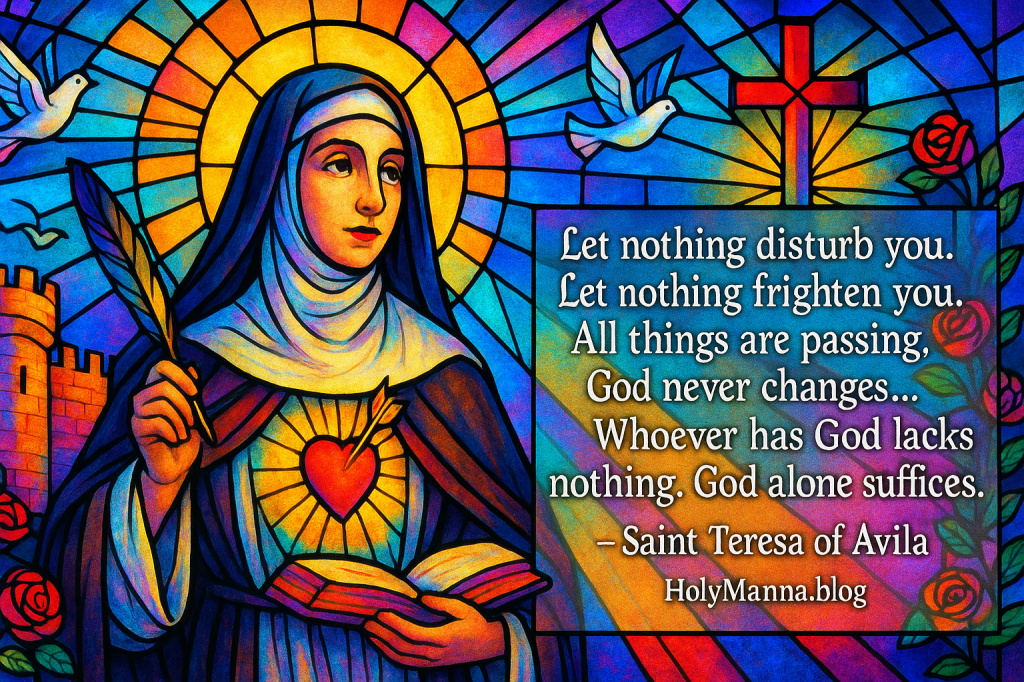
A Saint Who Teaches Friendship with God
Saint Teresa of Ávila, also known as Saint Teresa of Jesus, stands as a luminous Doctor of the Church whose teaching on prayer still guides disciples today. She renewed Carmel with evangelical poverty, sisterly charity, and a fierce love for Jesus Christ. She is co patroness of Spain, a master of the spiritual life, and a trusted companion for anyone who longs for contemplative intimacy with God. Teresa’s classic works, including The Interior Castle, The Way of Perfection, The Book of Her Life, and Foundations, map the soul’s journey toward transforming union. The Church treasures her definition of contemplative prayer, which she expresses with disarming simplicity: “Prayer is nothing else than a close sharing between friends. It means taking time frequently to be alone with Him who we know loves us.” Her short poem known as Nada te turbe continues to console countless hearts with the refrain “Let nothing disturb you. Let nothing frighten you. All things are passing. God never changes. Patience obtains all things. Whoever has God lacks nothing. God alone suffices.”
From Ávila’s Walls to the Interior Castle
Teresa Sánchez de Cepeda y Ahumada was born in Ávila, Spain, in 1515, into a devout family that nurtured her lively mind and generous heart. As a child she and her brother Rodrigo famously dreamed of martyrdom and once set out toward the lands of the Moors hoping to shed their blood for Christ, a youthful zeal that later matured into a lifelong courage for holiness. In adolescence Teresa enjoyed chivalric tales and lively company, yet grace drew her steadily toward God. She studied for a time with the Augustinian nuns of Santa María de Gracia, and at age twenty she entered the Carmelite Convent of the Incarnation in Ávila. Not long after profession she suffered a grave illness that left her partially paralyzed for years, and she credited Saint Joseph’s intercession with her recovery and ongoing protection. A decisive deepening came when she read The Confessions of Saint Augustine and contemplated a statue of the wounded Christ. She recounts that moment with piercing candor: “I felt so keenly how ill I had thanked Him for those wounds that my heart seemed to break.” From that encounter forward, Teresa surrendered to prayer, reformation, and a love for the Church that shaped all her decisions.
Reformer on the Road
Teresa’s sanctity unfolded in action and contemplation. Convinced that God was asking for a return to the original Carmelite fervor, she founded the first Discalced Carmelite monastery, Saint Joseph’s in Ávila, in 1562. Over the next two decades she established many more convents, traveling Spain’s dusty roads in fragile health, negotiating with town councils, bishops, and benefactors, and writing letters that sparkle with humor and supernatural common sense. With Saint John of the Cross and other companions she helped extend the reform to the friars, giving rise to the Discalced Carmelites. Teresa described profound mystical graces that the Lord granted for the building up of the Church, including the transverberation of her heart. In The Book of Her Life she writes, “I saw an angel close by me, on my left side, in bodily form. He was not large but small and very beautiful, and his face was so aflame that he seemed to be one of the highest angels. In his hands I saw a large golden dart. He seemed to pierce my heart several times, so that it penetrated to my entrails.” Witnesses also testified to occasions of levitation during prayer, which she received with humility, asking the sisters to hold her down or place heavy objects nearby so that she could remain recollected. Teresa is important because she shows that authentic contemplation produces concrete virtue. Her reform blossomed not from flights of emotion but from love of Jesus present in the Eucharist, unwavering fidelity to the Church, and charity among her sisters.
Storms Against a Saint
Teresa knew suffering in body and soul. Years of illness remained a steady cross, and her foundations often met fierce resistance from civil authorities and members of her own Order. She endured suspicion and scrutiny of her visions and writings, which were examined by learned confessors and theologians. She was misunderstood, criticized, and sometimes forbidden to found new houses, yet she persevered in obedience and peace. Teresa loved to remind her daughters that courage, humility, and mutual charity were the true measures of a Carmelite vocation. She once counseled her communities with striking realism, “We need no wings to go in search of Him, but have only to find a place where we can be alone and look upon Him present within us.” Although she did not suffer martyrdom, she bore an interior martyrdom of trial and contradiction and offered it for the glory of God and the renewal of religious life. Teresa died at Alba de Tormes in 1582 during the calendar reform, with her heart fixed on the Church she loved, and tradition preserves her final sentiment of fidelity, “I am a daughter of the Church.”
A Heart That Keeps Teaching
After her death Teresa’s body was venerated at the Monastery of the Annunciation in Alba de Tormes, and her heart, which bears the mark of the transverberation, is preserved and honored there. Reports of healings and favors through her intercession rapidly multiplied, contributing to her beatification in 1614 and canonization in 1622. Pilgrims continue to visit Ávila and Alba de Tormes to pray before her relics and to walk the streets where she loved and served Christ. The Carmelite family treasures her letters and manuscripts, which continue to unlock the “interior castle” for new generations. In 1970 the Church proclaimed Teresa a Doctor of the Church, recognizing that her doctrine is not only lofty but safe, practical, and enduringly fruitful for souls who seek holiness in every state of life.
How Teresa Can Shape Your Prayer Today
Teresa’s wisdom is wonderfully concrete. Set aside time daily for mental prayer and be with Jesus as with a faithful Friend. Read a short passage of Scripture and linger with the Lord, speaking with Him and listening in love. Receive the sacraments frequently, especially Confession and the Eucharist, since grace strengthens the will to love when feelings are weak. Ask Saint Teresa to teach you perseverance when distractions come and to purify your intentions when success or failure tempts you to vanity or discouragement. Let her words guide your day, “Let nothing disturb you. God alone suffices.” How will you make room today for that “close sharing between friends”?
Engage with Us!
We would love to hear how Saint Teresa speaks to your journey. Share your thoughts and graces in the comments.
- When you hear Teresa’s definition of prayer as “a close sharing between friends,” what changes in the way you approach your daily prayer time?
- What one attachment or anxiety do you need to surrender to live her line, “God alone suffices”?
- Where is Jesus inviting you to act on prayer through concrete love of neighbor this week?
- Have you ever visited or would you like to visit a Carmelite monastery? How might that silence and community shape your prayer life?
- Which of Teresa’s works will you read next, and when will you schedule that time with the Lord?
Go in peace, and let Saint Teresa’s brave love lead you to pray, to persevere, and to do everything with the love and mercy Jesus taught us.
Saint Teresa of Ávila, pray for us!
Follow us on Instagram and Facebook for more insights and reflections on living a faith-filled life.

 Holy Manna!
Leave a comment