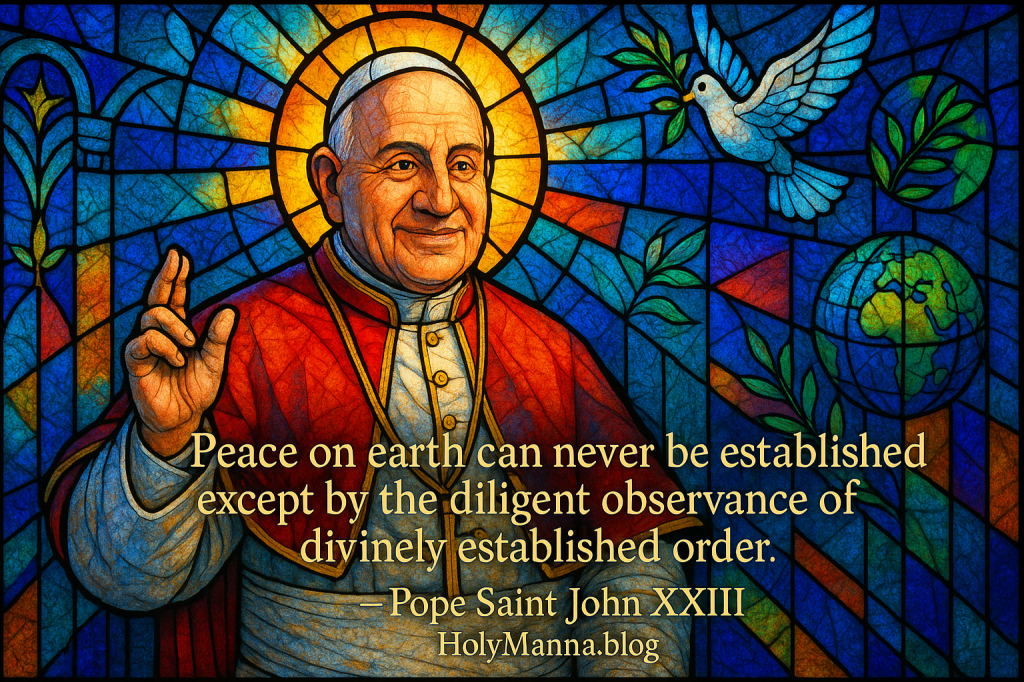
A Shepherd Who Let the Light In
Pope Saint John XXIII, born Angelo Giuseppe Roncalli, is remembered as the humble and joy filled “Good Pope” who let fresh air into the Church by convoking the Second Vatican Council. His pontificate lasted less than five years, yet it reshaped how the Church presents the unchanging Gospel to the modern world. He is revered for pastoral warmth, clear teaching on human dignity and peace, and a missionary heart that trusted the Holy Spirit. In his opening address to the Council he urged that the Church adopt the “medicine of mercy” rather than severity. He also offered a principle that continues to guide renewal in continuity with tradition, “The substance of the ancient doctrine of the deposit of faith is one thing, and the way in which it is presented is another.” His great social encyclical Pacem in Terris taught that authentic peace must be “based on truth, built up in justice, animated by love, and put into practice in freedom.”
Roots in Bergamo, Heart for the World
Angelo Roncalli was born on November 25, 1881, in Sotto il Monte near Bergamo, Italy, into a large family of tenant farmers. The simple faith of his parents, Giovanni and Marianna, formed him in daily prayer, love for the Blessed Virgin Mary, and devotion to the Eucharist. He entered the minor seminary at a young age, studied in Rome, and was ordained a priest in 1904. Early assignments included teaching church history and serving as secretary to Bishop Giacomo Radini Tedeschi, whose example of social concern left a lasting mark. During World War I he served first in the medical corps, then as a military chaplain, bringing sacramental comfort to the wounded and dying. In 1921 he was called to Rome to aid the missions, then in 1925 he was consecrated bishop and sent as apostolic visitor to Bulgaria, followed by service as apostolic delegate to Turkey and Greece. In 1944 he became papal nuncio to France, helping to rebuild ecclesial life after the war. Named Patriarch of Venice and created a cardinal in 1953, he was elected pope on October 28, 1958, choosing the name John in honor of his father and of venerable predecessors. His papal motto, Obedience and Peace, summed up his desire to listen to God and to lead the Church calmly and courageously.
Open the Windows
John XXIII is most known for announcing an ecumenical council on January 25, 1959, and then opening the Second Vatican Council on October 11, 1962. In Gaudet Mater Ecclesia he invited pastors to read the signs of the times with confidence, not fear, and he famously cautioned against the “prophets of doom” who saw only decay in the modern world. His encyclicals set a luminous path. Mater et Magistra renewed Catholic social teaching for a world of rapid economic and technological change, insisting on the dignity of workers, the duty of solidarity, and the responsibility of public authority to serve the common good. Pacem in Terris addressed all people of good will, grounding human rights and duties in the order established by God, and naming truth, justice, love, and freedom as the pillars of peace. He also wrote Ad Petri Cathedram, Grata Recordatio, Princeps Pastorum, Aeterna Dei Sapientia, and Paenitentiam Agere, each reinforcing missionary zeal, Marian devotion, and the call to penance. During the Cuban Missile Crisis in October 1962 he went on radio to plead with world leaders to follow the voice of conscience and choose dialogue over war, a plea remembered for the line “We beg all rulers not to remain deaf to the cry of humanity. Peace, peace.” His daily spiritual life, recorded in Journal of a Soul, reveals a priest and pope who examined his conscience with honesty and who sought to be, in his own words, “a humble instrument of God.”
Signs of Grace During His Lifetime
There are no public, physical miracles attributed to John XXIII during his life in the manner of biblical wonders. Yet his pastoral charity bore quiet and powerful signs of grace. As the Holy See’s representative in Istanbul during World War II he facilitated humanitarian assistance and helped Jewish refugees with transit documents and safe passage. He interceded tirelessly for prisoners and displaced persons and encouraged the faithful to works of mercy. As pope he modeled a spirituality of approachable fatherhood. He visited hospitals and prisons, spoke to the sick with tenderness, and reminded the world in simple phrases of the grandeur of Christian hope. He preferred a Church that taught clearly and loved generously, which is why he insisted again in his Council address that pastors should use the “medicine of mercy” in presenting doctrine. These deeds and words inspired countless conversions of heart, reconciliations in families, and renewed vocations to priesthood and religious life.
Trials, Illness, and a Gentle Finish
John XXIII knew hardship. He navigated the complexities of diplomacy between Eastern and Western Christians, labored to heal wounds left by war, and carried the weight of the papal office with serenity. Misunderstandings accompanied his bold call to renewal, and he bore criticism with patience and humor. In his final months he suffered from stomach cancer, which he accepted with faith and a spirit of offering. He died on June 3, 1963, after entrusting the Council to the Holy Spirit and to his successor. The Catechism of the Catholic Church teaches that the Bishop of Rome has a unique service of unity and universal pastoral care, and John XXIII lived that ministry with a fatherly heart. His last messages expressed gratitude to the Sacred Heart of Jesus and to the Blessed Mother, and he urged the world to seek peace. His passing was marked by an outpouring of prayer and affection from people of every nation and creed.
Miracles and Veneration
After his death many faithful reported favors through his intercession. The miracle approved for his beatification was the sudden and complete healing of Sister Caterina Capitani in 1966 after she invoked John XXIII while suffering from life threatening gastric illness. On September 3, 2000, Saint John Paul II beatified him. In a decision rooted in the widespread and enduring fruit of his holiness and teaching, Pope Francis dispensed with the usual requirement of a second miracle and canonized him on April 27, 2014, together with Saint John Paul II. His feast is celebrated on October 11, the date the Council opened. Pilgrims venerate his tomb in Saint Peter’s Basilica and visit his birthplace at Sotto il Monte Giovanni XXIII, where devotion continues to grow. Many testify to healings, reconciliations in families, and renewed desire for the sacraments through his prayer. His words continue to console and challenge, especially his reminder in Pacem in Terris that peace is not a mere balance of power but a moral order under God, and his Council insight that the unchanging deposit of faith must be presented with clarity and mercy for every age.
Living His Legacy
Pope Saint John XXIII teaches us how to hold fast to the fullness of Catholic faith while speaking to the modern heart with tenderness. He invites us to form our consciences in light of Scripture, tradition, and the Magisterium, since conscience must be instructed in truth in order to choose the good. He calls us to be peacemakers who build families, workplaces, and communities on justice and charity. His spiritual counsel is deeply practical. Pray the Rosary and entrust your day to Mary. Visit the Lord in the Eucharist and let your heart become gentle and strong. Make a daily examen of conscience and choose humility over self promotion. Practice the works of mercy, beginning with those closest to you. When disagreements arise, remember his line from the Council’s opening, “The Church… prefers to make use of the medicine of mercy.” Ask for the grace to be that medicine in your corner of the world. How is the Holy Spirit asking you to open a window in your life today?
Engage with Us!
Share your thoughts and prayers in the comments. We would love to hear how Saint John XXIII speaks to your journey.
- Where do you sense the Holy Spirit inviting you to use the “medicine of mercy” in your relationships this week?
- How can you form your conscience more deeply through Scripture, prayer, and the Magisterium so that your choices reflect Christ’s peace and justice?
- What practical step can you take today to be a peacemaker at home, at work, or online in light of Pacem in Terris and the Catechism’s teaching on peace?
- When you think about Vatican II’s call to renewal, what “window” might God be asking you to open in your parish or community?
Let us walk in mercy, form our consciences in truth, and do everything with the love and peace Jesus taught us.
Pope Saint John XXIII, pray for us!
Follow us on Instagram and Facebook for more insights and reflections on living a faith-filled life.

 Holy Manna!
Leave a comment