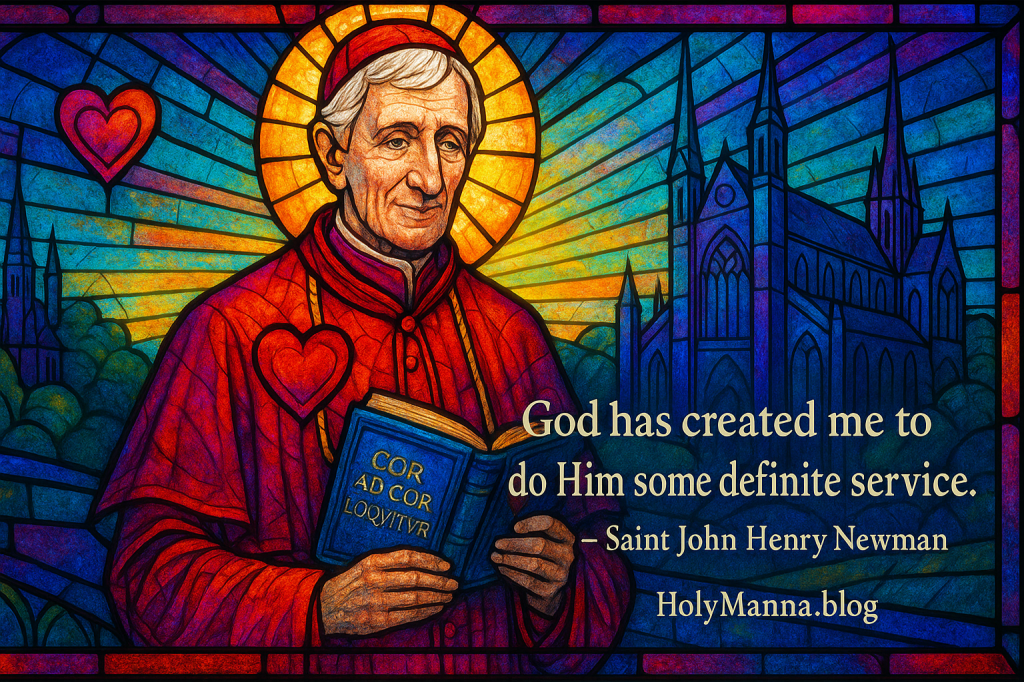
Heart Speaks to Heart
Saint John Henry Newman is one of the most influential Christian thinkers of the nineteenth century, a scholar and pastor whose life shows how love of truth can lead a soul to Christ and His Church. He served as a priest of the Oratory of Saint Philip Neri in Birmingham, became a cardinal late in life, and was canonized in 2019. His personal motto, Cor ad cor loquitur which means “heart speaks to heart,” captures the way he taught, wrote, and cared for souls. He is revered for the depth of his theology on conscience, the development of doctrine, and the harmony of faith and reason, as well as for the spiritual beauty of Lead, Kindly Light and The Dream of Gerontius. His books, including Apologia Pro Vita Sua, An Essay on the Development of Christian Doctrine, An Essay in Aid of a Grammar of Assent, and The Idea of a University, continue to guide Christians seeking intellectual integrity and holiness. In the light of the Catechism of the Catholic Church, Newman’s insights illuminate how the Church grows in understanding of the deposit of faith through contemplation, study, and the preaching of pastors (cf. CCC 94) and how conscience is the inner sanctuary where God speaks to man (cf. CCC 1776, 1783–1785).
Oxford Roots and the Road to Rome
John Henry Newman was born in London on February 21, 1801, to John Newman and Jemima Fourdrinier. Gifted from an early age, he studied at Ealing School and then at Trinity College, Oxford, where he became a fellow of Oriel College and an Anglican clergyman. In 1833 he helped spark what became known as the Oxford Movement, publishing the Tracts for the Times that urged a return to the faith and practices of the early Church. His historical study, especially of the Fathers, convinced him that the Catholic Church preserved the fullness of apostolic doctrine and sacramental life. A grave illness and an uncertain sea voyage during his return from Sicily in 1833 deepened his dependence on divine providence, and during that season he composed the poem later known as Lead, Kindly Light. After years of prayer, struggle, and study, Newman entered the Catholic Church in 1845, was ordained a Catholic priest in 1847, and established the first Oratory in England. He later served as the first rector of the Catholic University of Ireland, and in 1879 Pope Leo XIII created him a cardinal. He is most known for his courageous pursuit of truth, his theology of conscience, his account of doctrinal development, and his powerful defense of the reasonableness of faith. Among his many memorable lines are “To live is to change, and to be perfect is to have changed often.” and “Conscience is the aboriginal Vicar of Christ.”
Teacher of Conscience and Builder of Souls
Newman’s life matters because he shows how to love truth without fear and how to let Christ purify the mind and heart. He preached and wrote so that ordinary believers could live what they professed. In Grammar of Assent he explained how persons come to real, living faith, not just to abstract notions. In The Idea of a University he offered a vision of Catholic education that forms the whole person. In Apologia Pro Vita Sua he gave an honest account of his conversion that still helps readers discern the voice of conscience and the promptings of grace. He founded schools, formed the Birmingham Oratory, mentored converts, and wrote prayers that continue to strengthen faith. One of his most beloved meditations reads: “God has created me to do Him some definite service.” Another treasured line from his hymn encourages perseverance in dark hours: “Lead, kindly Light, amid the encircling gloom, lead Thou me on.” While there are no authenticated miracles from his lifetime, the supernatural fruit of his work is seen in the conversions he inspired, the renewal of Catholic life in England, and the countless consciences he helped to form in harmony with truth and grace (cf. CCC 1776; 1803).
Trials that Tempered a Servant
Fidelity cost Newman dearly. His conversion drew suspicion and hostility in Victorian society. He endured painful controversies, including the Achilli trial, where his attempt to defend the Church’s honor ended in a legal defeat and public scorn. Later, the public exchange with Charles Kingsley led him to write Apologia Pro Vita Sua, which defended both his integrity and the Catholic faith in a way that disarmed many critics. He also suffered misunderstandings within Catholic circles and anxieties about projects that did not unfold as he hoped, yet he persevered with humility and patience. In all of this he taught that the formation of conscience requires docility to revealed truth and courage to follow it, even when it isolates us (cf. CCC 1783–1785). His well known toast captures his balance: “I shall drink to the Pope, if you please, still, to Conscience first, and to the Pope afterwards.” Newman’s hardships purified his love for Christ and the Church and made his witness more luminous.
Signs After Death and Growing Veneration
After his death on August 11, 1890, reports of favors and healings through his intercession multiplied. The Church recognized two miracles as signs of God’s confirmation of his sanctity. The first was the healing of Deacon Jack Sullivan from a severe spinal disorder, which cleared the way for beatification in 2010. The second was the sudden and complete healing of a mother in Chicago from a life threatening hemorrhage during pregnancy, which supported his canonization in 2019. These events encouraged a wider devotion, and pilgrimages to the Birmingham Oratory and other Newman sites continue. When his grave was opened in 2008, no bodily remains were found, most likely due to natural decomposition in the damp soil of his burial, yet his spiritual legacy remains tangible. Devotees cherish his writings, personal effects, and the places he lived and served, and many testify to interior guidance received while praying with his words. His memory draws hearts to Christ, which is precisely what he desired.
Living Newman’s Wisdom Today
Newman teaches that holiness is faithful growth, that love of truth purifies desire, and that conscience must be formed and followed. Begin by setting aside time each day for prayer and a page from Apologia Pro Vita Sua or The Idea of a University. Ask the Holy Spirit to help you listen where God’s voice speaks in conscience, then act on the light you receive, however small the step (cf. CCC 1776, 1783–1785). When you are confused or discouraged, pray with his lines: “Lead, kindly Light, amid the encircling gloom, lead Thou me on.” When you face a difficult decision, recall his meditation: “God has created me to do Him some definite service.” Offer your work as a sacrifice of love, reconcile quickly when you fail, and seek the sacraments often, especially Reconciliation and the Eucharist. Newman’s life shows that authentic change does not mean abandoning truth. It means surrendering more fully to Christ who is the Truth, so that heart may truly speak to heart.
Engage with Us!
We would love to hear how Saint John Henry Newman speaks to your journey. Share your thoughts and prayer intentions in the comments.
- Where do you sense the Lord inviting you to “grow by changing” right now in light of “To live is to change”?
- How has your conscience been nudging you lately, and what is one concrete step you can take to form it more fully according to the Gospel (CCC 1783–1785)?
- What “definite service” might God be entrusting to you this week, and how will you begin?
- Which of Newman’s works will you sample first, and when will you make time for it?
Be encouraged. Walk in the light of Christ, love the truth, and do everything with the love and mercy Jesus taught us.
Saint John Henry Newman, pray for us!
Follow us on Instagram and Facebook for more insights and reflections on living a faith-filled life.

 Holy Manna!
Leave a comment