A Saint Who Shows How Far Mercy Can Go
Saint Pelagia the Penitent is remembered for one of the most dramatic conversions in Christian memory. Once celebrated in Antioch for her beauty and for leading a troupe of dancers, she encountered the preaching of Saint Nonnus of Edessa. His words about judgment and salvation pierced her heart. Moved to tears, she begged for Baptism, received the sacraments, and publicly renounced her former life. From that moment forward, Pelagia became a living icon of repentance, a sign that no past is beyond the reach of Christ’s mercy and that grace can redirect even the most public life toward holiness.
From Stage Lights to Baptismal Waters
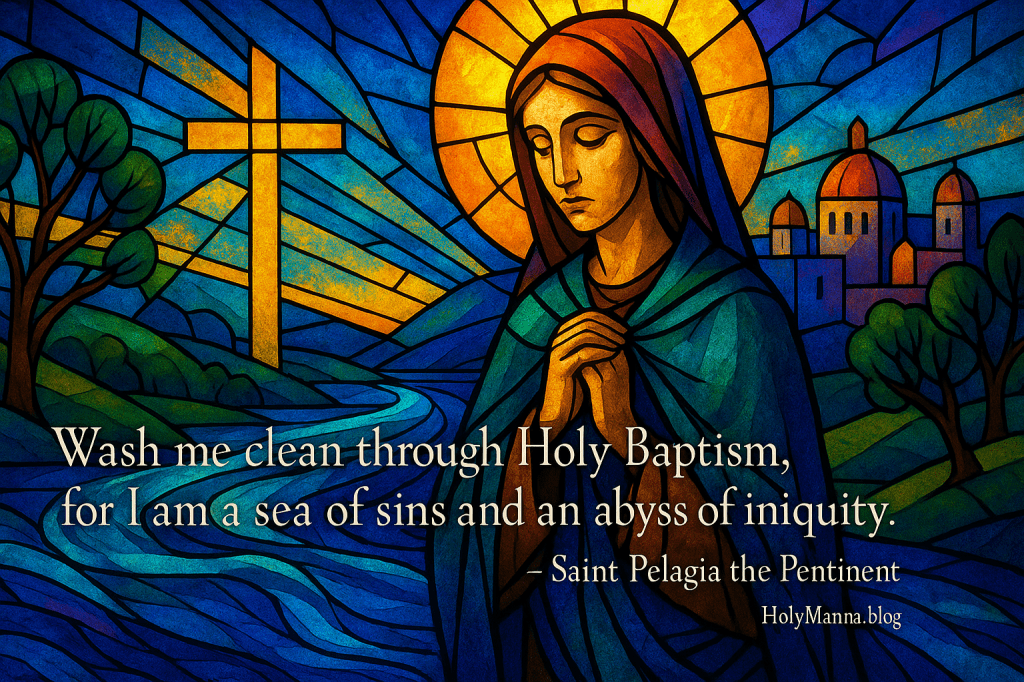
Accounts of Pelagia’s early life present her as a famed courtesan in Antioch around the mid-5th-century, admired everywhere she went and surrounded by attendants. When she passed a church where bishops had gathered, Saint Nonnus did not avert his eyes. He wept and admonished his fellow bishops that she put them to shame by the care she took to adorn her body while they neglected the adornment of their souls. He later preached on the Last Judgment. Pelagia entered the church, listened, and was cut to the heart. She sent him a letter addressed, “To Christ’s holy disciple from the devil’s disciple, a sinful woman.” She then came before the bishops, cast herself at Nonnus’s feet, and pleaded for Baptism with the cry, “Wash me clean through Holy Baptism, for I am a sea of sins and an abyss of iniquity.” She was catechized, baptized, and entrusted for a time to the care of the deaconess Romana. In a striking act of restitution, Pelagia gathered her jewels and wealth and placed them at the bishop’s feet for the poor, recalling his instruction that these riches should become a “wealth of righteousness.”
The Hidden Flame on the Mount of Olives
Soon after Baptism, Pelagia slipped away from Antioch in simple clothing. She traveled to Jerusalem and enclosed herself in a small cell on the Mount of Olives, living in solitude and prayer under the name “Pelagius.” Her identity was hidden. The holiness of this unknown recluse quietly became known to pilgrims and monks, who spoke of the monk Pelagius’s purity of heart, tears of compunction, and love of silence. Pelagia fought her battles in secret. Tradition remembers the devil tempting her with memories of her past, and her steadfast resistance through prayer, fasting, and the Sign of the Cross. She lived with great austerity, ate little, prayed much, guarded her senses, and poured out her love before God in reparation and intercession for sinners who lived as she once had.
Signs of Grace in a Life of Penance
Pelagia’s story highlights miracles that flow from conversion. The first is the miracle of a heart changed by grace, which transformed a public sinner into a hidden saint. The second is the power of the Cross against the enemy, as she is said to have driven away demonic assaults by tracing the Cross and invoking the Lord. Another sign of grace is the fruit of radical generosity. By turning her wealth into alms, she embodied the Gospel command to sell what one has and give to the poor. In her cell she became, in the words attributed to her, a “bride of Christ,” and her quiet life of prayer became a fountain of spiritual counsel to those few who ever spoke with the monk “Pelagius.” When a pilgrim-deacon knocked at her window, she asked only that he beg Bishop Nonnus to remember her in his prayers.
Trials, Temptations, and Holy Perseverance
Pelagia did not face tribunals or prison, yet her path was steep. She endured the hidden martyrdom of daily penance. She waged interior warfare against vanity and sensuality, and she persevered with heroic constancy. The ascetic tradition holds that her fasting and vigils were so rigorous that she died in her cell, spent in love. After her repose, those who prepared her for burial discovered that the revered hermit was in fact a woman. The discovery amazed many and magnified the message of her life. Her perseverance teaches us that holiness is not spectacle. It is fidelity to grace in the quiet places where God sees and rewards in secret.
After Her Repose
From early times, Christian pilgrims in Jerusalem honored Pelagia at her burial place on the Mount of Olives. Her tomb became a point of prayer for conversion, purity of heart, and hope for new beginnings. Accounts speak less of spectacular wonders than of the steady stream of penitents who sought her intercession and left strengthened to change their lives. The Church commemorates her on October 8 in the Roman Martyrology and distinguishes her from the martyr Pelagia remembered on June 9. Her memory endured not because of public fame, but because of the quiet radiance of a life wholly given to God.
Why Pelagia Matters Now
Pelagia’s journey is a living catechesis on repentance, Baptism, and chastity. The Church teaches: “Holy Baptism is the basis of the whole Christian life. Through Baptism we are freed from sin and reborn as sons of God.” (Catechism of the Catholic Church, 1213). True contrition is defined as “sorrow of the soul and detestation for the sin committed, together with the resolution not to sin again.” (CCC 1451). The Catechism reminds us that “Christ’s call to conversion continues to resound in the lives of Christians.” (CCC 1428) and that “All the baptized are called to chastity.” (CCC 2348). Pelagia embodies these teachings. She teaches us to let grace reach every corner of our story, to repair what we can by generosity to the poor, and to guard our hearts through prayer, fasting, and custody of the senses. How is Jesus inviting you to make a decisive, concrete turn toward Him today? What wealth of time, attention, or resources might He be asking you to place at His feet for the good of the poor?
Engage with Us!
Share your thoughts and reflections in the comments below.
- When you hear Nonnus’s challenge about caring for the soul more than the body, what specific change does the Holy Spirit bring to mind for you today?
- What step of restitution or mercy can you take this week to turn past sin into “a wealth of righteousness” for someone in need?
- Which teaching from the Catechism quoted above most challenges or consoles you right now, and why?
May Saint Pelagia intercede for us as we seek the courage to repent, the purity to love rightly, and the joy that comes from doing everything with the love and mercy Jesus taught us.
Saint Pelagia, pray for us!
Follow us on Instagram and Facebook for more insights and reflections on living a faith-filled life.

 Holy Manna!
Leave a comment