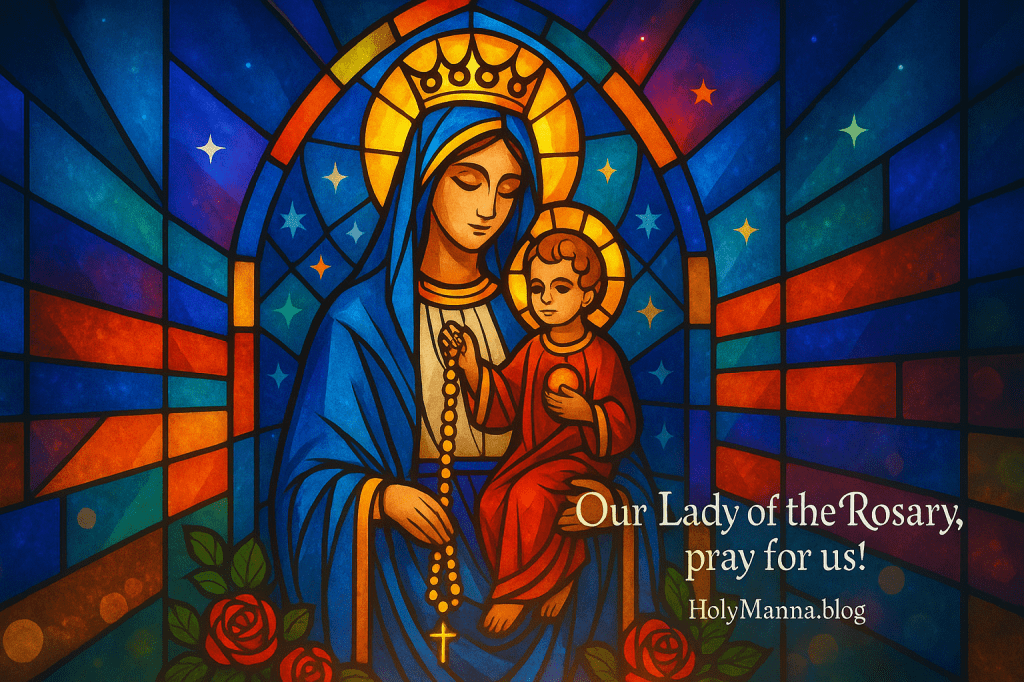
Beads That Echo the Gospel
The Memorial of Our Lady of the Rosary draws the whole Church into a humble, contemplative rhythm that mirrors the life of Jesus through the eyes of Mary. The Rosary is not a distraction from Christ. It is a doorway into his mysteries. The Church calls it an epitome of the Gospel because each set of beads is a path through Scripture. The prayer begins with the words of the angel and of Elizabeth in The Gospel of Luke, and it is completed by the Church’s confession of faith in Christ. Saint John Paul II captured this beautifully in Rosarium Virginis Mariae: “To recite the Rosary is nothing other than to contemplate with Mary the face of Christ.” This memorial matters because it reminds us that Marian devotion fosters adoration of the Triune God and strengthens the Church’s hope in times of trial. In honoring Mary as Our Lady of the Rosary, we are invited to receive her maternal help so that our minds, memories, and desires may be formed by the mysteries of Christ.
Lepanto and the Legacy of Prayer
The roots of this memorial trace to October 7, 1571, when a coalition known as the Holy League met the Ottoman fleet near the Gulf of Patras in the battle commonly called Lepanto. Pope Saint Pius V had asked all of Christendom to pray the Rosary for a decisive turning of events. After the victory, he attributed the outcome to the intercession of Our Lady and instituted the feast under the title Our Lady of Victory. Pope Gregory XIII soon renamed it Our Lady of the Rosary, highlighting not only a single historical triumph but the enduring power of contemplative prayer. Later, Pope Clement XI extended the observance to the universal Church, and Pope Saint Pius X fixed the date as October 7. The story behind the feast is therefore a story of persevering prayer in the face of fear and uncertainty, and of a Church that learns to entrust its battles to the gentle strength of the Mother of God.
“I Am the Lady of the Rosary”
Across the centuries the Rosary has been linked with Mary’s maternal interventions. At Fátima in 1917 she repeatedly urged the children to pray the Rosary daily for peace and for the conversion of sinners, and on October 13 she identified herself with the title of the feast: “I am the Lady of the Rosary.” The Rosary is also at the heart of the renewal that blossomed in Pompei through Blessed Bartolo Longo, whose apostolate showed how a simple, persevering Rosary can re-catechize a culture and rebuild hope for families, the poor, and those far from God. In many homes and parishes, healings, reconciliations, and quiet conversions have accompanied this prayer. Mary’s intercession is never an end in itself. It is a mother’s hand guiding her children to Jesus, the one Mediator, so that the grace of the mysteries might take root in concrete lives.
Christ at the Center, Mary as Teacher
The Rosary is profoundly Christological. Every Our Father directs the soul to the Father through the Son in the Holy Spirit. Every Hail Mary begins with Scripture and culminates in the holy Name of Jesus. The Glory Be returns praise to the Trinity, placing the entire prayer within the worship of God. The mysteries are a catechesis in miniature. The Joyful Mysteries open Nazareth’s school of humility and hiddenness. The Luminous Mysteries, proposed by Saint John Paul II, illuminate the public ministry of the Lord and lead to the Eucharist, source and summit of the Christian life. The Sorrowful Mysteries draw the heart into the Paschal obedience of Christ, and the Glorious Mysteries proclaim his victory and the outpouring of the Spirit, with Mary assumed into heaven as a sign of the Church’s destiny. Underlying this is the Church’s teaching on Mary’s unique cooperation in the economy of grace and her maternal intercession. As The Catechism of the Catholic Church teaches about Marian devotion, “This very special devotion… differs essentially from the adoration which is given to the incarnate Word and equally to the Father and the Holy Spirit, and greatly fosters this adoration.” In the Rosary, Mary is the contemplative teacher who forms disciples to look steadily at Christ until their lives begin to resemble his.
Where Beads Become Pathways
The Rosary has flourished in the Church through the preaching and example of the Order of Preachers. The Rosary Confraternity and countless parish groups have helped families keep this prayer alive from one generation to the next. October is observed as the Month of the Rosary, a time when many parishes add public recitation before the Eucharist and encourage households to renew the practice at home. Pilgrims encounter this Marian school of prayer at places like Fátima in Portugal and Pompei in Italy, where the daily rhythm of the sanctuary includes meditating the mysteries with Scripture and silence. Lourdes in France, with its Basilica of Our Lady of the Rosary, invites pilgrims to pray with candles in hand, uniting personal sufferings to the Sorrowful Mysteries and learning to hope with the Glorious Mysteries. In these shrines and in hidden chapels across the world, the Rosary becomes a pathway of conversion, healing, and missionary charity.
October’s Great Family Prayer
The memorial on October 7 anchors a wider culture of prayer that blossoms throughout the month. Communities organize candlelight processions with the Rosary, families revive the evening decade after dinner, and schools introduce children to the mysteries through simple Scriptural prompts. Mission rosaries highlight the universality of the Church and foster intercession for suffering regions. Soldiers and chaplains carry rosaries and learn to unite anxiety to Christ’s agony in the garden. In immigrant neighborhoods, language and custom may differ, but the beads are the same, and the mysteries build a quiet unity across parishes and generations. The feast has also nourished sacred art, music, and preaching, giving us litanies, hymns, and stained glass that depict Mary handing the Rosary to Saint Dominic and Saint Catherine of Siena, a reminder that contemplation and mission belong together.
Living the Mysteries, Receiving the Grace
To live the Rosary is to let the Gospel shape ordinary hours. You can begin with a single decade prayed slowly while commuting or walking, lingering over a word from Scripture before naming an intention. As days unfold, let the mysteries read your life. When family duties feel small and unseen, contemplate Nazareth and ask for the patience of the Joyful Mysteries. When discernment is confusing, enter the light of the Lord’s Baptism and the Transfiguration, and ask for a share in his obedience. In illness or discouragement, stay with Jesus in Gethsemane and on Calvary and unite your pain to his redeeming love. In moments of gratitude, abide in the empty tomb and the Cenacle, and ask the Holy Spirit to make your joy fruitful. The Rosary becomes a gentle discipline that teaches the soul how to breathe with Scripture, how to intercede for the world, and how to hear Mary’s counsel at Cana: “Do whatever he tells you.” Over time it forms habits of contemplation, mercy, and courage that bear fruit in concrete works of charity.
Engage with Us!
I’d love to hear how Our Lady has led you closer to Jesus through the Rosary—share below!
- What mystery of the Rosary has spoken most deeply to your life this month, and why?
- How could you make your Rosary more contemplative—slowing down, adding a brief scripture verse, or pausing after each mystery?
- Where is the Lord inviting you to ask specifically for Our Lady’s intercession—for peace, for a family member, for forgiveness, or for guidance?
- Would you consider forming a small Rosary circle among friends or in your parish this October? What first step could you take this week?
Let’s keep growing together in faith, hope, and love under the gentle guidance of Our Blessed Mother, Our Lady of the Rosary. “Do whatever he tells you.”
Our Lady of the Rosary, pray for us!
Follow us on Instagram and Facebook for more insights and reflections on living a faith-filled life.

 Holy Manna!
Leave a comment