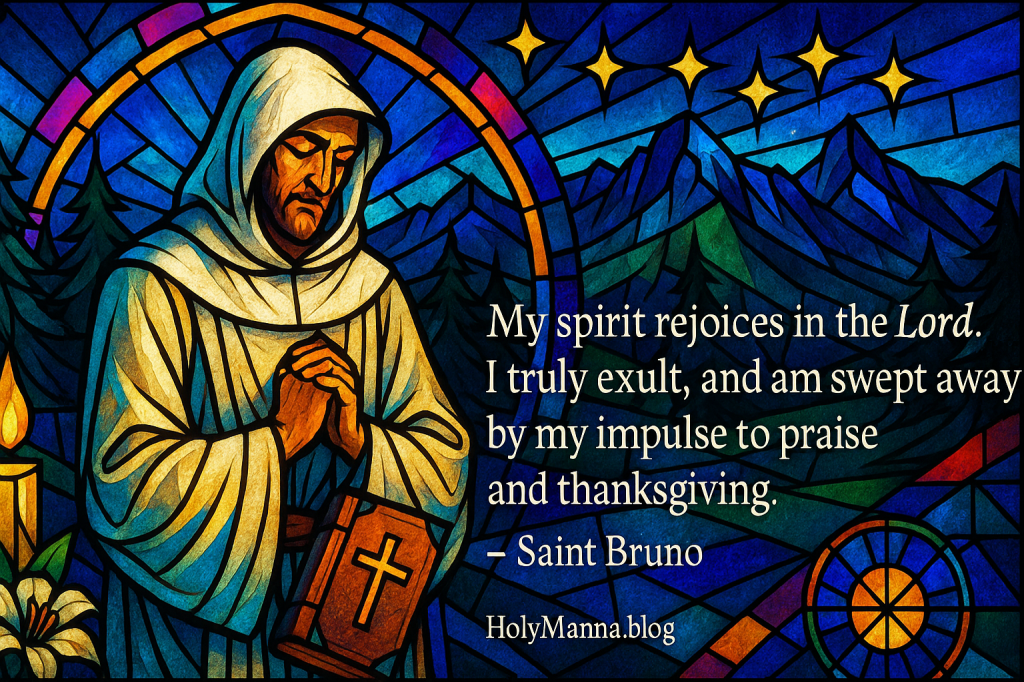
A Hidden Fire For God
Saint Bruno of Cologne is the quiet founder whose life of prayer reshaped the Church from within. He established the Carthusian Order in 1084 with six companions in the valley of Chartreuse, choosing silence, solitude, and continual prayer over public acclaim. The Church remembers him not for thunderous sermons or dramatic miracles, but for the steady blaze of contemplative fidelity that still warms souls today. His feast is celebrated on October 6, and his legacy remains a summons to interior conversion, deep humility, and a love for God that is content to be unseen.
From Scholar To Seeker
Born around 1030 in Cologne, Bruno received an exceptional education and soon distinguished himself as a gifted teacher. He studied and later taught at Reims, where he became head of the cathedral school. His students included future bishops and even a future pope, which speaks to his intellectual stature and moral authority. Yet amid academic success and ecclesial influence, a more radical desire began to grow. The turbulence surrounding reform in Reims taught him that titles and honors cannot satisfy a heart made for God. He discerned that Christ was inviting him to a purer love, one that would be tested through renunciation. When his former student became Pope Urban II, Bruno was called to Rome for counsel. Even then, he asked permission to follow the path of solitude. The decisive turn came when Bishop Hugh of Grenoble welcomed Bruno and six companions into the mountains of Chartreuse. There they began a life ordered to silence, Scripture, and the Divine Office, anchoring their days in the Eucharist and their nights in vigil and prayer.
A Desert In The Heart Of The Church
Bruno’s genius was to marry eremitical solitude with fraternal charity. The Carthusian rhythm he set in motion remains one of the most austere in the Church: monks live in individual cells, pray the Night Office at length, labor with their hands, eat simple meals, and gather only for the liturgy and limited community times. In this hidden furnace the Lord shapes souls for Himself. Bruno left only a few short writings, but they glow. In a letter from Calabria he unveils the grace he discovered in the cloister: “What benefits and divine exultation the silence and solitude of the desert hold in store for those who love it, only those who have experienced it can know.” This is not escapism. It is a school of love where the monk learns to gaze on God, intercede for the world, and let the Word of God become his breath. Bruno’s greatest “sign” is therefore the Order itself, which quietly supports the Church by ceaseless prayer.
Trials Without Blood
Bruno’s path was not free of sorrow. He endured ecclesial conflicts at Reims and chose to walk away from positions that many would have coveted. Summoned by Pope Urban II, he served the Church at the center for a time, but when offered a bishopric he begged to remain a monk. With papal blessing he withdrew to southern Italy and founded a new hermitage in the forests of Calabria near today’s Serra San Bruno. There he lived the final years of his life in poverty, chastity, obedience, and prayer, dying in peace on October 6, 1101. His renunciations were not rejections of the world, but acts of love for it. By embracing the Cross in hiddenness, Bruno allowed grace to flow unseen into the Church. The Carthusian motto captures the fruit of such fidelity: Stat crux dum volvitur orbis, which means the Cross stands firm while the world turns.
Graces That Flowed After
After his death, veneration of Saint Bruno spread from Calabria to Chartreuse and across Europe, nourished by the quiet holiness of Carthusian houses. Pilgrims visited his resting place and many reported favors through his intercession, especially healings of body and spirit that accompanied renewed fervor in prayer. Over time the Church confirmed his cult and established his feast day so that the faithful could give thanks for the grace God poured into the world through his hidden life. The charterhouse at Serra San Bruno and the Grande Chartreuse continue to be living memorials to his gift, places where prayer rises like incense for the life of the world.
Learning To Gaze On God
Saint Bruno shows that the Church needs both the active and the contemplative to breathe fully. His life is a living commentary on the Church’s teaching that contemplation is a simple gaze of faith fixed on Jesus, a loving awareness that purifies the heart and reorders all things in charity. If your life feels noisy or scattered, learn from him. Set a daily time for silence before the Lord. Open The Gospel slowly and let a single verse accompany you through the day. Visit the Blessed Sacrament during the week and speak simply to Jesus, then listen. Simplify your schedule so that love has room to grow. Create a small prayer corner at home and mark it with a crucifix, a Bible, and a candle. And remember that all of us, according to our vocation, can live the spirit of poverty, chastity, and obedience by putting God first, loving with an undivided heart, and surrendering our will to His gentle guidance. In that quiet surrender, the flame that burned in Bruno can begin to burn in us.
Engage with Us!
We would love to hear how Saint Bruno’s hidden fire inspires you. Share your thoughts and prayer intentions in the comments so we can lift one another up before the Lord.
- Where could God be inviting you to set aside ten minutes each day for true silence and a “gaze of faith” on Jesus in prayer?
- What practical step can you take this week to simplify your life so that love of God and neighbor has more room to grow?
- How might you create a small “school of prayer” at home, perhaps a prayer corner with a crucifix, Bible, and candle?
- Which aspect of Bruno’s renunciation speaks most to you, letting go of honors, embracing silence, or persevering in hidden service?
- Who in your life could benefit if you quietly interceded for them each day in front of the tabernacle?
May Saint Bruno help us love the hidden life with Christ so that every work we do flows from prayer. Let us live the Gospel with courage, mercy, and joy, and do everything with the love and tenderness Jesus taught us.
Saint Bruno, pray for us!
Follow us on Instagram and Facebook for more insights and reflections on living a faith-filled life.

 Holy Manna!
Leave a comment