A Secretary of Mercy for Our Times
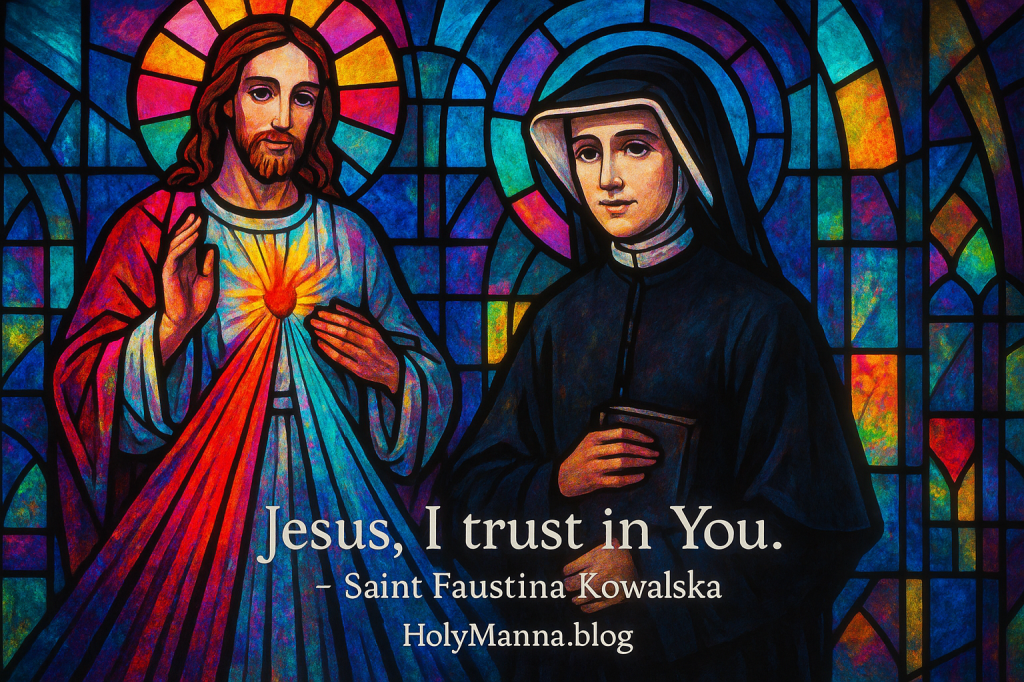
Saint Maria Faustina Kowalska, the Apostle of Divine Mercy, offered the Church a living reminder that the Heart of Jesus burns with love for sinners. Through a hidden life as a Polish religious sister and through her Diary: Divine Mercy in My Soul, she became the Lord’s “secretary” of mercy, calling the world to trust in Jesus, practice works of mercy, and contemplate the Divine Mercy image. Her witness helped inspire the universal Feast of Divine Mercy on the Second Sunday of Easter. She reminds us that holiness is not noisy or grand. It is a steady offering of self to Jesus for the salvation of souls. “Jesus, I trust in You.”
From Helena to Sister Faustina
Helena Kowalska was born on August 25, 1905, in the small village of Głogowiec, Poland, to a poor yet devout family. Baptized in nearby Świnice Warckie, she grew up working hard and praying harder, with little formal schooling but great love for the Eucharist. At seven she first sensed a call to religious life. As a teenager she labored as a domestic servant to support her family, still convinced that God wanted her for Himself. At nineteen, during a dance in Łódź, she saw a vision of the suffering Christ who asked her to enter a convent. She left for Warsaw with almost nothing, and after many refusals she was received by the Congregation of the Sisters of Our Lady of Mercy. On April 30, 1926, she received the habit and the name Sister Maria Faustina of the Blessed Sacrament. Her religious life unfolded in humble assignments as cook, gardener, portress, and shop assistant in Płock, Vilnius, and Kraków, where she was known for quiet charity and unwavering obedience. “A humble soul does not trust itself, but places all its confidence in God.”
Jesus I Trust in You
In 1931, while in Płock, Sister Faustina saw Jesus clothed in white with rays of pale and red light streaming from His Heart. He asked that an image be painted according to this vision with the inscription Jesus, I trust in You. Under the guidance of her confessor, Father Michał Sopoćko, the first image was painted in Vilnius. Jesus entrusted to Faustina concrete ways for the faithful to draw from the fountain of mercy: the Chaplet of Divine Mercy, the Hour of Mercy at three o’clock, a novena beginning on Good Friday, and the Feast of Mercy on the second Sunday of Easter. Her Diary records mystical graces ordered not to self exaltation but to conversion. She could read hearts in the confessional line so that people approached the sacrament honestly. She interceded for the dying and the despairing, often offering her own sufferings for them. She wrote simple, burning prayers that have become the heartbeat of the devotion, including the ejaculatory prayer many now pray daily: “O Blood and Water, which gushed forth from the Heart of Jesus as a fount of mercy for us, I trust in You.” In all of this, she desired nothing for herself but that sinners might know the mercy of the Lord. “I want to be completely transformed into Your mercy and to be Your living reflection.”
Thorns and Radiance
Sister Faustina’s path was marked by suffering. She endured tuberculosis of the lungs and digestive system, which required repeated hospitalizations in Kraków. She accepted humiliation and misunderstanding within and beyond the convent as talk of new devotions stirred confusion. She obeyed superiors and spiritual directors, wrote at their command, and kept silence when accused of delusion. Her patient endurance became a school of trust. She offered every pain for the conversion of souls and for priests. She was not a martyr by blood, yet her prolonged illness and interior darkness formed a white martyrdom of love. On October 5, 1938, at the age of thirty three, she surrendered her soul to God at the convent in Łagiewniki. Even amid trial she could still write with luminous hope: “Suffering is the greatest treasure on earth; it purifies the soul.”
Mercy Unbound
After her death, the flame spread. The Divine Mercy message reached Poland and beyond, even as a temporary prohibition confused the faithful for a time. When the Church later clarified the situation, authentic devotion blossomed across the world. The Lord confirmed her mission with striking favors. The healing of Maureen Digan from incurable lymphedema after prayer at Sister Faustina’s tomb opened the way to beatification. The dramatic cure of Father Ronald Pytel from severe heart disease through intercession to Divine Mercy hastened her canonization. Today, millions journey to the Shrine of Divine Mercy in Kraków Łagiewniki and to the Sanctuary of Divine Mercy in Vilnius to venerate the original images and to pray for mercy on the world. The fruit is not merely physical healing but the gift of peace for restless hearts. Faustina foresaw this reach of mercy beyond her earthly life and wrote with quiet confidence: “I feel certain that my mission will not come to an end upon my death, but will begin.”
Mercy in the Heart of the Church
The Church teaches in The Catechism that private revelations, even when recognized, do not add to the deposit of faith; they help us live the Gospel more fully in a particular time. In the light of CCC 67, the Divine Mercy message is a pastoral gift that points us back to Jesus, who is Mercy incarnate. The call to trust and to perform works of mercy flows directly from the Gospel and from the sacramental life of the Church. CCC 1846–1848 reminds us that God’s mercy confronts sin to heal it, not to excuse it. Saint Faustina’s witness therefore is profoundly ecclesial. She prayed and suffered for priests, she obeyed the Church, and she kept her devotion inseparable from Confession and the Eucharist. Her spirituality can be summed up in three movements that every Catholic can embrace daily: trust Jesus completely, receive mercy through the sacraments, and give mercy generously. “Patience, prayer, and silence these are what give strength to the soul.”
Living Divine Mercy Today
To live her message is to let mercy become your lifestyle. Begin with trust. Speak to Jesus from the heart and repeat throughout the day, “Jesus, I trust in You.” Anchor your week in the sacraments and examine your conscience with honesty. Keep the Hour of Mercy at three o’clock whenever possible, even for a brief moment. Pray the Chaplet for those in distress and for the dying. Place an image of Divine Mercy in your home and let it preach silently to your family that Christ’s Heart is open. Make mercy concrete by forgiving injuries, visiting the lonely, feeding the hungry, and praying for the living and the dead. Finally, ask Saint Faustina to teach you a merciful gaze. She learned to look at others through the lens of Christ’s compassion, and she longed to be His reflection. “Jesus, make my heart sensitive to all the sufferings of my neighbor, whether of body or of soul.”
Engage with Us!
Share your thoughts and stories of mercy in the comments. How has Jesus’ mercy met you, and how can we pray for you and with you?
- Where do you most need to trust Jesus with your whole heart today?
- How can you show concrete mercy this week to someone who has hurt you or who is in need?
- When will you pause at three o’clock to remember the Passion and pray for the Lord’s mercy on the world?
- What passage from Scripture best anchors your understanding of Divine Mercy?
- How might you invite a friend to experience Divine Mercy Sunday, Confession, or the Chaplet with you?
Go forth encouraged to live a life of faith, to trust in the Heart of Jesus, and to do everything with the love and mercy He has taught us.
Saint Faustina Kowalska, pray for us!
Follow us on Instagram and Facebook for more insights and reflections on living a faith-filled life.

 Holy Manna!
Leave a comment