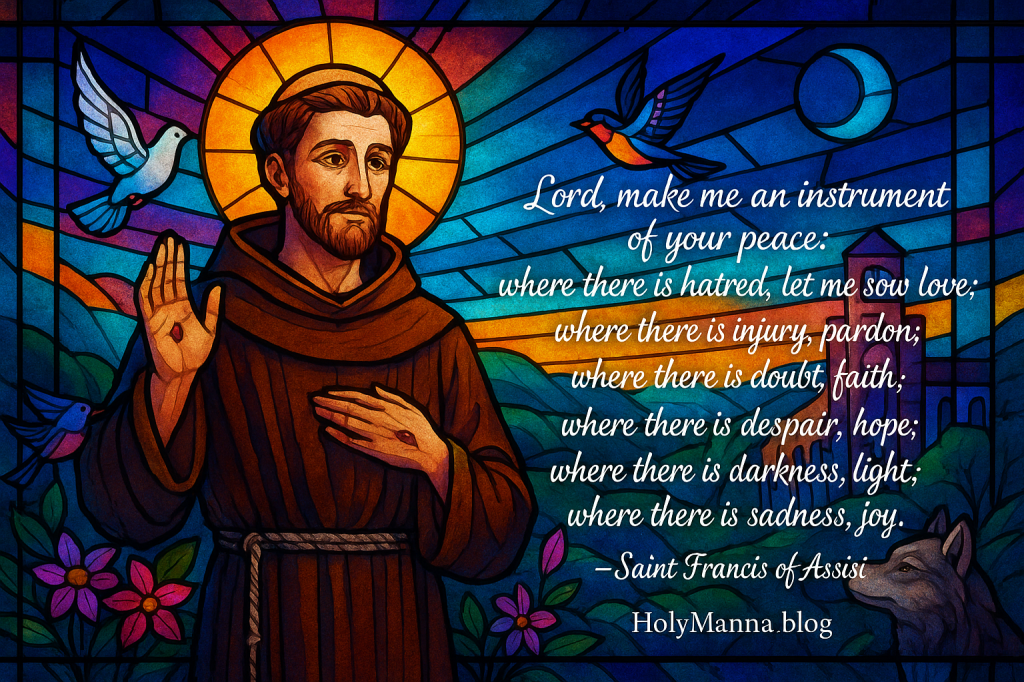
A Troubadour of Christ Who Rebuilt the Church
Few saints have reshaped Christian imagination like Saint Francis of Assisi. Born around 1181 or 1182 and celebrated on October 4, Francis founded the Order of Friars Minor, inspired Saint Clare to begin the Poor Ladies who became the Poor Clares, and sparked a lay movement that blossomed into the Secular Franciscan Order. His life was a living homily of the Gospel, radiant with poverty, humility, joy, and peace. He revered the Eucharist with awe and sang with all creation in praise of the Creator. He is remembered for a heart completely given to Christ, for daring peacemaking, for love of the poor and lepers, for the first Christmas crèche at Greccio, and for the mysterious gift of the stigmata in 1224. In his own words, he invites us to Eucharistic wonder: “Let us all consider the great humility of God, who gives Himself to us under the humble appearance of bread.”
The Turning of a Merchant’s Son
Francis was born in Assisi to Pietro di Bernardone, a prosperous cloth merchant, and his wife, Pica. As a youth he delighted in feasts, songs, dreams of chivalry, and the admiration of his peers. War shattered those dreams. Captured in battle and held prisoner, he returned home sick and sobered. His conversion deepened through prayer before the crucifix in the chapel of San Damiano and through an encounter with a leper that reversed his values. He laid aside his father’s wealth, stripped of worldly claims before the bishop, and began to repair dilapidated chapels, including San Damiano and the Porziuncola. He listened for the Gospel with the simplicity of a child and formed a small brotherhood that sought approval in Rome. Looking back, he summed up God’s initiative in his conversion with moving clarity: “The Lord gave me, Brother Francis, thus to begin doing penance. For when I was in sin it seemed to me very bitter to see lepers, and the Lord Himself led me among them and I showed mercy to them.” As his desire sharpened, so did his total gift to God: “Hold back nothing of yourselves for yourselves, that He who gives Himself totally to you may receive you totally.”
Joy Made Flesh
From the first oral approval of his way of life around 1209 to the definitive Rule in 1223, Francis taught his brothers to live the Gospel without gloss. He preached penance and peace in fields and market squares. He encouraged laypeople to pursue holiness in their own state of life through a simple rule. With Saint Clare he safeguarded a contemplative charism of poverty and praise. Francis’s devotion to the Incarnation flowered in the living Nativity at Greccio in 1223, where the faithful could behold the humility of the Child and be moved to love. His daring love took him across battle lines to meet the Sultan during the Fifth Crusade, a gesture of evangelical courage that sought to witness to Christ with respect and frankness. Traditional accounts from the earliest Franciscan sources tell of preaching to birds and reconciling the Wolf of Gubbio, signs that creation itself is invited into the song of the redeemed. In the language of his own Canticle of the Creatures, he teaches us to praise God in all things: “Praised be You, my Lord, with all Your creatures, especially Brother Sun.” He kept his heart small before God and warned his brothers against vanity with a sentence that pierces our age: “What a person is in the sight of God, so much he is and nothing more.”
Suffering Conformed to Christ
Francis was not a martyr, yet he was refined in fire. As his fraternity grew, he shouldered the burdens of discernment and obedience, entrusting the Order to the Church. Travel and fasting weakened his body. Eye disease tormented him and near blindness marked his final years. On Mount La Verna in 1224, the Crucified sealed him with the stigmata, a share in the Passion that filled him with both pain and indescribable joy. Even in affliction he sang, adding verses to his Canticle that bless God in illness and in reconciliation. He counseled his brothers to embrace correction and to bear wrongs patiently, leaving us a remedy for resentment: “Blessed is the servant who bears correction patiently, who accuses himself mildly, and is not haughty against him who accuses him.” At every stage he preferred humility to acclaim and chose the narrow road that resembles Christ.
After Glory, More Grace
Francis surrendered his spirit at the Porziuncola on October 3, 1226, and the brothers kept vigil in what Franciscans call the Transitus. Reports of favors and healings multiplied and he was canonized in 1228. The Basilica of Saint Francis rose in Assisi, and his relics were translated there in 1230, drawing pilgrims from every land. Through the centuries the Lord has continued to stir conversions at Francis’s tomb and at Franciscan shrines. The simple greeting of his children, Pax et bonum, has become a living benediction in homes and parishes across the world. His Eucharistic awe still shapes devotions and his love for the poor animates countless works of mercy. He remains a companion for seekers, artists, reformers, and anyone who longs to begin again. His famous cry still rouses the lukewarm to holy desire: “Let us begin, brothers, to serve the Lord God, for up to now we have done nothing.”
How to Walk the Franciscan Path
Francis hands us practices that fit every vocation. Begin with simplicity by letting go of what you do not need and by giving what you can to those who have less. Approach the Eucharist with reverence and gratitude, making time for Adoration and frequent confession so that your heart stays poor and available to God. Seek peace with those who have offended you and be the first to ask forgiveness. Make praise your morning language and thank God for Brother Sun, Sister Water, and the work set before you. Care for the poor and for creation in concrete ways that honor both human dignity and the goodness of the world God made. Let your home become a small Porziuncola where prayer, hospitality, and mercy are normal. Above all, give Jesus your whole heart, for Francis urges total surrender: “Hold back nothing of yourselves for yourselves, that He who gives Himself totally to you may receive you totally.” Return often to The Catechism to ground these practices in the Church’s living teaching, and let The Gospel of Matthew and The Gospel of Luke shape your imitation of Christ’s humility and mercy.
Engage with Us!
Share your thoughts and reflections below so our community can grow together in faith and love.
- Where is Christ inviting you to “repair My house,” beginning with your own heart, family, or parish?
- What concrete practice of simplicity can you adopt this week to imitate Francis’s poverty of spirit?
- How can you praise God with creation in a way that leads to real care for the poor and for our common home?
- Which scene from Francis’s life most challenges you to love more boldly in Jesus’s name, and why?
Go in peace and live a life of faith. Do everything with the love and mercy Jesus taught us.
Saint Francis of Assisi, pray for us!
Follow us on Instagram and Facebook for more insights and reflections on living a faith-filled life.

 Holy Manna!
Leave a comment