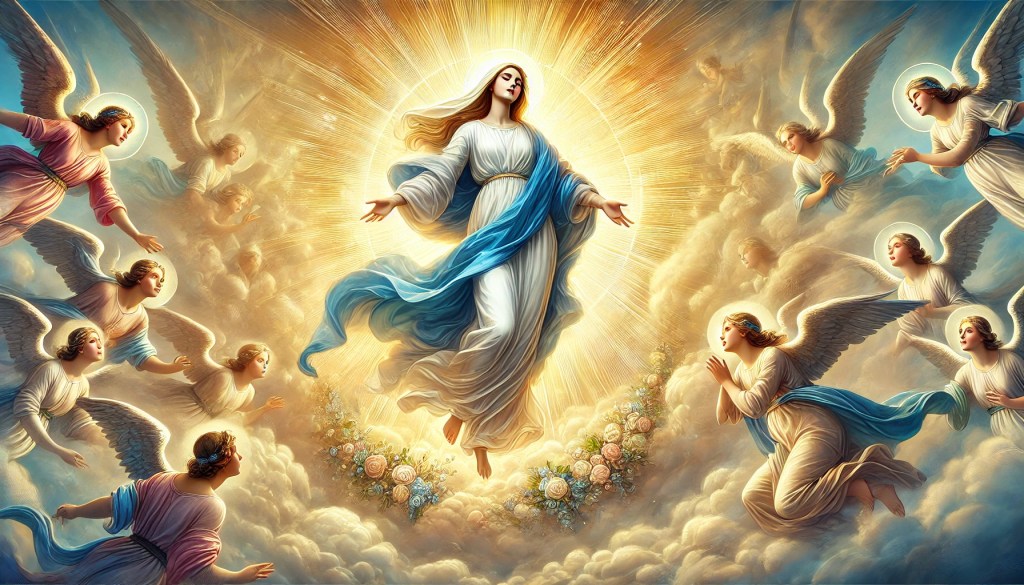
A Feast of Victory and Hope
The Solemnity of the Assumption of the Blessed Virgin Mary is one of the most profound and joyous celebrations in the Catholic Church. It honors the singular grace bestowed upon Mary—the Mother of Jesus—by God, who, at the end of her earthly life, assumed her body and soul into heavenly glory. This feast not only celebrates Mary’s unique role in salvation history but also points us toward our ultimate destiny in Christ. It is a reminder of the victory of grace over sin, of life over death, and of God’s plan coming to fruition in the life of His most faithful servant, Mary.
The Assumption is more than just a commemoration of Mary’s departure from this world; it is a testament to God’s ultimate plan for humanity. It reminds us of the victory over sin and death that Jesus Christ achieved through His Resurrection—a victory in which Mary, as the first and most faithful disciple, already shares. Through her Assumption, Mary becomes a sign of hope and comfort for the Church, pointing us toward our own resurrection and glorification in Christ.
The Theological Significance of the Assumption
Theologically, the Assumption is closely linked to the doctrines of the Immaculate Conception and the Resurrection of the Body. The Church teaches that because Mary was preserved from original sin from the moment of her conception, she did not suffer the corruption of the grave. Instead, she was assumed into heaven, where she reigns as Queen alongside her Son, the King of Kings.
This belief is beautifully encapsulated in the teachings of the Church Fathers and has been upheld by the Church for centuries. In 1950, Pope Pius XII solemnly defined the dogma of the Assumption in the apostolic constitution Munificentissimus Deus, declaring it to be “a divinely revealed dogma” that “the Immaculate Mother of God, the ever Virgin Mary, having completed the course of her earthly life, was assumed body and soul into heavenly glory” (MD, 44). This dogma affirms the dignity of the human body and the hope of eternal life, which are central to Christian faith.
The readings for today’s Mass weave together a rich tapestry of themes—God’s sovereignty, the struggle between good and evil, the promise of resurrection, and the blessedness of Mary’s unique role in salvation history. In the First Reading from Revelation, we are given a symbolic vision of a cosmic battle between the forces of good and evil, with the “woman clothed with the sun” standing as a powerful image of Mary and the Church. This is juxtaposed with the triumphant proclamation of God’s kingdom.
The Responsorial Psalm, with its imagery of a royal bride and her beauty, speaks to the dignity and honor bestowed upon Mary, who is often referred to as the “Queen of Heaven.” This royal imagery ties into the celebration of her Assumption, highlighting her exalted status in the heavenly realm.
In the Second Reading, Saint Paul’s reflection on Christ’s Resurrection as the “first fruits” points directly to the hope of our own resurrection, with Mary’s Assumption being the first realization of this promise for a human being. This reading underscores the eschatological hope that all who belong to Christ will be raised in glory.
Finally, the Gospel recounts the Visitation, where Mary’s encounter with Elizabeth leads to the proclamation of the Magnificat, a hymn of praise that exalts God’s mercy and power. This moment encapsulates Mary’s deep faith and her unique role in God’s redemptive plan, making it a fitting Gospel for this solemn feast.
The celebration of the Assumption has deep roots in both Eastern and Western Christian traditions. In the East, it is known as the Dormition of the Theotokos (the “Falling Asleep of the Mother of God”) and has been celebrated since at least the sixth century. The West adopted this feast, emphasizing the assumption of Mary into heaven rather than just her dormition. Over time, this belief became a central part of Catholic piety and theology, culminating in its formal definition as dogma in the mid-20th century.
Culturally, the Assumption has inspired countless works of art, literature, and music, reflecting the deep devotion of the faithful to Mary. It is a feast that transcends time and place, connecting believers to the mysteries of heaven and the destiny that awaits all who follow Christ.
As we meditate on the readings and the significance of the Assumption, we are invited to reflect on our own journey of faith. Mary’s Assumption reminds us that our lives, too, are oriented towards heaven. We are called to live in the hope of the resurrection, to trust in God’s promises, and to seek to magnify the Lord in our lives, just as Mary did.
This solemnity is a moment of joy and hope for the Church, reminding us of the glorious destiny that awaits us. It is a celebration of the love and mercy of God, who exalts the lowly and fulfills His promises in ways that surpass our understanding. As we journey through these Scriptures, let us open our hearts to the grace of this feast and allow Mary’s example to inspire us to a deeper commitment to our faith and a greater trust in God’s plan for our lives.
First Reading – Revelation 11:19; 12:1-6, 10
The Woman Clothed with the Sun
The Book of Revelation, often referred to as the Apocalypse, is a prophetic and symbolic text written by the Apostle John during his exile on the island of Patmos. It was written to provide hope and encouragement to the early Christian communities facing persecution under the Roman Empire. The visions in Revelation are filled with complex imagery and symbolism, depicting the cosmic battle between good and evil and the ultimate triumph of God’s kingdom.
Today’s reading, from Revelation 11:19 and 12:1-6, 10, introduces us to a dramatic and powerful vision that has been interpreted in various ways throughout Christian history. The “woman clothed with the sun” has traditionally been understood as a symbol of Mary, the Mother of Jesus, as well as a representation of the Church. This vision portrays the ongoing spiritual battle between the forces of good, represented by the woman and her child, and the forces of evil, symbolized by the great red dragon. The imagery of this passage is rich with references to the Old Testament, the cosmic struggle, and the hope of divine deliverance.
Revelation 11:19; 12:1-6, 10 – New Revised Standard Version Catholic Edition
19 Then God’s temple in heaven was opened, and the ark of his covenant was seen within his temple; and there were flashes of lightning, rumblings, peals of thunder, an earthquake, and heavy hail.
The Woman and the Dragon
12 A great portent appeared in heaven: a woman clothed with the sun, with the moon under her feet, and on her head a crown of twelve stars. 2 She was pregnant and was crying out in birth pangs, in the agony of giving birth. 3 Then another portent appeared in heaven: a great red dragon, with seven heads and ten horns, and seven diadems on his heads. 4 His tail swept down a third of the stars of heaven and threw them to the earth. Then the dragon stood before the woman who was about to bear a child, so that he might devour her child as soon as it was born. 5 And she gave birth to a son, a male child, who is to rule all the nations with a rod of iron. But her child was snatched away and taken to God and to his throne; 6 and the woman fled into the wilderness, where she has a place prepared by God, so that there she can be nourished for one thousand two hundred sixty days.
10 Then I heard a loud voice in heaven, proclaiming,
“Now have come the salvation and the power
and the kingdom of our God
and the authority of his Messiah,
for the accuser of our comrades has been thrown down,
who accuses them day and night before our God.
Detailed Exegesis
Verse 11:19
“Then God’s temple in heaven was opened, and the ark of his covenant was seen within his temple; and there were flashes of lightning, rumblings, peals of thunder, an earthquake, and heavy hail.”
This verse serves as a prelude to the vision that follows, setting the scene in the heavenly temple where God’s presence dwells. The opening of the temple signifies the revelation of divine mysteries. The Ark of the Covenant, a sacred object in Israel’s worship, symbolizes God’s covenant with His people and His faithfulness. The dramatic elements—lightning, thunder, earthquake, and hail—are reminiscent of the theophanies in the Old Testament (e.g., Exodus 19:16-19) and signal the awe-inspiring nature of what is being revealed. This imagery also connects the heavenly realities with the historical experiences of God’s people, reinforcing the continuity between the Old and New Covenants.
Verse 12:1
“A great portent appeared in heaven: a woman clothed with the sun, with the moon under her feet, and on her head a crown of twelve stars.”
This woman is traditionally interpreted as representing Mary, the Mother of Jesus, and also as a symbol of the Church, Israel, and even the idealized faithful people of God. Being “clothed with the sun” signifies her being enveloped in God’s glory, and the “moon under her feet” suggests her dominion over temporal powers, symbolizing her victory over death and evil. The “crown of twelve stars” represents the twelve tribes of Israel and the twelve apostles, indicating her queenship and the fullness of God’s people. This verse portrays her as a majestic and cosmic figure, honored and exalted in the heavenly realm.
Verse 12:2
“She was pregnant and was crying out in birth pangs, in the agony of giving birth.”
The imagery of childbirth evokes both the pain and the hope of new life. For Mary, this verse reflects her role in bringing the Messiah into the world, a task marked by both physical and spiritual suffering. In a broader sense, this could also symbolize the Church’s suffering and struggle in bringing forth new believers into the faith amidst persecution and trials. The agony of childbirth can also be seen as a metaphor for the laborious process of salvation history, with the promise of redemption and new life emerging through struggle and sacrifice.
Verse 12:3
“Then another portent appeared in heaven: a great red dragon, with seven heads and ten horns, and seven diadems on his heads.”
The “great red dragon” is a vivid and terrifying symbol of Satan, the adversary of God and His people. The seven heads and ten horns symbolize the completeness and the extent of the dragon’s power and influence, which spans across all nations and rulers. The diadems, or crowns, suggest a counterfeit authority, indicating the dragon’s claim to dominion, which is ultimately false and will be overthrown. The color red can also signify bloodshed and violence, characteristics of Satan’s reign in contrast to Christ’s kingdom of peace and justice.
Verse 12:4
“His tail swept down a third of the stars of heaven and threw them to the earth. Then the dragon stood before the woman who was about to bear a child, so that he might devour her child as soon as it was born.”*
This verse portrays the dragon’s destructive power, symbolized by its sweeping down of a third of the stars, which could represent fallen angels who joined Satan in rebellion against God. The dragon’s position before the woman, ready to devour her child, underscores the ongoing spiritual battle. This scene echoes the threat faced by the Christ child at His birth, as Herod sought to kill Him (Matthew 2:13-16). It symbolizes the broader struggle between Christ and Satan, with the forces of evil seeking to thwart God’s plan of salvation at every turn.
Verse 12:5
“And she gave birth to a son, a male child, who is to rule all the nations with a rod of iron. But her child was snatched away and taken to God and to his throne;”
The male child is clearly Jesus Christ, who is destined to “rule all the nations with a rod of iron” (a reference to Psalm 2:9), symbolizing His authority and power to judge and govern. The “snatching away” of the child to God’s throne indicates His Ascension, where He reigns with God, beyond the reach of the dragon. This emphasizes the ultimate victory of Christ over the forces of evil and the protection of His divine mission from any harm.
Verse 12:6
“And the woman fled into the wilderness, where she has a place prepared by God, so that there she can be nourished for one thousand two hundred sixty days.”
The woman’s flight into the wilderness represents a time of trial and divine protection. The wilderness, in biblical tradition, is often a place of both testing and encounter with God (e.g., Israel’s 40 years in the desert, Jesus’ 40 days of temptation). The “one thousand two hundred sixty days” (three and a half years) symbolizes a limited period of persecution or tribulation, reflecting the Church’s endurance through times of trial until the final victory. This time frame is often seen as symbolic, representing a period of suffering that is significant yet under God’s sovereign control.
Verse 12:10
“Then I heard a loud voice in heaven, proclaiming, ‘Now have come the salvation and the power and the kingdom of our God and the authority of his Messiah, for the accuser of our comrades has been thrown down, who accuses them day and night before our God.’”
This proclamation marks the turning point in the vision, celebrating the victory of God’s kingdom and the authority of Christ (Messiah) over the forces of evil. The “accuser” refers to Satan, who is depicted as the one who accuses the faithful before God (see Job 1:9-11). His being “thrown down” signifies his defeat and the end of his power to accuse and condemn God’s people. This verse encapsulates the triumph of God’s justice and the establishment of His kingdom, where evil is ultimately defeated.
Teachings and References
The Catechism of the Catholic Church (CCC 410-411) refers to the “woman clothed with the sun” as Mary, the New Eve, whose obedience and faith contrast with the disobedience of the first Eve. This connection underscores Mary’s unique role in salvation history as the Mother of the Redeemer and her participation in the struggle against evil. Her Assumption into heaven, as taught in CCC 966, is seen as the culmination of her victory over sin and death, prefiguring the resurrection of all the faithful.
Saint John Paul II, in his encyclical Redemptoris Mater, reflects on Mary as the “Woman of the Apocalypse,” emphasizing her role as both a figure of the Church and the first to share in the glory of her Son’s resurrection. He writes that Mary “continues to shine forth on the pilgrimage of faith as the model of the Church” (RM, 5), highlighting her exemplary faith and trust in God’s promises.
The Church Fathers, such as Saint Irenaeus and Saint Augustine, also saw this passage as indicative of the Church’s ongoing struggle against the forces of evil. They emphasized that just as the woman in the vision is protected by God, so too the Church is safeguarded by divine providence during times of persecution and trial.
Reflection
This reading from Revelation offers a powerful and dramatic depiction of the cosmic battle between good and evil, with Mary and the Church at the heart of this struggle. As we reflect on this passage, we are reminded of the reality of spiritual warfare in our own lives. The dragon’s desire to devour the child can symbolize the various ways in which evil seeks to disrupt our faith and hope in Christ. However, just as Mary and the child were protected by God, we too are assured of God’s protection and ultimate victory.
The imagery of the woman fleeing into the wilderness resonates with our own experiences of feeling tested and isolated in our faith journey. Yet, even in these moments of trial, God prepares a place of refuge and nourishment for us. How do we seek out and recognize these places of divine sustenance in our lives? Are we turning to prayer, the sacraments, and the support of the Christian community to sustain us in difficult times?
Moreover, the defeat of the “accuser” in heaven invites us to reflect on the power of God’s forgiveness and the liberation from guilt and accusation that Christ offers us. How can we embrace this freedom more fully and resist the lies and accusations that the enemy tries to plant in our hearts?
As we celebrate the Assumption, let us ask for Mary’s intercession, that we might have the courage to stand firm in our faith, trusting in God’s protection and the victory of His kingdom. Let us also reflect on how we can support and uplift one another in our spiritual battles, just as the early Christian communities supported each other during times of persecution. In what ways can you be a source of strength and encouragement to those around you who are struggling in their faith?
The message of Revelation is ultimately one of hope and triumph—God’s victory is assured, and those who remain faithful will share in His glory. Let this reading inspire us to live with confidence in the power of Christ and the protection of our Heavenly Mother, who has already been assumed into the glory that awaits us all.
Responsorial Psalm – Psalm 45:10-12, 16
A Royal Bride: A Psalm of Triumph and Beauty
Psalm 45 is one of the “royal psalms,” traditionally understood as a wedding song composed for a royal wedding, likely within the context of ancient Israel. It is an ode to a king, celebrating his majesty, power, and the beauty and dignity of his bride. While the historical context of this psalm may be tied to the marriage of an Israelite king, the Church has long interpreted it as having a deeper, prophetic significance, pointing towards the messianic King—Jesus Christ—and His bride, the Church. On the Solemnity of the Assumption of the Blessed Virgin Mary, this psalm takes on Marian dimensions, celebrating Mary as the queen and bride who is honored by the King of Kings.
This psalm’s imagery is rich and evocative, depicting a royal marriage that symbolizes the covenantal relationship between God and His people. The Church, throughout her history, has seen in this psalm a prefiguration of Christ’s relationship with His Church and, more specifically on this feast, a reflection of Mary’s unique relationship with her Son, Jesus. Mary, as the Mother of the King and the first and most perfect disciple, is honored in a special way, making this psalm a fitting reflection on her Assumption.
Psalm 45:10-12, 16 – New Revised Standard Version Catholic Edition
10 Hear, O daughter, consider and incline your ear;
forget your people and your father’s house,
11 and the king will desire your beauty.
Since he is your lord, bow to him;
12 the people of Tyre will seek your favor with gifts,
the richest of the people
16 In the place of ancestors you, O king, shall have sons;
you will make them princes in all the earth.
Detailed Exegesis
Verse 10
“Hear, O daughter, consider and incline your ear; forget your people and your father’s house,”
This verse opens with an invitation to the bride to listen and heed the call to a new life. The “daughter” symbolizes the bride who is called to leave behind her former life, including her family and her people, to embrace her new identity in union with the king. In a Marian context, this verse can be seen as reflecting Mary’s complete dedication to God’s will, leaving behind her former life to fully embrace her role as the Mother of God. Mary’s fiat, her “yes” to God’s plan, signifies this total offering of herself to God, a model for all believers to follow in their own spiritual journey.
The call to “forget your people and your father’s house” signifies a radical commitment and a break with the past, which in the context of the royal wedding, reflects the bride’s integration into the king’s household. For Mary, this can be seen as her total consecration to God, setting aside all earthly attachments to become the dwelling place of the Word Incarnate.
Verse 11
“And the king will desire your beauty. Since he is your lord, bow to him;”
Here, the psalmist speaks of the king’s delight in the bride’s beauty, which can be understood both physically and spiritually. The beauty mentioned here is not merely external but reflects inner purity and holiness, qualities that are supremely embodied by Mary. Mary’s immaculate conception and her sinless life make her the most beautiful of God’s creatures, and thus, the King of Kings, her Son, delights in her.
The call to “bow to him” reflects the bride’s submission to the king, a sign of respect and love. In the Marian context, this reflects Mary’s humility and her acceptance of God’s will, as seen in her response to the Angel Gabriel, “Behold, I am the handmaid of the Lord; let it be to me according to your word” (Luke 1:38).
Mary’s beauty is thus both physical and spiritual, and her submission to God’s will is a model of perfect discipleship.
Verse 12:
“The people of Tyre will seek your favor with gifts, the richest of the people.”
This verse speaks of the recognition and honor bestowed upon the bride by the nations, symbolized by the people of Tyre, who bring gifts to seek her favor. Tyre, a wealthy and powerful city, represents the foreign nations acknowledging the bride’s elevated status and beauty. In a Marian context, this can be seen as a foreshadowing of the universal veneration of Mary by the faithful throughout the ages.
The gifts and honor given to the bride are also symbolic of the spiritual gifts and graces bestowed upon Mary by God, which she in turn shares with the Church. This verse highlights Mary’s role as a mediator of grace and a beloved figure to whom the faithful turn in their need, bringing their prayers and petitions to her. The Marian title of “Mother of the Church” reflects this role of Mary in the life of every believer.
Verse 16
“In the place of ancestors you, O king, shall have sons; you will make them princes in all the earth.”
This verse reflects the promise of a fruitful lineage, with the king having sons who will continue his legacy and rule over the earth. In the context of the royal wedding, this speaks to the continuation of the royal dynasty. Spiritually, this can be seen as a prophecy of the spiritual descendants of Mary—those who are born into the Church and become children of God through Christ. The sons who are “princes in all the earth” can be seen as the apostles and their successors, who spread the Gospel to all nations, or as all believers who are called to reign with Christ.
For Mary, this verse reflects her spiritual motherhood over all Christians, as she is the Mother of the Church. Just as a queen mother would be honored and revered in the court, Mary is honored in the heavenly court, where she intercedes for her children, the faithful on earth.
Teachings and References
The Catechism of the Catholic Church (CCC 972) speaks of Mary as the “eschatological icon of the Church,” meaning that she represents the Church’s ultimate destiny to be united with Christ in glory. This connection is vividly illustrated in Psalm 45, where the royal bride’s union with the king symbolizes the union of the Church with Christ. The Catechism highlights that in Mary, the Church already reaches that perfection that will be ours at the end of time.
Saint Ambrose of Milan, in his commentary on Psalm 45, interprets the bride as a figure of the Church and Mary, noting that her beauty and purity are reflective of the grace given to her by God. He writes, “You see, Mary is that pure and immaculate bride whom the King of kings and Lord of lords has chosen for himself.”
The psalm also finds resonance in the Lumen Gentium, the Dogmatic Constitution on the Church from the Second Vatican Council, which reflects on Mary’s unique role within the Church. The document calls her “the model of the Church in faith, charity, and perfect union with Christ” (LG 63). Mary’s Assumption, as celebrated today, is seen as the first fulfillment of the Church’s eschatological hope.
Additionally, the psalm’s call to the bride to leave her father’s house and cleave to the king has been interpreted by the Church Fathers, such as Saint Augustine, as an invitation to believers to detach from worldly ties and dedicate themselves wholly to God. This detachment is not a rejection of the world but a call to prioritize our relationship with God above all else.
Reflection
Psalm 45, with its rich imagery and prophetic significance, offers us a deep wellspring for reflection, particularly in the context of the Assumption of Mary. As we meditate on this psalm, we are invited to see ourselves as part of this royal relationship with God, where we are called to respond to His love with total devotion.
In Mary, we see the fulfillment of the royal bride’s call to beauty, purity, and complete dedication to God. Her Assumption into heaven is a sign of the ultimate destiny that awaits all the faithful—a life in perfect union with Christ. How can we, in our own lives, emulate Mary’s total openness to God’s will? What areas of our life are we being called to “incline our ear” more fully to God’s voice, leaving behind the attachments that keep us from fully embracing our identity as children of God?
The verse that speaks of the people of Tyre seeking the bride’s favor can also lead us to reflect on our own relationship with Mary. How often do we turn to her in our need, seeking her intercession and bringing our gifts of prayer and devotion to her? Mary, who is honored and venerated by all generations, is a powerful intercessor who always leads us closer to her Son. We can deepen our relationship with her through practices like the Rosary, the Angelus, or simply by asking for her help in our daily struggles.
Finally, the promise of spiritual sons and daughters who will be “princes in all the earth” challenges us to consider how we are living out our own call to share the Gospel and bear spiritual fruit in the world. Just as Mary gave birth to the Savior, we are called to give birth to Christ in our hearts and to bring Him to others through our words and actions. How can we be more intentional about living out our faith in a way that draws others closer to God?
As we celebrate the Assumption, let us ask Mary to help us grow in holiness, beauty, and devotion, so that we too may one day share in the glory that she now enjoys in heaven. Let her example inspire us to live with a royal dignity as children of God, always striving to glorify Him in our lives.
Second Reading – 1 Corinthians 15:20-27
Christ, the First Fruits of Resurrection
The First Letter to the Corinthians was written by Saint Paul around 55 AD to address various issues within the Christian community in Corinth. This particular passage from chapter 15 is part of a larger discourse on the resurrection of the dead, a foundational doctrine of Christian faith. The Corinthians, influenced by Greek philosophy, struggled with the concept of bodily resurrection, and Paul writes to reaffirm the truth of Christ’s resurrection and its implications for all believers.
In today’s reading, Saint Paul emphasizes that Christ’s resurrection is not an isolated event but the “first fruits” of a general resurrection to come. The imagery of “first fruits” is drawn from Jewish agricultural practices, where the first portion of the harvest was offered to God as a sign of the whole harvest to come. By calling Christ the “first fruits,” Paul is teaching that His resurrection is the beginning of the resurrection of all the faithful, signaling the defeat of death and the inauguration of God’s eternal kingdom.
This passage is particularly appropriate for the Solemnity of the Assumption of the Blessed Virgin Mary, as Mary’s assumption is seen as a participation in the resurrection promised to all who are in Christ. Her bodily assumption into heaven prefigures the glorification that awaits all believers, making this reading a powerful reflection on the hope and victory that are central to Christian faith.
1 Corinthians 15:20-27 – New Revised Standard Version Catholic Edition
20 But in fact Christ has been raised from the dead, the first fruits of those who have died. 21 For since death came through a human being, the resurrection of the dead has also come through a human being; 22 for as all die in Adam, so all will be made alive in Christ. 23 But each in his own order: Christ the first fruits, then at his coming those who belong to Christ. 24 Then comes the end, when he hands over the kingdom to God the Father, after he has destroyed every ruler and every authority and power. 25 For he must reign until he has put all his enemies under his feet. 26 The last enemy to be destroyed is death. 27 For “God has put all things in subjection under his feet.” But when it says, “All things are put in subjection,” it is plain that this does not include the one who put all things in subjection under him.
Detailed Exegesis
Verse 20: “But in fact Christ has been raised from the dead, the first fruits of those who have died.”
Paul begins with a firm assertion of the resurrection, countering any doubts about its reality. By stating “in fact,” he emphasizes the certainty of Christ’s resurrection, which is not just a belief but a historical reality. The term “first fruits” is key here, indicating that Christ’s resurrection is the first installment of a greater harvest to come—namely, the resurrection of all believers. In the Jewish tradition, the first fruits were offered to God as a guarantee of the full harvest; similarly, Christ’s resurrection guarantees the future resurrection of the faithful.
Verse 21: “For since death came through a human being, the resurrection of the dead has also come through a human being;”
Paul draws a parallel between Adam and Christ, a common theme in his letters. Death entered the world through Adam’s sin (Romans 5:12), and because of this, all humanity experiences death. However, through Christ—the new Adam—resurrection and new life have been made possible for all. This verse underscores the idea of Christ as the “second Adam,” whose obedience and victory over death reverse the effects of the Fall. By emphasizing the human nature of both Adam and Christ, Paul highlights the solidarity of Christ with humanity and the transformative power of His resurrection.
Verse 22: “For as all die in Adam, so all will be made alive in Christ.”
Here, Paul makes a sweeping theological statement about the universality of death and resurrection. In Adam, all of humanity inherited sin and death, but in Christ, all who are united to Him will share in His resurrection. The phrase “all will be made alive in Christ” points to the hope of eternal life for all believers. This verse encapsulates the essence of Christian hope: that through Christ’s victory, death does not have the final word, and life in Christ is the ultimate destiny for those who believe.
Verse 23: “But each in his own order: Christ the first fruits, then at his coming those who belong to Christ.”
Paul outlines the sequence of resurrection: Christ was the first to rise, and when He returns, those who belong to Him will also be raised. This order of resurrection reflects the eschatological timeline—the end times—when Christ will return in glory. The phrase “those who belong to Christ” refers to the faithful, who through baptism and faith are united with Him. This verse also implies that the resurrection of believers is not yet fully realized but will occur at the Second Coming, reinforcing the Christian expectation of the Parousia (Christ’s return).
Verse 24: “Then comes the end, when he hands over the kingdom to God the Father, after he has destroyed every ruler and every authority and power.”
Paul describes the final consummation of history, where Christ, having accomplished His mission, hands over the perfected kingdom to God the Father. This verse highlights the ultimate triumph of God’s plan and the subjugation of all powers opposed to God’s reign. The “ruler,” “authority,” and “power” refer to both earthly and spiritual forces that stand against God’s kingdom. Christ’s destruction of these powers signifies the complete victory of God over evil, a theme that resonates with the eschatological vision of the Book of Revelation.
Verse 25: “For he must reign until he has put all his enemies under his feet.”
Paul emphasizes the ongoing reign of Christ, who is actively subduing all opposition to God’s kingdom. The imagery of “putting all enemies under his feet” is a reference to Psalm 110:1, a messianic psalm that speaks of the Messiah’s victory. This verse underscores the “already but not yet” nature of Christ’s kingdom: He is already reigning, but His victory is still being fully realized in history. This concept invites believers to live in the tension between the present reality of Christ’s reign and the future hope of its full manifestation.
Verse 26: “The last enemy to be destroyed is death.”
Paul identifies death as the final enemy to be defeated. Christ’s resurrection has already broken the power of death, but its ultimate destruction will occur at the end of time. This verse speaks to the Christian hope of the final resurrection, where death itself will be no more. In the context of the Assumption, Mary’s being taken up into heaven is seen as a sign of this final victory over death, as she has already been granted the glorification that all the faithful will one day share.
Verse 27: “For ‘God has put all things in subjection under his feet.’ But when it says, ‘All things are put in subjection,’ it is plain that this does not include the one who put all things in subjection under him.”
Paul concludes this section by quoting Psalm 8:6, which speaks of God placing all things under the authority of Christ. This verse reinforces the supremacy of Christ over all creation, but it also clarifies that God the Father is not included in this subjection. This distinction upholds the hierarchy within the Trinity, where the Son, while fully divine, remains obedient to the Father’s will. The subjection of all things under Christ points to the fulfillment of God’s plan, where Christ will restore all creation to the Father, bringing the story of salvation to its glorious conclusion.
Teachings and References
The Catechism of the Catholic Church (CCC 668-670) reflects on Christ’s ascension and exaltation, highlighting His role as the Lord of history. These passages emphasize that Christ’s reign is both a present reality and a future hope, where all creation will be fully subjected to Him. The Catechism also discusses the hope of resurrection (CCC 988-1001), affirming that all the faithful, like Mary, will share in the resurrection of the body and eternal life.
Saint Augustine, in his writings, speaks of Christ as the “first fruits” in his City of God, emphasizing that His resurrection is the guarantee of the resurrection of the faithful. Augustine’s reflection on the victory of Christ over death and sin offers a profound meditation on the hope that sustains the Church in times of trial and persecution.
Saint John Paul II, in his encyclical Redemptoris Mater, also reflects on Mary’s unique participation in Christ’s resurrection. He notes that Mary’s Assumption is “a sign of sure hope and solace for the pilgrim People of God” (RM, 41), emphasizing that her glorification points to the future glorification of all the faithful.
In the writings of the Church Fathers, such as Saint Irenaeus and Saint Athanasius, there is a strong emphasis on the resurrection as the culmination of God’s redemptive work. They saw the resurrection as the restoration of creation, where death is swallowed up in victory, echoing Paul’s triumphant proclamation in 1 Corinthians 15.
Reflection
This passage from 1 Corinthians offers a profound and hopeful vision of the Christian future—a future where death is no more, and all creation is restored in Christ. As we reflect on this passage in the context of the Assumption, we are invited to consider the deep connection between Mary’s Assumption and our own hope of resurrection.
Mary, assumed body and soul into heaven, is the first to fully experience the resurrection promised to all believers. Her Assumption is a sign that God’s promises are true and that our faith in the resurrection is not in vain. How does this hope shape the way we live our lives today? Do we live with the confident expectation that, just as Christ was raised, so too will we be raised?
Paul’s emphasis on the defeat of death challenges us to confront our own fears and uncertainties about death and the afterlife. The Christian response to death is not despair but hope—hope rooted in the victory of Christ. How can we cultivate this hope in our daily lives, especially in the face of suffering and loss? How can we support others who struggle with doubts about the resurrection?
The idea that Christ is currently reigning and will ultimately subdue all His enemies invites us to reflect on our role in this cosmic struggle. As members of the Church, we are called to participate in Christ’s victory over sin and death. How can we live out this calling more fully? Are there areas in our lives where we need to surrender to Christ’s reign, allowing Him to bring healing and transformation?
Lastly, this passage calls us to a deeper understanding of the interconnectedness of all believers with Christ. We are not isolated individuals but members of Christ’s body, sharing in His death and resurrection. This reality calls us to solidarity with one another, especially with those who suffer. How can we be a source of hope and encouragement to others, helping them to hold fast to the promise of resurrection?
As we celebrate the Assumption of Mary, let us be inspired by her example of faith and hope. Let us ask her to intercede for us, that we might live with the same confidence in God’s promises and the same readiness to embrace His will. May her Assumption remind us that our true home is with God, and that our journey, like hers, leads to eternal life in the glory of the resurrection.
Holy Gospel – Luke 1:39-56
The Visitation and Magnificat: Mary’s Joyful Praise
The Gospel reading from Luke 1:39-56 takes us to a deeply intimate and joyful encounter between two holy women—Mary, the Mother of Jesus, and her relative Elizabeth, the mother of John the Baptist. This event, known as the Visitation, occurs shortly after the Annunciation, where the Angel Gabriel announced to Mary that she would conceive and bear the Son of God. In response to this divine revelation, and having learned that her elderly cousin Elizabeth is also expecting a child, Mary sets out “with haste” to visit her.
This meeting is not just a familial visit; it is a profound moment of spiritual recognition and celebration. Elizabeth, filled with the Holy Spirit, recognizes the significance of Mary’s pregnancy and the divine nature of the child she carries. The unborn John the Baptist leaps in Elizabeth’s womb, a gesture that signifies his recognition of Jesus, even before birth. This encounter is followed by Mary’s Magnificat, a hymn of praise that has become one of the most cherished prayers in the Christian tradition. The Visitation and the Magnificat together reveal the joy, faith, and humility of Mary, and they highlight the fulfillment of God’s promises in salvation history.
On the Solemnity of the Assumption, this Gospel reading invites us to reflect on Mary’s role in the divine plan and the way she models perfect discipleship through her humility, faith, and joy. The Assumption itself can be seen as the ultimate fulfillment of the praise that Mary offers in the Magnificat—a recognition of God’s great works in her life and the lives of all the faithful.
Luke 1:39-56 – New Revised Standard Version Catholic Edition
Mary Visits Elizabeth
39 In those days Mary set out and went with haste to a Judean town in the hill country, 40 where she entered the house of Zechariah and greeted Elizabeth. 41 When Elizabeth heard Mary’s greeting, the child leaped in her womb. And Elizabeth was filled with the Holy Spirit 42 and exclaimed with a loud cry, “Blessed are you among women, and blessed is the fruit of your womb. 43 And why has this happened to me, that the mother of my Lord comes to me? 44 For as soon as I heard the sound of your greeting, the child in my womb leaped for joy. 45 And blessed is she who believed that there would be a fulfillment of what was spoken to her by the Lord.”
Mary’s Song of Praise
46 And Mary said,
“My soul magnifies the Lord,
47 and my spirit rejoices in God my Savior,
48 for he has looked with favor on the lowliness of his servant.
Surely, from now on all generations will call me blessed;
49 for the Mighty One has done great things for me,
and holy is his name.
50 His mercy is for those who fear him
from generation to generation.
51 He has shown strength with his arm;
he has scattered the proud in the thoughts of their hearts.
52 He has brought down the powerful from their thrones,
and lifted up the lowly;
53 he has filled the hungry with good things,
and sent the rich away empty.
54 He has helped his servant Israel,
in remembrance of his mercy,
55 according to the promise he made to our ancestors,
to Abraham and to his descendants forever.”
56 And Mary remained with her about three months and then returned to her home.
Detailed Exegesis
Verse 39: “In those days Mary set out and went with haste to a Judean town in the hill country,”
Mary’s journey to visit Elizabeth is marked by urgency and purpose. The phrase “with haste” indicates not only the physical speed of her journey but also her eagerness to share the joy of what God has done for her and her desire to serve Elizabeth in her time of need. This verse sets the scene for a significant encounter that will have profound spiritual implications. The “hill country” refers to the region of Judea, which holds historical significance as the setting of many important biblical events. Mary’s journey into the hills echoes the journeys of faithful individuals in the Old Testament who sought God’s will and presence in the mountains.
Verse 40: “Where she entered the house of Zechariah and greeted Elizabeth.”
Mary’s entrance into Zechariah’s house and her greeting to Elizabeth is more than just a social courtesy; it is a moment of deep spiritual connection. The greeting of Mary, who now carries the incarnate Word, brings with it the presence of Christ Himself, sanctifying the household of Zechariah and Elizabeth. This greeting, laden with divine significance, prompts the extraordinary reactions that follow.
Verse 41: “When Elizabeth heard Mary’s greeting, the child leaped in her womb. And Elizabeth was filled with the Holy Spirit”
The leaping of John the Baptist in Elizabeth’s womb signifies his recognition of Jesus, even before his birth. This is a powerful testimony to the sanctity of life from the moment of conception and the presence of the Holy Spirit in these events. Elizabeth’s filling with the Holy Spirit enables her to understand the significance of Mary’s visit and the identity of the child she carries. This moment underscores the role of the Holy Spirit in revealing divine truths and inspiring prophetic utterances.
Verse 42: “And exclaimed with a loud cry, ‘Blessed are you among women, and blessed is the fruit of your womb.’”
Elizabeth’s exclamation is both a recognition of Mary’s unique role in God’s plan and a declaration of the blessedness of Jesus, the “fruit of her womb.” The phrase “blessed are you among women” emphasizes Mary’s singular honor and grace. Elizabeth’s words echo those of the Angel Gabriel at the Annunciation, reaffirming Mary’s status as the most blessed of women due to her role as the Mother of God. This verse highlights the profound humility and grace that mark Mary’s life, as well as the special honor that God bestows upon her.
Verse 43: “And why has this happened to me, that the mother of my Lord comes to me?”
Elizabeth’s question reflects her deep humility and awe at the privilege of receiving Mary, whom she recognizes as the “mother of my Lord.” The title “Lord” here is significant, as it acknowledges the divine nature of the child Mary carries. Elizabeth’s humility mirrors that of Mary and serves as a model for how we should respond to God’s presence in our lives—with reverence, gratitude, and a sense of unworthiness before God’s greatness.
Verse 44: “For as soon as I heard the sound of your greeting, the child in my womb leaped for joy.”
This verse emphasizes the joy that comes from encountering Christ. John’s leap in the womb is a prophetic gesture that signifies the joy of recognizing the presence of the Messiah. This joy is not merely an emotional response but a deep, spiritual joy that arises from being in the presence of God. The leaping of John the Baptist also fulfills the prophecy given to Zechariah that his son would be filled with the Holy Spirit even before birth (Luke 1:15).
Verse 45: “And blessed is she who believed that there would be a fulfillment of what was spoken to her by the Lord.”
Elizabeth praises Mary’s faith, highlighting her belief in God’s promise. This verse contrasts Mary’s response to the angel’s message with Zechariah’s earlier doubt (Luke 1:18-20). Mary is blessed because of her faith and her trust in God’s word. This verse also serves as a reminder that faith is at the heart of our relationship with God—believing in His promises and trusting in His plan, even when we do not see the full picture.
Verse 46-47: “And Mary said, ‘My soul magnifies the Lord, and my spirit rejoices in God my Savior,’”
Mary’s Magnificat begins with an outpouring of praise and joy. The phrase “magnifies the Lord” reflects Mary’s deep recognition of God’s greatness and her desire to glorify Him in all things. Her “spirit rejoices” indicates a profound, inner joy that comes from her relationship with God. The title “God my Savior” acknowledges her own need for salvation, even as the one chosen to bear the Savior. This opening line of the Magnificat sets the tone for the entire hymn, which is a celebration of God’s mercy, power, and faithfulness.
Verse 48: “For he has looked with favor on the lowliness of his servant. Surely, from now on all generations will call me blessed;”
Mary acknowledges her humble state and the extraordinary grace that God has shown her. The term “lowliness” reflects her humility and her recognition of her own insignificance in the world’s eyes, yet she is aware that God has chosen her for a great purpose. The prophecy that “all generations will call me blessed” has been fulfilled throughout Christian history, as Mary is venerated by the Church as the Mother of God and the model of perfect discipleship. This verse highlights the reversal of worldly values—God exalts the humble and fills the lowly with His grace.
Verse 49: “For the Mighty One has done great things for me, and holy is his name.”
Mary attributes all the great things in her life to God, recognizing that it is His holiness and power that have brought about these wonders. The title “Mighty One” emphasizes God’s strength and authority, while the declaration of His holiness reflects His otherness and transcendence. Mary’s words here are a model for all believers to acknowledge and give thanks for the blessings in their lives, recognizing that every good thing comes from God.
Verse 50: “His mercy is for those who fear him from generation to generation.”
Mary speaks of God’s enduring mercy, which is given to those who “fear” Him—those who revere, honor, and are in awe of Him. This mercy is not limited to a single generation but extends throughout history to all who are faithful. This verse connects the personal experience of God’s mercy in Mary’s life with the broader covenantal mercy that God shows to all who trust in Him. It underscores the timeless and universal nature of God’s compassion and love.
Verse 51-52: “He has shown strength with his arm; he has scattered the proud in the thoughts of their hearts. He has brought down the powerful from their thrones, and lifted up the lowly;”
These verses highlight God’s justice and the reversal of human expectations. The “strength” of God’s arm is a common biblical metaphor for His power to save and deliver. God’s action in scattering the proud and bringing down the powerful contrasts with His raising up of the lowly. This reversal reflects the theme of the Beatitudes, where the last are made first, and the meek inherit the earth (Matthew 5:3-12). Mary’s Magnificat thus foreshadows the teachings of Jesus about the kingdom of God, where humility and dependence on God are exalted.
Verse 53-54: “He has filled the hungry with good things, and sent the rich away empty. He has helped his servant Israel, in remembrance of his mercy,”
Mary continues to praise God for His justice and His care for the poor and needy. The “hungry” being filled with good things reflects God’s concern for those who are materially and spiritually poor, while the “rich” being sent away empty signifies the downfall of those who rely on their wealth and power rather than on God. The reference to “His servant Israel” connects Mary’s personal experience with the history of God’s people, Israel, whom God has faithfully helped throughout their history. This verse highlights God’s faithfulness to His covenant and His people.
Verse 55: “According to the promise he made to our ancestors, to Abraham and to his descendants forever.”
Mary concludes her Magnificat by grounding her praise in the fulfillment of God’s promises to Abraham and his descendants. This reference to the Abrahamic covenant ties Mary’s experience to the broader story of salvation history, showing that God’s actions in her life are part of His eternal plan. The mention of “descendants forever” emphasizes the everlasting nature of God’s promises and His unwavering commitment to His people. This verse connects Mary’s song with the covenantal faithfulness of God, highlighting the continuity between the Old and New Testaments.
Verse 56: “And Mary remained with her about three months and then returned to her home.”
Mary’s three-month stay with Elizabeth reflects the deep bond between the two women and their shared joy in God’s work in their lives. This time spent together likely provided mutual support and encouragement as they both prepared for the births of their children. Mary’s return to her home in Nazareth signals the continuation of God’s plan as she prepares for the birth of Jesus. This verse also highlights the importance of community and support among believers, especially in times of great joy or challenge.
Teachings and References
The Catechism of the Catholic Church (CCC 2619) describes the Magnificat as “the song both of the Mother of God and of the Church,” highlighting its role as a model of Christian prayer. The Magnificat is a profound expression of faith, humility, and praise, embodying the spirit of the Beatitudes and the core values of the Gospel.
Saint Ambrose, in his commentary on Luke, emphasizes Mary’s faith and humility as key aspects of her greatness. He writes, “Mary was chosen not for her wealth, but for her humility, not for her wisdom, but for her submission to God’s will.” This reflects the Church’s understanding of Mary as the perfect disciple, whose life is a model for all believers.
The Lumen Gentium, the Dogmatic Constitution on the Church from the Second Vatican Council, further reflects on Mary’s unique role in salvation history, describing her as “the model of the Church in the order of faith, charity, and perfect union with Christ” (LG 63). This document highlights Mary’s example of discipleship and her role in the life of the Church.
The Church Fathers, such as Saint Augustine and Saint Jerome, also recognized the significance of the Visitation and the Magnificat. Augustine saw the Magnificat as a fulfillment of the psalms and prophecies of the Old Testament, while Jerome emphasized the connection between Mary’s song and the prayerful tradition of Israel.
Reflection
The Visitation and the Magnificat offer us a rich tapestry of themes to reflect upon—joy, humility, faith, and God’s justice. As we meditate on these passages, we are invited to consider how we, like Mary, can respond to God’s work in our lives with joy and praise.
Mary’s journey to Elizabeth is an act of
love and service, demonstrating her willingness to share in the joys and burdens of others. How can we, in our own lives, emulate Mary’s example of reaching out to others in their time of need? Are there people in our lives who need our support, encouragement, or presence? How can we bring the presence of Christ to them through our actions and words?
The Magnificat is a powerful expression of Mary’s faith and her recognition of God’s greatness. It invites us to reflect on how we can “magnify the Lord” in our own lives. How often do we take time to praise God for the great things He has done for us? Do we recognize and celebrate His work in our lives and the lives of those around us? How can we cultivate a spirit of gratitude and praise, even in the midst of challenges and uncertainties?
The themes of justice and reversal in the Magnificat challenge us to examine our own attitudes towards wealth, power, and humility. Mary’s song celebrates God’s preferential option for the poor and lowly, reminding us that true greatness in God’s eyes is found in humility and service. How can we align our values with the values of the Gospel? In what ways can we lift up the lowly and support those who are marginalized in our communities?
Finally, the Assumption of Mary is the ultimate fulfillment of the praise she offers in the Magnificat. It reminds us that the promises of God are true and that those who trust in Him will be exalted. As we celebrate the Assumption, let us ask Mary to intercede for us, that we might live with the same faith, humility, and joy that she exemplified. Let us also reflect on how we can prepare our hearts to be a dwelling place for Christ, just as Mary did, and how we can support one another in our journey of faith.
Assumption and Our Heavenly Hope
The Solemnity of the Assumption of the Blessed Virgin Mary is a powerful reminder of the ultimate destiny that awaits all who are faithful to God. In Mary’s Assumption, we see the fulfillment of God’s promises not only to her but to all of humanity—a promise of eternal life and the resurrection of the body. This feast is a celebration of the victory of grace over sin, of life over death, and of God’s plan coming to fruition in the life of His most faithful servant, Mary.
Throughout today’s readings, we are presented with a consistent theme of triumph and hope. The vision in Revelation reveals the cosmic battle between good and evil, with Mary symbolically portrayed as the woman clothed with the sun, standing victorious over the forces of darkness. Her Assumption is a testament to the truth that God’s kingdom will prevail, and that those who trust in Him will share in this victory.
The Responsorial Psalm, with its royal imagery, invites us to contemplate Mary as the Queen of Heaven, who has been exalted above all creation. Her beauty, both physical and spiritual, is a reflection of God’s grace, and her Assumption is a sign of the glory that awaits all who follow Christ. The psalm also challenges us to live in a way that is worthy of our royal calling as children of God, seeking to magnify the Lord in all that we do.
In the Second Reading, Saint Paul’s discourse on the resurrection reminds us that Christ is the “first fruits” of those who have died, and that His resurrection is a guarantee of our own. Mary’s Assumption into heaven is a first participation in this resurrection, a sign of the future glory that awaits the faithful. This passage calls us to live with the hope of resurrection in our hearts, trusting that death is not the end, but the gateway to eternal life with God.
The Gospel of Luke, recounting the Visitation and the Magnificat, offers us a glimpse into Mary’s soul—a soul that magnifies the Lord and rejoices in God’s saving power. The Magnificat is a song of praise and prophecy, highlighting the reversal of worldly values and the exaltation of the humble. Mary’s Assumption is the ultimate fulfillment of the praise she offers in the Magnificat, as she is taken up to share fully in the glory of her Son. This Gospel challenges us to cultivate the same spirit of humility, faith, and joy that Mary exemplified, and to trust in God’s promises, even when we do not see their fulfillment immediately.
The Assumption of Mary is not just a historical event or a theological doctrine; it is a living reality that speaks to the heart of our Christian faith. It is a reminder that our lives, too, are oriented toward heaven, and that we are called to live in the hope of the resurrection. Mary’s Assumption is a sign that God is faithful, that His promises are true, and that He has prepared a place for us in His eternal kingdom.
As we meditate on the mystery of the Assumption, we are invited to deepen our own commitment to God, to live with greater trust in His providence, and to seek a closer union with Him in our daily lives. Mary’s life was one of total surrender to God’s will, and her Assumption is the culmination of that surrender. How can we, in our own lives, imitate her example of faith and trust? How can we prepare our hearts to receive the fullness of God’s grace and to be ready for the day when we, too, will be called home to Him?
Let this feast of the Assumption inspire us to live with our eyes fixed on heaven, to embrace the path of discipleship with courage and hope, and to seek Mary’s intercession as we journey toward our heavenly home. Just as she was assumed into heaven, body and soul, we are called to rise above the trials and tribulations of this world and to set our hearts on the things that are above.
As we conclude our reflection on the Solemnity of the Assumption, let us remember that this feast is not just about Mary, but about all of us. It is a call to live with the hope of the resurrection in our hearts, to trust in God’s promises, and to strive for holiness in our daily lives. Mary’s Assumption is a sign of what awaits us if we remain faithful to Christ.
Take time today to pray the Rosary, particularly the Glorious Mysteries, reflecting on the Assumption and the Coronation of Mary as Queen of Heaven. Ask for her intercession in your own life, that you may have the grace to follow her example of faith and humility. Consider also how you can bring the hope and joy of this feast to others—through acts of charity, words of encouragement, and by living a life that reflects the love of Christ.
Let the Assumption be a reminder that our journey does not end with this life, but that we are called to eternal life with God. Live each day with the awareness that you are a pilgrim on the way to heaven, and that Mary, our Mother, is with you, guiding you and interceding for you. Embrace this journey with joy, knowing that the same God who assumed Mary into heaven will also raise you up on the last day.
Engage with Us!
We invite you to share your thoughts and reflections on today’s readings and the Solemnity of the Assumption of the Blessed Virgin Mary. Share your insights in the comments below and let’s grow together in understanding and devotion.
Reflection Questions
Revelation 11:19; 12:1-6, 10
- How do you understand the symbolism of the woman clothed with the sun?
- In what ways can you seek Mary’s intercession in your spiritual battles?
Psalm 45:10-12, 16
- How does the imagery of the royal bride inspire your relationship with God?
- What can you do to “incline your ear” more fully to God’s call in your life?
1 Corinthians 15:20-27
- How does the promise of resurrection shape your perspective on life and death?
- In what areas of your life can you live more fully in the hope of Christ’s victory?
Luke 1:39-56
- How does Mary’s Magnificat inspire you to praise God in all circumstances?
- What steps can you take to encourage and support others in their faith journey, as Mary did for Elizabeth?
Let these questions guide your reflection and deepen your understanding of the profound mysteries celebrated in today’s feast.
Follow us on Instagram and Facebook for more insights and reflections on living a faith-filled life.

 Holy Manna!
Leave a comment