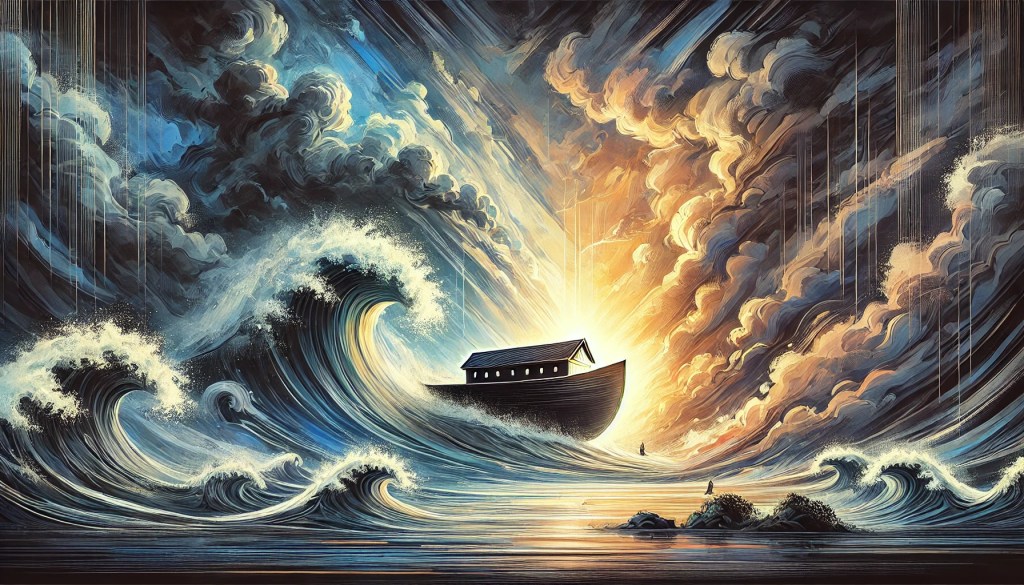
The Wickedness of Humankind and Noah’s Ark
Understanding Genesis 6
The Book of Genesis is not only the first book of the Bible but also the foundational narrative of God’s relationship with humanity and the created world. It tells the story of the beginning: from creation and the fall of man to the unfolding of God’s covenant with His people. Genesis 6 is a critical chapter that sets the stage for one of the most dramatic and theologically rich stories in Scripture—the Great Flood.
This chapter opens with an account of increasing human wickedness and divine sorrow, leading to God’s decision to cleanse the earth through a flood, sparing only the righteous Noah and his family. The narrative, though ancient, speaks to timeless themes of sin, judgment, mercy, and covenant.
Historically, Genesis was written in a context where other ancient Near Eastern cultures had their own flood narratives, such as the Epic of Gilgamesh. However, the biblical account stands out by focusing not just on the catastrophic event but on God’s righteous judgment and mercy. It is also deeply intertwined with the theological understanding of human sinfulness and God’s commitment to His creation despite its corruption.
Culturally, this passage reflects a world where humanity’s relationship with the divine and with each other has been fractured by sin. The term “sons of God” and “daughters of men” has been the subject of much theological debate and interpretation, adding to the rich tapestry of meanings within this text. This chapter reveals the depth of human depravity but also the hope found in God’s covenantal relationship with the righteous.
Religiously, Genesis 6 serves as a prelude to the covenant God establishes with Noah, which prefigures the later covenants with Abraham, Moses, and ultimately, the New Covenant through Christ. This chapter invites readers to reflect on the nature of sin, the consequences of turning away from God, and the hope that remains through God’s enduring promises.
Genesis 6 – New Revised Standard Version Catholic Edition
The Wickedness of Humankind
1 When people began to multiply on the face of the ground, and daughters were born to them, 2 the sons of God saw that they were fair; and they took wives for themselves of all that they chose. 3 Then the Lord said, “My spirit shall not abide in mortals forever, for they are flesh; their days shall be one hundred twenty years.” 4 The Nephilim were on the earth in those days—and also afterward—when the sons of God went in to the daughters of humans, who bore children to them. These were the heroes that were of old, warriors of renown.
5 The Lord saw that the wickedness of humankind was great in the earth, and that every inclination of the thoughts of their hearts was only evil continually. 6 And the Lord was sorry that he had made humankind on the earth, and it grieved him to his heart. 7 So the Lord said, “I will blot out from the earth the human beings I have created—people together with animals and creeping things and birds of the air, for I am sorry that I have made them.” 8 But Noah found favor in the sight of the Lord.
Noah Pleases God
9 These are the descendants of Noah. Noah was a righteous man, blameless in his generation; Noah walked with God. 10 And Noah had three sons, Shem, Ham, and Japheth.
11 Now the earth was corrupt in God’s sight, and the earth was filled with violence. 12 And God saw that the earth was corrupt; for all flesh had corrupted its ways upon the earth. 13 And God said to Noah, “I have determined to make an end of all flesh, for the earth is filled with violence because of them; now I am going to destroy them along with the earth. 14 Make yourself an ark of cypress wood; make rooms in the ark, and cover it inside and out with pitch. 15 This is how you are to make it: the length of the ark three hundred cubits, its width fifty cubits, and its height thirty cubits. 16 Make a roof for the ark, and finish it to a cubit above; and put the door of the ark in its side; make it with lower, second, and third decks. 17 For my part, I am going to bring a flood of waters on the earth, to destroy from under heaven all flesh in which is the breath of life; everything that is on the earth shall die. 18 But I will establish my covenant with you; and you shall come into the ark, you, your sons, your wife, and your sons’ wives with you. 19 And of every living thing, of all flesh, you shall bring two of every kind into the ark, to keep them alive with you; they shall be male and female. 20 Of the birds according to their kinds, and of the animals according to their kinds, of every creeping thing of the ground according to its kind, two of every kind shall come in to you, to keep them alive. 21 Also take with you every kind of food that is eaten, and store it up; and it shall serve as food for you and for them.” 22 Noah did this; he did all that God commanded him.
The Wickedness of Humankind: Exegesis of Genesis 6:1-8
Verse 1-2: “When people began to multiply on the face of the ground, and daughters were born to them, the sons of God saw that they were fair; and they took wives for themselves of all that they chose.”
In these verses, we witness the growth of humanity and the beginnings of moral decline. The term “sons of God” has been interpreted in various ways. Some early Church Fathers and theologians understood this as referring to angels who left their heavenly station, based on interpretations from sources like the Book of Enoch, an ancient Jewish text. Others, including St. Augustine, believed the “sons of God” referred to the descendants of Seth, the righteous line, while the “daughters of men” were the descendants of Cain, the line marked by sin.
This union, whether understood literally or metaphorically, represents a breach in the intended order of God’s creation. It symbolizes the infiltration of sin into what was meant to be sacred, leading to widespread moral corruption.
Verse 3: “Then the Lord said, ‘My spirit shall not abide in mortals forever, for they are flesh; their days shall be one hundred twenty years.’”
Here, God responds to the pervasive sinfulness with a decree of limited human lifespan. This is not just a reduction in years but also a reflection of God’s judgment on humanity’s fallen nature. The “120 years” may also be interpreted as the time remaining before the flood would come, offering humanity a final period to repent.
This verse highlights the transient nature of human life when lived apart from God. The Catechism of the Catholic Church teaches that the human person, created in the image of God, is called to communion with God, and this life is but a journey towards eternal communion with Him (CCC 355-361). The limitation of life span here serves as a poignant reminder of the consequences of turning away from God.
Verse 4: “The Nephilim were on the earth in those days—and also afterward—when the sons of God went in to the daughters of humans, who bore children to them. These were the heroes that were of old, warriors of renown.”
The Nephilim, often translated as “giants,” are enigmatic figures in the biblical narrative. Their mention suggests a time of great physical and possibly moral stature, but also of great wickedness. They are described as “heroes” or “warriors of renown,” indicating that their influence and reputation were significant, yet their association with the increasing corruption suggests they were part of the problem, not the solution.
This passage has been interpreted as highlighting the mixing of divine and human realms in ways that were not intended by God. The Church Fathers often saw in this a metaphor for spiritual pride and the overstepping of human boundaries, a theme that resonates throughout the Bible, particularly in the story of the Tower of Babel (Genesis 11).
Verse 5: “The Lord saw that the wickedness of humankind was great in the earth, and that every inclination of the thoughts of their hearts was only evil continually.”
This verse gives a stark assessment of the human condition before the flood. The wickedness is not just in actions but in the very thoughts and inclinations of the heart, emphasizing the depth of the corruption. This total depravity necessitates a divine response, as it is incompatible with God’s holiness.
In reflecting on this, the Catechism reminds us that sin is first and foremost an offense against God (CCC 1849). It is a rejection of God’s love, and when sin becomes pervasive, as in this account, it leads to a society that is fundamentally at odds with God’s will.
Verse 6: “And the Lord was sorry that he had made humankind on the earth, and it grieved him to his heart.”
This verse is one of the most poignant in Scripture, portraying God as deeply grieved by human sin. The anthropomorphic language used here, describing God as “sorry” and “grieved,” communicates the profound sorrow and relational pain that sin causes God.
This is not to be understood as God changing His mind or making a mistake but rather as a way to express the seriousness of sin and its impact on the relationship between Creator and creation. The Church teaches that God is immutable, meaning He does not change (CCC 212), but this verse helps us understand the depth of God’s engagement with humanity and the seriousness with which He regards sin.
Verse 7: “So the Lord said, ‘I will blot out from the earth the human beings I have created—people together with animals and creeping things and birds of the air, for I am sorry that I have made them.’”
Here, God’s judgment is articulated. The decision to “blot out” life from the earth reflects the severity of the situation. All creation suffers because of humanity’s sin, a theme that echoes St. Paul’s later writing that “the whole creation has been groaning as in the pains of childbirth right up to the present time” (Romans 8:22).
The comprehensive nature of the judgment—extending even to animals and birds—demonstrates that sin has cosmic consequences. The created order, which was “very good” (Genesis 1:31), is now under the shadow of judgment because of human rebellion.
Verse 8: “But Noah found favor in the sight of the Lord.”
Amidst this bleak picture, there is a glimmer of hope. Noah’s righteousness sets him apart, and he becomes the focal point for God’s plan to redeem and renew the earth. Noah’s finding “favor” is a sign of grace, an unmerited gift from God, which will be crucial for the unfolding of salvation history.
The Catechism emphasizes that God’s grace is always a free and unmerited gift, which precedes any merit on our part (CCC 1996). Noah’s example reminds us that even in the midst of widespread sin, God’s grace is at work, preserving and preparing a way for redemption.
Noah Pleases God: Exegesis of Genesis 6:9-22
Verse 9: “These are the descendants of Noah. Noah was a righteous man, blameless in his generation; Noah walked with God.”
Noah’s righteousness and blamelessness are highlighted as distinguishing him from the rest of humanity. His “walking with God” echoes earlier descriptions of Enoch (Genesis 5:24), indicating a life lived in close relationship with God. This sets the stage for Noah’s role as the new head of humanity post-flood.
The Church teaches that righteousness is living in accordance with God’s will, and blamelessness suggests integrity in one’s relationship with God and others (CCC 1807). Noah’s life is a model of faithfulness amidst a corrupt world, reminding us that holiness is possible even when surrounded by sin.
Verse 10: “And Noah had three sons, Shem, Ham, and Japheth.”
This genealogical detail is significant for the unfolding of the biblical narrative. Shem, Ham, and Japheth will be the progenitors of the post-flood human race, with Shem traditionally seen as the ancestor of the Semitic peoples, including the Israelites. This lineage emphasizes the continuity of God’s plan through specific family lines, a theme that will be crucial in understanding the later covenant with Abraham.
Verse 11-12: “Now the earth was corrupt in God’s sight, and the earth was filled with violence. And God saw that the earth was corrupt; for all flesh had corrupted its ways upon the earth.”
The repetition of the term “corrupt” underscores the total moral breakdown of society. Violence is singled out as a key manifestation of this corruption, pointing to the breakdown of relationships and justice. The word “all flesh” indicates that this corruption was universal, affecting not just individuals but the entire social and ecological order.
The Church Fathers often interpreted the corruption and violence of this time as reflective of a world turned
away from God, where the natural order is disrupted by sin. St. John Chrysostom, for example, spoke of how sin leads to disorder not just in human relationships but in the entire cosmos.
Verse 13: “And God said to Noah, ‘I have determined to make an end of all flesh, for the earth is filled with violence because of them; now I am going to destroy them along with the earth.’”
God’s decision to end “all flesh” is a sobering reminder of the consequences of sin. The earth, once filled with the glory of God’s creation, is now filled with violence, necessitating a divine response. The flood is presented as a means of purging the earth, a divine act of judgment but also of mercy, as it prepares the way for a new beginning.
The Catechism teaches that God’s justice is always linked to His mercy (CCC 211), and this passage exemplifies that truth. The impending flood, while a judgment, is also the means by which God will preserve a remnant and establish a new covenant.
Verse 14-16: “Make yourself an ark of cypress wood; make rooms in the ark, and cover it inside and out with pitch. This is how you are to make it: the length of the ark three hundred cubits, its width fifty cubits, and its height thirty cubits. Make a roof for the ark, and finish it to a cubit above; and put the door of the ark in its side; make it with lower, second, and third decks.”
God gives Noah detailed instructions for building the ark, indicating the seriousness and specificity of God’s plan. The ark, with its dimensions and construction details, is not just a vessel for survival but a symbol of God’s salvation. It is meticulously designed to fulfill God’s purposes.
In Church tradition, the ark has often been seen as a type or prefigurement of the Church, which provides safety and salvation amidst the storms of life. St. Augustine famously interpreted the ark as a symbol of the Church, within which humanity finds refuge from the floods of sin and death.
Verse 17: “For my part, I am going to bring a flood of waters on the earth, to destroy from under heaven all flesh in which is the breath of life; everything that is on the earth shall die.”
The flood is described as a total and cataclysmic event, meant to cleanse the earth of its corruption. The “breath of life” being extinguished indicates the severity of this judgment, as life itself is under threat. This verse highlights the profound impact of sin, which leads to death, not just spiritually but physically and cosmically.
The Church teaches that sin disrupts the harmony of creation (CCC 400), and the flood narrative is a dramatic illustration of that truth. Yet, even as God announces this destruction, there is an implicit hope in the covenant He will establish with Noah.
Verse 18: “But I will establish my covenant with you; and you shall come into the ark, you, your sons, your wife, and your sons’ wives with you.”
Amidst the announcement of judgment, God reveals His plan for salvation through a covenant with Noah. This covenant is the first explicit mention of a covenant in the Bible, setting the stage for the unfolding of God’s redemptive plan throughout salvation history. The covenant is a binding promise, underscoring God’s commitment to preserving life and restoring creation.
The Catechism explains that a covenant is a sacred agreement between God and humanity, marked by mutual commitments (CCC 56). The covenant with Noah is a foreshadowing of the New Covenant in Christ, where God fully reveals His mercy and love.
Verse 19-21: “And of every living thing, of all flesh, you shall bring two of every kind into the ark, to keep them alive with you; they shall be male and female. Of the birds according to their kinds, and of the animals according to their kinds, of every creeping thing of the ground according to its kind, two of every kind shall come in to you, to keep them alive. Also take with you every kind of food that is eaten, and store it up; and it shall serve as food for you and for them.”
God’s instructions to preserve animal life alongside Noah’s family emphasize the comprehensive nature of His salvation plan. This is not just about saving humanity but about preserving the integrity of God’s creation. The pairing of animals, male and female, ensures the continuity of life after the flood, symbolizing hope and renewal.
In this, we see God’s providential care for all His creatures. The Church teaches that God’s love extends to all creation, and we are called to be stewards of the earth (CCC 2415-2418). Noah’s role as caretaker of the ark reflects our own responsibility to care for the world God has entrusted to us.
Verse 22: “Noah did this; he did all that God commanded him.”
Noah’s obedience is crucial to the unfolding of God’s plan. His willingness to follow God’s commands, even when they must have seemed daunting or incomprehensible, is a testament to his faith. Noah’s actions foreshadow the call to all believers to live in faithful obedience to God’s will.
The Catechism emphasizes that faith involves both belief and obedience (CCC 143). Noah’s example teaches us that true faith is demonstrated in action, in doing what God asks, even when we do not fully understand His plans.
Teachings and References
The story of Noah and the flood is rich with theological significance and is referenced throughout Scripture and Church teaching. The Catechism explains that God’s covenant with Noah is a sign of His enduring commitment to humanity and creation, despite sin’s corruption (CCC 56-58). This covenant is universal, extending to all living things, and is a precursor to the covenants with Abraham, Moses, and ultimately, the New Covenant in Christ.
The flood itself is seen as a type of baptism in the New Testament, where the waters represent both judgment and salvation. St. Peter writes, “God waited patiently in the days of Noah during the building of the ark, in which a few, that is, eight persons, were saved through water. And this water symbolizes baptism that now saves you also” (1 Peter 3:20-21). The Catechism echoes this, stating that through baptism, we pass through the waters of death to new life in Christ (CCC 1219).
The Ark, as mentioned earlier, is often interpreted as a prefiguration of the Church. St. Augustine and other Church Fathers saw the Ark as a symbol of the Church, which offers refuge and salvation to believers in a world still marred by sin and corruption. Just as Noah and his family were saved by entering the Ark, so too are we saved by entering the Church and living in communion with Christ.
Moreover, the narrative of Noah reminds us of the importance of righteousness and obedience to God. Noah’s faith and righteousness not only saved him but also his family and the animal species, underscoring the impact one person’s faithfulness can have on others. This is a powerful reminder of the call to live as witnesses to God’s love and truth in our own time.
Embracing Righteousness in a Corrupt World
Genesis 6 offers a sobering reflection on the consequences of sin and the transformative power of faith and obedience. In a world that often mirrors the corruption and violence of Noah’s time, we are called to stand apart, to live righteously, and to walk with God as Noah did. This passage challenges us to examine our own lives, to repent of our sins, and to trust in God’s covenant promises.
As we reflect on Noah’s example, let us strive to be faithful stewards of God’s creation, to nurture and protect the life that God has entrusted to us. Let us also commit to living out our faith in concrete actions, following God’s commands, and being a beacon of hope and righteousness in a world that desperately needs it.
Engage with Us!
We invite you to share your thoughts and reflections on Genesis 6 in the comments below. Let’s deepen our understanding and grow together in faith!
Reflection Questions:
- How do you interpret the “sons of God” and “daughters of men” in Genesis 6:1-2? What significance does this have for understanding human sinfulness?
- What does Noah’s obedience teach us about faith and trust in God?
- How can we apply the lessons of Noah’s story to our daily lives, especially in terms of righteousness and faithfulness?
Let these questions guide your personal reflection, and feel free to share your thoughts in the comments below. Together, let’s strive to live out the lessons of Genesis 6 in our daily walk with God.
Follow us on Instagram and Facebook for more insights and reflections on living a faith-filled life.

 Holy Manna!
Leave a comment